35 Years of Yellow: The Simpsons Time Loop
A fake series finale and the cartoon that somehow predicted 9/11, COVID, and President Donald Trump on an escalator.
In September 2024, The Simpsons aired a special episode called Bart’s Birthday that looked like a series finale.
The episode frames itself as The Simpsons Series Finale, complete with Conan O’Brien hosting a farewell ceremony and an in-universe machine generating the neat ending a long-running show is supposed to have.
It felt like a curtain call.
A send-off.
Maybe even the end?
And then the episode pulled back, looped time in on itself, and dropped us right back into the status quo.
Bart turns eleven inside the fake finale, the world starts changing, and then the premise breaks. The show chooses the reset over the landing.
And that’s the joke. Not just of the episode, but of the entire series.
The Simpsons doesn’t end. It reboots. It resets. It outlasts.
It’s a living paradox ~ an aging cartoon frozen in time. One that watches America evolve while it stays (more or less) the same.
How a Crude Sketch Became a Global Standard
History of the Simpsons
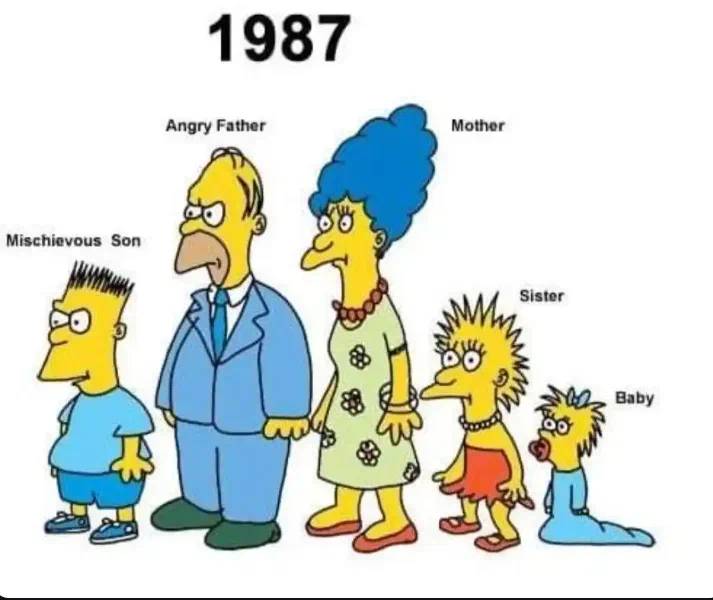
Matt Groening came up with The Simpsons in the lobby of James L. Brooks’s office in the late 1980s. He was originally going to pitch a cartoon based on his Life in Hell comic, but didn’t want to give up the rights. So he invented a suburban family on the spot, naming the characters after his own parents and sisters ~ except “Bart,” an anagram for “brat,” stood in for Matt.
The family first appeared on The Tracey Ullman Show in 1987 as one-minute bumpers. The animation was crude ~ Groening expected the artists to clean up his sketches, but they just traced them. The characters caught on anyway. Two years later, they got their own show.
The Simpsons premiered on December 17, 1989 with a Christmas episode called Simpsons Roasting on an Open Fire. The animation was better, but rough. The show’s tone, though, was crystal clear: irreverent, smart, rebellious, and just subversive enough to freak out parents.
Bart was really the big hit.
With catchphrases like “Eat my shorts” and “Don’t have a cow, man,” he was marketed as a countercultural icon.
Kids loved him.
Schools banned the merchandise.
President George H. W. Bush even used the show as a punching bag, saying families should be “more like the Waltons and less like the Simpsons.”
In 1990, The Simpsons became so popular that Fox moved it to Thursday nights to go head-to-head with The Cosby Show.
The media billed it as “Bill vs. Bart.”
The Simpsons lost the ratings battle but won the longer cultural argument.
The Cosbys faded away while the Simpsons kept eating dinner on that same old crusty couch.
The American Cartoon That Became America Itself
The Simpsons Cultural Relevance
A big part of what kept The Simpsons alive was its cultural scope. The show wasn’t just about Homer, Marge, Bart, Lisa, and Maggie.
It was about everyone and everything.
It skewered politics, religion, celebrity, technology, education, healthcare, and even itself. Springfield wasn’t just a town ~ it was America, compressed into a cul-de-sac and painted yellow.
The characters became avatars for different slices of American life.
- Homer, the perpetually distracted working dad.
- Marge, the overburdened mom with no outlet.
- Lisa, the voice of reason who never wins.
- Bart, the rebel without a cause.
- And Maggie, the mute baby who always knows what’s going on.
Over the decades, the show became a guestbook of pop culture:
- Leonard Nimoy
- Johnny Cash
- Paul McCartney
- Lady Gaga
- Stephen Hawking
And more recently:
- Billie Eilish and Lizzo.
Presidents were parodied. Corporations were dragged.
No one was safe ~ and everyone watched.
And while the characters never aged, the show kept time.
1990s Springfield feels different from 2024 Springfield, but it’s built on the same grid. The town updates with the times ~ they have smartphones now ~ but the stories stay familiar.
That’s the big trick.
The Simpsons isn’t timeless. It’s time-looped.
Wait, Did They Really Predict 9/11?
The Simpsons Predicts the Future
The most absurd part of The Simpsons legacy is the long, increasingly bizarre list of things the show somehow predicted.
While some of those connections are overblown, others are hard to ignore.
9/11 (1997)
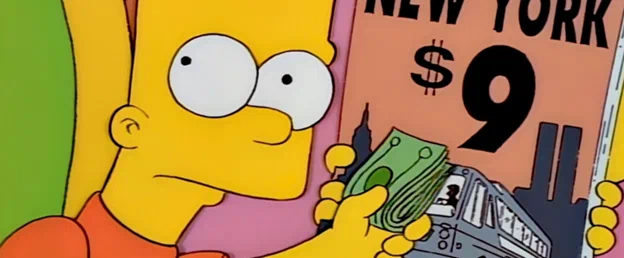
In the 1997 episode “The City of New York vs. Homer Simpson”, Bart holds up a brochure advertising a $9 bus fare to Manhattan. Behind the “9” are the Twin Towers ~ forming a visual “9/11.”
The scene lasted one second. Four years later, it became internet lore.
President Trump (2000)
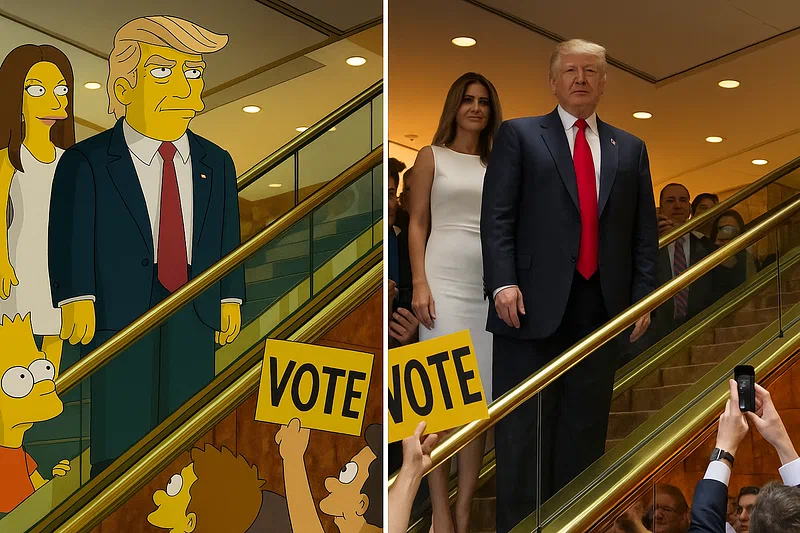
In “Bart to the Future” (Season 11), a grown-up Lisa becomes president and says, “We’ve inherited quite a budget crunch from President Trump.”
But it didn’t stop there.
In 2015, the show released a short parody of Trump’s golden escalator announcement, which fed the mythology around the earlier Season 11 line.
The real point was not prophecy. It was the show’s habit of turning American spectacle into a repeatable gag.
The Pandemic (1993)
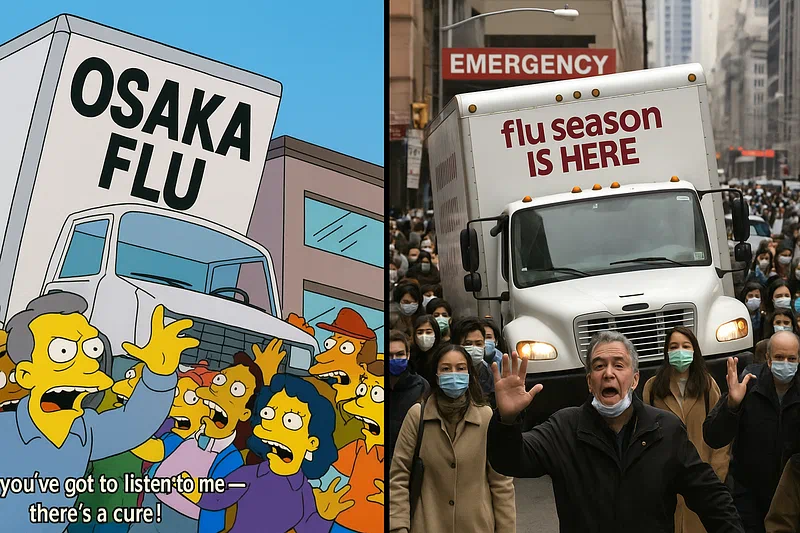
The 1993 episode “Marge in Chains” features an “Osaka Flu” that spreads through Springfield after being shipped in from Asia.
Citizens panic, hospitals overflow, and chaos ensues.
One guy shouts, “You have to believe me ~ there’s a cure!” before the crowd tips over a delivery truck.
The echo was loose, but legible, nearly 30 years later.
Other Hits
- Smartwatches (predicted in 1995, released in 2014)
- Disney buying 20th Century Fox (joked about in 1998)
- The Higgs Boson equation (shown in a 1998 chalkboard gag)
- Autocorrect errors (featured in 1994’s “Lisa on Ice”)
- The FIFA corruption scandal (predicted in 2014)
- The Siegfried and Roy tiger attack (fictionalized in 1993, real in 2003)
To be fair, the show has made thousands of jokes across decades.
Some are bound to come true.
The real story isn’t that The Simpsons is psychic.
It’s that the world keeps catching up to its satire.
Immortality in Syndication
The Simpsons: 35 Years and Counting
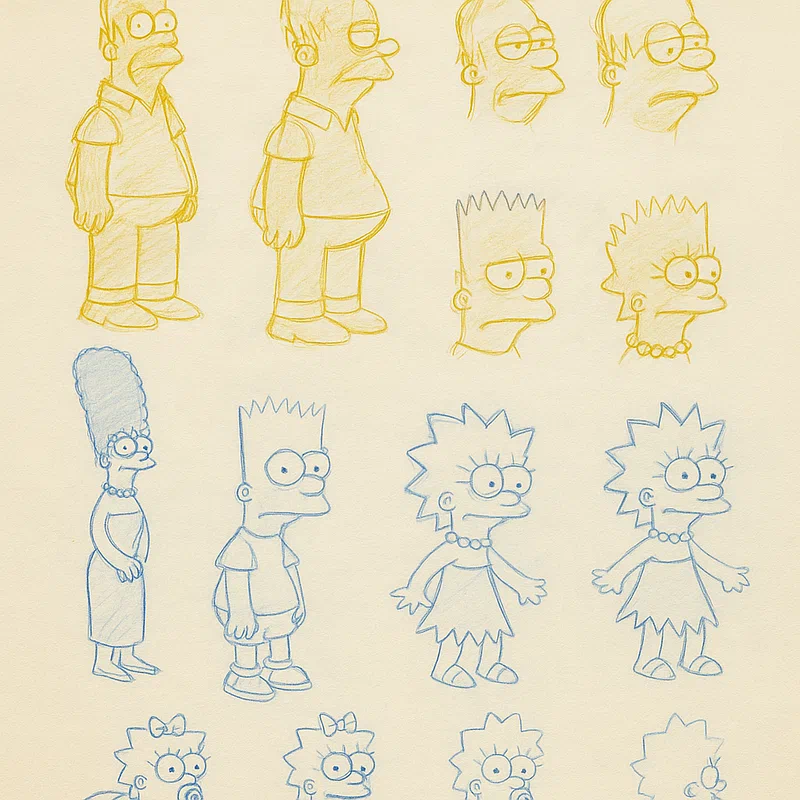
With more than 750 episodes under its belt, The Simpsons holds the title for the longest-running scripted primetime series in American television history.
No other show has stayed on air this long ~ and few have even come close.
Its cultural relevance has risen and fallen over time. Critics argue about when the golden era ended ~ some say Season 9, others push it to 13 ~ but even during quieter years, the show kept iterating.
It evolved from hand-drawn cel animation to digital ink. It shifted from parodying VHS-era dads to riffing on influencers and streaming culture.
The milestones stack up:
- Longest-running American sitcom (since 2009)
- One theatrical feature film (2007)
- A Guinness World Record for most guest stars
- A theme park ride, mobile games, and LEGO sets
- Streaming syndication rights that helped anchor Disney+
Homer outlasted everyone.
The Cosby Show. Seinfeld. Friends. The Office. The Sopranos.
Game of Thrones.
All gone.
Some with grace, some with pain.
The Simpsons just kept airing Sundays at 8pm.
For some, it’s background noise. For others, it’s their last regularly scheduled programming. But either way, it’s not just a TV show anymore.
It’s collective memory.
A familiar voice, always there, quietly narrating America in real time.
Conclusion
-That Was the Joke-
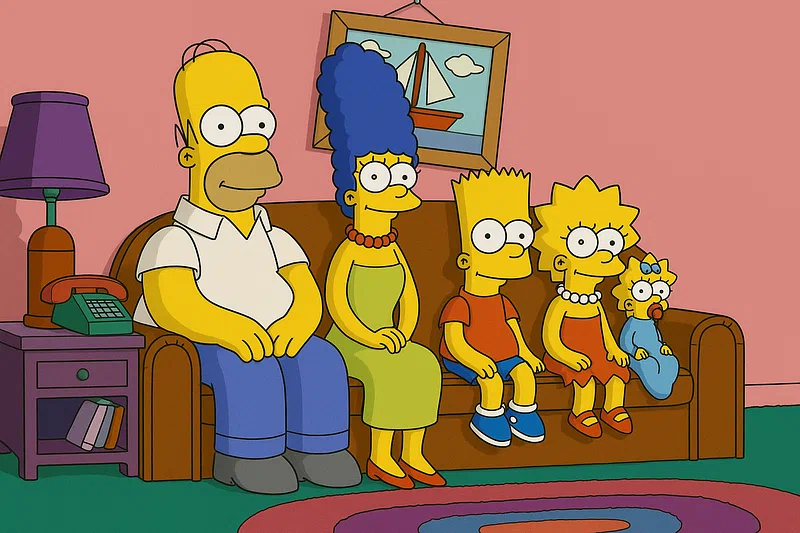
When Bart’s Birthday aired in 2024,
it felt like the curtain was falling.
The frame was final, the tone was self-aware, and the joke was built around closure.
You could almost believe it was the end.
But then the episode refused the premise. The loop reset. Bart went back to being ten, Springfield went back to being Springfield, and the fake finale became one more way for the show to avoid becoming a museum piece.
That wasn’t just a punchline ~ it was a thesis statement.
The Simpsons isn’t a story with a climax. It’s an acid fueled fever dream. A series of time loops. A very yellow lens pointed at whatever version of America happens to be flickering on the screen that week.
In an entertainment industry obsessed with sticking the landing, The Simpsons offers something stranger:
No landing at all.
It just keeps floating.
Through wars, recessions, presidencies, new platforms, and generational turnover ~ it just keeps going and going and going.
Will it ever really end?
Maybe it fades out when no one’s watching.
Maybe it gets rebooted, shinier and fatter ~
same voices ~ new skins.