Beyond Moore’s Law
Examining the parallels between compute power, renewable energy, and battery technology
Introduction
Made using ChatGPT in January 2025.
In our previous essay on Moore’s Law, we explored how the doubling of transistors every two years has driven unprecedented progress in computing power and shaped the modern technological landscape. But could the principles underlying Moore’s Law extend beyond computing? Renewable energy technologies like solar and wind, as well as battery storage systems, appear to exhibit similar patterns of exponential growth in efficiency and cost reductions.
This essay delves deeper into these parallels, examining the similarities and differences between Moore’s Law and advancements in renewable energy and battery technology. While all three domains share trends of rapid improvement and cost decline, their mechanisms, constraints, and implications are distinct, offering a nuanced understanding of technological progress.
Building on our earlier discussion of Moore’s Law, we will contextualize the exponential trends in renewable energy and batteries, integrating quantitative data, case studies, and global perspectives to assess their transformative impact and the critical role of policy, market dynamics, and innovation.
Overview of Moore’s Law in Computing

Made using ChatGPT in January 2025.
Moore’s Law is often regarded as one of the most influential principles in modern technology. First articulated by Gordon Moore in 1965, it predicted that the number of transistors on integrated circuits would double roughly every two years, leading to exponential growth in computing power. Over the past half-century, this trend has not only held but has also spurred massive advancements in computing, enabling the development of smaller, faster, and cheaper devices.
The law’s success lies in its predictability: engineers could confidently anticipate increases in transistor density and plan their innovations accordingly. This predictability catalyzed the rapid expansion of the semiconductor industry, from microprocessors to the modern ubiquity of AI and cloud computing.
However, as transistors approach atomic scales, maintaining this trajectory has become increasingly difficult. Advanced fabrication techniques, such as extreme ultraviolet (EUV) lithography, have extended the law’s applicability, but at ever-increasing costs. These challenges foreshadow the need for a paradigm shift, possibly through quantum computing or neuromorphic architectures. The advent of these technologies could redefine the limits of computation, much as Moore’s Law once did.
Renewable Energy Technology Trends

Made using ChatGPT in January 2025.
Swanson’s Law and the Learning Curve
Renewable energy technologies, particularly solar photovoltaics (PV), have seen cost reductions reminiscent of Moore’s Law. Swanson’s Law posits that the price of solar PV modules drops by about 20% for every doubling of cumulative production. This has resulted in a staggering 96% decline in the cost of solar panels since 2000, making solar energy one of the cheapest sources of electricity globally.
Wind energy has followed a similar path, with advancements in turbine design and manufacturing reducing costs while improving efficiency. By 2021, the global weighted-average cost of electricity from newly commissioned wind farms had fallen 68% since 2010, driven by larger turbines, optimized logistics, and scaling of production. These trends highlight how renewables have achieved cost parity with, and in some cases undercut, fossil fuel alternatives.
Efficiency Improvements
While cost reductions have been dramatic, efficiency gains in renewable energy have been more incremental. The efficiency of commercial solar panels has increased from around 15% in the early 2000s to over 20% today, with cutting-edge laboratory prototypes achieving over 40%. Similarly, wind turbine capacity factors have improved through taller towers, longer blades, and more sophisticated design algorithms. Such advancements are crucial in maximizing energy yields, particularly in regions with suboptimal conditions.
Drivers of Progress
The progress in renewable energy has been driven by a combination of technological innovation, economies of scale, and supportive policies like subsidies and tax incentives. Notably, international agreements such as the Paris Climate Accord have galvanized national commitments to renewables, further accelerating their adoption. In tandem, public-private partnerships and investments in grid infrastructure have played a pivotal role in mainstreaming renewable energy sources.
Advancements in Battery Technology
Made using ChatGPT in January 2025.
Cost Reductions and Production Scaling
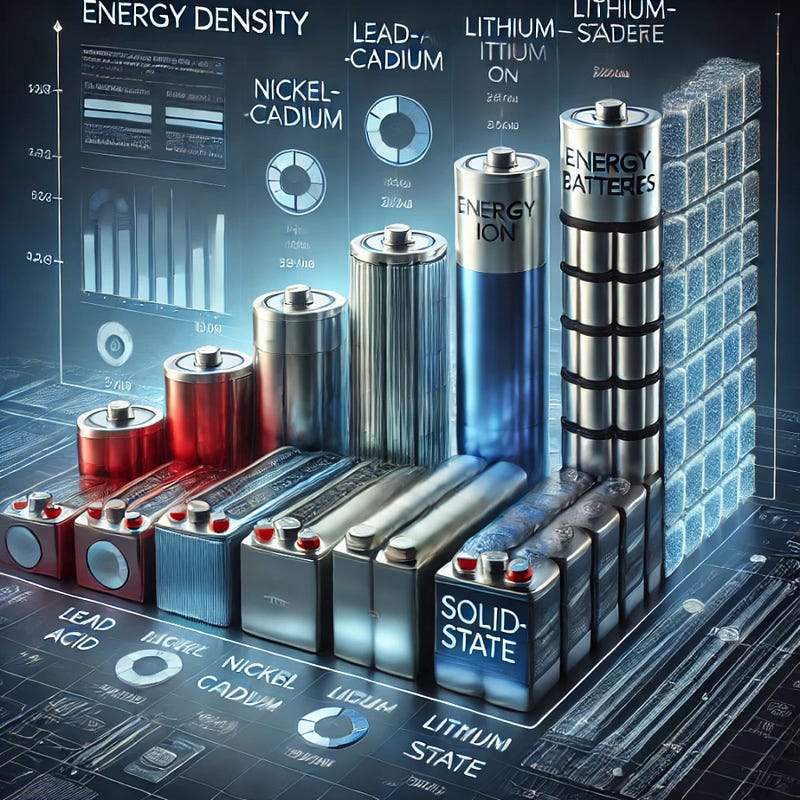
Batteries, particularly lithium-ion technology, have experienced significant cost reductions, declining by 97% since the 1990s. These reductions are largely driven by production scaling, with manufacturing facilities becoming more efficient as demand for electric vehicles (EVs) and energy storage systems grows. Analysts predict that the cost of battery packs could fall below $100 per kilowatt-hour (kWh) by 2025, a critical threshold for EV affordability. Such cost declines have also enabled utility-scale battery deployments, making energy storage a viable solution for renewable intermittency.
Energy Density and Performance Improvements
In terms of energy density, batteries have made steady but slower progress compared to Moore’s Law. Current lithium-ion batteries have energy densities of 250-300 watt-hours per kilogram (Wh/kg), with next-generation technologies like solid-state batteries promising to double or even triple this capacity. Emerging breakthroughs in lithium-metal and sodium-ion chemistries further highlight the innovation pipeline. These advancements are not only critical for extending EV range but also for reducing battery weight and size, which are key factors in transportation and aerospace applications.
Challenges and Constraints
Battery technology faces unique challenges, including reliance on scarce raw materials like lithium, cobalt, and nickel. Supply chain constraints and geopolitical issues add complexity, potentially limiting the pace of progress. However, ongoing research into recycling technologies and alternative materials offers pathways to address these constraints sustainably. Policies encouraging a circular economy, where battery components are recycled and reused, could alleviate resource dependencies.
Similarities Between Moore’s Law, Renewable Energy, and Batteries
Made using ChatGPT in January 2025.
Exponential Progress
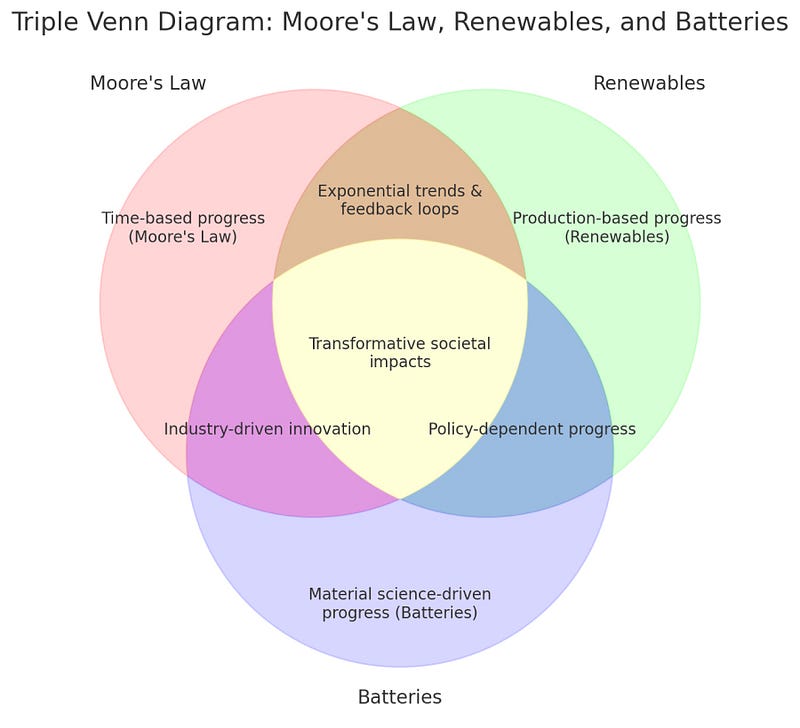
Computing, renewable energy, and batteries have all demonstrated exponential trends in cost reductions and performance improvements. Moore’s Law predicts the doubling of transistor density every two years. Similarly, Swanson’s Law shows that solar PV module prices decrease by about 20% with every doubling of cumulative production. Meanwhile, lithium-ion battery costs have fallen by 97% since the 1990s, driven by scaling and manufacturing efficiencies.
Adoption-Driven Feedback Loops
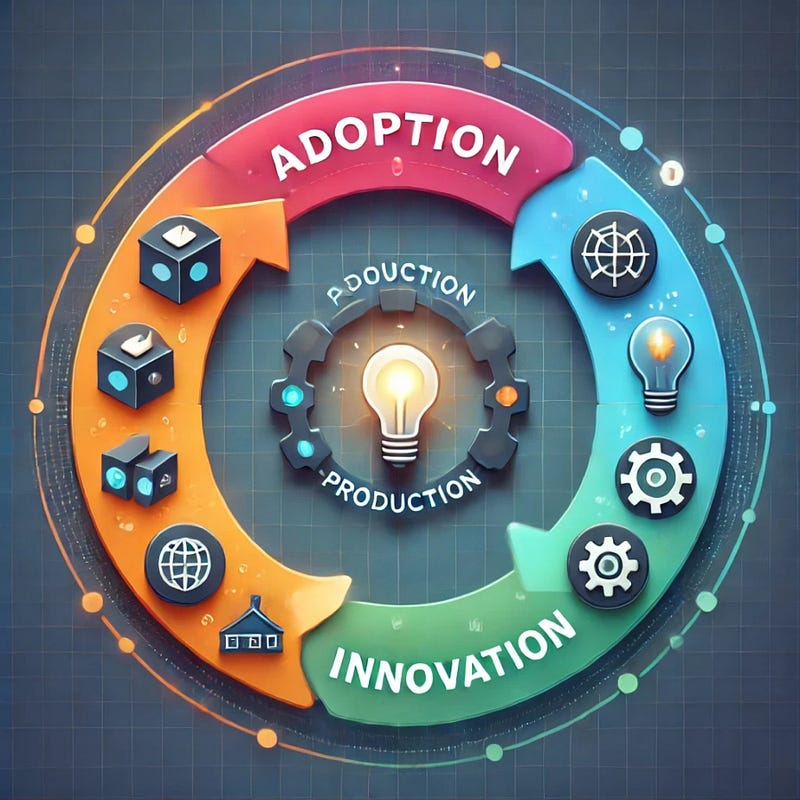
Declining costs and increasing adoption create self-reinforcing feedback loops. For example, falling solar costs spurred adoption, driving cumulative production and further cost reductions, a dynamic mirrored in computing and battery technologies. These feedback loops amplify the speed and scale of technological diffusion, from global semiconductor networks to sprawling solar farms and EV supply chains. By scaling innovation globally, these trends enable equitable access to transformative technologies.
Transformative Impacts
Moore’s Law catalyzed the digital revolution, while renewable energy and battery advancements are reshaping the global energy landscape. All three sectors drive economic growth, foster new industries, and redefine societal norms, whether through enabling smart cities, democratizing access to energy, or decarbonizing the transportation sector. The cumulative societal impacts underscore the centrality of technological innovation in addressing both economic and existential challenges.
Key Differences Between Moore’s Law, Renewable Energy, and Batteries
Made using ChatGPT in January 2025.
Nature of Progress
Moore’s Law: Time-based progress, tied to predictable semiconductor scaling.
Renewable Energy and Batteries: Progress is production-driven, linked to cumulative manufacturing and adoption, governed by learning curves and market dynamics.
Constraints and Limits
Moore’s Law: Facing physical limits as transistor sizes approach atomic scales, requiring new paradigms such as quantum computing.
Renewables and Batteries: Constrained by resource availability (e.g., rare earth elements), supply chain dependencies, and infrastructure requirements, such as grid integration and EV charging networks.
Achieving scalability also depends on overcoming regional disparities in renewable resource availability and manufacturing capacity.
Policy Dependence
Moore’s Law is largely independent of policy, while renewables and batteries depend heavily on government incentives and international agreements. Policy volatility, as seen in the U.S. with shifting administrations, can significantly impact progress in these sectors. International competition, particularly from China and the EU, further highlights the need for stable policy frameworks to secure technological leadership.
Societal Impact
Moore’s Law enabled digitalization, while renewable energy and batteries address existential challenges like climate change and energy security. The stakes for renewables and batteries are inherently tied to global sustainability and equity, positioning them as cornerstones of the 21st-century energy transition.
The parallels between Moore’s Law, renewable energy, and battery technology reveal an inspiring story of human ingenuity and progress. All three domains have demonstrated exponential trends in improvement, driving transformative societal impacts. Moore’s Law catalyzed the digital revolution, renewable energy offers a pathway to mitigate climate change, and battery advancements are unlocking the full potential of clean energy and electric mobility.
However, these technologies operate under distinct mechanisms and constraints. Moore’s Law describes predictable, time-based scaling in semiconductors, while renewables and batteries are shaped by production-driven cost reductions, policy frameworks, and resource availability. This divergence highlights the critical role of policy and market dynamics in sustaining progress in the clean energy sector, particularly in the face of political shifts that may threaten stability.
As we face the urgent challenge of climate change, the stakes for renewable energy and battery technology are extraordinarily high. Unlike the relatively apolitical nature of Moore’s Law, the trajectory of these technologies is deeply intertwined with global politics, supply chains, and public investment. The exponential trends we’ve seen so far are promising, but realizing their full potential will require sustained innovation, collaboration, and commitment from governments, industries, and individuals alike.
In many ways, the legacy of Moore’s Law offers a blueprint: a testament to how focused effort and collective vision can drive technological revolutions. Applying this same ethos to renewable energy and batteries could help us build a sustainable future where clean technologies are affordable, accessible, and capable of powering the next phase of human progress.
Sources checked
The source trail for this essay includes Intel’s overview of Moore’s Law and semiconductor technology , IEEE Spectrum’s coverage of EUV lithography , PV Tech’s explainer on Swanson’s Law , IRENA’s global renewable energy cost report , Nature Energy’s history of lithium-ion battery cost reductions , Scientific American’s overview of solid-state battery development , McKinsey’s discussion of technology feedback loops , the International Energy Agency’s Renewables 2023 report , and CSIS work on China’s renewable supply chain.