Fine China
The Long Road from Jingdezhen to Grandma's Cabinet
The Room
The Peacock Room began as a dining room, but it reads like an altar.
In the London house of Frederick Richards Leyland, a wealthy Liverpool shipowner, architect Thomas Jeckyll built an intricate lattice of shelving to hold Leyland’s Chinese blue-and-white porcelain, mostly from the Kangxi era of the Qing dynasty. James McNeill Whistler then transformed the room with blue paint, gold, peacock feathers, and a theatrical sense of possession. The Smithsonian object record says the room remained intact and fully furnished with Chinese porcelain until Leyland’s death in 1892.
That room catches porcelain near the height of its Western social life. It had crossed oceans as a rare commodity, entered European treasuries as luxury, consumed the attention of kings, provoked chemical experiments, and supplied merchants with a form of domestic rank. By the 1870s, porcelain had become an aesthetic code. A shipowner could fill a dining room with blue-and-white vessels and ask the room to speak before a meal was served.
Fine china in the West is a story of desire following a technology Europe did not understand. China made porcelain first. Europe desired it, displayed it, mounted it in precious metal, imitated it, industrialized it, and domesticated it into the holiday cabinet. The later irony is hard to miss: “china” once named a material so rare that nobles treated it like treasure. “Made in China” later became, in many Western retail contexts, shorthand for cheap abundance. The object changed hands, and then it changed meanings.
Porcelain Before The Plate
The British Museum gives the starting point: porcelain was first produced in China around AD 600, and Chinese ceramics served imperial, domestic, and export markets.
The date widens the story beyond tableware. Porcelain was hard, white, resonant, thin, and often translucent. It required the right materials, including porcelain stone and kaolin-rich clay, plus kiln technologies that could fire hot enough to vitrify the body without ruining it. Ordinary earthenware and much stoneware could not perform the same visual trick. Porcelain looked delicate and survived like a stronger material.
The Victoria and Albert Museum emphasizes Jingdezhen’s role in refining clay recipes and firing technologies, especially for blue-and-white ceramics. It also records the fascination Chinese products held in Europe before European manufacturers mastered their own porcelain.
This mystery turned matter into power. The material exposed a gap. Europe could buy porcelain, admire it, break it, mount it, and copy its painted surfaces. For a long stretch, European workshops failed to make true hard-paste porcelain.
China Before “China”
Jingdezhen is not background. It is the production capital in the story. The Smithsonian’s Jingdezhen exhibition page describes the city as a center of global ceramics production since the fourteenth century, with trade expanding in the sixteenth century and global preeminence continuing after Europeans learned how to manufacture porcelain.
Ronald W. Fuchs II, writing for the Chipstone Foundation’s Ceramics in America , points to the combination that made Jingdezhen so difficult to displace: raw materials, skilled workers, government encouragement, and transport networks.
That list changes the scale of the object. Porcelain belonged to a system. It required mines, kilns, labor discipline, workshops, painters, merchants, river routes, imperial taste, and export demand. The finished bowl looked serene because the industrial arrangement behind it had been worked out over centuries.
Europe did not discover china as an empty object waiting for European meaning. Europe entered an existing Chinese ceramic world and then renamed its most desired material after the country that supplied it.
Treasure In A European Mount
Chinese porcelain reached Europe before Europeans had either the recipe or the production system. The Metropolitan Museum of Art describes Chinese porcelains introduced to Europe by the fourteenth century as rarities and luxury objects, often mounted in gilt silver in the fifteenth and sixteenth centuries.
The British Museum’s Lennard Cup is the early Western status mechanism in one object. It is a Ming porcelain bowl made at Jingdezhen, dated to the Jiajing reign period, and mounted in London with silver-gilt in 1569/70. The museum identifies it as the earliest known blue-and-white porcelain with a dated mount.
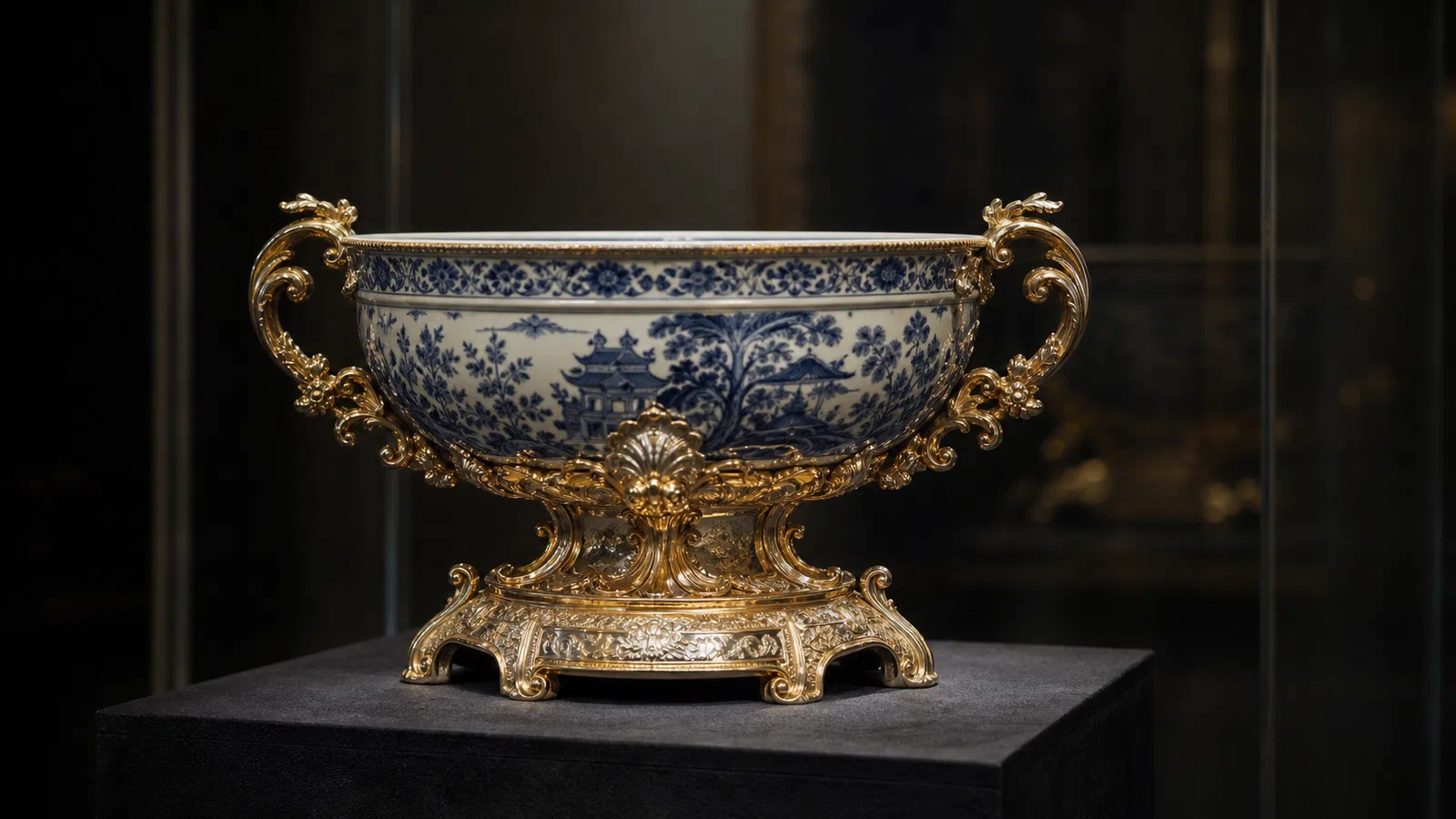
A mounted porcelain bowl shows how European metalwork converted imported ceramic into treasure. Editorial illustration for Outside In Print.
The mount tells us that early European owners treated Chinese porcelain as treasure. They enclosed it in precious metal, made it legible through European goldsmithing, and gave it the qualities of relic, drinking vessel, and proof of worldly connection. The porcelain carried one kind of value from China. The mount added another from Europe.
The V&A’s account of blue-and-white export history shows how the trade matured. Large quantities reached Europe in the sixteenth century, first through Portuguese merchants and later through the Dutch East India Company. Chinese makers also responded to Western demand, producing European forms and decoration for export.
The exchange worked as an early global design loop. European buyers wanted Chinese porcelain. Chinese producers and exporters learned which shapes, coats of arms, motifs, and services those buyers desired. European households used those objects to announce wealth and a particular relation to distance.
Porcelain Sickness
The most theatrical European porcelain collector was Augustus the Strong, elector of Saxony and king of Poland. Meissen’s own history describes a European collecting frenzy, with Augustus driven by what contemporaries called a “maladie de porcelaine.”
Fuchs gives the number that makes the obsession material: Augustus amassed about 21,000 pieces of Chinese and Japanese porcelain. In 1717, he traded 600 Saxon dragoons to Frederick William I of Prussia in exchange for 151 porcelain pieces, including the large vessels remembered as soldier vases.
The trade sounds bizarre only if porcelain is treated as dishware. At court, porcelain was about command over global luxury and over useless beauty. A vase without practical use could become more socially powerful because of its uselessness. It did not serve the household. It elevated it.
The next move was obvious. The court that could not buy enough porcelain would try to make it. Meissen dates the first successful European hard-paste porcelain to January 1708, through the work of Johann Friedrich Bottger and Ehrenfried Walther von Tschirnhaus, and the Royal-Polish and Electoral-Saxon Porcelain Manufactory to 1710.
This breakthrough was state ambition as much as art. The same elite culture that collected Chinese porcelain wanted to break its monopoly. The secret of porcelain, often called the arcanum, became a matter of power, secrecy, chemistry, and industrial advantage.
From Royal Cabinet To Family Table
Once porcelain moved beyond courts, it changed the scale of status. Chinese export porcelain could be ordered with European coats of arms, family symbols, and Western forms. The Met’s export porcelain essay describes armorial porcelain as a major category and records Chinese producers working from European models.
That made porcelain a portable genealogy. A service decorated with a family’s arms turned imported tableware into a claim about rank, ancestry, and aspiration. The plate did not need to say much. The crest said enough.
Fuchs writes that armorial porcelain tied wealth to family heritage and that Chinese export porcelain was among the early global commodities, with tens of millions of pieces crossing markets during the fourteenth through nineteenth centuries.
Here the meaning begins to move down the social ladder. Porcelain could signal aristocratic rank, mercantile success, colonial imitation, and proper household management. This is the route toward “good china.” The object became less rare, yet it remained ceremonially loaded. A cabinet of fine dishes could tell visitors that the household understood order, occasion, inheritance, and restraint.
Chinamania
By the nineteenth century, blue-and-white porcelain had become a different kind of status symbol. Ownership was only part of it. Display, conversation, and domestic arrangement carried the social charge.
The V&A connects blue-and-white collecting to the Aesthetic Movement of the 1850s and 1860s, noting that collectors such as Whistler and Rossetti made Chinese blue-and-white ceramics into markers of cultivated taste. By the late nineteenth century, blue-and-white was described as essential to the “house beautiful.”
The Smithsonian’s Porcelain Frenzy material places Leyland and Whistler inside this Victorian craze. It describes the middle-class appetite for blue-and-white porcelain and the satirical attention it drew from Punch.
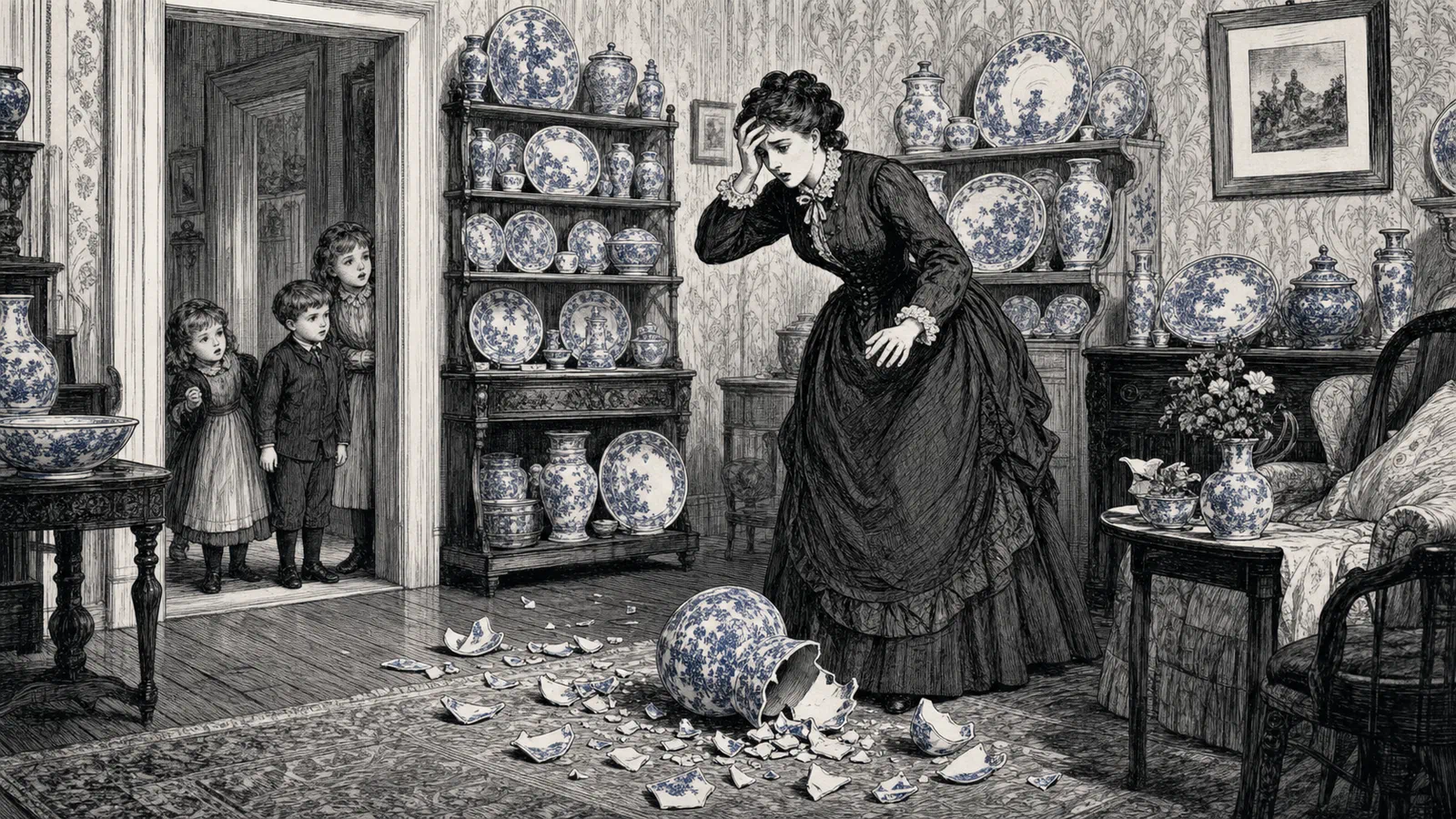
Victorian Chinamania turned blue-and-white porcelain into domestic performance and satire. Editorial illustration for Outside In Print.
Amy Matthewson’s ImageTexT article gives the strongest interpretive account of the cartoons. During 1874-1880, George du Maurier produced Punch cartoons mocking aesthetes and china collectors. Matthewson records his use of “Chinamania” for the craze for blue-and-white porcelain and reads the cartoons as a way to visualize anxieties about taste, gender, social decline, and China itself in the British imagination.
Chinamania mixed admiration, parody, xenophobia, class anxiety, gender anxiety, and consumer satire. Blue-and-white porcelain had become so familiar in British interiors that it could operate as a joke everyone understood. The joke depended on the object’s prestige. A craze with no social force would not have carried the cartoon.
The Peacock Room sits at the elegant end of the same phenomenon. Punch translated porcelain worship into comedy. Whistler translated it into a total room. In both cases, blue-and-white porcelain had become a stage on which people performed refinement.
Cheap As China
Porcelain did not become cheap overnight. European porcelain manufactories multiplied, industrial ceramics expanded, and tableware gradually became accessible to wider households. The prestige language persisted. Families kept “good china” for holidays, weddings, Sunday dinners, and guests. The object remained special because it had been socially trained to mark occasions.
At the same time, the Western meaning of China as a country-of-origin label shifted in another direction. CSIS’s ChinaPower project reports that China held under 9 percent of global manufacturing output in 2004 and reached 28 percent in 2023. The same source describes the earlier availability of cheaper Chinese-made goods and China’s later move into more sophisticated manufacturing.
That modern label shift was cultural as well as economic. Iowa State’s summary of Gang Han’s research states that for many Americans the “Made in China” label became associated with low cost and low quality, while older Chinese exports such as tea, furniture, and dishware had once been viewed as distinctive and valuable.
Country-of-origin research supports the broader point. Wu Jian and Fu Guoqun’s 2007 study on brand origin and made-in country found that made-in cues can affect quality evaluation while brand-origin cues influence purchase intention.
The reversal should be kept narrow. “Made in China” never meant one thing everywhere, and Chinese manufacturing now spans low-cost goods, high-tech products, luxury-adjacent components, and advanced industrial systems. The name stayed. The signal changed.
Grandma’s Cabinet
The grandmother’s china cabinet is a small domestic archive of a long world system.
Behind the glass sit objects whose ancestry runs back through Jingdezhen kilns, Portuguese sea routes, silver-gilt mounts, porcelain rooms, Meissen experiments, armorial services, Victorian dining rooms, Punch cartoons, wedding registries, department stores, and global manufacturing. Most modern plates no longer need the aura of technical impossibility. They are replaceable. The ceremony around them is not.
The old plates remember something the modern label tends to forget. Before “China” meant cheap, it meant difficult. Before it meant mass-produced, it meant nearly impossible to copy. Before it meant disposable, it meant an object a king would trade soldiers to possess and a shipping magnate would build a room around.
Grandma’s china was never only dishware. It was the last household echo of a global status object, stacked carefully behind glass.