Hindsight 2026: d4vd's alleged "Romantic Homicide"
How a viral breakout song, a murder allegation, and the machinery of modern fame collided in public, and why the culture keeps returning to art when life turns ugly.
Some titles age strangely.
Some get darker.
Some become unbearable.
A few years ago, “Romantic Homicide” sounded like what it was sold as: young heartbreak rendered as theater, moody and compact, the kind of song that turns private despair into something cinematic. It helped turn d4vd , an internet-native teenager making songs to avoid copyright strikes on gaming videos, into a mainstream artist with chart success, a growing fan base, and later a debut album. His rise followed the now-familiar digital path: early uploads on SoundCloud , viral traction on TikTok , official releases on YouTube , then the full commercial machinery of a breakout act.
He was not a one-song curiosity. After “Romantic Homicide” broke through, “Here With Me” helped lock in his audience, and the releases kept coming: the Petals to Thorns EP , more official videos, new singles, merch, tour promotion, and eventually the Withered rollout through his official channels . By the middle of the decade, he looked like a very modern success story: emotionally branded, algorithmically amplified, everywhere at once, and close enough to internet culture that fans felt they had watched him happen in real time.
Now the title lands differently.
On April 17, 2026, Reuters reported that d4vd, born David Burke, had been arrested by Los Angeles police on suspicion of murder in the death of 14-year-old Celeste Rivas Hernandez. The Associated Press reported that her remains were found in September 2025 in a Tesla registered to Burke after the vehicle had been towed from the Hollywood Hills and searched by police. Burke is being held without bail while prosecutors review the case. Public reporting also says he has not yet been formally charged, and his attorneys maintain that he is innocent.
That is the story as it stands.
This essay reflects reporting available on April 17, 2026. The criminal case is unresolved, and the public record can change.
It is already a huge one for obvious reasons. A young artist with a large audience. A song called “Romantic Homicide.” A dead teenage girl. A missing-person case. A vehicle tied to the artist. A delayed arrest. A legal process unfolding. You could not design a more combustible mix for the internet if you tried. The facts are grave enough on their own. The song title only adds another layer of static.
So the first useful move is to slow down and separate what is known from what is being projected onto the case.
What we know right now
d4vd is 21, and he rose fast. His early career belonged to the hybrid online world of gaming clips, bedroom recording, short-form virality, and youth-driven platform discovery. Reuters says he first gained momentum after songs made for his Fortnite-video ecosystem broke out online. The AP describes him as a Houston-born alt-pop artist who built momentum through TikTok before signing to major labels. That version of his story – fast, homemade, direct-to-audience, then suddenly very big – is not rumor. It is the accepted public outline of his ascent.
Celeste Rivas Hernandez had been missing since 2024. The remains later identified as hers were found in September 2025 inside Burke’s Tesla after the car had been towed and impounded. Burke was arrested on April 16, 2026, and the case is now being reviewed by prosecutors. His legal team is denying guilt and stressing that suspicion is not the same as conviction.
The normal machinery of a pop career has already been blown apart by the case. AP coverage says several tour dates were canceled, and Pitchfork’s report says public promotion had already begun collapsing around him as the case intensified. The center of gravity around his name is no longer musical. It is legal, forensic, and tabloid. One day you are a young artist selling a mood. The next day the whole catalog sits under a homicide headline.
The missing public record is just as important. The full evidentiary picture behind the arrest is not public. We do not know what charges, if any, prosecutors will ultimately file. We do not know what the complete forensic account will be once the case is aired in court. We also do not know how much of the internet’s current storytelling will survive contact with an actual record of evidence. Right now there is an arrest, an allegation, a dead child, and a public rushing to turn incomplete information into a finished narrative.

The case file and the catalog now sit side by side, whether they belong together or not.
Why this case hit so hard
Part of the answer is obvious. The victim was a child. That alone guarantees national attention.
Another part is timing. d4vd is not some older celebrity from a distant era. He belongs to the platform age. For many listeners, he was never fully separate from the feed. He felt close: on the phone, in the algorithm, in the stream, in the scroll. That intimacy changes the scandal. Scandal feels different when it arrives around someone whose rise happened inside the same apps people open every day.
Then there is the title. “Romantic Homicide” was already the sort of phrase that sticks because it sounds dangerous, theatrical, wounded, and adolescent in a way popular music knows very well. Before this arrest, it read as stylized misery: the language of heartbreak sharpened until it sounded lethal. After the arrest, people hear it differently. Not because the song changed, but because the listener changed. Context rewrites tone. A track that once sounded like emotional melodrama now gets replayed as omen, clue, leakage, or confession.
That is usually where people lose the thread.
A song title is not a police report. A metaphor is not a deposition. A persona is not a sworn statement. The urge to connect the art to the allegation is not random. It comes from something ancient and very human. Once something awful happens, people go backward. They replay old interviews. They reopen old songs. They study the archive as if it contains a map. They want proof that the future was already visible if only someone had looked hard enough.
That instinct runs all through celebrity culture, not just criminal cases. We do it after breakdowns, ideological spirals, addictions, public collapses, and abrupt turns in behavior. A lyric that once felt abstract starts to look autobiographical. A performance choice starts to look like a warning flare. The artist gets re-read in reverse.
The internet does not wait for the case file
That process is more intense now because modern entertainment runs on constant exposure. Public life is no longer album, interview, disappear. It is album, interview, vlog, livestream, clip, post, story, reaction, repost, rumor, fan theory, and crowd diagnosis. The artist is no longer just a maker of songs. He is a permanent signal.
And that changes the way scandal works.
In an earlier era, the public might have received a few magazine profiles, a handful of television appearances, and whatever music the artist officially released. Now it gets atmosphere. It gets fragments. It gets enough material to build a personality model, whether that model is accurate or not. By the time a real legal crisis arrives, millions of strangers feel as if they already know the person in question. They do not. But that feeling alone is enough to power a whole narrative economy.
That is one reason public life in modern entertainment can be psychologically dangerous in ways people do not fully grasp. It is not just the pressure to perform. It is the pressure to remain legible all the time. You are always being interpreted. Often by strangers. Often at scale. Often by people who mistake access for understanding. For young artists, damaged artists, unstable artists, or simply artists who start believing their own myth too early, that environment can warp reality fast. It can intensify paranoia, dissociation, recklessness, self-dramatization, and the sense that your inner life is something to stage rather than something to master.
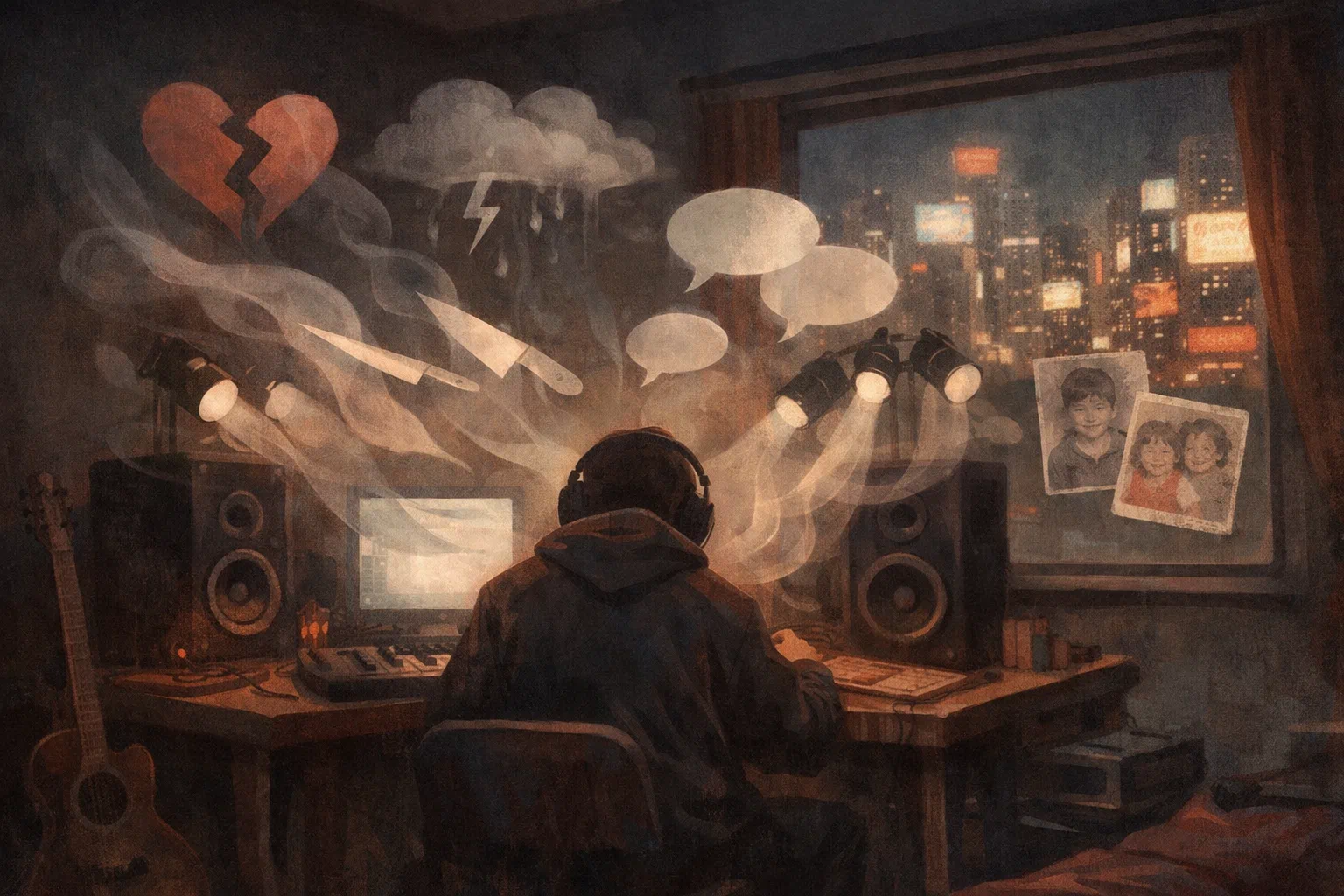
What starts as mood, symbol, and private pressure can look very different once the world starts reading backward.
Kanye and the crowd
This is part of why Kanye West became such a central modern case study in the dangers of public life. Not because he and d4vd belong in the same factual box. They do not. Their situations are plainly different. But Kanye became a very public example of what happens when performance, pathology, ego, grievance, genius, commerce, and constant exposure start bleeding into one another in front of millions of people.
For years, the public treated Kanye as a kind of moral Rorschach test. To some people, he was the misunderstood visionary who saw things earlier than everyone else and spoke in raw form before the culture was ready. To others, he was a reckless narcissist with no discipline, no filter, and no clear line between impulse and declaration. Both readings held part of the truth. Neither held all of it.
That is what made him so difficult to read and so easy to exploit.
The public likes unstable brilliance as long as it remains aesthetically useful. Labels like it. Platforms like it. Audiences like it. Headlines like it. Everyone likes the electricity. Everyone likes the thrill of watching someone “unfiltered.” Yet “unfiltered” is often just a more glamorous word for unwell, undisciplined, manic, compulsive, or self-destructive. The culture does not always know the difference. Sometimes it does not want to.
This is one of the psychological dangers of public life in modern entertainment. Fame no longer rewards output alone. It rewards exposure. It rewards escalation. It rewards the conversion of inward disorder into public signal. The artist who should step back is often pushed forward. The artist who should go quiet is often told to keep posting. The artist who most needs an ordinary human boundary is often the one making the most money by having none.
The condemned and the canonized
This pattern predates the feed, even if the feed has industrialized it.
Kanye is only the most visible modern example of a much older cycle in art and literature: the cycle in which creators are lifted up, denounced, reclaimed, reinterpreted, and folded back into culture again, sometimes all at once. The public rarely knows what to do with artists who become larger than their work. It turns them into symbols, and symbols are always easier to praise or punish than people.
J.K. Rowling became an ideological battlefield, a case where millions of readers found themselves trying to decide whether a beloved body of work could remain emotionally intact while its author became politically radioactive. Tolkien, long treated as settled canon, has been repeatedly challenged, defended, and re-read by generations who see his work as noble or narrow, humane or exclusionary, timeless or bound to older moral assumptions. David Bowie moved through public life as both artist and construction, a figure of constant reinvention whose brilliance was inseparable from ambiguity, costume, performance, and the cultivated instability of persona. Michael Jackson remains the clearest example of all: an artist so embedded in popular memory that the argument over the work and the man never really ends, only changes shape.
The point is not that these figures belong in one moral category. They do not. Their controversies are different in kind, scale, and consequence. The point is that public culture has always struggled with the same basic question: what do we do when the work remains alive, but the person around it becomes contested, compromised, opaque, or unbearable?
Sometimes the culture answers by trying to split the art from the artist. Sometimes it fuses them completely. At other moments it moves back and forth between those positions depending on the decade, the headline, or the mood of the crowd. That instability is not a side effect. It is part of how canon formation works now. To be canonized is no longer to be settled. It is to be endlessly reopened.
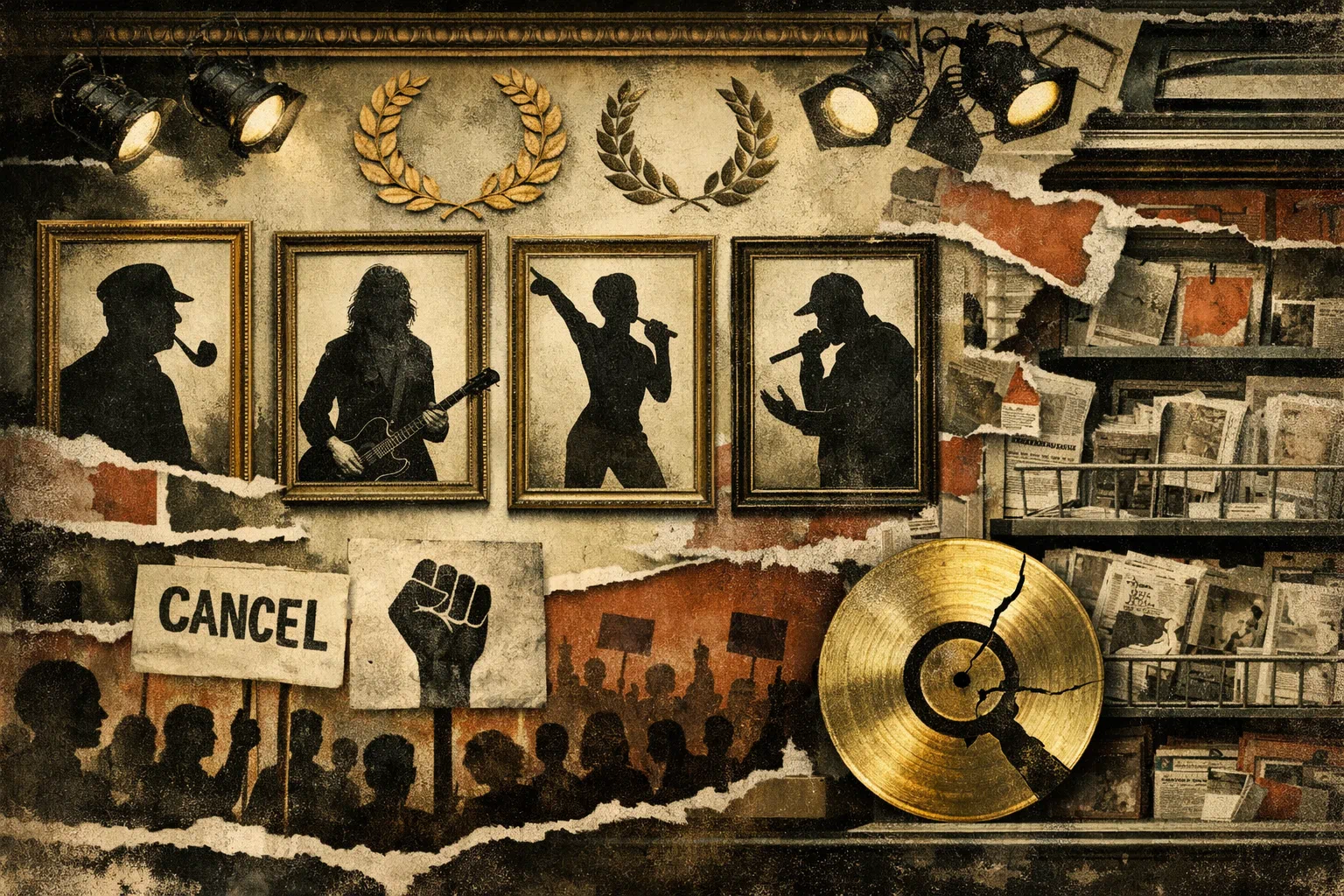
Artists are often crowned and condemned in the same cultural breath.
Why people misread artists
The problem is not only that the public is too harsh. Sometimes it is too romantic.
It likes the damaged artist. It likes the difficult artist. It likes the artist who seems to live closer to the nerve than everyone else. There is a very old idea that great art must come from a special kind of wound, and there is some truth in that. Pain, alienation, humiliation, desire, rage, and instability have always fed art. But the culture often turns that fact into cheap mythology. It stops distinguishing between suffering that gets transmuted into form and suffering that is simply eating the person alive.
That is where misunderstanding begins.
Some artists are condemned too quickly because the public cannot tolerate real strangeness. Others are indulged too long because the public confuses strangeness with depth. Some are flattened into villains before anyone has fully understood what they were trying to make. Others are granted endless aesthetic credit for behavior that is plainly corrosive. The audience swings back and forth between puritanism and worship, between cancellation and canonization, between “monster” and “genius,” with very little appetite for the messier middle ground where actual human beings live.
The same system now hovers over every younger artist who breaks through online.
d4vd belongs to a generation raised inside permanent visibility. His rise did not pass through old gatekeepers first. It passed through SoundCloud , TikTok , YouTube , repost culture, short-form fandom, and the strange intimacy of platform-native fame. That kind of ascent can look democratic, and in some ways it is. It can also be brutal. Your voice, face, aesthetic, moods, and fragments of biography become raw material very early. Before the self is settled, the brand is already live. Before the person is formed, the audience is already interpreting him.
It is a dangerous arrangement for anyone, and especially dangerous for the young.
Art as rehearsal, not verdict
One useful way to think about art is as rehearsal space.
Not rehearsal in the sense that every violent song is practice for violence. That would be too dumb to take seriously. Rehearsal in the sense that art is often where people try out emotional states before they know what to do with them. It is where they experiment with voices, appetites, postures, wounds, identities, and inner weather. The song becomes a room where something can be felt at full volume without yet being lived at full consequence.
That is why art can seem prophetic after the fact. Not because it foresaw events with supernatural clarity, but because it may have caught the shape of an inner pressure before the artist or the audience could explain it in ordinary terms.
This is true far beyond pop music. Writers, painters, filmmakers, comedians, and actors all leave traces of themselves in their work that only become obvious later. Sometimes that later reading is profound. Sometimes it is paranoid. Sometimes it is both. What matters is resisting the lazy move of pretending that all difficult art is either meaningless theater or literal confession. Most of it lives in murkier territory than that. The work is neither innocent nor conclusive. It is suggestive.
And suggestion is where culture gets into trouble.
Suggestion invites projection. It invites the crowd to fill in the gaps. Once the public already suspects the person, every image darkens. Every line tilts. Every title becomes loaded. The old catalog gets processed through a new emotional machine. It is no longer heard as it was heard before. It is heard as postscript. As foreshadowing. As the first scene in a story people now think they know the ending to.
That is why hindsight is so intoxicating. It gives the illusion that confusion was avoidable. It flatters the audience with the idea that the signs were there, that the song told us, that the artist showed his hand. Sometimes there were signs. Sometimes there were only symbols. The two are not the same, even if the culture keeps trying to make them so.
The real lesson of stories like this
The strongest lesson is not that art predicts crime.
The stronger lesson is that art often gets to the feeling before life gets to the language.
People live in advance of their own explanations. They act before they understand. They desire before they can justify. They break before they can describe the crack. Artists, more than most, externalize those unfinished states. They turn confusion into surface. They make style out of fracture. That is why songs, paintings, poems, films, and performances can later seem to contain more truth than the artist knew how to say outright at the time.
That is not mystical. It is human.
It is also why public life can be so corrosive. When a person is rewarded for turning unfinished inner life into consumable art, he may begin to lose the habit of translating that life into ordinary speech, ordinary boundaries, ordinary self-command. The audience applauds the expression. The machine monetizes it. The artist may never fully learn where performance ends and responsibility begins.
At its worst, modern fame creates people who are always visible and never fully seen. They are interpreted constantly and understood rarely. Their work becomes overfamiliar. Their actual interior life becomes less accessible, not more. The crowd thinks it knows them because it has consumed their signal. The signal keeps growing. The person underneath may be shrinking.
That is one reason stories like this hit such a nerve. They expose the instability of the entire arrangement. The same culture that elevates young artists for emotional rawness then acts shocked when rawness turns out not to be a stable way to live. The same audience that wants “realness” recoils when real life invades the aesthetic frame. The same platforms that reward exposure become the places where every old lyric is reprocessed as possible proof.
Outside the feed
What remains after all the noise is a harder, quieter point.
The public may be right to revisit the work. It may be wrong in how it does so. The songs may contain traces of truth. They may also be nothing more than stylized feeling, darkened by context. The case itself will move on its own legal track. The culture will move on its interpretive one. Those two tracks will overlap. They will not always be the same.
What matters is understanding what hindsight does to art.
It hardens it.
It narrows it.
It drags metaphor toward verdict.
It makes ambiguity feel like evasion.
It makes style feel like signal.
It makes the old work sound less like expression and more like evidence.
Sometimes that rereading reveals something real. Sometimes it only reveals our own hunger to believe that the past was clearer than it was.
That may be the truest meaning of “Hindsight 2026.”
Not that a song title became fate.
Not that the art told us everything.
Not that the audience should ignore what it hears.
Only this: once life turns ugly, the culture goes back to the work and listens for a confession. Sometimes it finds one. Sometimes it finds only itself.
And in the age of the permanent feed, that difference gets harder to hear every year.