How American Farm Labor is Set to Evolve…
Again
Here comes the boom?
Farm Labor from 1950 to the Future
Introduction
The American agricultural sector has long been the backbone of the nation’s economy, feeding millions and driving exports. This story of abundance, however, rests on the shoulders of farmworkers, whose labor is as indispensable as it is underappreciated. Over the past seven decades, the dynamics of farm labor have evolved drastically, shaped by mechanization, immigration policies, and social advocacy. From the sweeping changes of the mid-20th century to the relative stabilization of the labor force since 1985, farmworkers’ contributions tell a story of resilience amid systemic challenges.
Now, a new technological frontier emerges: humanoid robots powered by advanced AI and large language models (LLMs). These systems promise to take on specialized agricultural tasks, such as picking strawberries or pruning vineyards, within the next decade. While this innovation offers exciting potential to address labor shortages and improve productivity, it also raises complex questions about cost, accessibility, and the ethical implications of replacing human labor.
This essay examines the transformations in American farm labor since 1950, highlighting the forces that shaped its trajectory, the challenges that remain, and the potential impact of LLM-powered humanoid robots.
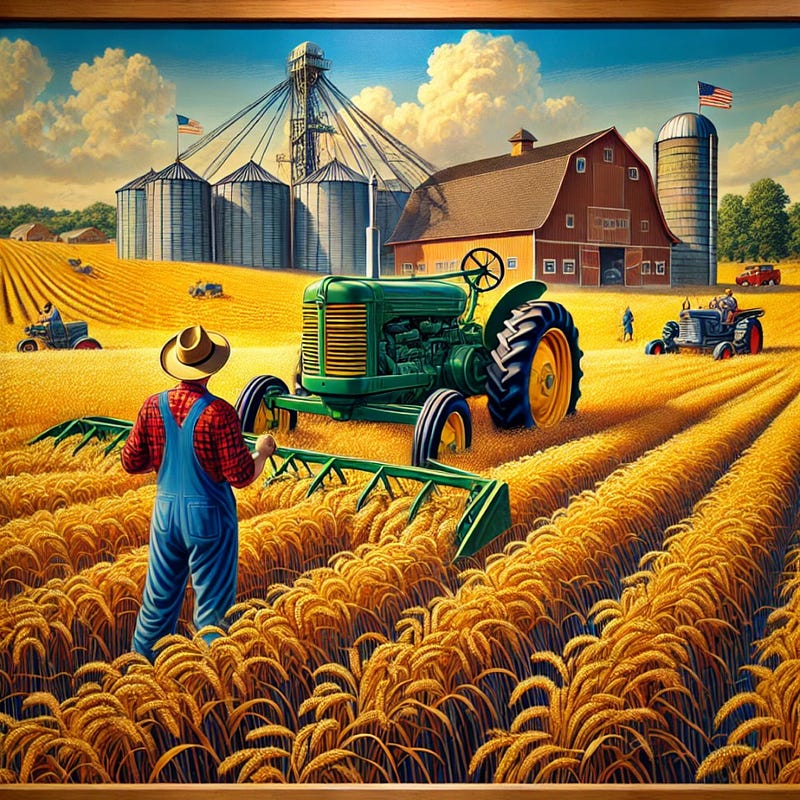
The Mid-Century Agricultural Boom and Labor Shifts (1950-1985)
The decades following World War II were transformative for American agriculture. Rising global demand, government support, and technological innovation spurred an agricultural boom. Mechanization revolutionized farming practices, with machines like the mechanical cotton picker reducing the need for manual labor by up to 90% in certain crops. In the Midwest, tractors replaced farmhands, while automated harvesters transformed wheat and corn production.
However, not all sectors could mechanize. Fruits and vegetables, requiring delicate handling, still depended heavily on manual labor. To meet these needs, the U.S. turned to immigrant labor. The Bracero Program (1942-1964) brought millions of Mexican workers to American farms, offering temporary visas to address labor shortages. While the program met critical economic demands, it also exposed workers to exploitative conditions, often with little recourse.
The program’s end coincided with the rise of the United Farm Workers (UFW) movement in the 1960s and 1970s. Led by Cesar Chavez and Dolores Huerta, the UFW fought for better wages, union protections, and improved working conditions. Strikes, boycotts, and marches drew national attention to farmworkers’ struggles, marking a pivotal moment in the fight for agricultural labor rights.
Stabilization of the Farm Labor Force Since 1985
By the mid-1980s, the farm labor force reached relative equilibrium. Mechanization had reduced the need for domestic labor in crops like cotton and wheat, while immigrant labor stabilized in sectors reliant on handpicking, such as fruits, vegetables, and tree nuts. Today, immigrant workers account for over 70% of the agricultural workforce, with nearly half being undocumented.
Yet this stability masks persistent challenges:
Low Wages: Farmworkers earn among the lowest wages in the country, averaging $16.50 per hour in 2022, compared to $27.07 for all private-sector jobs.
Seasonal Precarity: The seasonal nature of farm labor often leaves workers without healthcare or unemployment benefits.
Labor Shortages: Despite the growth of programs like the H-2A visa, which issued over 370,000 permits in 2023, farmers report widespread difficulty finding enough workers during peak seasons.
The Future of Farm Labor: Humanoid Robots Powered by LLMs
Within the next decade, humanoid robots powered by LLMs could take on specialized agricultural tasks, such as picking strawberries, pruning grapevines, or harvesting delicate fruits like cherries. These robots are designed to combine physical dexterity with real-time problem-solving capabilities, enabling them to handle tasks that have historically required skilled human labor.
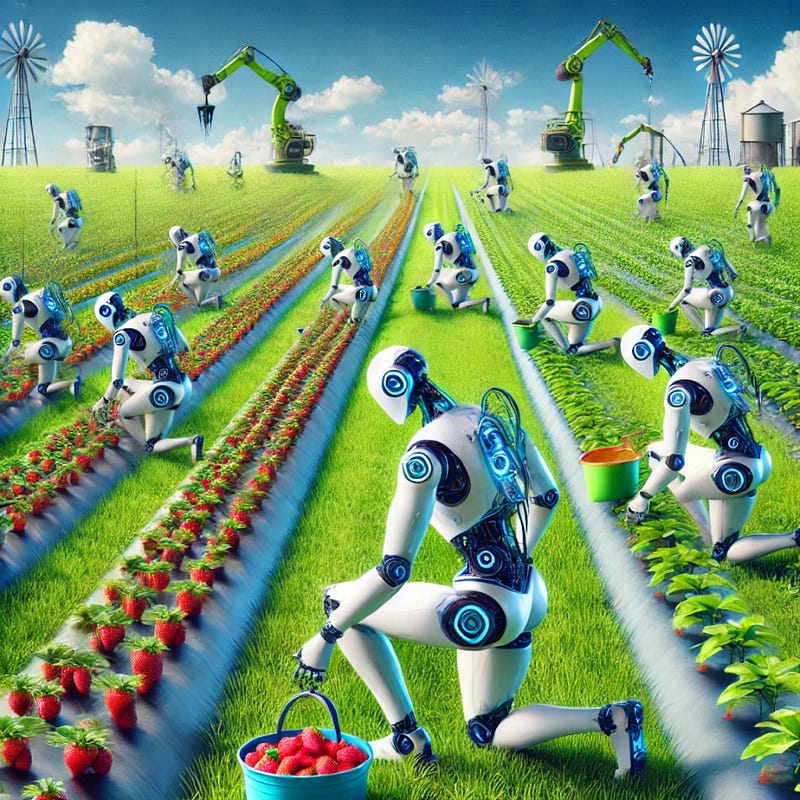
Advantages of LLM-Powered Robots
Addressing Labor Shortages: Robots could ease chronic labor shortages, reducing dependency on immigrant labor.
Precision and Efficiency: A strawberry-picking robot, for example, could visually identify ripe fruit, calculate the optimal angle for removal, and pick it without damaging the plant, tasks requiring human intuition today.
Reduced Crop Damage: Unlike conventional machines, these robots would be capable of minimizing damage through precise movements and adaptability.
Challenges of Adoption
High Costs: The upfront expense of humanoid robots could be prohibitive for small and medium-sized farms, exacerbating economic disparities.
Ethical Concerns: Displacing human labor poses significant ethical questions, particularly in rural communities that rely on farm jobs for income.
Infrastructure Needs: Reliable power sources, maintenance facilities, and technical expertise would be necessary to integrate these systems.
Timeline for Implementation
Prototypes are already under development, and large-scale adoption could begin within the next decade. Large corporate farms are expected to be the first adopters due to their financial capacity, while smaller farms may require subsidies or cooperative solutions to compete.
Economic and Policy Considerations
The introduction of humanoid robots intersects with broader economic and policy challenges. Immigration reform remains critical, as the transition to full automation will take time, leaving an ongoing need for human labor. Programs like the H-2A visa must evolve to address immediate shortages while preparing for future changes.
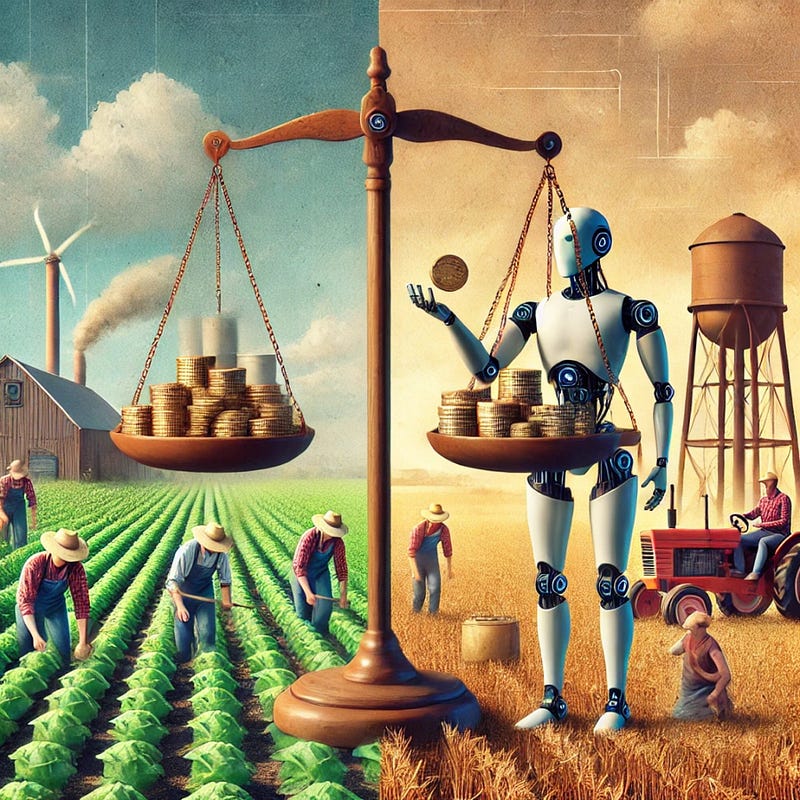
Additionally, policymakers must anticipate the ripple effects of automation. Rural communities that depend on agricultural jobs may face significant displacement, underscoring the need for:
Workforce Retraining: Preparing displaced workers for roles in other industries.
Subsidies for Small Farms: Ensuring equitable access to robotics technology.
Social and Environmental Impacts
Farmworkers today face dual threats: the physical risks of manual labor and the looming prospect of automation displacing their jobs. Beyond automation, the agricultural sector must address long-standing issues, including:
Housing: Farmworkers often live in overcrowded and unsafe conditions.
Healthcare: Many lack access to adequate medical care.
Climate Change: Extreme weather events increasingly expose workers to hazardous conditions like heat stress.
Humanoid robots may offer some environmental benefits, such as optimizing resource use and reducing water waste. However, their reliance on advanced materials and energy could introduce new environmental challenges, including electronic waste and carbon emissions from manufacturing.
Conclusion
The American farm labor force has undergone profound transformations since 1950, shaped by mechanization, immigration, and now, the promise of humanoid robots powered by LLMs. These robots have the potential to revolutionize agriculture by performing specialized tasks like strawberry picking within the next decade. However, their adoption must be carefully managed to avoid exacerbating inequality or displacing vulnerable workers without support.
Farmworkers remain the backbone of American agriculture, and any technological revolution must honor their contributions. As the sector faces unprecedented change, the path forward demands innovation, inclusion, and sustainable practices that serve both the industry and the people behind it.
Read More
William Kandel, Profile of Hired Farmworkers: A 2020 Update, U.S. Department of Agriculture, Economic Research Service.
Philip L. Martin, Immigration and Farm Labor: Challenges and Opportunities, UC Davis.
Keith Murray, Mechanization and Labor in American Agriculture, 1945-1970, Agricultural History Journal.
U.S. Department of Agriculture Economic Research Service, Farm Labor: Background.