ID Required
A federal citizenship list and the fight over voter ID are testing whether voter verification can be serious, lawful, auditable, and worthy of the franchise it guards.
The File
A voter file looks plain because power often arrives that way.
It is a name, date of birth, residence, signature, citizenship attestation or status marker where law requires it, registration date, precinct assignment, district lines, voting-history markers, and whatever state law requires around the edges. It may live in a statewide database, a county election system, a paper backup, a mail notice, a provisional-ballot envelope, and a federal data exchange at the same time.
To the citizen, it is usually invisible until something goes wrong. To the republic, it is one of the records that decides who may help govern.
On March 31, 2026, President Donald Trump issued Executive Order 14399 , directing the Department of Homeland Security, through USCIS and in coordination with the Social Security Administration, to compile and transmit a State Citizenship List to each state’s chief election official. The list is supposed to identify people confirmed as United States citizens, 18 years of age or older by the upcoming federal election, and resident in the state.
The order says the list will draw from federal citizenship and naturalization records, SSA records, SAVE data, and other federal databases. It also directs DHS to create procedures for individuals to access, update, or correct their records before elections, and for states to supplement or amend the list. It makes an important caveat: appearing on the citizenship list does not itself register anyone to vote. State and federal election rules govern registration.
That caveat is the hinge. The federal file may give a state a lead. It cannot deliver the civic verdict.
The Ordinary Case for Identification
The suspicion around voter ID has become stranger than the requirement itself.
Identification is one grammar of modern public life. We show it to cross regulated thresholds, prove age, pick up certain medicines, claim benefits, start employment, enter records, and correct records. Some ID demands are foolish or abusive. Identification itself is a common demand in a society built on records, permissions, and public responsibility.
A person can buy many cold medicines without showing identification. The pseudoephedrine version of Sudafed is different. Federal rules require photo identification, limit purchases, and require sellers to keep purchaser information. Sudafed is a cold medicine; a ballot helps choose a president. If a regulated decongestant can require a buyer to identify himself, the act of helping choose the president of the United States can bear the same basic expectation.
Asking for identification before a ballot is cast is ordinary civic administration. Treating that request, in principle, as a civic insult is the stranger move.
A voter ID rule can be poorly written. It can be weaponized. It can be made needlessly hard for the poor, the elderly, the disabled, the young, the rural, the homeless, the recently married, or the recently naturalized. Those are real design questions. They do not defeat the concept. They define the work.
Abuse calls for better identification law: lawful, accessible, auditable, and correctable.
By 2026, voter ID had become common election administration. The National Conference of State Legislatures counted 36 states with laws requesting or requiring voters to show some form of identification at the polls. The remaining states and Washington, D.C., use other methods to verify identity, most often by checking signatures or other identifying information against records on file. Federal law already requires identification from certain first-time voters who register by mail and have not otherwise verified identity.
So the country is not deciding whether elections should include verification. It already has. The argument is over what kind of verification is serious enough for self-government and fair enough for eligible citizens.
The Duty Behind the Record
Voter-list maintenance is ordinary election administration.
People move. People die. Records duplicate. Names change. Citizenship status changes. Some people register improperly, by error, misunderstanding, or fraud. Some records stay active after eligibility has ended. A state that never checks the roll leaves the franchise to drift under bureaucratic neglect.
Federal law already reflects that premise. DOJ’s NVRA guidance says states must maintain accurate and current voter-registration lists and make a reasonable effort to remove people who are ineligible because of death or a move outside the jurisdiction, while following statutory procedures. The same guidance describes limits on removals, including notice and timing rules.
The point is practical before it is ideological. Voting is a civic franchise with responsibilities attached. The citizen has duties inside that system: register truthfully, keep records current, respond to lawful notices, and prove eligibility when a credible process asks for proof. The state has its own duties: maintain the roll, apply law evenly, make qualifying ID available, keep evidence in view, and correct its own mistakes.
The same duty runs in the other direction: proof cannot become a maze, a trap, or a presumption of guilt.
If proof becomes unthinkable, the civic culture has already been damaged. A franchise without duties becomes an entitlement administered by trust. Trust alone cannot carry a voter roll.

Federal records reach the franchise through state law and county desks.
The Machine Has to Be Worthy of the Task
The hard question is how identification and citizenship verification move through the machinery.
Executive Order 14399 gives DHS, USCIS, SSA, DOJ, and USPS new assignments around federal-election verification. It directs DHS to build the State Citizenship List, says the Attorney General should prioritize investigations and prosecutions involving ballots issued to ineligible people, and directs USPS to begin proposed rulemaking around mail-in and absentee ballots, including official mail markings and unique ballot-envelope identifiers.
Those are serious instruments. Politics cannot explain them away, and official integrity language cannot authenticate them. A verification system earns authority through accuracy, lawful scope, transparency, auditability, correction procedures, and respect for state election law.
Voter ID is the front counter of the system. It asks whether the person presenting himself is the person entitled to cast the ballot.
A citizenship list is the back office of the system. It asks whether the record confirms eligibility.
Both questions are legitimate. Both can be mishandled.
USCIS describes SAVE, the Systematic Alien Verification for Entitlements program, as an information service for citizenship or immigration-status verification. It supplies verification information. It does not decide registration, roll status, or voting eligibility. A federal response travels through state law and county procedure before it reaches a voter.
A SAVE result can be useful evidence. It can also be incomplete evidence. Naturalized citizens, derivative citizens, people with missing markers in SSA data, people with old immigration records, and people caught by name or number errors can require further review.
A no-match response cannot be allowed to masquerade as a final civic judgment.
That evidence supports grown-up verification: process before judgment.
Where the File Can Fail
The failure point is usually small.
A digit is transposed. A married name and birth name drift apart. A child derives citizenship through a parent but never receives a certificate. A naturalized citizen’s status lives in one federal system while a state query reaches another. A county imports a batch, an automated response sorts the file, and a notice leaves the office with a deadline attached.
Recent reporting supplies useful field examples.
The Associated Press reported that at least 67 million registrations had gone through the expanded DHS verification process, that at least 25 states had used SAVE checks since April 2025, and that USCIS said 60 million checks identified about 24,000 potential noncitizens. AP also reported potential-deceased flags, a North Carolina check of 7.4 million registrations, and state differences in how quickly a voter must answer a flag.
Those numbers call for scale discipline. Twenty-four thousand potential noncitizen flags inside 60 million checks would be about 400 per million registrations if every flag became a confirmed ineligible registration. The public should want confirmed numbers, not theatrical numbers. It should also want every county clerk to know exactly what a flag means before a citizen receives a deadline.
AP reported mistakes involving Anthony Nel, a naturalized citizen in Texas whose registration was temporarily canceled after a SAVE-related check while he was waiting on a passport replacement, and Domingo Garcia, a Dallas lawyer who had voted regularly for decades and was canceled after apparently being treated as deceased.
ProPublica and The Texas Tribune reported Missouri and Texas mistakes, including a Boone County, Missouri batch in which more than half the voters flagged as potential noncitizens turned out to be citizens, and at least 87 misidentified Texas voters across 29 counties. Their reporting also found that some Texas clerks did identify improper registrations, including cases where voters had marked themselves as noncitizens and were then registered by election-office staff in error.
That is the real world. Verification can find bad records. Verification can also create bad records.
The lesson is not that voter ID is suspect. The lesson is that every verification tool must be treated as evidence inside a process, not as a machine that replaces judgment.
The Process That Would Earn Trust
A serious verification process should be easy to describe.
Identification at the polling place or registration stage should be ordinary, not punitive. The acceptable forms should be clear. The ID should be free or practically reachable for citizens who need one. A voter without ID should have a provisional path. A voter caught by an error should have a cure path. A voter whose registration is canceled by mistake should have a reinstatement path.
The federal record should begin as a lead before any verdict.
The state should compare the lead against its own law and registration record. A county official should review the match before any status change. The voter should receive plain-language notice that identifies the issue, the evidence category, the proof options, the deadline, and the office responsible for correction.
The file should then show who made the decision, what source record was used, what response came back, how the voter answered, and how the final decision was reached. Aggregated error data should be public.
Such a process respects both sides of the franchise. It treats proof as part of citizenship’s public duty and treats government error as the government’s responsibility to document, measure, and repair.
The weaker process is familiar: match, status change, notice, burden, deadline, silence.
That chain may clean some bad records. It can also hide official mistakes inside the system built to find other people’s mistakes.
Federal Pressure, State Responsibility
The Justice Department has been suing states over voter-registration records. DOJ’s February 26, 2026 announcement said it had sued five additional states for failing to produce voter rolls and brought the nationwide total to 29 states and the District of Columbia.
DOJ framed the lawsuits as election-integrity oversight. The frame does not supply authority. Law has to supply it.
By mid-May, Reuters reported that DOJ had drafted a legal opinion supporting its voter-roll demands, even after several adverse district-court rulings. That development sharpens the question. An agency may believe its theory is correct. A court may reject the statute offered to carry it.
The Arizona order in United States v. Fontes shows the risk of letting a demand outrun the law invoked to justify it. The court dismissed the case after rejecting DOJ’s theory that Arizona’s statewide voter-registration list fit the Civil Rights Act production demand in the manner DOJ claimed. The order also noted the conflict that would arise if a live voter list that state and federal law require to be maintained and amended were treated like a frozen preservation document.
That does not erase the civic need for accurate rolls. It separates two questions that political argument often merges. The country needs clean rolls. The government also has to use authority it actually possesses.
Federal officials gain a national enforcement mechanism. States receive pressure and data. County election offices inherit the practical work. Citizens carry the duty to identify themselves, keep records correct, and answer lawful process.
Each actor can defend its role. The danger comes when one actor’s incentive quietly absorbs the others.
If Washington wants a citizenship list to anchor election integrity, Washington should publish how the list is built, what records feed it, how conflicts are resolved, how often the list is wrong, and who is responsible for correction.
If states require voter ID, states should make identification available, legible, and correctable.
If citizens claim the franchise, citizens should treat proof and responsiveness as part of the duty.
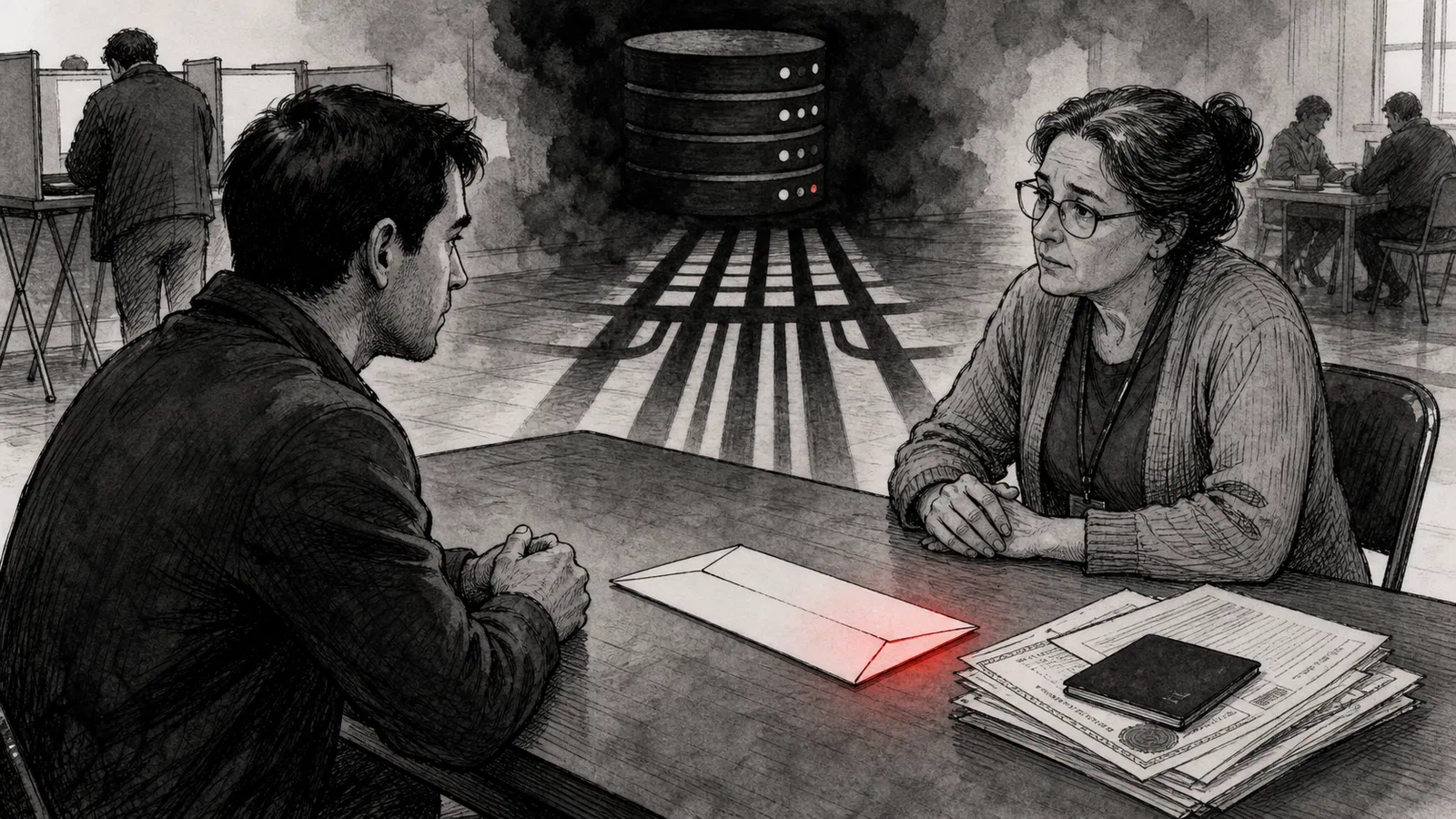
The burden of proof belongs in a process, not in a panic.
The File and the Franchise
The franchise is expensive in the old civic sense.
The state has to maintain a roll that means what it says. The citizen has to meet eligibility rules and keep the record answerable. Local officials have to translate national data into lawful procedure. Federal agencies have to know the limits of their own files.
The public argument often reaches for the loudest noun: purge, fraud, suppression, integrity. The file is quieter. It asks who is eligible, who checked, what source answered, who corrected the record, and who bore the burden while the system sorted itself out.
A republic cannot treat voter eligibility as rude to verify. It also cannot let a verification machine hide its own workings.
Properly designed voter ID can honor the franchise. It gives a citizen one way to stand behind the act of voting. The citizenship list may become another way the state stands behind the roll.
Both will deserve trust only if they can show their work, correct their errors, and leave the voter roll strong enough to bear the weight of self-government.