In The Image of God
An introduction to Catholic social teaching
Teaching Note
This essay draws from a weekly social teaching course taught by Matthew, a Catholic educator and parish instructor whose ministry focuses on helping ordinary people understand how the Church thinks about society, politics, and moral responsibility.
His teaching is grounded in Scripture, the Catechism, and the Church’s social doctrine, and is offered not as personal opinion but as faithful explanation of what the Church actually professes.
What follows is my own effort to understand, articulate, and reflect on those teachings as they were presented.
Most conversations about religion and society begin in the wrong places. They start with policies and parties or slogans. Accusations begin, and they stop listening.
The Church asks us to be radically different.
She begins with a claim about reality itself ~
A claim about love, humanity, and what it means to live together in the world.
You are a Child of God. Therefore, your dignity is infinite and comes from Him alone ~ not from any earthly power.
The Church doesn’t open with economics, healthcare, climate policy, or voting strategies.
It opens with a sentence so simple, and so sweet:
“God is love. ” ~ 1 John 4:8, NRSV-CE
In all of history, this may be the most radical three-word sentence that anyone ever said. And everything that follows ~ every social principle, every moral obligation ~ flows directly from it.
Love, before anything else
If God is love, then love is no feeling or preference!
It can’t be reduced to kindness, tolerance, nor personal fulfillment.
Love is creativity moving over the waters of chaos bringing order and goodness into the world.
Love is joie de vivre ~ the very essence of life itself.
Love is the quiet voice you hear after the storm has pounded on the walls. Love is the call to adventure beckoning you around the corner.
Love is the warm embrace of your wife and children after a long day.
Love is God.
Paul said it this way.
“If I have prophetic powers, and understand all mysteries and all knowledge, and if I have all faith, so as to remove mountains, but do not have love, I am nothing. ” ~ 1 Corinthians 13:2, NRSV-CE
The story of Jesus Christ ends in His crucifixion at the hands of corrupt, hypocritical political leaders. And why did they murder him? He spoke the Truth.
The God of the Universe, He who exists in-around-through all things, manifested Himself as a mortal man and proceeded to sacrifice Himself in the name of Truth and for the Love of his friends.
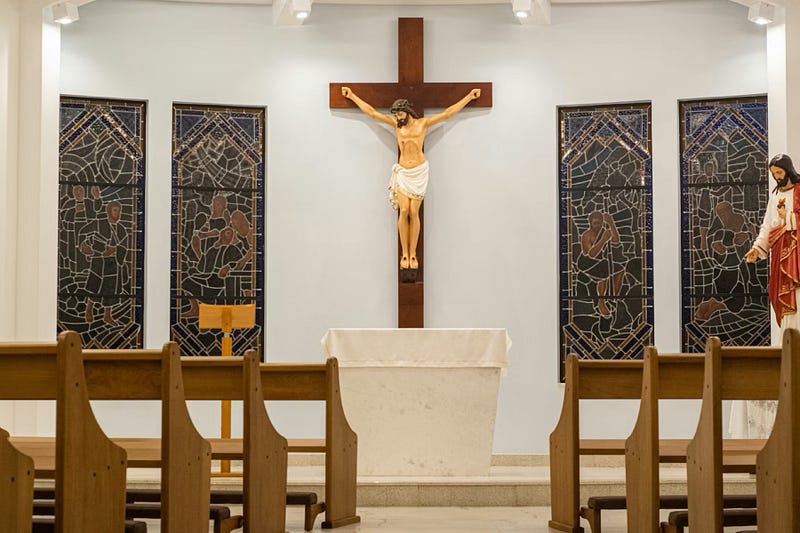
And that is why the crucifix is at the center of our attention.
The crucifix is not decorative. It’s not sentimental.
It’s the Church’s most concrete social statement.
“No one has greater love than this, to lay down one’s life for one’s friends. ” ~ John 15:13, NRSV-CE
“It is not good that the man should be alone”
The Bible’s first explicit social claim appears before any potential play partners existed!
Everything in creation is declared good ~ light, land, sea, animals.
“Then the Lord God said, ‘It is not good that the man should be alone.’ ” ~ Genesis 2:18, NRSV-CE
Isolation is not good. Human beings are not designed as self-sufficient units. We are relational, social creatures by nature. We need each other!
The Church draws a decisive conclusion from this: society is not an artificial construct.
It’s a moral reality.
We need community to discover meaning, survive hardships, and find salvation.
That is why Christianity never presents itself as a solo project. No one baptizes themselves. No one saves themselves. Faith is received, transmitted, and lived in the community.
This is not incidental. It reflects something deeper.
God is not solitary.
God is Trinity ~ a communion of persons.
To be made in God’s image is to be oriented toward relationship. Social concern is not a political hobby layered on top of faith ~
It flows directly from God.
From Love.
Dignity is Divine
Human beings are made in God’s image, and their worth cannot be granted ~ or revoked ~ by governments, markets, productivity, or popularity.
This is one of Catholic social teaching’s most consistent claims.
Human dignity is inherent, not earned.
“So God created humankind in his image, in the image of God he created them. ” ~ Genesis 1:27, NRSV-CE
Dignity does not depend on capacity.
It doesn’t depend on age, intelligence, usefulness, citizenship, health, or moral track record.
Recent Church teaching has used the phrase infinite dignity explicitly, including in the Vatican’s 2024 declaration Dignitas infinita , to make this unmistakable. The dignity of a human person is not diminished by weakness, guilt, or dependence.
A criminal does not lose it.
A migrant does not lack it.
A child does not need to earn it.
This claim explains why the Church resists systems that tie worth to output, conformity, or utility. It also explains why Catholic social teaching often frustrates ideological consistency.
It refuses to reduce people to categories.
Human Dignity is from God.
Scripture does not allow selective concern
Jesus does not speak about social responsibility in abstract terms.
He tells short and mysterious stories that communicate the deepest truths.
His parable of the Good Samaritan tells us of a man beaten by robbers and left for dead on the side of the road. Two religious officials pass by and avert their gaze. A Samaritan, of all people! ~ an outsider ~ stops, tends to his wounds, pays for his care, and promises to return.
“Which of these three, do you think, was a neighbor to the man who fell into the hands of the robbers? ” ~ Luke 10:36, NRSV-CE
The Good Samaritan doesn’t ask whether an injured man shares his beliefs. He doesn’t need to consult a system. Instead he responds to need when he witnesses it! Church tradition goes further and sees Christ himself as the Greatest Samaritan ~ lifting humanity toward restoration and the true path of fellowship.
Matthew 25 removes any remaining ambiguity.
“Truly I tell you, just as you did it to one of the least of these who are members of my family, you did it to me. ” ~ Matthew 25:40, NRSV-CE
This passage does not invite metaphorical interpretation.
Christ came to be the least of us. He is the hungry, the sick, the imprisoned, and the poor. Social concern is not requisite charity layered onto faith:
It’s an encounter with Christ Himself.
The Church offers principles, not blueprints
One of the most persistent misunderstandings Matthew addresses is the idea that the Church exists to issue policy prescriptions.
It does not.
Catholic social teaching operates at the level of principles ~ durable moral guideposts that can be applied across cultures, economies, and political systems. The Church does not prescribe tax rates. It doesn’t endorse parties. It doesn’t claim technical expertise in every policy domain.
What it does claim is moral competence.
From that competence emerge four foundational themes that will recur throughout this series:
- Human dignity ~ every person possesses inherent worth
- The common good ~ social arrangements must serve all, not a few
- Subsidiarity ~ decisions should be made at the most local level capable of addressing them
- Solidarity ~ we are responsible for one another, not merely ourselves
These are not slogans.
They’re foundational.
They prevent moral outsourcing.
Citizens, lawmakers, and institutions remain responsible for applying these principles in concrete ways.
Disagreement is expected.
Indifference is not.
Why this matters now
Modern public life oscillates between two extremes ~ technocratic detachment and moral outrage.
Catholic social teaching resists both extremes.
It insists that love must shape systems, not just sentiments.
It insists that truth matters even when it is inconvenient.
And it insists that the poor, the weak, and the unseen are not peripheral ~ they are central.
This is why the coming weeks will address economics, healthcare, the environment, war, migration, punishment, and political responsibility ~ not as battlegrounds, but opportunities to think clearly about what love requires.
None of these topics are distractions from faith. They’re the practical applications of faith.
A quiet invitation
This series is not an argument. It’s an exploration of a moral tradition that refuses simplification and rewards patience. If you follow along, you may not agree with every conclusion.
That’s not the point.
The point is to develop a framework that takes human dignity seriously and resists both cynicism and utopianism.
Thank you for reading.
If you would like to continue this journey, I invite you to follow the series as it unfolds week by week.
A closing prayer
Father
Father,
You created us in your image
Your commandments are right and true
Though night may fall and darkness surround us
The sun will rise in the morning
You give us courage when we are ‘fraid,
Lift heavy burdens from our shoulders
We pray for peace and for your reign
Gratitude, mercy, love, and grace.
Protect the weak,
Open our eyes,
Show us the truth,
God is alive.
Amen.