Modern Prometheus
When humans learned to command lightning, they changed night, labor, distance, and the shape of modern life.
When Humans Learned To Command Lightning
For most of human history, night meant surrender.
When the sun dropped below the horizon, the productive day ended with it. Light came from flame ~ torches, oil lamps, candles ~ all dim and dangerous. Energy meant muscle, wind, falling water, or fire carefully tended. Lightning, by contrast, belonged to the heavens. It split trees, ignited cities, killed without warning. Ancient cultures treated it as divine judgment or cosmic theater, not something a person could touch, much less use.
That division held for millennia. Fire was mastered early. Lightning was for the gods.
The change that followed turned lightning as terror into electricity as infrastructure, reshaping human life with a speed and scale rivaled only by the first control of fire itself. And like fire, electricity did more than improve existing habits. It reordered time, labor, space, and society in ways few living through it fully understood.
The phrase carries force for a reason. Mary Shelley’s 1818 novel was titled Frankenstein; or, The Modern Prometheus , and it arrived in a culture already fascinated by galvanism, life, and artificial force. Prometheus had stolen fire. Modern humans began to steal the lightning.
Wonder Becomes Experiment
By the early modern period, curiosity began to chip at the myth. Natural philosophers noticed strange effects ~ rubbed amber attracting straw, sparks jumping from metal, shocks stored in glass jars. These were parlor tricks, unsettling and amusing, but they hinted at something deeper. The Greeks had named amber elektron. The word lingered, waiting for meaning.
The first decisive break came with Benjamin Franklin. In 1752, Franklin’s kite experiment helped demonstrate that lightning and the small sparks produced in laboratories were the same phenomenon. Electricity belonged to nature’s rules. It could be conducted, redirected, grounded.
Franklin built the lightning rod ~ a simple metal spike and wire that gave lightning a safer path to earth. Churches, homes, and warehouses gained a practical defense against fire from above. The Franklin Institute’s account is careful about the myth: Franklin did not discover electricity, and the kite was not struck by lightning. The point was stranger. The storm’s charge could be drawn, stored, and studied.
Humanity domesticated the power of the sky.
Life, Metal, And Motion
A generation later, electricity entered the body.
In the 1780s, Luigi Galvani observed dead frogs’ legs twitching when touched by metal during electrical experiments. Muscles moved. Nerves fired. Galvani concluded that living tissue carried its own electrical force.
Life itself, he argued, must run on electricity.
The claim sparked controversy and fascination. If true, electricity was more than a physical curiosity. It was biological.
Enter Alessandro Volta. Volta doubted the frog. He suspected the metals. To prove it, he stacked zinc and copper discs separated by salt-soaked cloth and produced a steady current. No storm. No animal. Just flow.
The Whipple Museum at Cambridge puts the dispute plainly: Galvani saw animal electricity; Volta saw metal contact and moist conductors. Volta’s answer became the pile. The Volta heritage project describes it as a device capable of producing electricity continuously, without needing to be recharged.
The voltaic pile changed everything. For the first time, electricity could be generated on demand. A spark would vanish. A shock would pass. This was a continuous stream.
Lightning had been captured indoors.
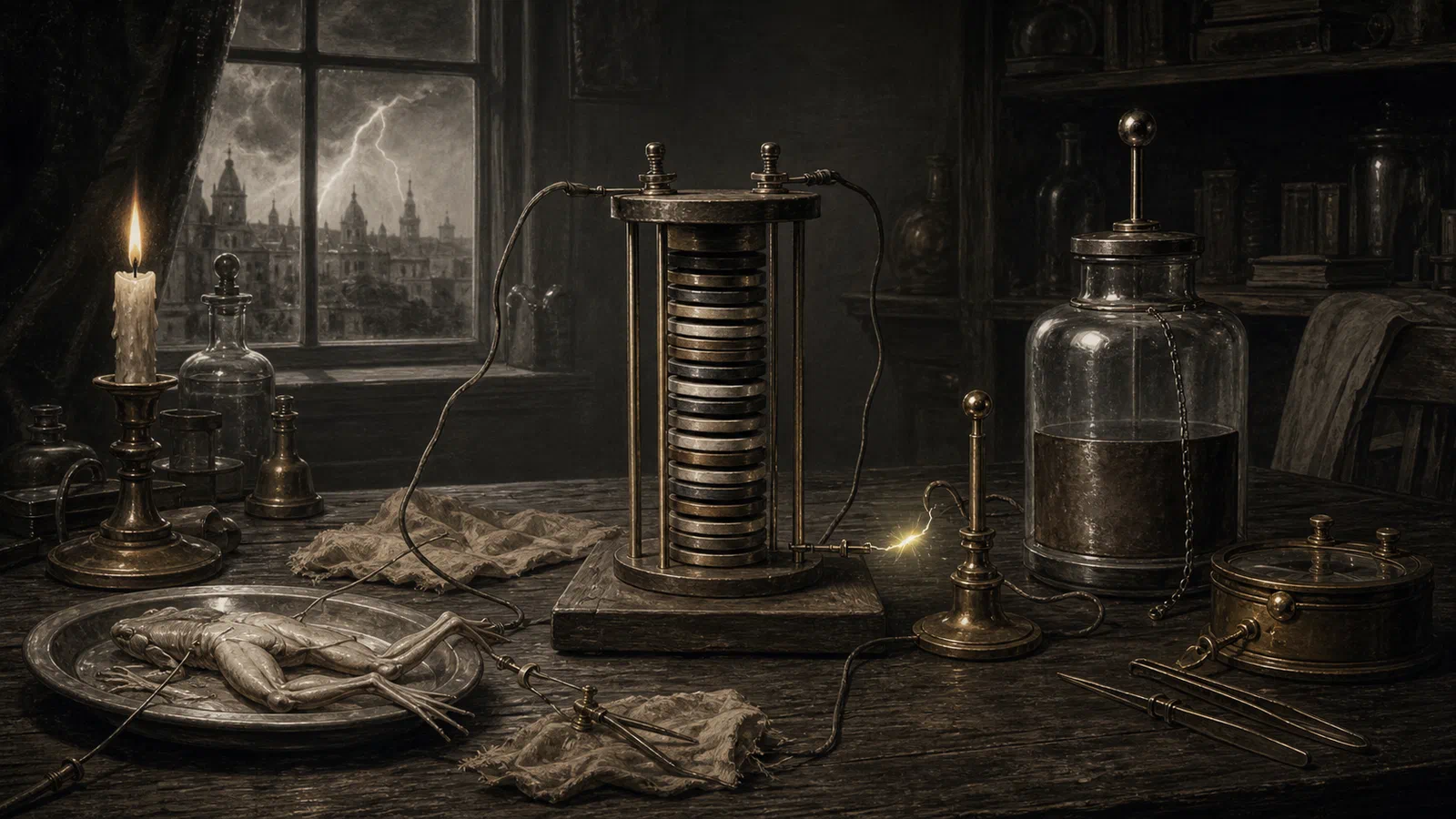
Electricity crossed the threshold through glass jars, wet cloth, metal, and nerve.
Motion Becomes Power
The next leap came from motion.
In 1831, Michael Faraday discovered electromagnetic induction ~ moving a magnet near a wire produced current. Mechanical motion could become electricity. Turn a wheel. Rotate a shaft. Power emerged.
Faraday built crude generators and motors. He showed that electricity could do more than store and spark. It could be produced endlessly so long as motion continued. Waterfalls, steam engines, wind ~ all could be converted.
Electricity had become work.
Faraday lacked mathematical training, yet his intuition reshaped physics. He spoke of fields and lines of force, invisible structures governing matter. Others would translate his vision into equations. The Royal Institution’s Faraday generator , built in October 1831, shows the principle in physical form: a magnet moving through a coil, a current appearing where none had been.
The World Becomes A Circuit
That task fell to James Clerk Maxwell. In the 1860s, Maxwell unified electricity, magnetism, and light into a single framework. His equations showed that light itself was an electromagnetic wave.
This was not philosophy. It was prediction. Maxwell calculated the speed of these waves before anyone had seen them. When radio waves were later detected, the theory held. The Clerk Maxwell Foundation describes the breakthrough as a wave equation implying that disturbances in electric and magnetic fields travel together through space at the speed of light.
Electricity was no longer mysterious fluid or living essence. It was law-bound, measurable, transferable. Nature itself was written in current and field.
Power Leaves The Laboratory
Science alone does not reshape society. Infrastructure does.
In the 1880s, Thomas Edison built the first practical electric power stations. His Pearl Street Station lit parts of New York City using direct current. Streets glowed. Stores stayed open. Night softened.
The IEEE Engineering and Technology History Wiki records the scale with useful modesty. On September 4, 1882, the station at 257 Pearl Street began supplying electricity to customers in a quarter-square-mile district of Manhattan. It was historic, but small. The first day served fewer than 90 customers.
Edison’s system had limits. Power could not travel far. Cities required dense webs of generators.
Another approach emerged ~ alternating current. It could be transformed to high voltage for transmission, then stepped down for safe use. Motors ran smoother. Distance collapsed.
The rivalry became personal.
The War Of The Currents
Nikola Tesla envisioned an electrified world built on alternating current. George Westinghouse supplied capital and manufacturing. Edison fought back, warning that AC was deadly. Public demonstrations turned grotesque. The stakes were enormous.
The question was simple ~ could electricity become a universal utility, or remain a local novelty?
The answer arrived at scale. The Chicago World’s Fair of 1893 blazed with AC light. Niagara Falls followed, sending power miles away to Buffalo. Factories hummed. Costs fell. Industry clustered where energy flowed.
The National Park Service history of hydroelectric power makes the transmission problem clear. Direct current could travel only short distances from Pearl Street. Alternating current could be stepped up, sent long distances, and stepped down for local use. In 1896, Westinghouse used a Tesla-based AC system at Niagara Falls to transmit power to Buffalo, 26 miles away.
The war ended quietly. Alternating current won.
Electricity had escaped geography.
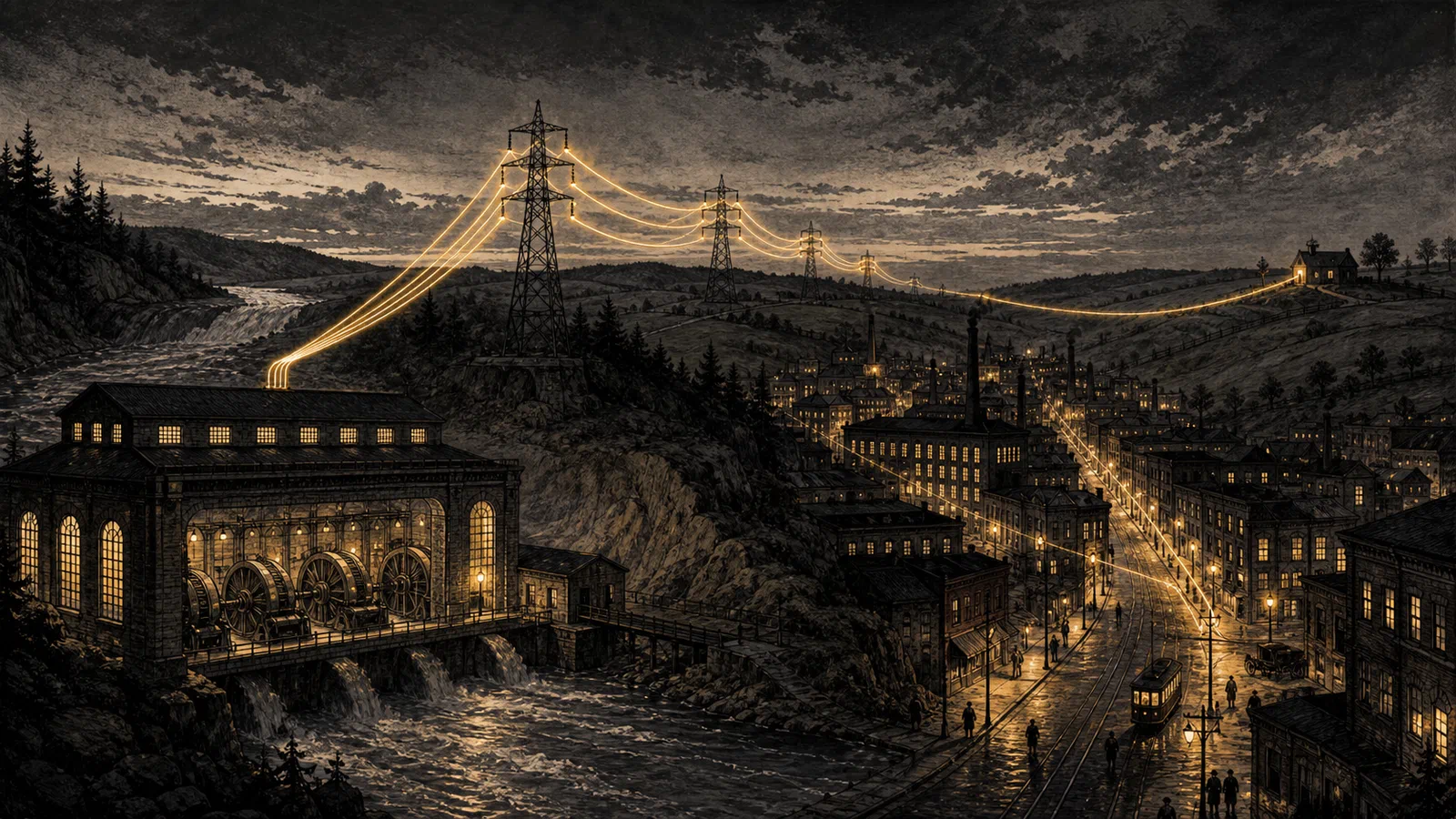
Once power could travel, geography lost one of its oldest vetoes.
Time, Labor, And The Night
Once electricity spread, its effects multiplied.
Factories no longer shut at sunset. Shifts extended. Output climbed. Motors replaced belts and steam shafts. Workspaces reconfigured. Productivity surged.
Cities changed shape. Electric streetcars allowed workers to live farther from factories. Suburbs formed. Streets brightened. Nightlife followed.
Homes changed more slowly, then all at once. Electric light replaced flame. Appliances displaced hours of manual labor. Radios carried voices across continents. Refrigeration altered food storage. Children studied after dark.
The numbers lagged behind the wonder. The National Park Service notes that by 1910, only 10 percent of American homes had electricity; by 1930, the figure had climbed to 70 percent, while most American farms had to wait. Governments noticed. In the United States, rural electrification brought power to farms decades after cities. The USDA traces that campaign to 1935, when Franklin Roosevelt created the Rural Electrification Administration to bring power to rural areas.
When power arrived, the change felt immediate and irreversible.
Electricity did not ask permission. It rewrote routine.
The New Fire
Fire gave humanity warmth, protection, cooked food, hardened tools. Electricity did something stranger. It dissolved limits.
Distance shrank. Darkness retreated. Muscle lost its monopoly on work. Information outran geography. Entire industries appeared without precedent ~ aluminum smelting, telecommunications, electronics.
Franklin’s kite and continental power grids sit little more than a century apart. In historical time, that is a blink.
Electricity now underwrites nearly every function of modern life. When it fails, society stutters. When it flows, progress feels effortless.
Ancient humans gathered around fire and told stories of gods. Modern humans flip switches and rarely pause to wonder.
Lightning strikes. It inspires awe.
The difference is that now, like fire, lightning obeys.