Multiple Shmultiple
The Many Casualties of an American Psychiatric Scandal
In this article
A Sentence In A Court File
An Illinois appellate opinion contains the sentence.
Rhonda Bloom alleged that her doctors told her she had to uncover all her memories of satanic ritual abuse because “each memory could house a separate personality.” The court was not finding the allegation true. It was summarizing a complaint in a case dismissed on limitations and legal-disability grounds. The sentence says almost everything. A memory could house a personality. A personality could house a history. A history could explain the patient. The therapist could then keep looking for more memories, more personalities, more hidden truth. (Justia )
That was the machine.
The old name was multiple personality disorder. The later name was dissociative identity disorder. The public version of the story usually arrives as a strange 1980s and 1990s episode: daytime television, recovered memories, satanic rumors, a few reckless doctors, and then a correction.
That version is too gentle.
Dissociation is real. Human beings can lose time, lose contact with lived experience, fail to remember, compartmentalize experience, and feel divided under pressure. The scandal was that a psychiatric subculture, helped by official diagnostic legitimacy and a mass-market memory culture, turned dissociation into a script, taught patients that script, and treated the script’s output as discovery.
The diagnosis learned to speak because the room taught it a language.
The Public Got The Story Before It Got The Science
The public did not meet multiple personality disorder through a cautious research program.
It met it through story.
The Three Faces of Eve came first as a best-selling book and then as a 1957 motion picture. It presented the case of a young housewife with multiple personalities, diagnosed and treated at the Medical College of Georgia. The case gave the public a shape it could understand: a woman, a doctor, a split self, a hidden explanation. (New Georgia Encyclopedia )
Then came Sybil.
Flora Rheta Schreiber’s 1973 book about Shirley Mason, the patient called Sybil, and Cornelia Wilbur, her psychiatrist, became the case that taught America the grammar of multiple personality disorder. The selves had names. They had ages. They had memories. They appeared as witnesses inside one body. The therapist interviewed a cast.
The case has not aged cleanly. Debbie Nathan, citing the Flora Rheta Schreiber Papers at John Jay, reports that Mason gave Wilbur a typed letter in May 1958 denying that she had multiple personalities and saying she had been “essentially lying.” Robert Rieber later argued that tape recordings from the case documented the “fraudulent construction” of multiple personality and stressed the role of hypnosis. (SelfDefinition ) (Sage Journals )
That does not settle every later dissociative identity case. It does something more limited and more useful. The most famous public foundation of the diagnosis was more disputed cultural artifact than clean medical discovery. It was built from therapy, hypnosis, publishing, memory, expectation, and performance.
The patient became a cast.
The cast became an expectation.
The expectation entered the consulting room.
The Manual Gives The Story A Code
The timing was perfect.
DSM-III was published in 1980. The American Psychiatric Association describes it as a major diagnostic turn: explicit diagnostic criteria, a multiaxial assessment system, and a cause-neutral approach meant to give clinicians and researchers more precise definitions. Multiple personality disorder entered the manual in that era and was later renamed dissociative identity disorder. (American Psychiatric Association )
The code gave the category force.
A diagnosis does not have to be common to become powerful. It needs a name, a code, a professional vocabulary, a few famous cases, a specialty society, a conference circuit, hospital programs, training materials, and a method for turning ambiguous suffering into category-specific signs.
DSM-III gave the category official weight.
Sybil gave it theater.
Recovered-memory therapy gave it a past.
The combination was dangerous because the diagnosis contained its own means of confirmation. If the patient denied abuse, denial could be read as repression. If memory was missing, amnesia could become the clue. If the patient doubted the diagnosis, doubt could be assigned to a protective part. If new inner figures appeared after treatment began, those figures could be treated as discoveries shaped outside the clinical setting.
The loop was not complicated.
Look for hidden selves. Ask the patient to listen for them. Treat them as separate speakers when they appear. Give them names, motives, histories, injuries, and tasks. Then count their appearance as proof that they were there all along.
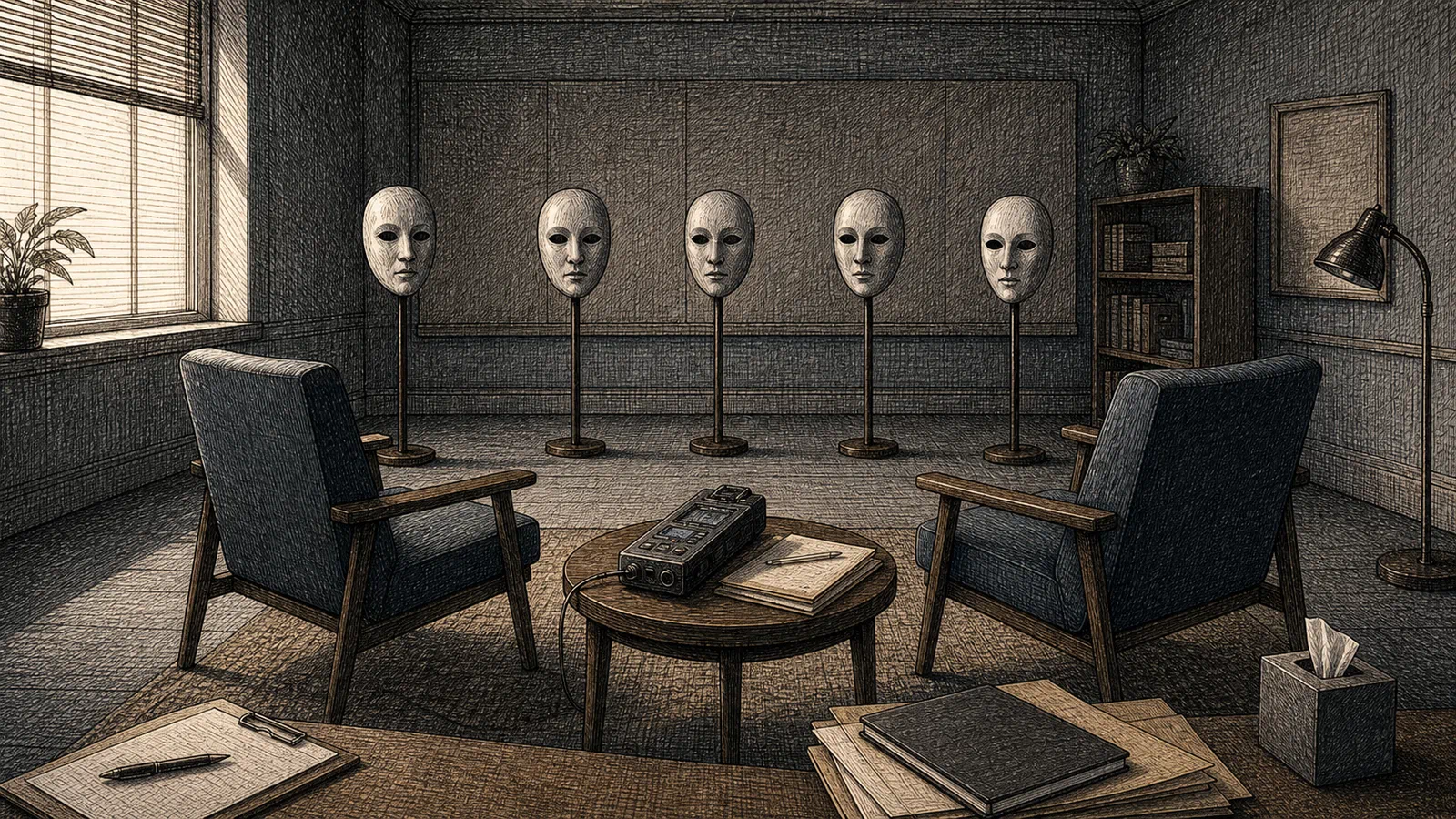
The script did not have to begin as deception. It could begin as a method that rewarded the right answer.
The Boom Behaved Like Fashion
A real condition can be underdiagnosed. A field can miss suffering for decades. Those possibilities do not rescue the multiple-personality boom from the chronology.
Harrison Pope and colleagues tracked scientific publications on dissociative identity disorder and dissociative amnesia across 1984 through 2003. Publications rose out of low 1980s levels, reached a sharp mid-1990s peak, then fell by 2002 and 2003 to about one quarter of the peak. The authors compared that pattern with 25 other diagnoses and found that none showed the same “bubble” pattern. Their conclusion was blunt: the diagnoses appeared to have had a brief period of fashion and did not command broad scientific acceptance. (Karger Publishers )
Individual DID cases remain separate from that publication curve. The narrower point is more useful: professional excitement around the diagnosis behaved less like steady discovery than a fad.
The skeptical psychiatric literature sharpened the point. In 2004, August Piper and Harold Merskey argued that the literature showed no proof that DID results from childhood trauma, that the condition could not be reliably diagnosed, that child cases were almost never reported despite the theory’s childhood origins, and that evidence of iatrogenesis appeared in the practices of some proponents. In the second part of their review, they argued that diagnostic and treatment methods reified alters and encouraged patients to behave as if they had multiple selves. (Sage Journals ) (Sage Journals )
The public was told this was discovery.
The critics were saying it was manufacture.
The Room Becomes A Memory Engine
Recovered-memory therapy supplied the fuel.
The old question was: What happened to you?
The new question became: Who inside you remembers what happened?
That shift changes the room. The patient no longer needs a clear memory. Another self may hold it. The patient no longer needs to believe the scene. Another self may testify. The patient no longer needs evidence. Feeling, imagery, nightmares, bodily sensations, inner voices, drawings, dreams, and therapeutic exercises can all become leads.
This was simpler than a secret conspiracy.
A distressed patient searches for an explanation. A therapist offers a theory. A group or ward rewards fluency in that theory. Popular books and television provide imagery. The patient learns which answers count as progress. The therapist hears those answers and takes them as confirmation.
The lie does not have to begin inside the patient. It can begin inside the procedure.
Lindsay and Read’s 1995 review of memory work made the careful distinction the culture often refused. Childhood sexual abuse is real. Some recovered memories may be true. Memory work can also yield false beliefs. The review described a culture of hypnosis, guided imagery, journaling, dream interpretation, body symptoms, family photographs, survivor groups, self-help books, and therapist encouragement, all used to search for hidden abuse histories. (APA via ResearchGate )
That is where The Courage to Heal belongs in this history: part of the mass-market movement that carried recovered-memory assumptions from clinics and workshops into ordinary homes. Lindsay and Read identified Bass and Davis’s book as one of the central self-help texts in that culture, and noted that many practitioners reported recommending it. (APA via ResearchGate )
By the late 1980s and 1990s, memory work had left the clinic. It had become a genre, a workshop language, a survivor vocabulary, and a way to convert symptoms into suspected biography.
The Satanic Turn
Then the machine found its darkest subject.
Satanic ritual abuse gave recovered-memory therapy a mythology large enough to explain anything. If a patient did not remember cult abuse, the memory had been repressed. If the scenes seemed absurd, that showed how traumatic they were. If there was no physical evidence, the cult was sophisticated. If investigators found nothing, investigators were naive, compromised, or part of the cover-up. If the patient recanted, fear or dissociation explained the recantation.
The claim became almost impossible to falsify because every disconfirming fact could be folded back into the theory.
Michelle Remembers, published in 1980, helped fuse recovered memory with satanic ritual abuse. Lindsay and Read later described Sybil and Michelle Remembers as books that popularized the belief that severe trauma could be hidden from memory and later recovered through therapy. (APA via ResearchGate )
Law enforcement had to deal with the claims in the real world.
In 1992, Kenneth Lanning, a supervisory special agent in the FBI’s Behavioral Science Unit at the National Center for the Analysis of Violent Crime, wrote an investigator’s guide to allegations of ritual child abuse. Lanning said he had first heard satanic and occult child-abuse claims in the early 1980s and had initially tended to believe them. As the claims grew to hundreds of victims, thousands of offenders, and tens of thousands of alleged murders with little or no corroborative evidence, the similarity of the stories became a reason to question them. (Wikisource )
Lanning did not deny child abuse. He said his professional life had been committed to the issue. His point was evidentiary. When allegations had public, legal, and personal consequences, proof had to be stronger. He warned about contagion among intervenors and alleged victims, and about the danger of public hysteria becoming a self-fulfilling prophecy. (Wikisource )
Near the end of the report, Lanning gave the public a standard psychiatry should have kept closer to hand: believe what investigation can corroborate. Until hard evidence appeared, he wrote, the public should not believe claims about baby breeding, baby eating, mass occult murder, or satanic conspiracies taking over daycare centers and institutions. The burden belonged to the people making those claims. (Wikisource )
That report is one of the cleanest records in the entire story.
It separates child abuse from cult mythology.
It separates crime from atmosphere.
Psychiatry did not do that with enough discipline.
Bennett Braun And The Professional Record
Bennett Braun does not explain the whole scandal. No single doctor does.
That is the point.
Braun was a credentialed specialist in a prestigious setting. A reproduced Illinois Department of Professional Regulation complaint identified him as a psychiatrist who represented expertise in psychopharmacology, psychoanalysis, hypnosis, hypnotherapy, dissociative disorders, and multiple personality disorder. It also said he represented expertise in retrieving repressed memories and treating alleged survivors of satanic ritual abuse. (False Memory Syndrome Foundation )
The complaint alleged the mechanism in plain language: assigning personalities, encouraging the development of alter personalities when none existed, using suggestive techniques, using hypnosis and post-hypnotic suggestion, treating MPD as the product of extreme repressed childhood abuse, and telling patients that recovered memories corresponded to historical events. It also alleged failures to disclose the risk that such techniques could create false memories, that MPD was controversial, that the diagnosis might be overdiagnosed, and that improper therapy could cause MPD-like symptoms. (False Memory Syndrome Foundation )
Those were allegations in a disciplinary complaint. They were also a map of the scandal’s method.
Civil litigation made the costs visible. Psychiatric Times reported that an October 1997 settlement totaling $10.75 million ended the Burgus lawsuit against Braun, Rush-Presbyterian-St. Luke’s Hospital, and others. The suit claimed that memories of satanic ritual abuse and other trauma recovered in psychiatric treatment were false and resulted from negligent care over six years. A settlement stops short of a verdict. It remains a record of legal exposure. (Psychiatric Times )
The same account reported that Braun later agreed to a two-year Illinois medical-license suspension, a $5,000 fine, probation, and a promise not to treat patients with dissociative identity disorder during that period. It also included Braun’s side: he alleged that insurers settled against his wishes and maintained the case was defensible. (Psychiatric Times )
Braun is useful less as a cartoon villain than as a professional case record. The record around him shows the system at work: prestigious hospital setting, specialty expertise, hypnosis, recovered memory, satanic abuse claims, alters, litigation, licensing consequences, and then a profession able to treat the case as exceptional instead of diagnostic.

The treatment room did not stay private once memory became accusation.
The Name Change Did Real Work
In 1994, DSM-IV was published after a six-year revision effort involving more than 1,000 people and a broad literature review. DSM-5-TR began development in 2019 and was published in March 2022. Today, the DSM remains the central reference language for American psychiatric classification. (American Psychiatric Association )
The name changed. Multiple personality disorder became dissociative identity disorder.
That change did real work. It softened the theatrical image of a body occupied by separate full persons. It shifted the frame toward discontinuities in identity, memory, agency, behavior, and self-experience. The current APA public page says DID was previously called multiple personality disorder and describes it as associated with overwhelming childhood experiences, traumatic events, or abuse. It lists criteria including two or more distinct identities or personality states, ongoing memory gaps, and distress or impairment. (American Psychiatric Association )
That current description is more careful than the old spectacle.
It inherits the old problem.
A 2021 paper on false-positive and imitated DID states that ICD-10 and DSM-5 do not give clinicians clear enough guidelines to distinguish genuine DID from imitated or false-positive cases with ease. In six false-positive or imitated cases studied, themes included identification with the diagnosis, the explanatory appeal of dissociative parts, learning about DID changing the clinical presentation, discussion of fragmented personality with others, and anger or disappointment when DID was ruled out. (Frontiers )
The same paper warned that people can learn DID symptoms from media, videos, books, support groups, and clinical language, then later report core symptoms convincingly without fully conscious intent to deceive. It also warned that treatment designed for DID can reinforce pathology when used on patients who do not have autonomous dissociative parts. (Frontiers )
That is the afterlife of the scandal.
The script remains teachable.
The patient can learn it.
The clinician can mistake fluency for proof.
The Best Case For The Other Side
The correction cannot become its own stupidity.
Child abuse is real. Trauma can deform memory. Dissociation exists. Some patients experience frightening discontinuities in identity, agency, and recall. None of that rescues the multiple-personality boom. The issue is the reliability of a professional method asked to distinguish memory from suggestion, discovery from rehearsal, clinical metaphor from literal history.
The defenders of DID are not all fools. Their strongest argument should be stated plainly: severe trauma can produce deep dissociation, dissociative symptoms are often missed, some patients have disabling identity fragmentation, and hostile skepticism can leave real suffering untreated.
The International Society for the Study of Trauma and Dissociation maintains adult treatment guidelines for DID. Its 2011 guidelines describe themselves as a synthesis of scientific knowledge and informed clinical practice, with clinical judgment required, and state that they try to present divergent views where the field disagrees. (ISSTD )
The more serious modern literature has also moved beyond the cartoon fight pitting “trauma explains everything” against “culture explains everything.” Steven Jay Lynn and colleagues argued in 2022 that neither the posttraumatic model nor the sociocognitive model gives a satisfactory account of dissociation. They proposed a broader framework involving sleep disturbance, impaired self-regulation, hyperassociation, shifting mental sets, reality testing, source attribution, and metacognition. (Maastricht University )
That is a better frame.
It leaves the central failure intact.
The profession gave the public far more certainty than the evidence could bear. It allowed methods that could shape the symptoms they claimed to discover. It let recovered memory move from therapy rooms into families, courts, police reports, and television with an authority it had not earned. Then, when the most spectacular claims became indefensible, it narrowed the vocabulary and moved on.
The Gaslight Was Procedural
The word “gaslighting” gets used too loosely. Here it names something specific.
Doubt could be treated as symptom. Denial could be treated as repression. Lack of memory could be treated as trauma. Lack of evidence could be treated as cult sophistication. A therapist’s certainty could become the patient’s history. A patient’s new history could become proof of the therapist’s theory.
That was the gaslight. Not one lie told once. A procedure that made resistance useful to the story.
This was not the whole field acting in unison. The dissent was always there. Lanning warned investigators. Lindsay and Read warned about memory work. Piper and Merskey attacked the diagnostic and treatment model. Pope and colleagues later showed that the publication pattern looked like a bubble. The problem was not that nobody knew. The problem was that enough of the profession treated the warnings as secondary while the story spread.
The cultural chain was short enough to fit on one page.
A case history became entertainment.
Entertainment became expectation.
Expectation became diagnosis.
Diagnosis became treatment.
Treatment became memory.
Memory became accusation.
Accusation became public fact before evidence had caught up.
That is the scandal.
Psychiatry has value. Trauma is not fake. Dissociation can happen. The scandal is that professional authority turned a speculative story into a clinical machine, then treated the machine’s output as confirmation.
The old television image was a woman with many voices.
The real image is more ordinary and more frightening: a manual, a therapist’s chair, a patient desperate for an explanation, and a professional story waiting to be spoken.
The Illinois file has the sentence.
Each memory could house a separate personality.
That was the trick: less hidden truth rising cleanly out of the depths than a method teaching the mind where the next voice belonged.