The Rise of Pornography and the Fall of Morality
The obvious connection explained
The pendulum swinging from a stylized depiction of an actual shepherd with his sheep to a neon fueled modern moral hell-scape.
America didn’t vote to become a porn-saturated culture.
It drifted there ~ bit by bit ~ as old guardrails collapsed and the
children of decadence learned how to speak a new moral language.
Porn isn’t merely “speech,” “private taste,” or “just a guilty pleasure.” For many users, it can become compulsive. It can damage trust and intimacy. It trains the mind toward falseness and relational dysfunction.
In the modern digital environment, the market has a coercive edge ~ not because anyone is literally forced to click, but because children and teens are exposed early, often, and long before they can understand what they are seeing. Pornography reaches childhood through porous age gates, platform spillover, and ordinary phone use, so “consensual” doesn’t really seem like a fair description.
At the same time, the moral authority that used to tell Americans what sex was for ~ and what the family was for ~ has been steadily hollowed out.
The old moral story was simple: sex creates children, and families bind societies together. Or at least, that’s what they told us until the sexual revolution of the 60’s and 70’s.
In the moral vacuum that followed, a secular state religion rose in God’s place: an identity-centered moral framework that functions like a public creed across schools, HR departments, media, and professional life. It offers rules, taboos, confessions, heresies, and excommunications. It tells people what they must affirm out loud to be considered decent ~ or suffer the consequences.
Two trends that seem separate ~ porn everywhere and politics-as-morality ~ exist as mirror image symptoms of our collapsing societal foundations.
Humans will always place their faith in something, for no man exists in the void.
When gatekeepers existed, porn was marginalized
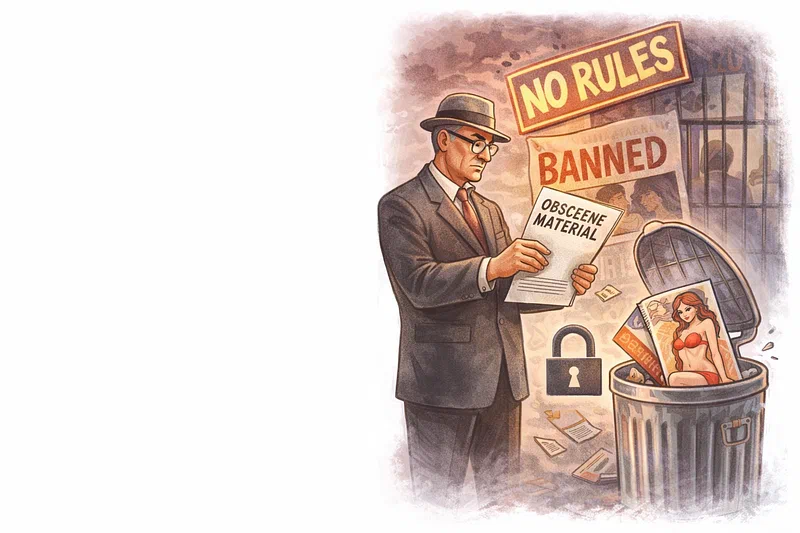
For much of American history, explicit material wasn’t treated as a quirky consumer category. It was treated as corrosive. Law, religion, and social stigma formed a tight net that made the market hard to scale.
The Comstock-era regime is the blunt example people cite: federal law restricted the distribution of “obscene” materials through the mail, and enforcement was serious business.
You can argue that the older regime went too far. Even so, the basic mechanism is straightforward: strong moral gatekeeping makes certain markets expensive, risky, and socially disreputable. Porn existed, but it lived in the shadows.
Then the gatekeepers weakened ~ culturally, legally, and technologically.
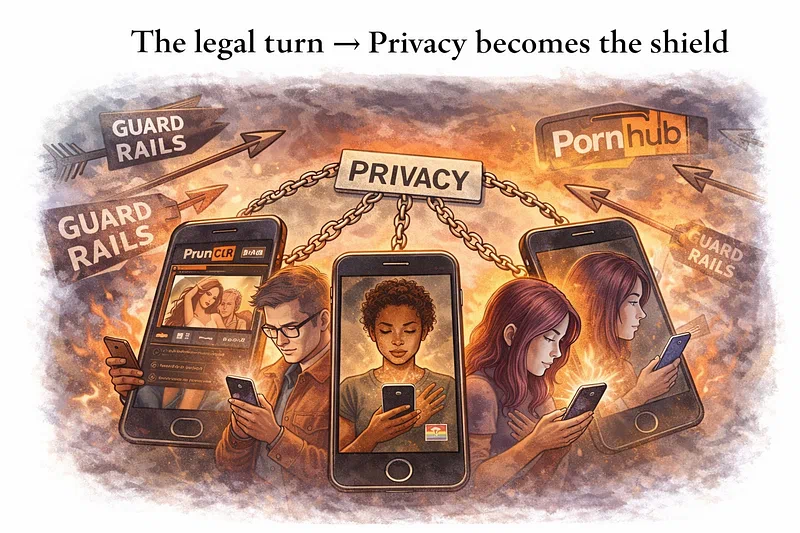
The legal turn ~ privacy becomes the shield
The cultural shift wasn’t just vibes and Woodstock posters.
It was institutional.
In 1969, the Supreme Court ruled in Stanley v. Georgia that a state cannot criminalize the private possession of obscene material. The decision did not create demand, but it strengthened a moral framing that turned out to be decisive: explicit sexual material was increasingly treated as a private matter the public has no standing to judge.
Once that logic becomes normal, stigmas fade, enforcement becomes harder, and distribution gets easier.
Then the internet shows up, and the scale “problem” gets solved.
Smartphones made porn an ambient environment
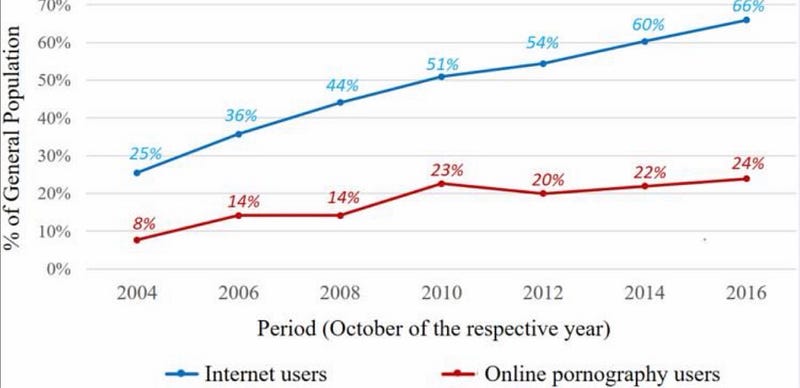
Porn used to require effort: a theater, a magazine, a store, a VHS, a desktop computer in a shared room. The phone erased effort. Porn became frictionless, private, portable, and cheap.
The old adult compromise ~ “do what you want, just keep it away from children” ~ is pretty hard to take seriously in the smartphone era.
Common Sense Media’s nationally representative survey reported that 73% of teens ages 13 - 17 had seen pornography online, and 54% reported first exposure by age 13. The report also notes that some teens encounter it by age 10 or younger.
Daniel Cox at the Survey Center on American Life summarizes the modern reality in plain terms: young people are exposed earlier, and spend more time watching porn than prior generations.
That’s where “coercive” enters the conversation. Not in the dramatic sense ~ more of an environmental sense. A market that predictably reaches children through default exposure is not operating inside a clean adult-only consent framework, even if it tells itself it is.
The decline of Christian moral authority
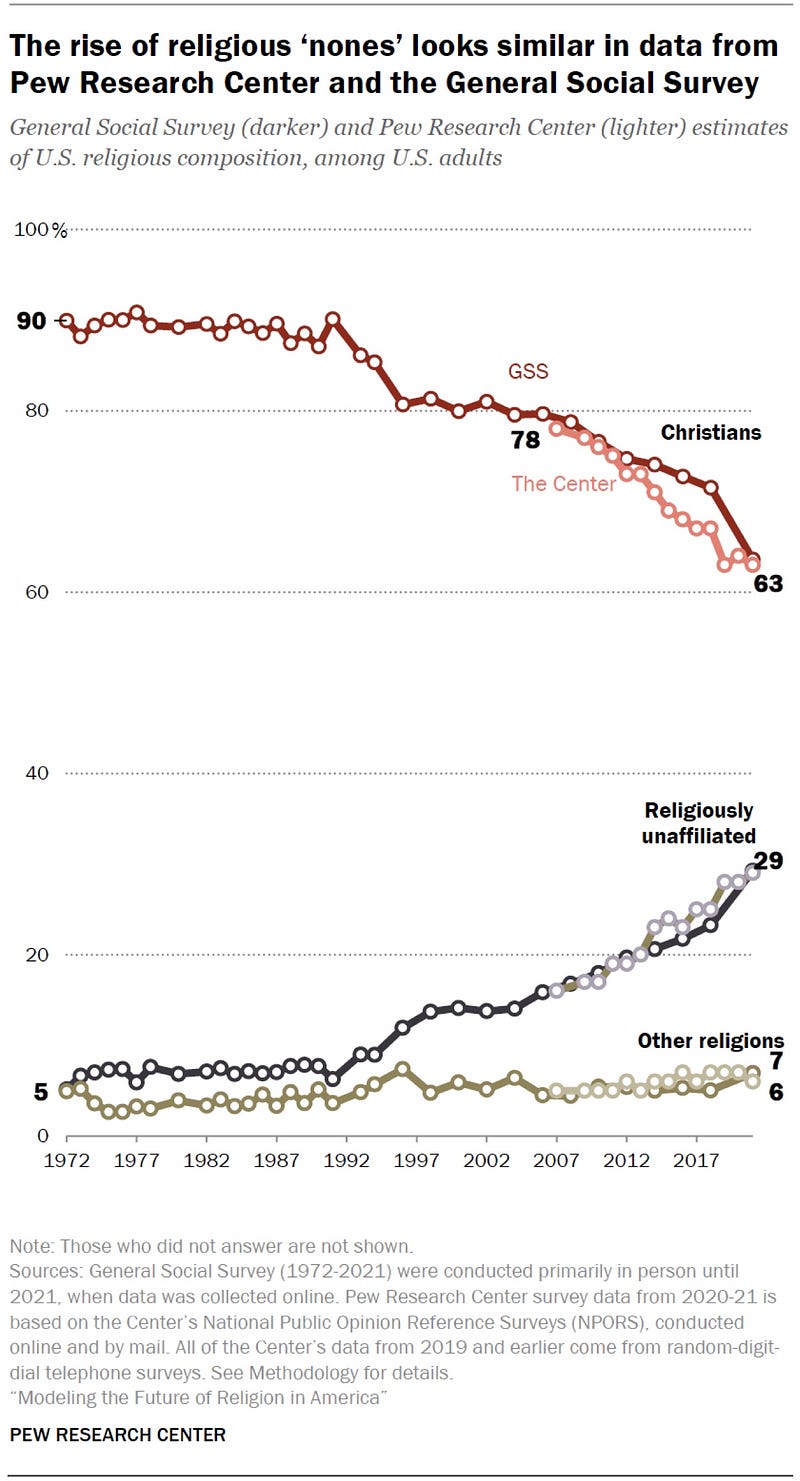
As porn access became effortless, Christian identification and institutional religious participation fell hard.
Pew’s long-run view is striking: as recently as the early 1990s, about 90% of U.S. adults identified as Christian. Today, it’s about two-thirds, driven largely by people leaving the religions they were raised in. Pew’s newer reporting suggests the decline may have slowed since 2020, but at a much lower level than the mid-century norm.
Gallup documents a related milestone: U.S. membership in a church, synagogue, or mosque fell below 50% in 2020 (47% in their series), after hovering near 70% for decades.
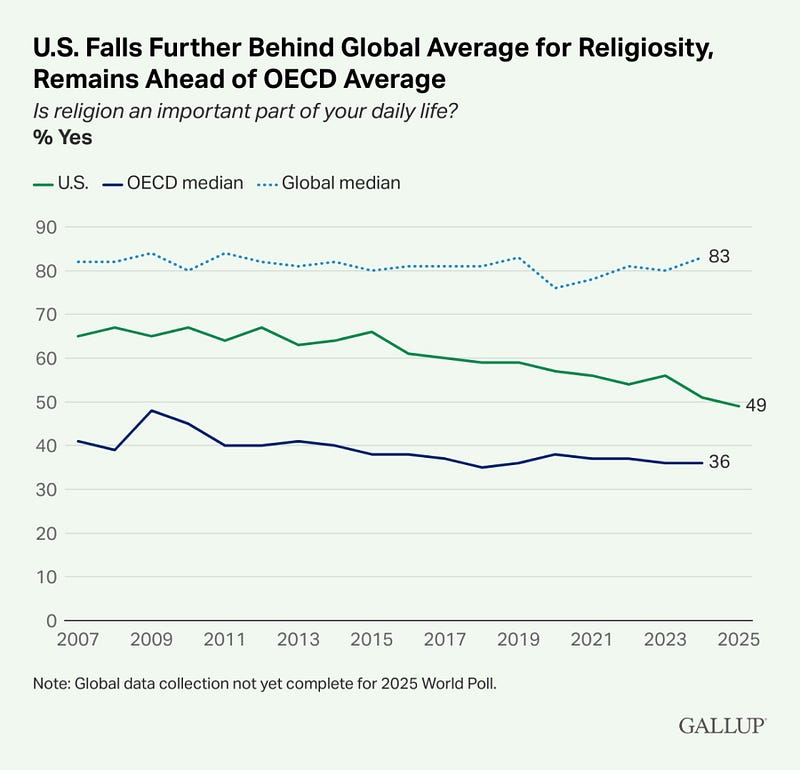
So what fills the gap when a culture stops sharing a thick moral vocabulary about sex, duty, restraint, and family?
It doesn’t become morally neutral. It becomes morally reorganized.
The modern secular state religion ~ moral imperatives without God
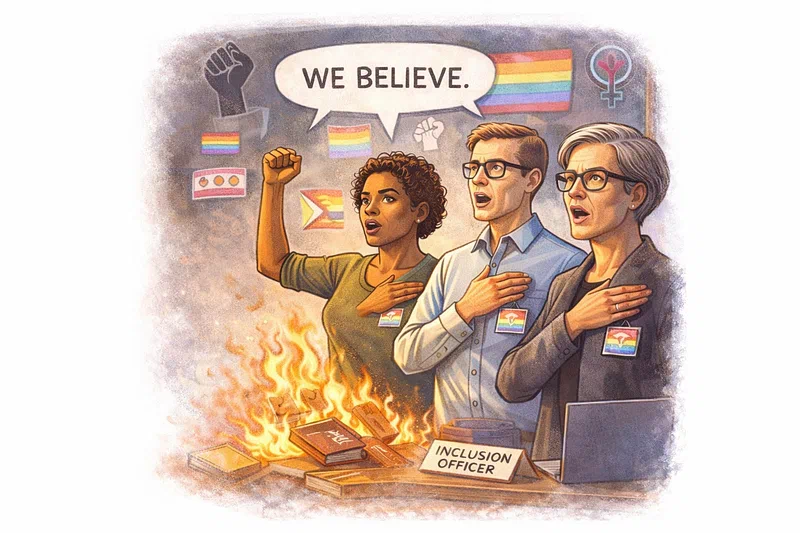
Call it “woke,” “identity politics,” “DEI,” or “the new orthodoxy.”
Labels are the least interesting part.
The structure of belief is as old as humanity itself.
A secular state religion functions like dogmatic faith without admitting it. They have dogmas, taboos, rituals, purity tests, and punishments. State religion offers a moral calendar. It sorts people into innocent and guilty categories. It treats dissent as moral contamination rather than good-faith disagreement.
John McWhorter’s framing is useful precisely because he’s not preaching from a pulpit. In his discussion of Woke Racism, he describes modern antiracist activism as “not a progressive ideology, but a religion,” complete with “original sin,” heresy, and punishment for dissent.
That doesn’t mean every person who supports social justice causes is a zealot. It means our public moral language increasingly acts like a creed that institutions enforce.
Now pair that with a porn-saturated consumer culture, and you get a strange mix:
- Private appetite becomes harder to restrict in practice, even for minors, because restriction reads as “judgmental” or “prudish.”
- Public speech becomes easier to restrict in elite settings, because restriction signals moral seriousness.
One side of the moral ledger says “don’t police desire.” The other says “police language.” That combination does not produce cohesion.
It produces fragmentation.
Family life is social infrastructure
A culture can survive a lot.
But no society can survive the steady, intentional erosion of its most basic bonding mechanisms.
Marriage, stable two-parent households, and shared moral norms are not quaint traditions. They are the very fabric of our social infrastructure.
When they weaken, people don’t become “freer.”
They become more isolated, anxious, and dependent on substitutes ~ often online, tribal, and brittle.
Divorce trends are complicated (rates peaked around 1980 and have fallen since), and fewer people marry now, which changes how people interpret the numbers. The National Center for Family & Marriage Research captures the long-run pattern: a big rise across the 20th century, then decline in recent decades.
Porn sits in that story as one of many contributing factors. It is not a single-cause explanation for family breakdown. Even so, the association with relationship instability should not be dismissed.
In a longitudinal study using U.S. panel data, Samuel Perry found that pornography use among married Americans was associated with an increased likelihood of marital separation, with a more complicated pattern at the highest frequencies.
Even if you reject porn as a causal driver, it’s hard to deny it can train expectations and habits that undermine intimacy ~ especially when it becomes a frequent private routine and an early formative exposure.
The same family-data record also shows a long rise in the average age at first marriage in the United States.
The warning ~ fragmentation is the real risk
A society can’t run indefinitely on two contradictory principles:
- First: desire is private, untouchable, morally off-limits to judge.
- Second: speech is public, punishable, morally mandatory to affirm.
When porn becomes ambience, kids are exposed early, relationships weaken, and community trust thins out, people don’t become calm libertarians. They become anxious and atomized.
They look for belonging. They become susceptible to totalizing movements. They treat politics as salvation and others as infidels.
That’s the long-run risk: not porn, not the ideologies, but full-on institutional moral theater and the social breakdown it can produce.
What do we do when a fourteen-year-old has seen more explicit content than any prior generation has in their whole lives, and the adults around them can’t even agree on whether that is a crisis or something that should be protected???
That’s the moral vacuum. Vacuums get filled.
Institutionalized moral theater ~ enforced and detached from shared humanity ~ is a sad way for the West to crumble. If Christian moral leadership loses the ability to speak plainly about appetite, restraint, family, and human dignity, the vacuum will not remain empty.
Sources
- Pew Research Center ~ “How U.S. religious composition has changed in recent decades” - https://www.pewresearch.org/religion/2022/09/13/how-u-s-religious-composition-has-changed-in-recent-decades/
- Pew Research Center ~ “Decline of Christianity in the U.S. has slowed…” - https://www.pewresearch.org/religion/2025/02/26/decline-of-christianity-in-the-us-has-slowed-may-have-leveled-off/
- Pew Research Center ~ “Religion holds steady in America” - https://www.pewresearch.org/religion/2025/12/08/religion-holds-steady-in-america/
- Gallup ~ “U.S. Church Membership Falls Below Majority for First Time” - https://news.gallup.com/poll/341963/church-membership-falls-below-majority-first-time.aspx
- Common Sense Media ~ “Teens and Pornography” (press release) - https://www.commonsensemedia.org/press-releases/new-report-reveals-truths-about-how-teens-engage-with-pornography
- Common Sense Media ~ “Teens and Pornography” (report) - https://www.commonsensemedia.org/research/teens-and-pornography
- Survey Center on American Life (Daniel Cox) ~ “The Pornography Problem” - https://www.americansurveycenter.org/newsletter/the-pornography-problem/
- Columbia News ~ McWhorter on ‘woke racism’ - https://news.columbia.edu/content/woke-racism-how-new-religion-has-betrayed-black-america
- Justia ~ Stanley v. Georgia (1969) - https://supreme.justia.com/cases/federal/us/394/557/
- NCFMR (BGSU) ~ “Divorce: More than a Century of Change, 1900-2018” - https://www.bgsu.edu/ncfmr/resources/data/family-profiles/schweizer-divorce-century-change-1900-2018-fp-20-22.html
- PubMed ~ Perry (2018) on pornography use and marital separation - https://pubmed.ncbi.nlm.nih.gov/28936726/