Public vs Private Pay: Who Really Earns More?
Jobs, Benefits, and Work-Life Trade-Offs Across Sectors
The government can’t outbid Silicon Valley for engineers, but it will pay a school custodian a whole lot more than a hotel would pay a maid.
The custodian at your local public school probably makes more ~ per hour, with benefits ~ than the guy who just cleaned your hotel room.
It’s not because one job is easier or harder. It’s because one of them has a union, a pension, great health insurance, and a predictable schedule.
The other has $2 and some change in their pocket.
Salaries.
Labor rates.
Wages.
We talk about getting paid like it’s just money in the bank ~
but the deal you strike with your employer is bigger than your paycheck.
Wages, benefits, expectations, and culture all shape your standard of living.
That’s why comparing public and private sector pay is tricky.
We pulled federal data from the Bureau of Labor Statistics to estimate total compensation across jobs and sectors.
The results show that government jobs often beat private ones ~ but not always where you’d expect.
This piece looks at where, why, and how the differences in pay, benefits, and lifestyle add up.
Pay isn’t just wages; it’s the whole package.
Job-by-Job: Public vs Private Pay Compared
Let’s stack up a few familiar jobs side by side.
- Teachers: A public K-12 teacher makes more than a private school teacher. Not just in salary ~ the pension and health insurance bump that advantage even further. If you’re eyeing a teaching career, this is why public schools attract and keep more talent.
- Nurses: Many government-employed nurses work for VA hospitals or county systems. The paychecks are bigger, and the retirement packages can be generous. For nurses, public often beats private.
- Engineers: Civil engineers in the public sector edge out their private peers in wages, and benefits push them further ahead. But the higher up you go in private firms ~ especially in tech or energy ~ the golden handcuffs of bonuses and equity start to outweigh the public advantage.
- Economists: The private sector pays better, especially in finance and consulting. Federal agencies compete decently, but state and local economist jobs usually trail far behind.
- Maintenance Workers: This is the clearest divide. Custodians and maintenance crews on the public payroll earn more in base pay and enjoy far more reliable benefits.
Of course, nobody picks a career based on one comparison chart.
Individual jobs only tell part of the story.
Take a step back and sector-wide patterns emerge.
Sector-Wide Pay Patterns: Education, STEM, Healthcare, Service
Widen the lens, and you see consistent patterns.
- Public-sector workers dominate in education, healthcare support, and service jobs.
- Private-sector workers excel in high-end professional and executive roles.
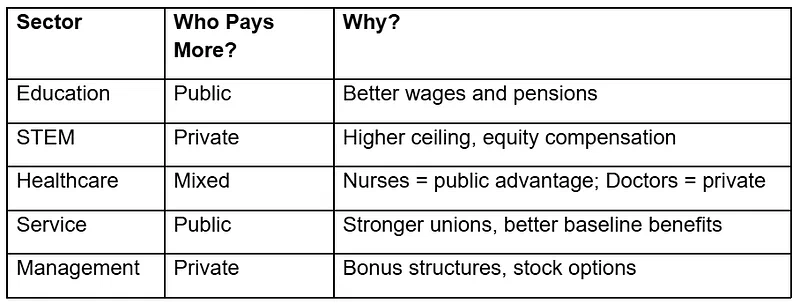
The structure of compensation matters.
Public jobs lean toward predictable salaries and long-term security.
Private jobs offer greater upside and volatility, often with fewer safety nets.
Take three snapshots:
- Nurses: A VA hospital nurse might out-earn a private hospital nurse, thanks to higher wages and guaranteed retirement. But the doctor down the hall is almost always better paid in private practice.
- Engineers: A civil engineer at a state DOT will likely earn less than a software engineer in Silicon Valley. But when you add in pensions, healthcare, and stability, the public-sector engineer may end up more secure over the long haul.
- Custodians: The custodian at the county courthouse usually makes more ~ and has stronger benefits ~ than the custodian at a chain hotel. The difference isn’t skill or effort; it’s the public sector’s wage floor and access to unions.
Some say that split ~ education vs STEM, public vs private ~
misses something even bigger.
The real divide in American work is between blue-collar and white-collar jobs.
Blue-Collar vs White-Collar Pay: The Real Divide in Public and Private Work
Zooming out, the patterns show up clearly in the averages.
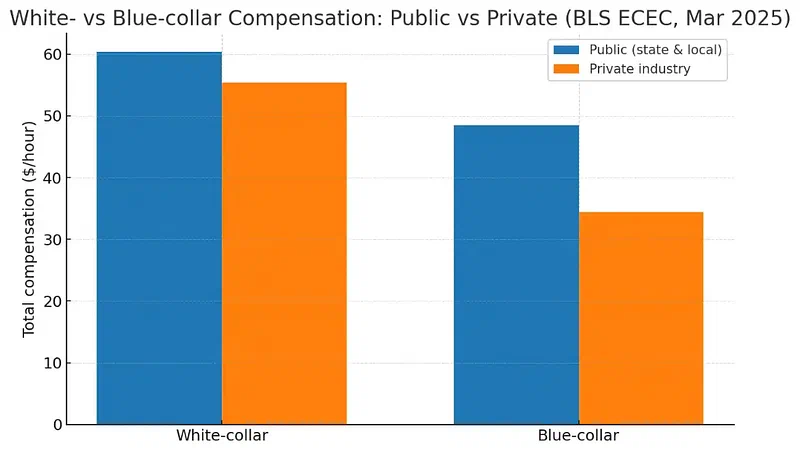
In the author’s BLS-based comparison, government jobs pay far more for blue-collar work, while white-collar pay is closer and leans public in these figures. In elite roles, private compensation often dwarfs public pay. Source: BLS ECEC, March 2025.
Here’s what the numbers show:
Blue-collar workers (custodians, bus drivers, protective service, maintenance crews) earn about $48/hour in the public sector vs $35/hour in the private sector.
The difference is striking ~ government consistently raises the floor with higher wages and more reliable benefits.
White-collar workers (engineers, economists, managers, office staff) average $60/hour in government vs $56/hour in private industry.
That’s a smaller margin ~ and in elite private-sector roles (finance, consulting, tech), the upside can shoot way up ~ far higher than what the government can match.
On average, white-collar government jobs edge out private peers.
But averages hide the extremes:
Elite private-sector jobs in finance, tech, or consulting can pay multiples more.
Blue collar workers earn substantially higher wages in public roles across the board with few exceptions.
This helps explain why people’s experiences feel so different.
A maintenance worker might see government work as the clear winner.
A high performing consultant in private industry might feel the opposite.
Both are right ~ the divide isn’t just public vs private.
It’s blue-collar vs white-collar.
And here’s the thing:
The divide isn’t just about wages.
For both blue- and white-collar workers, the kicker is how much of their pay comes in the form of benefits.
A custodian might be better off in government not only because of higher wages, but also because of a pension and health insurance. An economist in the private sector might get a big salary bump, but far less in guaranteed retirement, health insurance benefits, and paid time off.
Which raises the next question:
What actually counts as “pay”?
Wages vs Benefits: What Counts as Pay?
Paychecks only tell part of the story.
The real differences between public and private jobs show up in benefits.
- Public workers give up some cash wages but gain far more in guaranteed benefits.
- Private workers take home a larger paycheck, but the benefits package is thinner and often riskier.
Some public workers get a smaller paycheck ~ but a bigger bag overall.
- Public Sector ~ 62% wages, 38% benefits
- Private Sector ~ 71% wages, 29% benefits
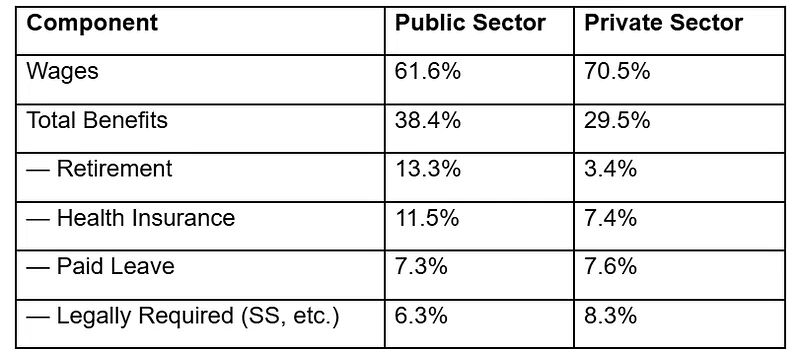
For many state and federal employees, retirement isn’t just a 401(k) match ~ it’s a defined pension. That can mean decades of guaranteed income.
Private workers, meanwhile, tend to get more up front in salary and may chase bonuses, stock options, or equity ~ which can swing high or low.
In other words,
Public jobs trade cash for long-term security.
Private jobs trade stability for immediate upside.
The percentages in the table might feel a bit abstract ~ until you see how they shape real careers.
Job Trade-Offs: Stability vs Upside in Public and Private Sectors
At the end of the day, life (and your career) is about more than just numbers.
A public-school teacher trades a higher salary for the chance at early retirement and summers off.
Engineers may start ahead in government roles, but the private sector offers steeper raises, bonuses, and equity if they’re willing to chase them.
Nurses in public hospitals usually earn more stable pay and retirement benefits than their private counterparts, though high-demand specialties tilt private.
Custodians and maintenance crews almost always do better in public work ~ higher wages, pensions, and unions all do a lot to tip the scales.
For many, the public sector means slow, steady hours, union protection, and the promise of a safe retirement.
For others, the private sector offers fast promotions and higher ceilings, but also the risk of layoffs, burnout, or benefit cuts.
That’s why the answer to “who gets paid more?” is so tricky.
It’s not just about today,
it’s also the promise of tomorrow.
The Bottom Line: Public vs Private Pay Isn’t One-Size-Fits-All
- Public-sector jobs offer more security and stronger benefits.
- Private-sector jobs offer higher upside with more risk.
The trade-off isn’t just economic ~ it’s structural.
So when people ask “Who gets paid more ~ private or public workers?”
The work, the balance, the money, the risk… it’s all relative.
The only real answer is:
It depends ~
What kind of life are you trying to build?
Sources
- U.S. Bureau of Labor Statistics, Occupational Employment and Wage Statistics (OEWS) → https://www.bls.gov/oes/
- BLS Employer Costs for Employee Compensation (ECEC) → https://www.bls.gov/ncs/ect/
- Congressional Budget Office → https://www.cbo.gov/
- Economic Policy Institute → https://www.epi.org/