Save Some Air for the Fishies
A new global study of river oxygen turns heat, runoff, dams, and ordinary water rules into one public question: how much life can a warmer river carry?
The Meter At The Bank
A river can look alive after it has begun to lose breath.
The surface can shine. The trees can lean over it. The bridge can cast the same afternoon shadow it cast last summer. A person standing on the bank may notice nothing except heat, glare, and slower water. The change appears first as a number: milligrams of dissolved oxygen per liter, recorded by a probe lowered into the current.
That small number now carries a large warning. A new study in Science Advances , reported Friday by The Associated Press , found that oxygen levels in rivers worldwide have declined on average since 1985. The researchers used satellite data, field measurements, climate records, and machine learning to estimate dissolved oxygen across more than 21,000 river reaches. The average decline was about 2.1 percent.
Two percent sounds like bookkeeping. In water, margin can be habitat. Fish, insects, mussels, microbes, and the whole working metabolism of a river depend on dissolved oxygen. The number does its civic work quietly. It tells a farmer, a sewer operator, a stormwater engineer, a dam manager, and a fisheries biologist how much room the river has left before ordinary stress becomes a biological failure.
The study’s central claim is plain enough: many rivers are losing some of that room.
What Water Can Carry
Dissolved oxygen is not scenery. It is a condition of life inside the water column.
The U.S. Geological Survey explains dissolved oxygen as oxygen gas held in water and available to aquatic organisms. Cold, turbulent water usually carries more. Warm, slow water carries less. When algae and organic waste decay, bacteria consume oxygen as they break that material down. The river then has to absorb oxygen again through contact with the air, turbulence, plants, and mixing.
Heat changes that balance at the base. Warmer water has lower oxygen capacity. Hot weather also speeds up biological activity. A river under heat stress can hold less oxygen while organisms and decay processes demand more of it.
The research team described both forces. A Chinese Academy of Sciences summary of the study says warming water explained nearly 63 percent of the observed deoxygenation, while heat waves accounted for about 22.7 percent. Other pressures included dams, flow alteration, runoff, and pollution.
That distribution is useful because it resists a lazy story. Climate warming is the largest pressure in the study, yet the local damage often arrives through local systems: fertilizer washed off fields, stormwater pushed through pipes, sewer overflows, reservoirs that slow water, and permits written for rivers with older temperature patterns.
The oxygen meter sees all of it at once.
Heat Meets Runoff
Low oxygen has a way of turning separate policy files into one river.
A city may treat stormwater as a drainage problem. A farm may treat fertilizer as a yield problem. A wastewater utility may treat nutrients as a plant-upgrade problem. A dam operator may treat release schedules as power, flood, or storage management. A climate plan may sit in another office entirely. In the river, those files meet as physics and biology.
Nutrient pollution is one familiar path. The Environmental Protection Agency describes excess nitrogen and phosphorus as fuel for algal growth. When algae die and decompose, oxygen can fall. In a warmer river, the same nutrient load may carry a sharper biological cost because the water begins with a smaller oxygen margin.
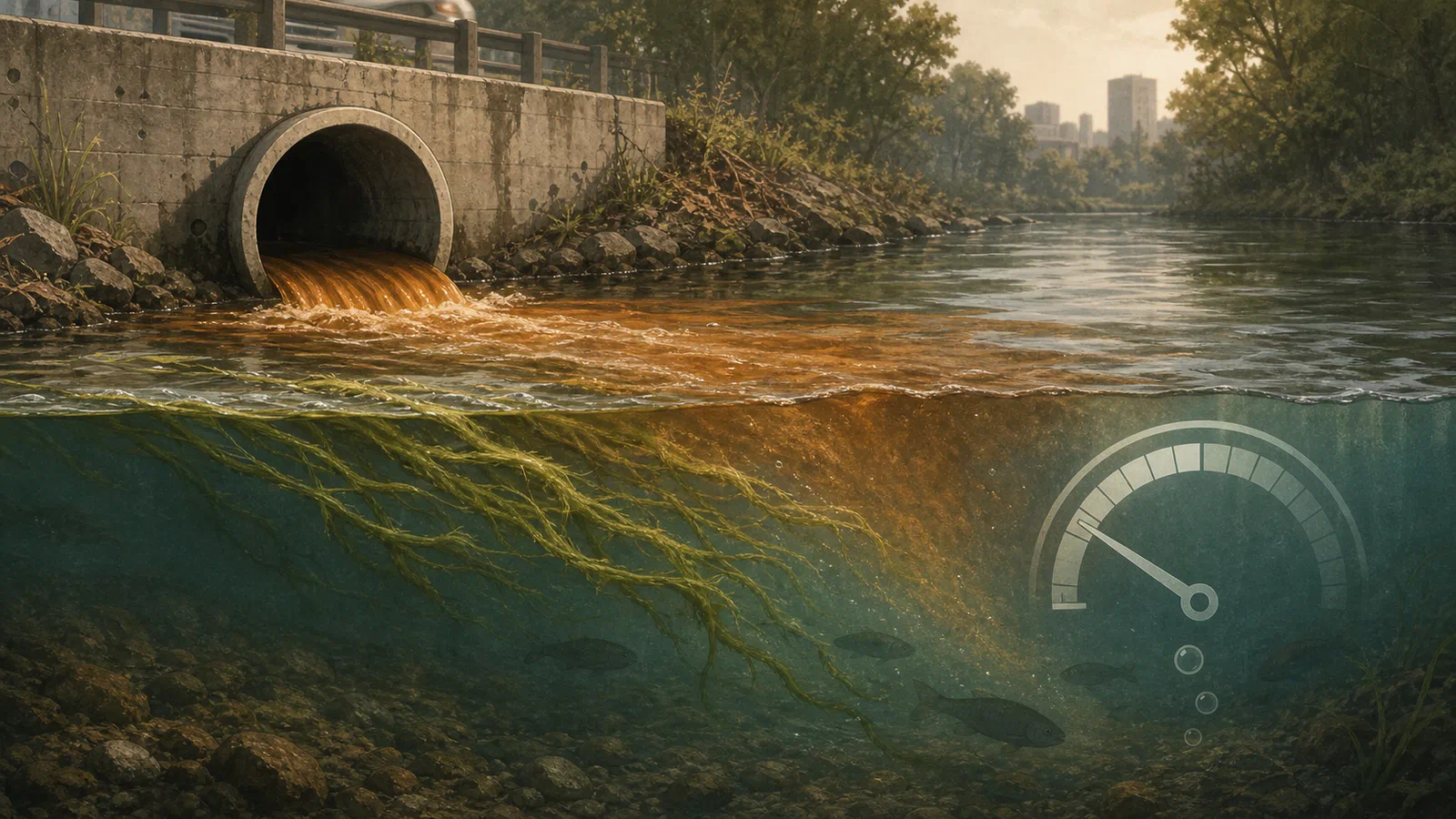
Runoff, heat, and slow water meet as a single oxygen problem.
That is the public difficulty. Many water rules were built around visible inputs: a pipe, a discharge, a numeric permit limit, a treatment plant, a farm practice, a storm drain. Oxygen loss turns the question toward capacity. How much can this river absorb under today’s heat? How much margin will it have during the next heat wave? Which upstream decision uses up the last cushion for life downstream?
No single actor owns the whole answer. The farmer cannot cool the summer. The city cannot undo regional warming with a pipe upgrade. The dam manager cannot erase nutrient loads with a release schedule. The state permit writer cannot replace a river’s lost oxygen by editing a spreadsheet. Each actor can shift part of the burden, and each has an incentive to describe its own part as small.
The river has no separate accounting department. It receives the sum.
A Water Quality Problem With A Calendar
The study’s time frame gives the warning its weight. The researchers looked at a period long enough to cross ordinary political cycles, local capital plans, and utility bond schedules. Since 1985, water treatment plants have been upgraded, farming practices have changed, suburbs have expanded, dams have aged, monitoring technology has improved, and global temperatures have risen. The record combines policy effort and physical pressure.
That combination should make the story harder, not easier.
Cleaner wastewater, better nutrient control, restored riparian shade, floodplain work, and smarter dam operations can help. The study also cautions against treating past water-quality gains as permanent property. A river can receive better management and lose oxygen margin because the baseline changed.
That is a hard message for public agencies. Most infrastructure programs are designed around budgets, compliance deadlines, and visible projects. A river’s oxygen budget follows weather, flow, chemistry, shade, and biological demand. The political calendar asks if a rule passed, if a grant arrived, if an agency checked the box. The river answers with temperature and oxygen.
Here the tradeoff becomes practical. Tighter nutrient controls can cost farms, utilities, developers, and households money. Larger buffers can limit land use. Dam releases can conflict with storage, power, recreation, or flood management. More monitoring means staff, equipment, and maintenance. A serious water policy cannot pretend those costs vanish.
It also cannot place every cost downstream by default.
The River As Public Works
Water infrastructure usually appears as concrete: a treatment plant, a culvert, a dam, a levee, a pump station, a pipe under a street. A river’s oxygen margin is infrastructure of another kind. It is the working condition that lets public and private systems use the water without exhausting it.
When that margin thins, public life receives the bill in scattered forms. Fish kills are the visible failures. Other costs arrive quietly: reduced habitat, shorter safe recreation windows, taste and odor problems for drinking-water systems, emergency monitoring, pressure on hatcheries, conflicts over releases, and tougher permit decisions. A community may learn about river oxygen only after a hot week forces every upstream choice into view.
This is why the global map in the Science Advances study is more than a scientific illustration. It points toward the places where ordinary public administration may have to adjust. A river basin that once managed nutrients under one temperature regime may need a different margin. A wastewater plant designed for an older baseline may face new performance pressure. A reservoir release plan may need to account for downstream oxygen as heat waves become more punishing.
The most honest version of the story leaves room for local variation. The study is a global estimate. A site-specific permit file does different work. Some rivers may improve because pollution controls work, flows recover, or local management gets sharper. Some may decline faster because heat, nutrients, low flow, and dams stack up. The paper supplies a direction of pressure, then local evidence has to do the rest.
That uncertainty should lead to better measurement, not easier dismissal.
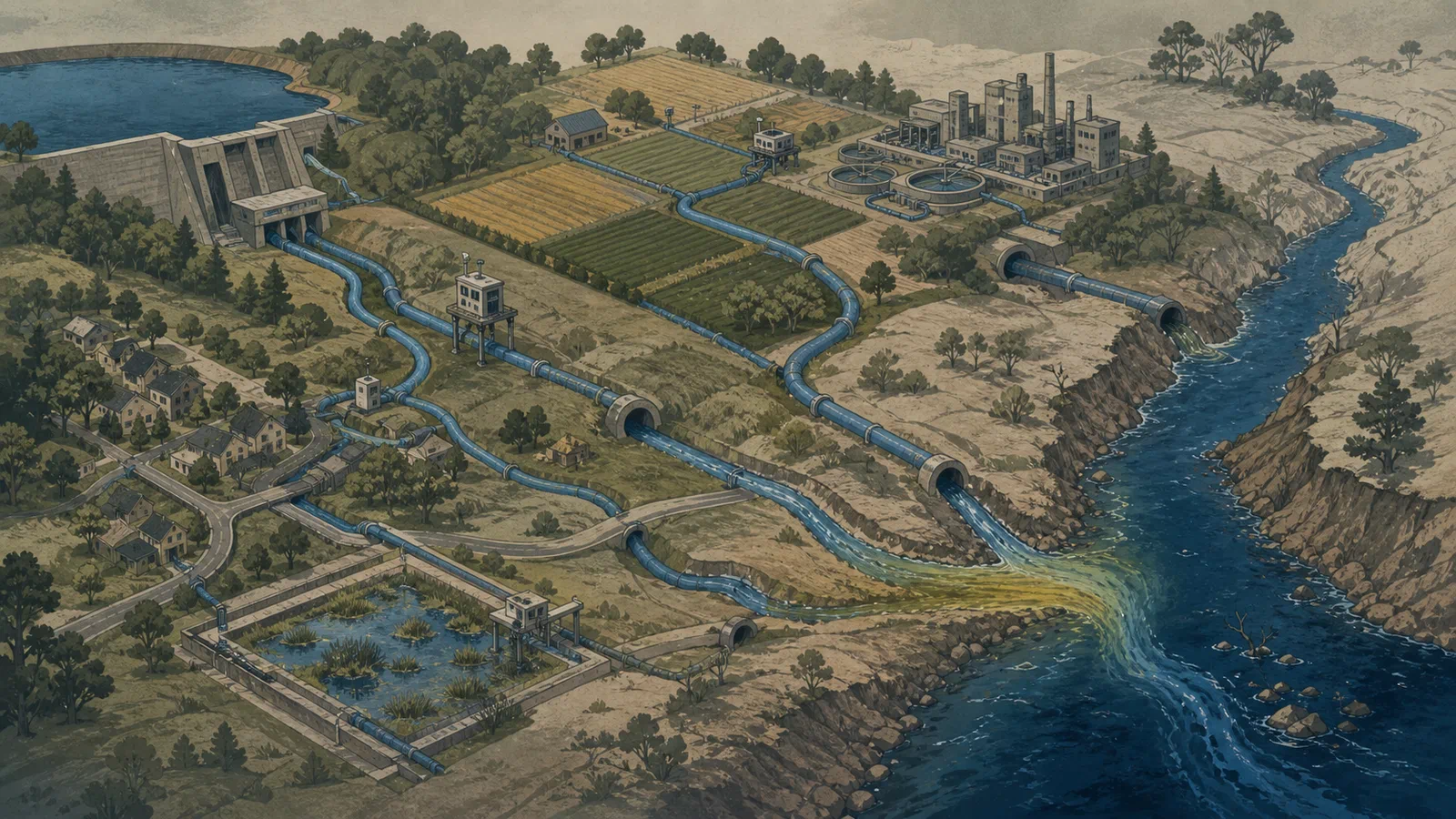
A river’s oxygen margin is built or spent across the whole basin.
The Quiet Failure
The public imagination understands dirty water when the dirt is visible. Oil on the surface, sewage in the street, dead fish by the bank, a sign warning people away. Oxygen loss is harder. It can begin in clear water. It can travel as a decimal. It can hide inside hotter nights, slower flows, heavier algae, and one more permit exception.
That makes it a useful test of public seriousness. A community that waits for spectacular failure will find the river late in the process. A community that measures margin can act while the water looks ordinary.
The new study does not hand anyone a simple villain. It gives a harder assignment: treat rivers as living public systems whose capacity can be spent by heat, runoff, dams, land use, and delay. The work is technical, local, and costly. It asks for monitoring before crisis, investment before collapse, and enough humility to admit that old baselines may no longer describe the water in front of us.
The probe at the bank is not dramatic. It lowers into the current, waits, and returns a number.
The question is what the public will do before that number reaches the point where the river can no longer carry the life it seems to promise.