Standard of Living vs. Quality of Life: What the Numbers Miss
GDP is UP… So Why Does Life Still Feel So Hard?
When old metrics no longer match real life experience, it’s time to change the way we measure success.
What Even Is the Standard of Living?
“Raising the standard of living” might be the most recycled promise in modern American politics.
Presidents say it. Think tanks measure it. Journalists cite it.
But stop and ask yourself: what does the standard of living actually mean?
Is it about income? Owning a home? Access to healthcare?
Or is it something softer: feeling safe, optimistic, and at ease in your life?
For most of us, it’s all tangled together.
You can have the newest iPhone and still feel broke. You can earn more than your parents did and still feel like you’re behind.
That tension, between the numbers we hear and the lives we live, is at the heart of this story.
So let’s break it down.
What is the standard of living?
How has it changed?
And why does it so often fail to capture how we actually feel about our lives?
How Economists Measure Standard of Living
Economists define standard of living in relatively simple terms: the level of material comfort a person or group enjoys.
That means income, housing, goods, services, education, healthcare, and the whole package of “stuff you can afford” and “conditions you live in.”
The most common shorthand? GDP per capita, or how much economic output the country generates divided by its population. In theory, more output means more income, which means people can buy more and live better.
But here’s the catch: averages can hide a lot.
Take real median household income, a more grounded metric that shows what the typical household earns, adjusted for inflation.
Compare that against real per capita GDP.
They should move together, but they do not move together cleanly.
Source note: FRED Series ID MEHOINUSA672N.
Since the 1980s, GDP per capita has climbed more steadily than real median household income. The gap reveals a basic distribution problem: economic growth does not automatically translate into gains for the typical family.
Yes, there are ups and downs. But for all the talk of progress, many American families do not feel much more secure than they were a generation ago.
That’s not how it is supposed to work.
When the Stats Say You’re Winning
On paper, the United States is one of the richest countries in the world.
Our GDP is huge.
Our homes are bigger than ever.
Our shelves are stocked with cheap electronics and endless options.
So then how and why does life still feel hard?
The answer is that standard of living, as it is traditionally measured, does not account for how people actually experience their lives.
It does not factor in whether:
- You’re working 55 hours a week just to stay afloat.
- You feel anxious or depressed more days than not.
- You can’t afford to take a sick day or pay for child care.
- You rarely feel rested, safe, or socially connected.
That’s where the term “quality of life” comes in, a broader, more human-centered concept.
It includes the material side of living, but also looks at things like:
- Mental and physical health
- Time for family and leisure
- Community and social support
- Personal autonomy and life satisfaction
The U.S. ranks near the top in GDP per person, but lower on many happiness and well-being measures.
Source note: General Social Survey data cited in the 2019 World Happiness Report.
Despite economic growth, self-reported happiness among U.S. adults has not kept pace with rising output. That suggests quality of life, as lived and felt, cannot be reduced to production totals.
The message is clear:
Economic output is not the same thing as personal well-being.
Why the Rising Tide Hasn’t Lifted All Boats

Wealth is growing, but not for everyone.
We’ve all heard the phrase: “A rising tide lifts all boats.”
For decades, that was the promise of economic growth.
Grow the economy, and everyone benefits.
But the data tells a different story.
Since the late 1980s, U.S. household wealth has grown dramatically. But that growth has not been evenly shared.
The top slice of households controls a disproportionate share of wealth. The bottom half holds only a small share.
This isn’t a bug in the system.
It is the system working through assets. Wealth in the U.S. grows fastest not through wages, but through ownership: homes, stocks, and businesses. If you do not already have those things, you are not riding the wave in the same way.
Inequality like this reshapes lives. It determines:
- Who can retire with dignity.
- Who can weather an emergency.
- Who gets to pass something on, or start from scratch.
If we only look at averages, the country looks wealthier than ever. But if we care about how people are actually living, not just how much wealth exists, we need to start paying more attention to the distribution.
A rising tide only lifts the boats that are seaworthy.
How Misreading Living Standards Warps Policy
When we misunderstand standard of living, we misread the health of the country.
We assume the economy is strong just because GDP is rising. We assume people are better off just because they own more stuff.
But the numbers can mislead.
Here is the reality many Americans are living:
- They are stressed. Gallup has found high reported stress among U.S. workers.
- They are lonely. Surveys continue to show deep social isolation.
- They are struggling mentally. Depression diagnoses and suicide concerns have become more visible public-health problems.
- They are unwell. U.S. life expectancy has moved unevenly since its mid-2010s peak, with a severe COVID-era decline and only partial recovery afterward.
Source note: Gallup and KFF survey data.
If we only measure progress by income or GDP, we miss the point. We miss the fact that progress has stopped feeling like progress for a lot of people.
That affects more than just people’s moods.
It shapes politics, culture, and trust in institutions. If people feel like they’re doing everything right, working hard and staying afloat, and they still feel worse off, eventually they stop believing the system works.
Quality of Life: The Better Yardstick
It’s time to update the vocabulary.
Standard of living still matters. We need ways to measure material well-being: whether people can afford homes, food, healthcare, or time off.
But it is not enough.
We need to make room for quality of life as a central idea. Not a fuzzy afterthought. A core metric.
Some countries already do this. The OECD’s Better Life Index, for example, looks at things like:
- Health
- Education
- Environmental quality
- Work-life balance
- Social support
- Safety
- Civic engagement
- Life satisfaction
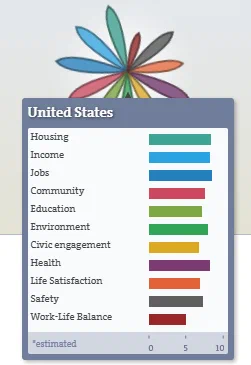
Source note: OECD Better Life Index.
Some states have experimented with alternatives like the Genuine Progress Indicator , which adjusts for inequality, pollution, and unpaid care work.
Even just tracking median net worth, instead of the average, would offer a clearer view of how regular people are doing.
The change we need is cultural.
America needs to change the way we talk about success.
Moving away from “more is better” to “better is better.”
Moving from quantity of life to quality of life.
Conclusion: We Don’t Just Need More
So where does that leave us?
The American standard of living is high by global averages, by historical standards, and by the number of gadgets in your home. But for many, it no longer feels like it. It feels fragile. It feels like a treadmill.
It feels like a game where the rules are always changing and the goalposts keep moving.
That’s because our measures of progress stopped telling the whole story.
We’ve been tracking the wrong things, or at least incomplete things.
Income without security. Output without rest. Access without time.
Growth without balance.
It is not enough to make the economy bigger if it doesn’t make our lives better.
It is not enough to grow if we grow exhausted.
This isn’t just a measurement problem. It’s a moral one.
Maybe what we really want isn’t a higher standard of living, but a better quality of life. Not just higher numbers, but deeper satisfaction.
A life that feels sustainable, connected, and human.
That might not fit neatly into a spreadsheet, but that’s okay.