The AI Data Center Wants Its Own Power Plant
The race to build AI at industrial scale is no longer just a story about chips and models. It is becoming a story about gas turbines, utility filings, and the quiet privatization of power.
There is a certain kind of honesty in an air permit.
A keynote can promise abundance. A product demo can promise intelligence. A permit has to say how much fuel will burn.
That is why the freshest and most revealing AI story in America is not really about a model release at all. It is about the new reporting in WIRED’s April 22 review of gas-fired data center permits , which found that projects tied to just 11 U.S. data center campuses linked to OpenAI, Meta, Microsoft, and xAI could permit more than 129 million tons of greenhouse gases per year. Permit numbers are maximum modeled outputs, not guaranteed real-world emissions. Even so, they tell the truth about direction.
The truth is that AI is becoming a power story.
Not in the vague way people already say that large models use “a lot of energy.” In a much more literal way. The next phase of the AI boom is producing gas plants, transmission lines, battery installations, nuclear uprates, and local fights over air, land, and ratepayer risk. The software story has reached the utility commission.
That changes the underlying bargain. For years, data centers were described as large but basically ordinary customers on the grid. The new buildout looks less like that and more like something else: a private industrial system assembling its own electricity fast enough to outrun public bottlenecks.
The Grid Is Too Slow for the New Compute Race
The core mechanism is simple. AI companies want capacity now. The grid does not move at the speed of venture timelines, chip orders, or White House industrial policy slogans.
In its January 2026 report , Global Energy Monitor found that the United States nearly tripled its gas-fired power capacity in development in 2025 to almost 252 gigawatts. More than one-third of that in-development capacity is slated to power data centers directly on-site. Texas alone accounts for 80.6 gigawatts of gas-fired capacity in development, and nearly half of that ~ 40 gigawatts ~ is planned to directly power data centers.
That is not a side effect. It is a build pattern.
The phrase of art here is “behind-the-meter” power. Instead of waiting in line for traditional interconnection, developers build or contract for generation that serves the campus itself. That makes sense if you are an operator trying to avoid queue delays and headline risk around higher public electricity bills. It makes less comforting sense if you thought the cloud was supposed to be lighter than the smokestack era it claimed to replace.
AP reported in late March that data centers used about 4.6% of total U.S. electricity in 2024, and that share could nearly triple by 2028. The same report said natural gas accounted for more than 40% of the electricity powering U.S. data centers in 2024. The old internet story was that software would dematerialize the economy. The new AI story is that software is rematerializing itself as industrial load.
OpenAI is not hiding the scale. In its January 2026 “Stargate Community” post , the company said it was already well beyond halfway to its planned 10 gigawatts of U.S. AI infrastructure, with sites under development across Texas, New Mexico, Wisconsin, and Michigan. It promised that Stargate campuses would “pay our own way on energy” through some mix of dedicated generation, storage, transmission, and utility coordination.
That is a serious promise. It is also an admission.
If AI campuses need their own energy arrangements in state after state, then the constraint is not just compute. It is power governance.
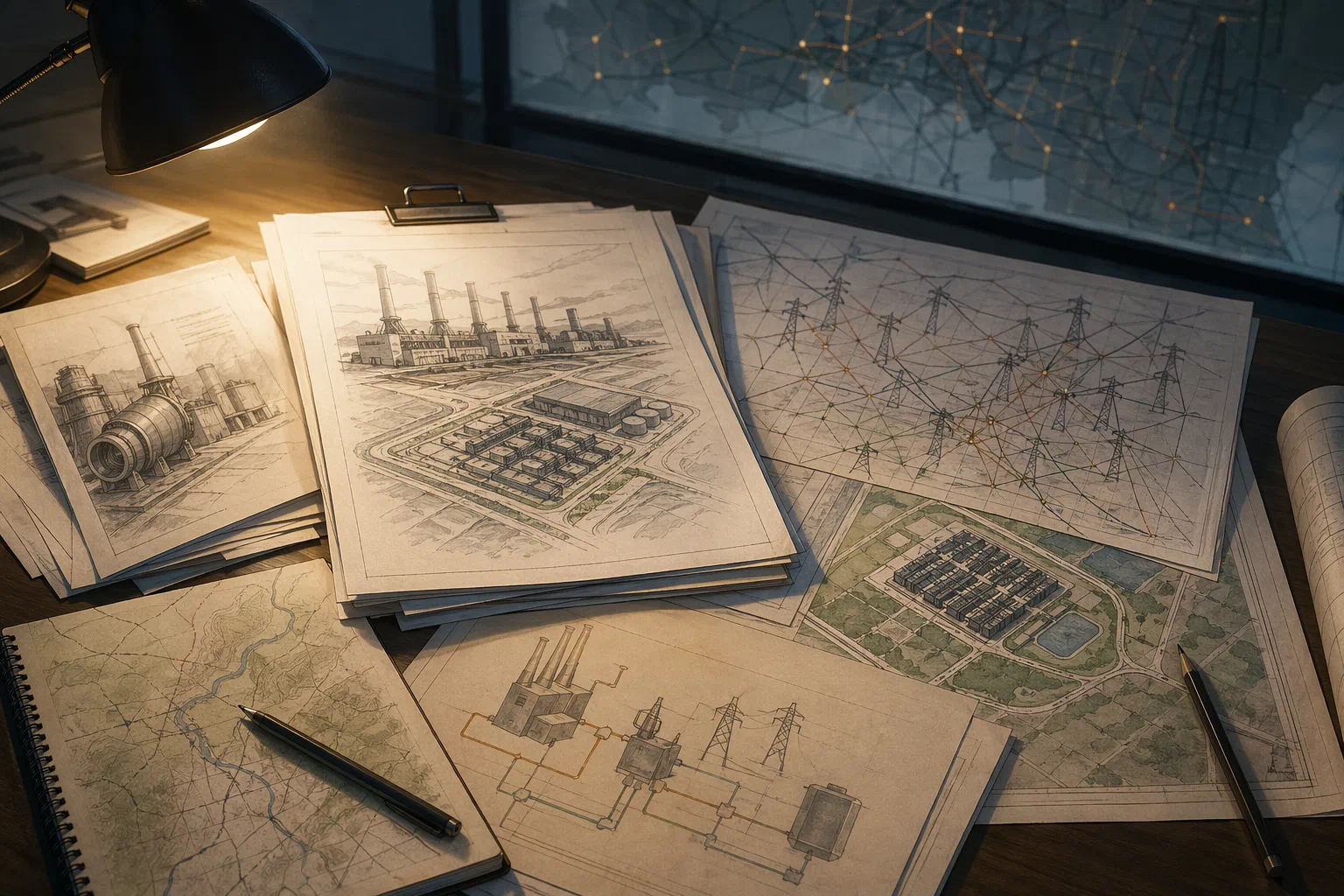
The future enters public life through paperwork first ~ site plans, rate cases, air permits, and the map of what will have to be built.
The Private Fix Reshapes the Public System
To be fair, the companies and utilities involved do have a real argument.
Interconnection queues are long. Regulators are under pressure to protect ordinary customers from subsidizing hyperscale loads. Communities want jobs and tax base without being handed higher bills. If a company is willing to bring new generation, new transmission, and new storage to the table, the deal can look pragmatic rather than predatory.
You can see the appeal in Entergy Louisiana’s March 27 announcement with Meta . The agreement says Meta will cover the cost of infrastructure meant to support its Richland Parish campus and is expected to deliver an additional $2 billion in customer savings over 20 years. The package includes seven new natural gas combined-cycle plants totaling more than 5,200 megawatts, roughly 240 miles of new transmission, battery storage, nuclear uprates, and support for up to 2,500 megawatts of new solar.
If you are a governor, a utility executive, or a local official trying to attract capital while telling voters their bills are safe, that is close to the ideal script. The customer pays. The grid gets stronger. The state gets a prestige project. The companies get reliable power. No one has to say no to AI.
There is a reason this framing has political traction.
But a private fix does not stay private for long.
Even when a hyperscaler says it will pay for everything, it is reorganizing public infrastructure around its needs. Transmission corridors cross ordinary land. Utility planning gets bent toward one very large customer. A plant built for a single campus alters the fuel mix, air shed, and long-term capital structure of a region. A state that learns to fast-track one customer learns something about whom it exists to serve.
That is the deeper issue with the “pay our own way” language. It treats electricity as if it were just another line item on a campus budget. It is not. Electricity is the basic circulatory system of modern life. Once a company starts rearranging generation and transmission at gigawatt scale, it is no longer merely buying power. It is participating in the governance of a public system, whether it says so or not.
That is also where the human stakes return. WIRED noted that one of xAI’s earliest and most visible projects in Memphis drew protest from residents in a low-income Black community worried about local air pollution, and that the NAACP filed suit last week alleging illegal turbine operations. Even if those claims are litigated away or technically cured, the pattern is already visible. The glamorous vocabulary of frontier AI keeps resolving into very old questions: who bears the fumes, who gets the jobs, who carries the risk, and who is told the future requires this sacrifice.
Climate Accounting Has Finally Caught Up with the Server Rack
There is another fair point worth taking seriously.
Permit numbers overstate what many power plants will actually emit in ordinary operation. Grid-connected plants cycle. Demand varies. Maintenance happens. Companies also argue that some gas projects are transitional and will be paired with solar, batteries, nuclear, or future carbon capture.
That is all true as far as it goes.
The problem is that AI campuses are not normal demand. One of the details in the WIRED reporting is more important than the headline number. A permit application for a Crusoe-linked project described the data center load as unlike a traditional power plant serving a constantly varying grid because the power requirements at the data center “do not vary significantly.” In plain English, the campus wants a steadier, harder-working stream of electricity than the traditional grid often provides.
That means the comforting assumptions people make about permit ceilings may travel poorly into this context. If the server load is persistent, the generation behind it may run harder, longer, and closer to modeled limits than the public hears in a normal debate over peaker plants and reserve margins.
That is why the climate numbers matter even before they settle into actual annual operations.
The same AP report on tech emissions found that Google’s reported emissions have risen by nearly 50% over the first five years of its climate commitments, while Meta’s rose by more than 60%. It also cited the Rhodium Group’s estimate that AI contributed to a 2.4% increase in U.S. fossil fuel emissions last year. The industry’s public pitch leans heavily on better chips, future clean power, and promises of doing more with less. The physical buildout, at least for now, looks like a gas rush.
This does not mean the case for AI is fake. It means the case is expensive in ways the culture would rather not picture. The story Silicon Valley prefers is one of disembodied intelligence. The story the permits tell is one of combustion, cooling, transmission, and land use. Intelligence may scale in software. Compute scales in steel, concrete, copper, and fuel contracts.
The bridge-fuel defense deserves a hearing. The grid is constrained. Nuclear is slow. Transmission is hard. Solar and batteries cannot instantly replace every hour of firm load in every place. A country that wants more AI, more manufacturing, more electrification, and lower household bills all at once is going to collide with physics and permitting sooner or later.
Bridges built at gigawatt scale have a habit of becoming neighborhoods.
Once capital is sunk into gas plants, pipelines, and transmission tied to specific campuses, the “temporary” solution acquires lobbyists, debt schedules, local tax dependence, and political defenders. The bridge starts asking to become a district.
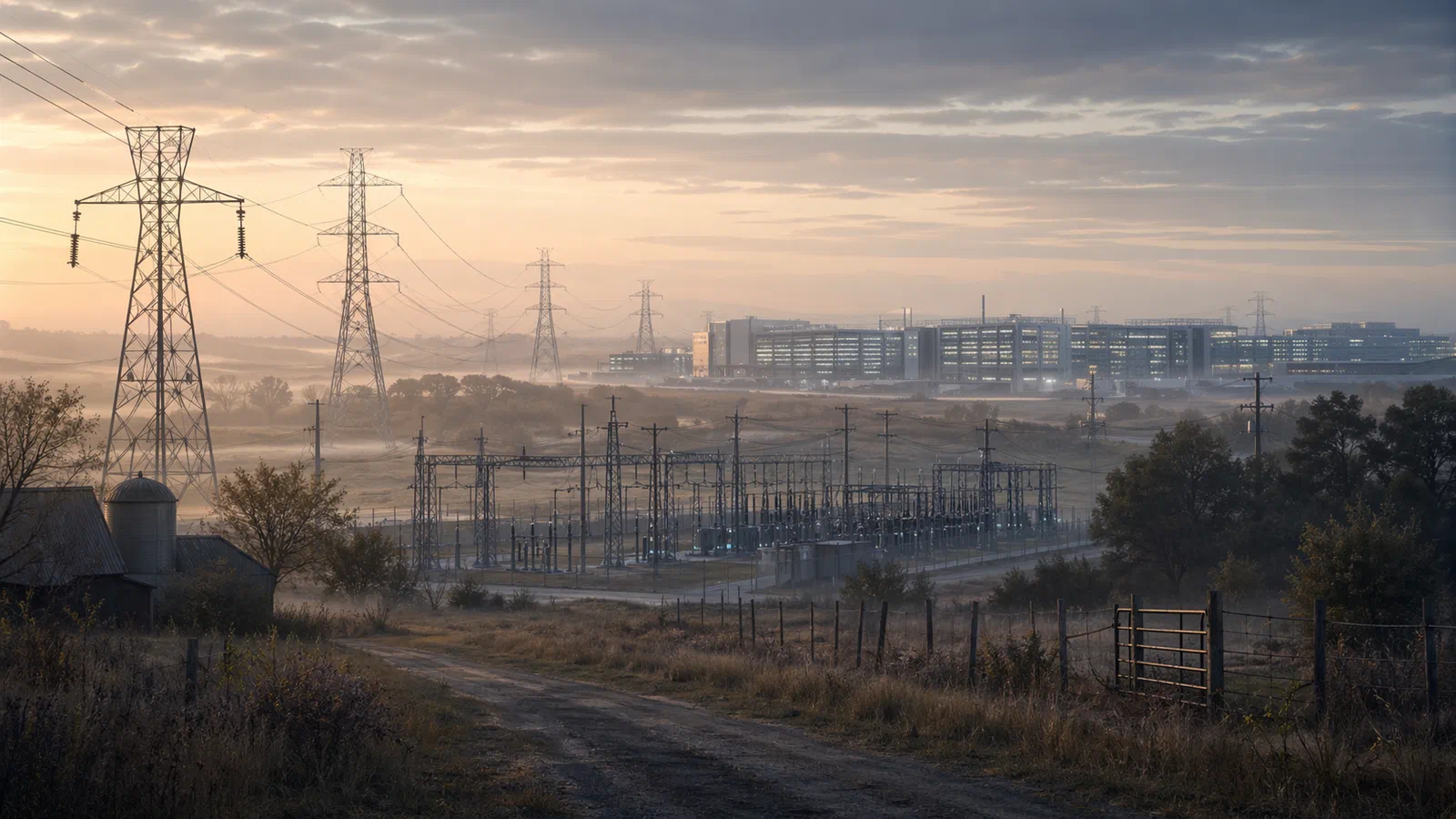
Even a “private” power solution leaves a public footprint behind it.
What We Are Really Building
The most important shift here is not environmental, though it is certainly that. It is conceptual.
We are watching AI stop being merely a digital product category and start behaving like a territorial industry. The unit of competition is no longer just model quality or user adoption. It is land assemblage, substation access, water design, turbine procurement, transmission rights, utility negotiations, and the ability to win local legitimacy before anyone else does.
That is a very different kind of business.
It looks less like the old cloud era and more like railroads, petrochemicals, aluminum smelters, or semiconductor fabs ~ industries whose real footprint only becomes visible when a county road turns into an access corridor and the local newspaper starts printing megawatt figures.
OpenAI’s own Stargate announcement from January 2025 framed the project as part of American leadership, jobs, and reindustrialization. That language was not ornamental. It was accurate. AI infrastructure is becoming a form of industrial policy whether Washington governs it as such or not.
The danger is not simply more emissions. It is moral evasiveness.
The country is being asked to accept a huge physical buildout in the name of intelligence, productivity, and national advantage. Maybe much of that buildout will prove worthwhile. Maybe some of it will even become the backbone for cleaner and more resilient systems later on. But the public deserves a more honest description of the trade.
This is not a frictionless knowledge economy. It is an industrial scramble to secure energy-hungry compute by whatever means can get permitted, financed, and defended first.
The AI data center wants its own power plant because the public grid is too slow, too contested, or too politically exposed to satisfy the speed of the race. That may be rational from the operator’s point of view.
It should not be invisible from everyone else’s.
An air permit is useful for that reason. It strips away the mood music. It asks a simpler question: if this future gets built, what exactly will be burning beside it, above it, or just down the road?
That is the question more AI coverage should start with.
Not because it cancels the promise of the technology. Because it tells the truth about the system required to deliver it.
The permit on the table is not only a permit. It is a translation device. It converts abstract intelligence into fuel, land, risk, and obligation. It is where the software story finally admits that it needs a smokestack.