The Ballot List at the Mailroom
The election-order fight now turns on a working machine that has barely been built: a federal citizenship file, a postal participation list, and the county office that must live with the match.
The disputed object is ordinary enough to fit on a clerk’s desk.
It is a record that can travel.
On one side sits the voter roll already maintained by state and local election officials. On another sits the federal citizenship file described in President Trump’s March 31 executive order on citizenship verification and federal elections . Nearby sits a possible Postal Service rule for mail-in and absentee ballots, with envelope identifiers, state participation lists, and mail routing tied to eligibility records.
That is the machine U.S. District Judge Carl Nichols declined to stop on May 27. In a 26-page opinion , he rejected a preliminary injunction sought by Democratic Party organizations, civil-rights groups, and voters. The ruling leaves the order alive for now because the court treated the feared harm as future harm. The Postal Service has yet to issue a final rule. The federal government has yet to send state citizenship lists that leave named people out. The plaintiffs, Nichols wrote, can return if concrete action creates concrete injury.
By June 1, the Postal Service had put a proposal on the table. A public-inspection notice for “Ballot Mail for Federal Elections” , scheduled for Federal Register publication on June 2, proposes new Domestic Mail Manual standards for federal ballot mail.
The Associated Press reported the ruling as a refusal to block a Trump order that could create a federal voter list and limit mail voting ahead of the midterms. That description names the fight. It also risks flattening the issue into a familiar partisan picture: Democrats warn of voter suppression, Republicans invoke election integrity, and the court keeps the order alive.
Outside that frame, the civic problem is sharper. Citizenship verification is a legitimate part of republican government. Eligible voters have a claim on a clean franchise, and ineligible ballots injure that franchise. Yet a federal list that reaches into a county mailroom can injure the franchise in another way if its authority, source data, correction path, and timing are weak.
The question is practical before it is rhetorical. Who owns the list at the moment an envelope moves?
The Empty Machine
The order tells the Department of Homeland Security, through U.S. Citizenship and Immigration Services and in coordination with the Social Security Administration, to compile a state-by-state list of adult U.S. citizens who maintain residence in each state. The list is supposed to draw on federal citizenship and naturalization records, Social Security records, SAVE data, and other federal databases. It is to be sent to chief state election officials at least 60 days before each regular federal election.
The exact machinery is in two places: Section 2(a) creates the State Citizenship List, while Section 3(b) directs the Postmaster General to begin proposed rulemaking for mail-in and absentee ballot services within 60 days of the order.
The order also tells DHS to create procedures that let people access, update, or correct their records. States would be able to suggest changes. The order stresses that inclusion on the federal citizenship list alone does not register anyone to vote. State and federal law would remain part of registration.
Those caveats matter. A citizenship list is only one input. State registration law, age, residence, felony rules, deadlines, signature rules, and absentee-ballot procedures remain separate questions. A person can be a citizen and lack a valid registration. A person can be properly registered and then face a federal file mismatch because one database stores a name, date, address, or naturalization record in a way another database fails to read cleanly.
That is why the timing question carried so much weight in court. The plaintiffs wanted an injunction before the government built the machinery. The government argued that the challenged pieces remained plans. Nichols accepted that posture for preliminary relief. The opinion does not settle the final legality of the order. It postpones the fight until a postal rule, a citizenship list, or an agency action creates a firmer record.
The result is a pause with movement inside it. Agencies can prepare. Plaintiffs can watch. Election offices can worry. Voters can only guess how a database they have never seen might treat them.
Citizenship In A File
The case should begin with a plain admission. Federal elections are for citizens. Federal law already makes noncitizen voting in federal elections a crime. State election offices already carry a duty to maintain voter rolls and administer elections accurately.
The Help America Vote Act requires each state to maintain a single, uniform, official, centralized, interactive computerized voter registration list for federal elections. The National Voter Registration Act governs list maintenance and removal procedures. These statutes already recognize that voter lists are public infrastructure, not campaign props.
The federal order steps into that infrastructure with a different kind of record. A voter roll is built for election administration. A citizenship file is built through immigration, naturalization, Social Security, and benefits systems. Each system has its own definitions, data standards, update rhythm, and error path.
This does not make the project illegitimate. It makes the project dangerous unless the mechanics are visible.
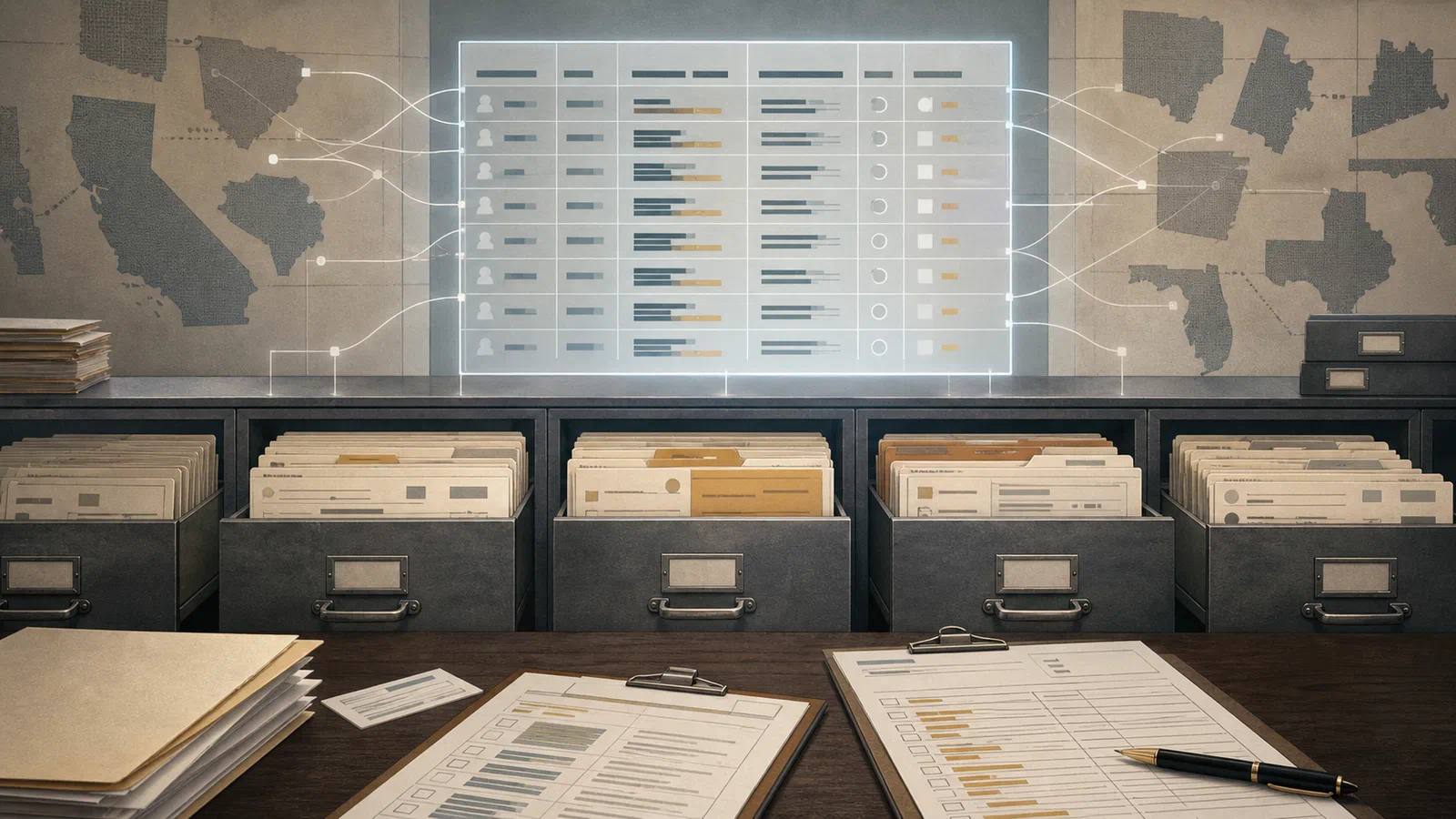
A clean list depends on the source record, the correction path, and the person who bears the cost of error.
Data matching works best when the consequence of error is small and the correction process is easy. A misspelled name on a marketing file is irritation. A mismatch on an election file can become lost time, provisional voting, litigation, or a ballot that never reaches a voter through the channel state law allowed.
The order says individuals should have access to correction procedures before elections. That promise is useful only if the procedure is fast, legible, local enough to use, and early enough to prevent failure. A right to correct a file after an envelope has been stopped is a thin comfort.
Here the court’s ripeness logic and the election administrator’s risk logic pull in different directions. A judge wants concrete agency action before blocking federal power. An election office wants clear rules before ballots are printed, envelopes are coded, and voters are told how to act.
Both instincts are understandable. Courts should avoid injunctions based on guesses. Election systems degrade when the rule arrives after the calendar has already moved.
The Mailroom Gate
The Postal Service piece is the most concrete part of the order because every mail ballot must physically travel.
The proposed rule calls for official election mail markings, automation-compatible envelopes, unique identifiers such as intelligent mail barcodes, a federal ballot mail portal, state-specific participation lists, and a verification standard before outbound ballot mail is accepted.
Some of this overlaps with ordinary election-mail administration. The Postal Service already provides election mail guidance , ballot-mail logos, tracking tools, and mailpiece design advice. County offices already depend on barcodes and mail visibility because ballots are time-sensitive paper.
The new pressure comes when tracking becomes gatekeeping.
A barcode can help an election office see where an envelope is. A list match can decide which envelopes move. The first tool is a dashboard. The second is a locked door.
The proposal places the Postal Service in an awkward role. Mail carriers are built to deliver lawful mail according to postal rules. Election officials are built to decide voter eligibility under state law, subject to federal constraints. A rule that makes the postal system police ballot eligibility would move a legal decision into a routing system.
That may sound technical. It is a major institutional transfer. The place where a ballot succeeds or fails would no longer be only the registration office, the election board, or the courtroom. It could become the sorting plant, the envelope format, the barcode table, and the data match behind it.
Power Before Error
The inherited media frame asks which side won this round. That is a thin way to read the ruling.
Federal agencies would gain operational power before the public has seen how their files handle error. A government can claim lawful authority to verify eligibility. It then has to build a process that can survive its own mistakes.
If a federal list excludes a lawful voter, who notices first? The voter, the county clerk, the state election director, DHS, SSA, USCIS, USPS, a party lawyer, or a judge? If a state list disagrees with the federal list, whose record governs the envelope? If a ballot is delayed because the barcode, address, or participation file fails, which office owns the remedy? If an election is close, which actors can credibly explain the failure without asking the public to accept a black box?
Those questions do not assume bad faith. They assume normal public administration.
Large databases produce edge cases. Voters move. Names change. Naturalized citizens have records across agencies. Military families and students can have unusual address histories. Elderly voters can depend heavily on mail procedures. County offices run on calendars, printers, contractors, temporary workers, state guidance, and local habits. The ballot envelope looks simple; the machinery behind it is complex.
Inside a county office, the proposed system would become a sequence of clerical acts. The office would receive a participation list, match a voter record against the state roll, prepare or reject a ballot envelope, attach the required barcode, flag a mismatch, send notice to the voter, and leave enough time for a cure before mailing and canvass deadlines close. The public argument lives inside that sequence.
The executive order also changes incentives. Federal officials gain a role in election-mail control. State officials may gain a new source of citizenship data, but they also inherit federal errors and voter anger. The Postal Service may gain technical duties that draw it into eligibility conflict. Plaintiffs may have to wait for a concrete failure before courts give them firmer ground. Voters bear the risk when the file is wrong, late, or opaque.
Those costs land in different offices before they become public anger. Election integrity and ballot access are usually treated as rival slogans. In practice they are linked. A system that cannot exclude ineligible ballots loses legitimacy. A system that wrongly blocks eligible voters also loses legitimacy. The hard work is designing a rule that can do the first task without hiding the second injury.
The County Desk
The ruling leaves the dispute in a tense place. The order survives because the machine has yet to act. The same fact that helps the government in court creates anxiety for election offices: the rule is alive while its working shape remains unclear.
That uncertainty will not stay in Washington. If the order proceeds, it will arrive as file formats, data-sharing agreements, state guidance, vendor instructions, ballot-envelope specifications, postal scans, correction portals, and deadlines. It will arrive in offices that already count time by print dates, mail dates, canvass dates, certification dates, and court dates.
The Constitution’s Elections Clause gives state legislatures the power to prescribe the times, places, and manner of congressional elections, while allowing Congress to alter those rules. Presidents are absent from that text. The executive branch enforces federal law and administers federal programs, but election administration remains a divided system. That division can protect liberty, confuse accountability, or do both at once.
The citizenship-list order tests that division at a weak point: the mailed ballot. Mail is federal infrastructure. Ballots are state election instruments used in federal contests. Citizenship records sit in federal systems. Voter rolls sit in state systems. The voter experiences all of it as one envelope.
The court has said, for now, that the feared injury is too early for preliminary relief. That may be correct as litigation doctrine. It is less satisfying as civic preparation. A ballot-mail system can fail through small delays, quiet mismatches, and unclear responsibility before a clean constitutional question appears.
The list at the mailroom is therefore the object to watch. It will show whether citizenship verification can be made accurate, transparent, correctable, and lawfully bounded. It will show whether a federal data tool can support state election administration without becoming a hidden veto point. It will show whether the Postal Service can help secure the envelope without becoming the office that decides the voter.
The argument will return to court if the machinery begins to move. By then the civic question should be simpler than the pleadings. A republic may guard its ballot. It must also know the hand that closes the slot.

The envelope looks local until the federal file meets the postal scan.