The Bars on the Gum
A small black code turned a grocery package into a shared record of price, stock, labor, supply, and trust.
The Pack At Marsh
The package was small enough to vanish in a palm. A pack of Wrigley’s Juicy Fruit gum crossed a scanner at a Marsh supermarket in Troy, Ohio, on June 26, 1974. The register read the code, found the price, and made the sale. IBM’s history of the UPC gives the price as 67 cents. The Smithsonian’s supermarket scanner object record places one of the first ten Spectra Physics model A scanners in the museum collection and says the original pack of gum stayed with Clyde Dawson of Marsh Supermarkets.
The familiar version of the scene is tidy. It has a first scan, a first product, a first beep, and a little grocery-store theater. It lets a reader imagine technology entering commerce through a single counter. That scene is true enough as an event. It is too small as an explanation.
The scanner did not know gum. It knew a pattern. The register did not know appetite, brand loyalty, shrinkage, or the day’s aisle work. It knew a product identity linked to a price file. The moment worked because a store, a manufacturer, a standards council, equipment makers, packaging printers, and back-office record keepers had made one quiet pledge: this object would carry a name a machine could read, and the store would treat that name as the doorway to price, inventory, ordering, and sale.
The gum is useful because it refuses grandeur. It was candy-counter ordinary, cheap enough to be forgettable, and small enough to make the machinery around it look absurd. A helium-neon laser, a rotating mirror, a computerized register, a new standard, a national numbering system, and a store willing to risk money on adoption all met on the wrapper of a chewing-gum pack. If a system can read gum, it can read a supermarket.
A barcode looks like the last thing added to a package. The recipe is settled. The brand is printed. The weight, warnings, logo, flavor, coupon, and sales claim are already there. The bars seem like packaging debris. In practice, they became the package’s address inside a larger order. The gum did not become more edible. It became more accountable.
The public bargain changed at the same instant. A visible price on a can or sticker had once let a shopper accuse the object. The UPC pointed elsewhere. Price lived in a file. Stock lived in a file. The receipt became the shopper’s late view into a system already trusted at the moment of sale. The small code carried a new rule for ordinary life: the object in the hand was no longer the whole record.
The gum belongs with public objects more than with business trivia. It belongs with street numbers, library cards, survey marks, license plates, voting rolls, and stamped weights. Each looks modest. Each works by asking many people to trust a shared identity. The barcode’s setting was private retail, yet its effect was public-facing. Millions of people learned to accept a machine’s statement about what an object was and what the object cost.
The Dream Of Machine Reading
The desire to make packages readable came before the UPC. Norman Joseph Woodland and Bernard Silver filed their Classifying Apparatus and Method patent in 1949. The patent, published in 1952, described patterns of light and dark markings that could classify objects by optical reading. Its drawings include straight lines and a circular target. The older device belongs to a postwar faith in automatic classification: if the mark could be seen, a machine could count, sort, or price.
The Woodland and Silver idea did not become the Troy, Ohio, scanner by direct path. The technology had to catch up. Light sources, optics, printing, electronics, computing costs, store systems, and retailer appetite all had to change. A workable grocery code also needed something the patent could not supply by itself: agreement among competitors.
Invention stories often flatter the lone device. A person has an insight, a machine appears, and the world falls in line. The UPC story runs in the other direction. It had inventors, engineers, and patents, but the central event was a negotiated common language. The hard question was not whether black and white marks could encode numbers. They could. The hard question was who would accept the same marks and numbers across firms that did not otherwise share their ledgers.
The grocery trade had reasons to want an answer. Supermarkets had grown into places where thousands of items moved through shelves, back rooms, delivery doors, coupons, weekly ads, and registers. A cashier could type a price, but a person at a keyboard also carried fatigue, memory, line pressure, and error. A clerk could stick prices on packages, but every price change turned into hand work. A manager could walk the aisles, but the store’s own memory was scattered across shelf tags, invoices, delivery slips, handwritten counts, and the private knowledge of workers.
IBM describes a 1970 call by grocery retailers and packaged-goods manufacturers for a standard machine-readable symbol. That account is corporate history and should be treated as an interested source. It also matches the museum record and later standards record: the retail problem was collective. A code used by only one manufacturer offered too little value to a supermarket. A scanner limited to one retailer’s mark carried too much cost. A package marked only for one store lost value when it moved through wholesalers and rival chains.
The selected symbol had to survive dirty hands, curved cans, shiny plastic, crushed corners, bad angles, speed, and a checker pulling a product across a glass window without performing a ritual. It needed human-readable digits because machines fail. It needed a check digit because errors happen. It needed a footprint small enough for candy and medicine, yet steady enough for cereal, soap, soup, and rice.
A later scanner patent, US4064390A , points to the missing source at the center of the story: a May 1973 “U.P.C. Symbol Specification” published by the Distribution Number Bank, administrator of the Universal Product Code and the UPC symbol for the Uniform Grocery Product Code Council. I did not find a clean public copy suitable for direct use in this package. The flagship argument should not pretend to have inspected the full original standard. The defensible claim is narrower and stronger: contemporaneous patent material identifies the specification and shows the scanner as a machine built around a grocery-industry code already chosen by 1973.
The patent also reminds us that the checkout counter remained a workplace. Its description assumes a checker stationed at the counter, physically moving each package with its code toward the window, then bagging the goods. The human body stayed in the lane. The machine changed what that body had to do quickly, repeatedly, and accurately.
Agreement Before Ink
The UPC was a treaty printed as packaging.
The word treaty can sound too grand for a cereal box or gum wrapper. The structure fits. A manufacturer accepted an external numbering order. A retailer accepted the promise that the number would travel with the product. A scanner maker accepted the burden of reading a standard mark instead of inventing a private one. A package printer accepted tolerances. A store accepted the cost of equipment before the benefit was guaranteed. A standards body accepted the role of assigning and policing a shared identity.
No one gained the same thing. Retailers wanted faster checkout, better stock records, fewer keying errors, and greater control over price files. Manufacturers wanted a path into stores and a way to make products legible across chains. Equipment makers wanted a market. Shoppers wanted shorter lines and correct prices. Workers wanted a lane that could be managed under pressure. Each party could support the same code for different reasons.
That mixed motive is the point. Shared standards often work because they do not require shared ideals. They require a shared surface where conflicts can be processed. The barcode gave retail a surface small enough for a wrapper and stable enough for a database.
The number under the bars was a kind of compromise. It did not list the ingredients, endorse the brand, set the price, tell the cashier how to handle the package, or tell the shopper whether the item was a good buy. It identified. Identification sounds thin until a system grows around it. Once a product had a common identity, the register could attach a sale to the exact item. The store could count movement. The warehouse could reorder. A manufacturer could learn which sizes and flavors traveled. A chain could compare stores without reducing every aisle to memory and guesswork.
The code also narrowed some forms of local discretion. A store that once handled many product facts by local habit now had a stronger reason to match outside identifiers. A checker who once keyed a price by sight now handled an object whose identity had already been settled before it reached the lane. A manufacturer with enough scale could make its products easier for stores to accept. A small producer had to enter the numbering order to reach the same shelf on equal technical terms.
The barcode did not make retail fair. It made retail more recordable.
That distinction carries the essay’s burden. A record can reduce chaos without reducing power. It can lower error in one place and create dependence in another. It can save labor and intensify labor. It can help a shopper get the sale price and make the source of that price harder to see. The UPC is a public lesson because it shows how a neutral-looking mark can redistribute trust without announcing that it is doing so.
The first scan is often treated as the start of automated checkout. It was also a public demonstration of adoption. The machinery needed enough UPC-marked goods to justify itself. Manufacturers needed enough scanner-equipped stores to justify printing. Stores needed confidence that other stores and suppliers would join. The gum at Marsh became a proof-of-work object for a whole adoption problem. One small package said the loop could close.
The Register As Record
The scanner turned the register into an intake point for the store’s memory.
Older registers were already record machines. They totaled sales, produced tapes, and disciplined cash drawers. The barcode added item identity at the moment of sale. That change sounds simple, but it moved the checkout lane deeper into the store’s operating system. A sale was no longer only money received. It was evidence that one exact item had left the shelf.
The register became a listening post. It heard demand in individual units. It heard which sizes moved, which flavors stalled, which promotions worked, which stockouts hurt, and which supplier claims could be tested by movement instead of charm. A store could begin to read itself through transactions.
The NBER paper by Emek Basker and Timothy Simcoe studies UPC adoption and its effects during the early years of the barcode system. Their findings point toward network effects in diffusion and tie UPC adoption to changes in firm size, trademark registration, product variety, and retail supply chains. The working paper is not a cultural essay. Its value here is mechanical. It supports the claim that the UPC worked as infrastructure. The code gained value as more firms used it, and the effects ran upstream and downstream.
Infrastructure is often boring at the point of contact. The shopper sees the glass, hears the beep, and watches the total climb. The live force sits elsewhere. A price file has to match a shelf tag. A product master has to match a package. A supplier has to use the right identifier. A back room has to receive goods under names the system recognizes. A promotion has to know which code qualifies. A recall has to find the right lot or product family. A return has to point back to the sale.
The UPC became the hinge for all those acts, though the bars themselves did not perform them. The barcode did not carry the price, reorder the case, check the promotion, or select the assortment. It pointed to records that did. Blaming or praising the barcode alone would confuse the mark with the system behind it.
This is where private record systems take on public weight. A grocery store is private property. A shopper’s weekly food purchase is ordinary public life. The scanner sits at the crossing. It turns private databases into lived facts for anyone buying milk, gum, diapers, bread, medicine, coffee, or dog food.
When the system works, it feels like nothing. The right product rings at the right price. The receipt matches the shelf. The store has enough stock. The line moves. When the system fails, the shopper sees how many invisible agreements were involved. A price tag was wrong. A sale did not load. A coupon rejected the product. An item was not in the file. The cashier had to call someone. The machine had turned an everyday object into a question.
The old store had its own errors. A clerk could type badly. A stamped price could lag the weekly ad. A shelf could hide old goods. Memory could fail. The barcode did not invent error. It centralized it. A bad price file could repeat the same wrong charge across lanes and stores until discovered. The system made error less personal and more scalable.
That is the price of a shared record. It can make a good fact travel quickly. It can make a bad fact travel with the same confidence.
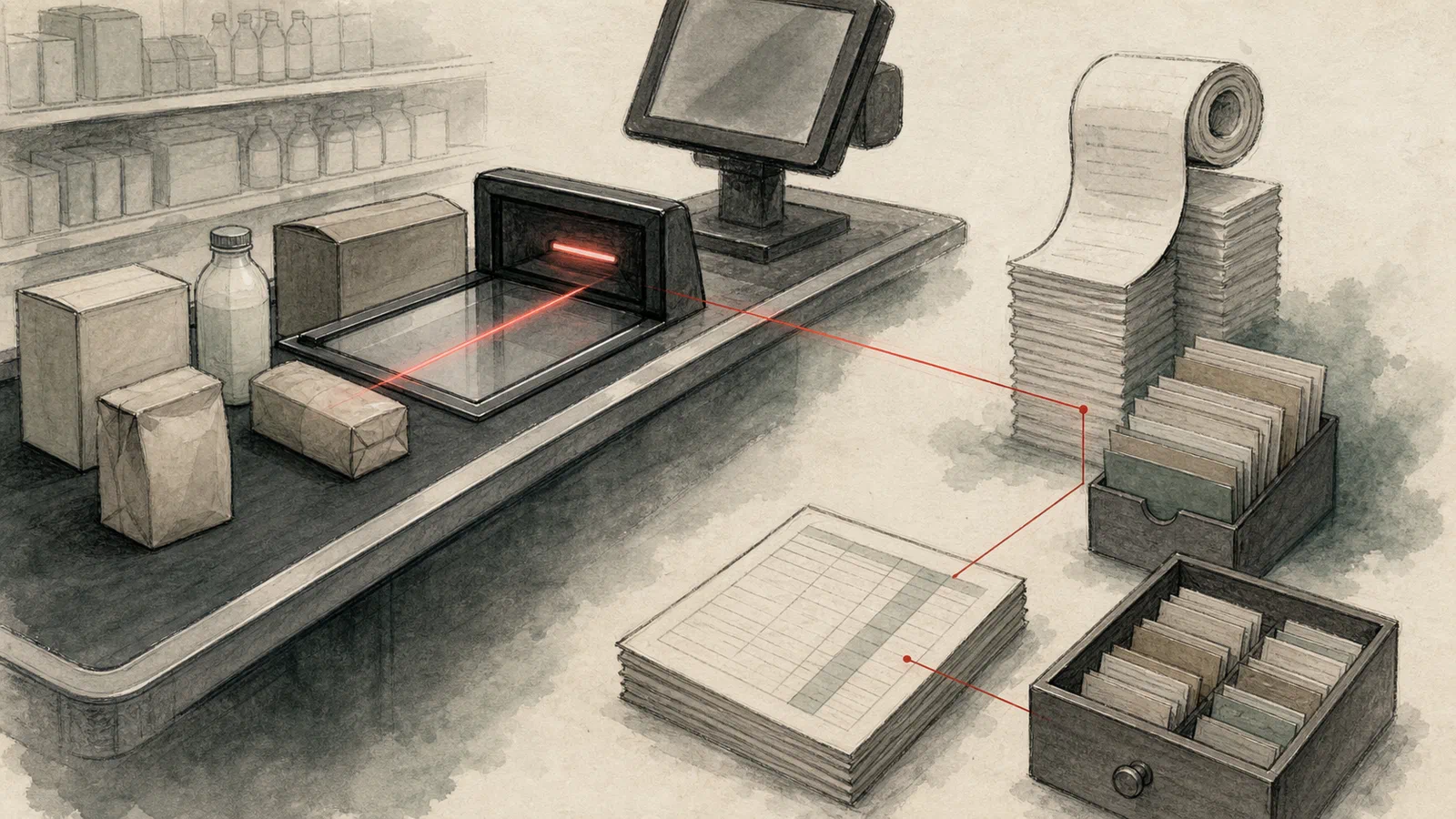
The scanner made the checkout lane a point of sale and a point of record.
The Shelf As Archive
A supermarket shelf is an archive with expiration dates.
Every slot is a record of a decision: this brand gets space, this size gets a facing, this flavor gets a trial, this seasonal package gets a chance, this private-label version gets to sit next to the national brand. The shopper sees abundance. The store sees claims on space, labor, attention, refrigeration, promotion, and cash.
The barcode made variety easier to manage because it gave difference a cheap common name. Strawberry yogurt, low-fat strawberry yogurt, family-size strawberry yogurt, a holiday label, a club pack, and a private-label copy could each be treated as separate items without asking every worker to preserve the distinction by memory. The code helped turn the shelf into a more detailed ledger.
That detail changed the politics of variety. A store can carry more products when it can count them without drowning in hand records. A manufacturer can propose more variants when it can give each one an address in the ordering and scanning system. A retailer can test the claim. If a new flavor moves, the record says so. If it sits, the record says that too.
Basker and Simcoe’s UPC research links adoption with variety-enhancing product change and larger retail supply chains. The phrase sounds bloodless until one stands in an aisle. The ordinary result is the long wall of nearly identical choices: gum flavors, cereal shapes, pasta sauces, toothpaste claims, seltzer cans, coffee pods, snack bags. The barcode did not create desire for novelty. It made the cost of naming novelty lower.
The shelf became easier to refresh and easier to crowd. A product could win because shoppers wanted it. A product could also win because the record made it easy to sell, replenish, promote, and compare. Technical legibility became part of market access. If a good has no scannable identity, it enters the modern store as an exception. Exceptions cost time.
That creates a strange kind of equality. A tiny pack of gum and a heavy bag of rice both have to pass the scanner. Their codes speak the same grammar. Yet equality at the scanner does not mean equality in the market. Large firms can manage codes, package changes, data flows, and retailer demands more easily than small firms. Standards lower friction, then reward those who can move through the lowered friction at scale.
The shopper receives the result as choice. More sizes, more flavors, more temporary versions, more private labels, more claims. The store receives the result as a living map of demand. The manufacturer receives it as proof or warning. The worker receives it as a shelf that changes faster.
An archive also forgets. Products leave. Labels change. Package sizes shrink. Prices move. The code can keep the store’s memory precise without making the shopper’s memory stronger. If a cereal box loses two ounces while keeping a familiar shape, the code will know the item. The shopper may have to notice the weight line.
The barcode therefore belongs in the history of attention. It made packages easier for machines to distinguish, then left people to decide which differences deserved human notice.
Checkout Labor
The barcode changed work before it changed rhetoric about work.
The early scanner was not a self-checkout kiosk. It was a tool at a staffed counter. The patent language for a scanner at a checkout station assumes a checker who moves each package past the window and enters the human-readable code when the machine cannot read the label. That worker had to feed the system with body movement: reach, turn, pull, listen, bag, correct, repeat.
The public often hears automation as replacement. At the lane, the first effect was remeasurement. The store could ask how fast items moved through a line, how many errors occurred, how much labor a sale required, and how much throughput a checkout lane could support. The job changed because the machine made the work more measurable.
Emek Basker’s NBER working paper on barcode scanners and retail productivity estimates early scanners increased store labor productivity by about 4.5 percent in the first few years, with larger effects in stores carrying more packaged products. The paper does not say the scanner simply removed cashiers. It gives a more disciplined claim: scanners helped stores get more output from labor, especially where the product mix made the code more valuable.
That finding fits the counter. A scanner can shorten keying time, reduce some errors, and support faster lines. It can also increase the pace expected of the worker. The cashier no longer proves skill by memorizing prices. Skill moves into handling, speed, exception management, customer conflict, coupon trouble, age checks, bagging choices, and recovery when the machine fails.
The machine also changes blame. A keyed error could be blamed on the clerk. A scanner price error could be blamed on the system, but the customer usually faces the person at the register. The cashier becomes the human surface of a database decision. That is hard service work: absorbing distrust produced elsewhere.
The barcode did not remove human judgment from checkout. It changed where judgment was allowed. A worker could override, call a supervisor, enter digits, accept a correction, or explain a policy. The main identity of the item had already been declared. The code spoke first.
This altered status matters. Older cashiers held more local price knowledge, but they also carried more burdens of memory and error. Scanner lanes relieved some of that load and made other demands. The job became less about knowing the store by heart and more about keeping the system moving without losing the customer.
The barcode also changed work outside the lane. Someone had to maintain price files. Someone had to manage product masters. Someone had to apply shelf tags, handle item setup, correct bad scans, check promotions, maintain devices, audit receipts, and answer consumer complaints. Automation often moves work out of sight before it reduces work. The UPC is a clean example. The visible motion at the register became shorter. The hidden work of record maintenance became more valuable.
That hidden work has public consequence. A store’s price file is only as trustworthy as the people and procedures maintaining it. The scanner’s authority depends on workers whose names never appear on the receipt.
Price Files And Public Trust
There is a small democracy in a visible price. It gives the shopper an object to point at.
The UPC weakened that old habit because the code does not contain the price. It identifies the product. The register retrieves the price from the store’s system. That change lets stores update prices without touching every package. It also asks shoppers to trust a chain of records they cannot fully inspect while standing in line.
This is where weights-and-measures law enters the story. Barcode trust did not remain a private promise. Public offices had to decide how to test scanner prices. NIST Handbook 130, current 2026 edition , includes an “Examination Procedure for Price Verification” adopted through the National Conference on Weights and Measures. The Section V PDF says the procedure applies to retail stores, including those using UPC scanners and price-look-up codes at checkout, and defines the purpose as making sure consumers are charged the correct price.
The procedure tells us what the public problem became. Inspectors compare the price charged at the register or device with the shelf, item, advertisement, or posted price. They sample items. They document findings. They distinguish overcharges, undercharges, and pricing files. The law-facing question is no longer “Can the machine read?” It is “Does the record the machine reaches match the promise made to the shopper?”
That is the real scanner trust problem. A scanner can be optically accurate and publicly wrong. It can read the correct code and call the wrong price. It can identify the product and betray the shelf tag. It can do its narrow job perfectly while the system around it fails the buyer.
The UPC made that problem sharper because the code separated identity from price. A stamped price on a package can be stale, messy, and labor-heavy, but it is visible. A database price can be current, flexible, and easier to manage, but it has to be audited through procedures most shoppers never see.
The receipt became the shopper’s appeal document. It lists what the store says happened. The shelf tag remains the public promise. The register is the moment of judgment. NIST’s procedure exists because confidence cannot rest on the beep itself.
The stakes can look small. A nickel on soup. Twenty cents on gum. A missed sale price on cereal. A dollar on diapers. Retail errors add up through repetition and through unequal attention. Shoppers with time, confidence, and flexible budgets can argue. Shoppers with children in the cart, a bus to catch, limited English, low vision, or shame at holding up the line may accept the total and leave.
The barcode does not create those differences. It helps route them through a machine-readable bargain. The system is fair only if the records behind it are maintained, tested, and corrected.
The old visible price had a social drama of its own. Stickers could be wrong. Clerks could misunderstand. Sale signs could mislead. The scanner replaced one trust surface with another. The public record left the package and settled into the relation among shelf, file, register, and receipt.
The gum at Marsh was therefore a preview of a larger legal question. When a private store uses a private database to name the public price of a necessity, who checks the checker? NIST Handbook 130 offers one answer: public procedures, state and local adoption, sampling, and defined errors. The scanner enters civic life through the unglamorous form of inspection.
The Code Outside The Store
The UPC’s public face is the checkout lane. Its wider life is movement.
A product code helps goods move through cartons, pallets, warehouses, invoices, purchase orders, planograms, recalls, returns, and sales reports. The same identity that lets the register ring up gum also lets a retailer know which gum to reorder. A code on the individual package can connect to case codes, supplier systems, and distribution records. The barcode became a small bridge among firms that do not share ownership.
That bridge did not eliminate bargaining. Retailers and manufacturers continued to fight over price, promotion, shelf space, slotting, data access, packaging, and private labels. The UPC gave their fight a common reference point. It is easier to argue over a product when both sides can name it exactly.
Supply chains need such exactness because goods lose their stories as they move. A box leaves a plant, enters a truck, reaches a warehouse, gets broken into cases, lands in a back room, waits for shelf space, and passes through a register. Without stable identity, each handoff invites translation. With stable identity, translation has an anchor.
The anchor can support public safety. Recalls need product identity. Expiration handling needs product identity. Lot tracking, where available, needs records more detailed than the old UPC. Allergy notices, supplier withdrawals, and counterfeit concerns all become harder when objects cannot be named consistently.
The anchor can also support commercial surveillance of demand. Retailers gained better knowledge of what people bought, when, where, and in response to which prices. That knowledge has value. It can reduce waste, improve stocking, and reveal unmet demand. It can also concentrate power in firms with the ability to collect, analyze, and act on records faster than suppliers, workers, regulators, or shoppers can understand them.
The barcode did not turn a supermarket into a data company by itself. It gave the supermarket a grammar for item-level facts. Later systems wrote longer sentences.
This helps explain why the UPC belongs in material history. The material object is a printed code, but the thing being built is a record path. The path passes through paper, ink, glass, light, copper, steel, plastic, software, invoices, price books, training manuals, shelf labels, receipts, and public inspection forms. A cultural history that stops at the black bars misses the machinery of agreement around them.
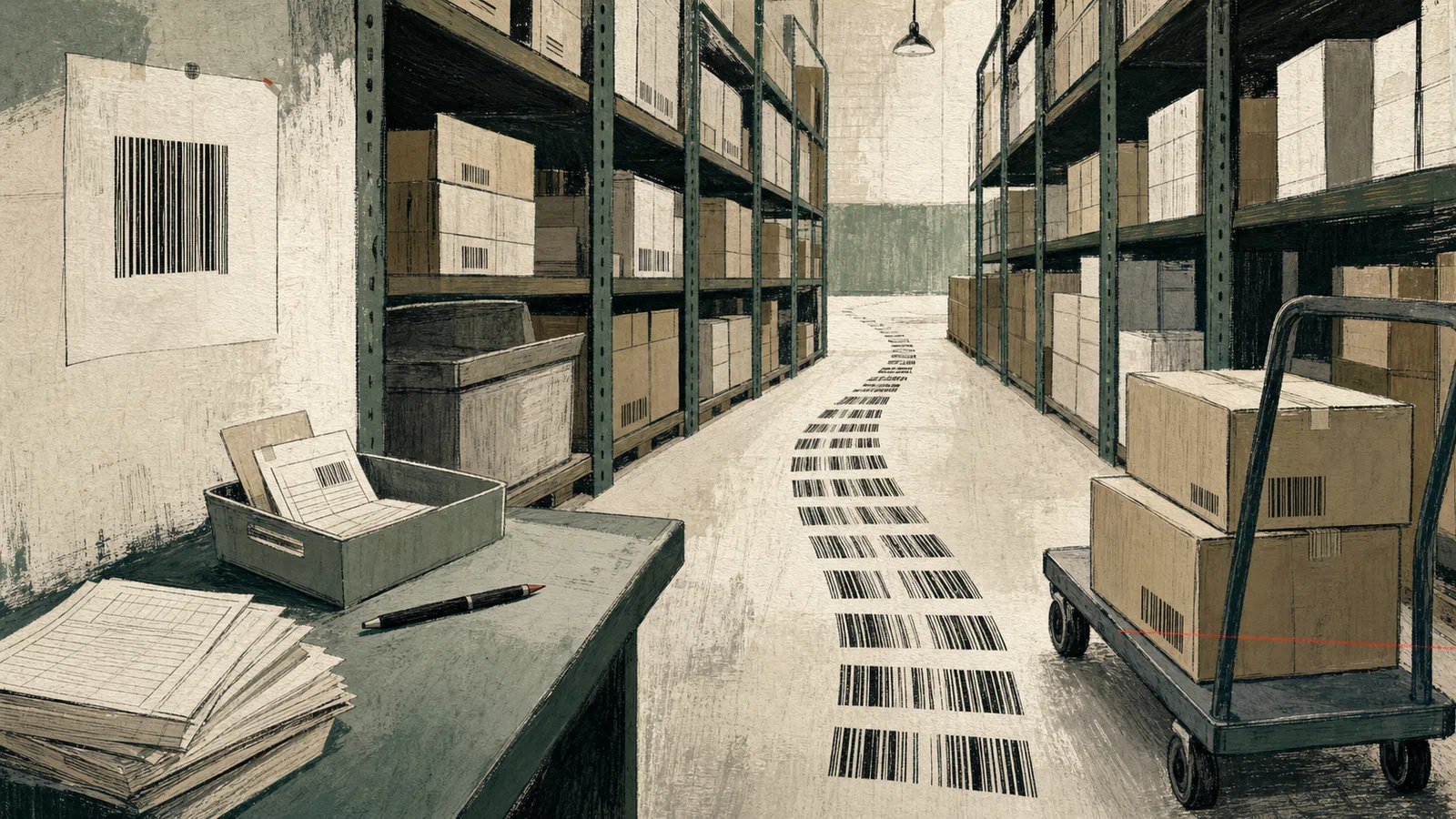
The barcode gave variety a common address, then handed power to the records behind that address.
The Next Code
The UPC now faces succession without disappearing.
GS1 US is promoting Sunrise 2027 , a move toward point-of-sale systems able to read two-dimensional barcodes such as QR codes that can carry more data than the familiar one-dimensional UPC. GS1’s current material says Sunrise 2027 marks a global transition toward 2D barcodes and tells retailers to install scanners able to read 2D codes and extract the Global Trade Item Number at checkout. Its one-pager and guidance describe richer product data, traceability, consumer information, recall support, and supply-chain uses.
That language is interested source material. GS1 exists to promote standards adoption. Its claims deserve use, not surrender. The old bargain returns in larger form: a package can carry more facts, but those facts depend on systems that create, govern, and update them.
A UPC points mainly to identity. A 2D code can carry or connect to expiration dates, batch or lot data, serial numbers, web links, product pages, recall information, sustainability claims, coupons, age-gating, regulatory disclosures, and brand-controlled material. Some of this can help a shopper. Some of it can help a store rotate stock and remove recalled goods. Some of it can help regulators and suppliers trace risk. Some of it can turn the package into a live doorway whose destination can change after printing.
The old barcode’s austerity was a virtue. It did little, so its public claim was easier to understand: this package has this shared identity. The next code can say more. More data means more need for governance. Who maintains the linked page? Who decides which facts stay printed on the package? What happens when a web link breaks, a brand changes a claim, a recall page updates, or a shopper has no phone? Which facts belong at the register, which belong in the supply chain, and which belong directly in the buyer’s hand?
The 2D transition also reopens the labor question. More data at checkout may help the system catch expired goods or recalled items. It may also create more exceptions for workers to resolve at the lane. A scanner that reads richer information can produce richer interruptions. The customer sees a delay. The cashier sees a machine asking for judgment under time pressure.
The price problem also returns. A richer code can help verify more facts, but it cannot solve the old relation among shelf, file, register, and receipt. The shopper’s confidence depends on the store maintaining the public promise. A code can point to a product page; it cannot by itself make that page honest, current, accessible, and complete.
The next code may improve recall handling and freshness tracking. It may reduce waste. It may give shoppers better access to product information. It may create new points of control for brands and retailers. The only honest view holds those possibilities together without turning the transition into destiny.
The lesson of the UPC is useful here. The code that won was more than a clever mark. It was a mark backed by adoption, rules, hardware, software, labor, law, and habit. A richer barcode will require the same kind of public attention. The symbol can hold more. The harder question is who gets to act on what it holds.
The Beep That Disappeared
The first scan at Marsh supermarket is easy to picture because it is small. A pack of gum. A window in the counter. A red beam. A price. A sale.
The later system is harder to see because it became normal. The barcode now hides by being everywhere. It sits on food, medicine, books, tools, toys, shipping labels, lab samples, boarding passes, warehouse racks, envelopes, and hospital wristbands. Its success made it visually dull. The eye slides past it.
That dullness is historical evidence. A public-facing system has done deep work when people stop noticing the mark that governs the transaction. The beep became ordinary. The ordinary sound carried a changed bargain.
The barcode sped checkout, widened practical variety, supported supply-chain coordination, and gave stores sharper records. It also moved price trust away from the object and toward files. It made some labor less dependent on memory and more dependent on pace, exception handling, and record maintenance. It gave manufacturers and retailers a shared grammar while rewarding those who could best use the data behind it. It made the store more knowable to itself and sometimes less legible to the shopper in the moment of purchase.
The pack of Juicy Fruit at Marsh did not contain all of that. It opened the door. The object matters because it shows the scale of modern systems. A person buys gum. A store tests a scanner. A code joins a wrapper to a database. A standards council gains proof. A manufacturer sees a path. A worker changes motion. A shopper learns to trust a receipt.
The black bars are not the system. They are the handle.
When the next code arrives on more packages, it will likely look like a convenience. Scan for details. Scan for freshness. Scan for recall data. Scan for a coupon. Scan for the story behind the product. The old gum suggests the better first question: what record is being made public, what record is being kept private, and who has to trust the difference?
The smallest artifacts often teach the cleanest lessons. A barcode on gum says that modern trust rarely announces itself as trust. It arrives as a tiny mark, a short sound, and a total on the screen.