The Bolt Beside the Gas Tank
Ford built the Pinto fast, and its own crash tests found a gas-tank danger before federal rules caught up.
In one Ford crash test, the rear of a production Pinto struck a fixed barrier at 21 miles per hour. The fuel-tank assembly tore, and a bolt head near the rear axle punctured the tank.
The Pinto was Ford’s small car for the 1970s, built to be a cheap and light rival to foreign-made subcompacts. Its gas tank sat behind the rear axle and ahead of the bumper. The differential sat just in front of the tank. That metal case surrounds the gears joining the rear wheels, and bolt heads stuck out from it.
The engineering-ethics textbook used for this essay also describes tests of prototype Pintos. A moving barrier struck them from behind at 21 miles per hour, driving their tanks forward into the bolts. The tanks were punctured and leaked. In at least one test, spilled fuel entered the driver’s compartment.
No crash test can predict every road crash, but these tests showed a clear way for fuel to escape during a rear hit.
Ford also tested a flexible rubber bladder inside the tank and a tank above the rear axle at 20 miles per hour. Both passed the tests described by the record, but key questions remain. The record does not show directly comparable test setups or whether either design was ready for the factory line.
Engineers also proposed a buffer to separate the tank from the exposed bolts. Ford left it out and kept the existing design, saying the Pinto met the federal safety rule then in force.
The crash test had raised a question the rule did not answer. What should a company do when its own test finds a danger that the law has not yet caught?
A Small Car Built Fast
Ford began work on the Pinto in the late 1960s to compete with foreign-made subcompacts. The company wanted a quick answer.
The Pinto program had two easy goals to remember: the car should weigh less than 2,000 pounds and sell for less than $2,000. Ford finished the program in a little more than two years, while a normal cycle took about three and one-half years.
Early choices about the shape of the car limited what engineers could change later. Ford also wanted to preserve cargo space, which helped place the gas tank behind the rear axle and ahead of the bumper.
Each goal offered something a buyer might want: a car that cost less, weighed less, held more, and reached the market sooner. Together, those goals left less room for change as the deadline drew near.
The failed tests changed the problem. The tank location had begun as one choice among many, then became a safety concern when the rear of the car pushed the tank toward the bolts.
At that point, the costs appeared in different places. Managers could see the price of delay or a new part in the current budget. A crash remained a future possibility, and its cost would fall on a driver or passenger.
Ordinary buyers did not have Ford’s test reports or a meaningful way to compare the layouts before choosing the car. Ford controlled the design, the schedule, and the test data, while the people inside the car carried the risk.
A large company can split one choice across many offices. One team runs the tests, another watches the cost, senior managers guard the launch date, and federal workers write the minimum rule. The customer drives away with the finished car.
When those pieces stay apart, a danger can be known without becoming anyone’s job to fix.
The case record does not name one official who received the full warning and had clear power to change the car. It also does not show what every Ford worker or leader knew, so a job title alone proves little. Fair blame depends on what a person knew, what power that person had, and what the person did.
Passing the Rule
When the Pinto went on sale, the federal rule did not include the rear-crash test later required for 1977-model passenger cars. Ford maintained that the car met the rule then in force even while its own tests showed a problem beyond the rule’s reach.
Safety rules set a common floor. New designs can reveal dangers before the law catches up. Once a company’s own test finds such a danger, compliance cannot end the review.
Fair questions remain about the possible fixes. The alternative configurations were tested at 20 miles per hour, while the failed tests took place at 21. We lack detail to know if Ford used the same setup, what each fix cost, or whether each one could work on the factory line.
Ford needed side-by-side tests of the choices. The record shows a serious failure in Ford’s chosen design, but it cannot name the best factory-ready answer or prove that schedule pressure caused Ford to reject a change. The people inside the car could not see the failed test or lower the risk. Ford had the evidence and power over the design; passing the rule did not settle the safety choice.
The Memo Came Later
Years after Ford designed the Pinto, a cost memo took over the story.
The common version goes like this: Ford found an $11 fix, placed a price on human lives, and decided that deaths would cost less than safer cars. The story is easy to remember because it has a victim, a villain, and a shocking number.
The record is less tidy.
A Ford Motor Company memo titled Fatalities Associated with Crash Induced Fuel Leakage and Fires analyzed costs across a broad fleet. The catalog record linked from that course page dates the memo to 1977.
Its table applied an $11 change to 11 million cars and 1.5 million light trucks. It reported a total cost of $137 million, though those inputs multiply to $137.5 million. The table reported benefits of $49.15 million, while its listed parts add to $49.53 million, or about $49.5 million. It also used a government estimate of $200,000 for the social cost of one death.
The date changes what the memo can prove because Ford designed the Pinto from 1967 through 1970. A paper written years later cannot, by itself, show why Ford made each earlier choice. It covered millions of cars and trucks beyond the Pinto, and the case record does not tie its $11 figure to the buffer proposed for this car.
The math needs context because safety agencies often compare rules that affect many people. They may ask what people, taken together, would pay for small reductions in the risk of death. The Organisation for Economic Co-operation and Development (OECD) calls this the value of a statistical life. The name sounds cold, but the tool has a narrow job: helping officials compare costs and small changes in risk across a large group. A named person’s worth stays outside the math.
That kind of number can help with a rule for millions of cars, but it cannot settle what to do after a test finds a known danger in one design. Ford had the test reports and power over the car; drivers had neither.
Putting the memo in its proper place leaves the gas-tank problem intact.
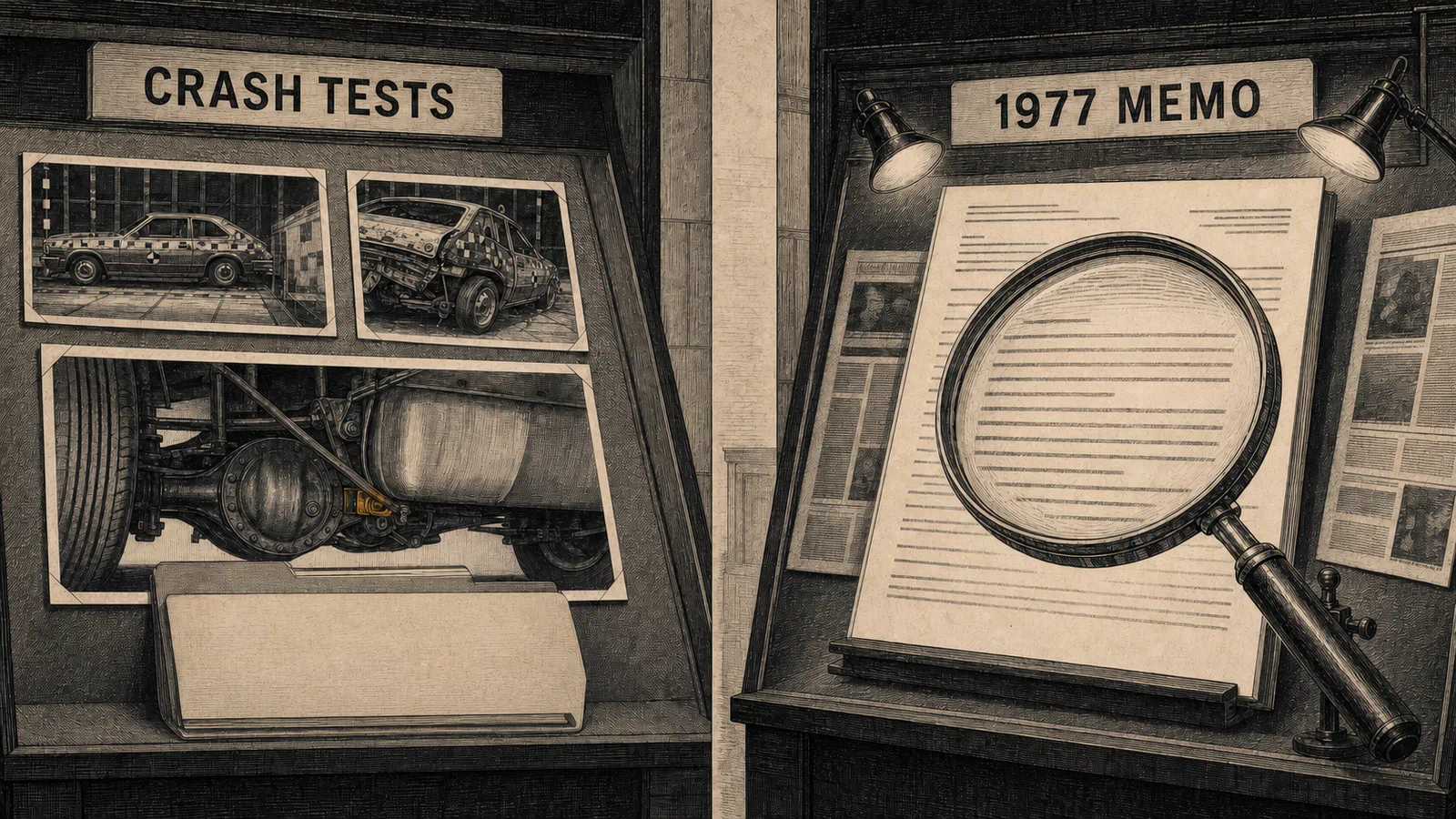
The crash tests came first. The 1977 memo later became the story most people remembered.
In 1978, the National Highway Traffic Safety Administration , known as NHTSA, issued a finding on certain Pintos and Mercury Bobcats. It said the cars posed an unreasonable risk of substantial fuel leaks in rear crashes at low or moderate speeds. The finding covered 1971-1976 Pintos and 1975-1976 Bobcats, but not station wagons.
The agency named two main ways the system could fail: the fuel-filler pipe could separate from the tank, or the tank’s forward face could be punctured. If the leaking fuel met a spark or another ignition source, it could catch fire.
Ford disputed the finding but agreed to recall about 1.4 million vehicles. The main changes included a longer filler pipe, a better seal, and a plastic shield in front of the tank.
The records used here do not establish a reliable total of deaths or injuries tied to this defect, so this account does not offer one.
By then, the cars were already on the road, so Ford had to find the owners and change the cars one at a time.
Who Could Stop the Line?
The record says that in at least one test, spilled fuel entered the driver’s compartment. What should have happened next?
The report should say what broke, how people might be hurt, what remains unclear, and which fixes need another test. Then it should reach a named person with power to approve a change, pause the launch, or stop production. If that person says no, the reason should go in writing and engineers should have a clear path to appeal.
Paperwork cannot repair a car. Its value is keeping a warning alive until it reaches someone who can act.
One exposed bolt makes the case easy to see. The first failure happened in metal: a rear crash could push the tank into an ordinary bolt and puncture it. Ford’s tests showed that path before federal rear-impact requirements first applied to 1977-model passenger cars.
The record shows that engineers proposed a buffer and Ford declined it. It does not show how the warning moved through Ford or who made each decision. The car reached the market, and drivers carried the risk.
Once the test showed what the metal would do, safety depended on the full result reaching someone with the power and duty to change the car.