The Brass Disk in the Sidewalk
A survey mark looks like a small civic relic. It is part of the public coordinate system that lets roads, deeds, bridges, flood maps, emergency plans, and GPS argue about the same ground.
In this article
The Disk Underfoot
A brass disk in a sidewalk asks for almost nothing.
It sits flush with concrete. Rain finds the rim first. The center may be stamped with a station name, a year, an agency mark, and a warning against disturbance. A shoe crosses it. A stroller wheel clips it. A surveyor may kneel over it with a tripod and a field book. Most people pass the point without knowing that a public coordinate is underfoot.
The disk is a survey mark. The word benchmark often gets used for all of them, but NOAA’s National Ocean Service explains the distinction: a benchmark is one kind of survey mark, and survey marks can be metal disks set in concrete or bedrock. The same NOAA page defines geodesy as the science of measuring Earth’s size and shape and accurately locating points on its surface. That sounds remote until the point is in the sidewalk.
The small object gives the country a way to say here.
NOAA’s survey mark fact sheet says the National Geodetic Survey and its predecessor agencies have placed permanent survey marks throughout the United States since 1807. It describes typical marks as brass, bronze, or aluminum disks or rods, while some marks use prominent objects such as towers or spires. The same fact sheet says the NGS database contained information on about 1.5 million survey disks across the United States and its possessions.
The current public map layer is narrower than that older broad description, but it shows the same public habit in working form. On June 23, 2026, a count query to the NGS Datasheets Feature Service reported 798,914 features in its public datasheet layer. That figure describes the records exposed through the service at that time, not every mark ever set, every disk ever placed, or every local control point in the country. It is enough to show the scale: public coordinates are a maintained record system.
The mark looks local. The system behind it is national. The conflict inside it is civic. A country that governs land, water, construction, emergency response, property, and risk needs a shared language of place before its arguments can be honest.
A Country Learns To Share Place
The United States began measuring its coast before it had a modern map of itself.
NOAA’s history of the Coast and Geodetic Survey traces the line back to President Thomas Jefferson’s 1807 act establishing the Survey of the Coast. The early work served a practical federal task: measure the coast, improve charts, and make commerce and safety less dependent on guesswork. In time, that work became triangulation, leveling, gravity measurement, datums, and published control.
A survey mark is one of the places where that work touches the ground.
The mark carries an old public idea: a measurement should be recoverable by someone else. The next surveyor should be able to find the point, read the record, test the condition, and connect local work to a larger frame. Without that habit, the country fills with private coordinate dialects. One crew’s grade, one builder’s plan, one courthouse record, one map layer, and one emergency route can each look exact while disagreeing with the others.
The old survey system did not make America simple. It made disagreement legible.
That distinction is worth keeping. Public control points never removed conflict over land. They made the conflict answerable to a record. A deed might carry metes and bounds. A road project might carry stationing and elevations. A flood insurance map might carry contours and base flood elevations. A bridge plan might carry a vertical reference. A court case might ask where a line was set. In each case, the measurement has force only when someone can say which ground, which datum, which mark, which coordinate system, and which record.
The U.S. Geological Survey makes the modern relationship plain. Its benchmark FAQ says most survey marks were set by the U.S. Coast and Geodetic Survey, now NGS, and directs users to NGS for records. A USGS Yellowstone note describes benchmarks as reference points with known elevation or position, set relative to a reference such as sea level or latitude and longitude. It also notes that classic disk benchmarks are often about 3.5 inches across and may be used for boundaries and construction.
The disk is small because it points into a larger public chain: observation, adjustment, publication, recovery, correction.
That chain is fragile in ordinary ways. A mark can be paved over. A bridge can be replaced. A curb can be cut. A sidewalk can be rebuilt. A file can be copied without its datum note. A plan set can survive in a clerk’s archive while the field condition changes. The country has thousands of ways to keep place and thousands of ways to lose it.
The old federal survey did not solve that problem once. It built a public routine for working on it.

A survey mark turns location into a record that engineers, clerks, builders, and mapmakers can share.
How A Point Becomes Public
A point becomes public through discipline.
Someone observes it. Someone describes it. Someone sets a mark, or recovers an older one, or records why a mark can no longer be trusted. Someone adjusts the observation against other observations. Someone publishes a datasheet. Someone later reads that datasheet in a field truck, a public works office, a courthouse, a GIS department, or a consulting engineer’s plan review. The mark is physical. The authority is procedural.
That procedure gives geodetic control its civic value. A private measurement can be useful to the person who made it. A public control point has to survive another user’s skepticism. The mark has to be findable. The description has to be clear. The datum has to be named. The height has to carry a method. The coordinate has to say which frame supports it. The record has to reveal enough about quality that the next user can judge the risk.
NGS datasheets show this discipline in compact form. A station record may include a permanent identifier, designation, state and county, latitude and longitude, orthometric height, geoid model, order, class, method, accuracy notes, marker type, setting, stamping, stability, recovery descriptions, and warnings. The public sees a disk; the surveyor sees a chain of evidence. The useful public fact is created by the connection.
That connection carries the most weight when the next user has a different job than the person who made the original observation. A road designer may need a vertical benchmark. A title surveyor may need a boundary tie. A floodplain manager may need a base elevation. A utility engineer may need control for a buried line. A court may need to know why a line on paper should govern a line on the ground. None of those users needs every detail of geodesy, but each needs the record to carry its own limits.
The public coordinate system is therefore a practical trust system. The reader trusts a published process, inspects the record, and matches the use to the quality of the control. A first-order vertical mark carries a different kind of confidence than a rough handheld GPS location. A recovered mark with a clean history carries a different risk than a disturbed mark under new pavement. A coordinate without a datum note asks for confusion.
This is why a survey mark can look humble and govern expensive choices. The object is cheap compared with the decisions that lean on it. The disk may cost little. The bridge design, drainage project, subdivision, flood appeal, or emergency route can carry millions of dollars and years of public consequence. The small object works because many users can meet there.
In that sense, geodetic control is a form of public memory. It remembers where the country said a point was, under which frame, with which quality, at which time. It does not freeze the earth. It gives later users a way to account for movement, improvement, error, and change. Public memory of place has to be technical because place itself becomes technical once money, law, risk, and construction depend on it.
The brass disk is one visible part of that memory. The datasheet is another. The statute, plan note, benchmark description, flood panel, and project file are others. Each can fail alone. Together they give public life a way to keep a promise about where things are.
The Datum Beneath The Deed
A datum is a reference frame. The phrase is plain. The consequences are not.
Latitude, longitude, elevation, a road grade, a flood contour, a bridge clearance, a parcel corner, a drainage invert, and a state-plane coordinate all need a frame beneath them. A number without its datum can look precise and travel badly. The same point on the ground can be described in different systems. The same elevation can change meaning when a public record is tied to another vertical reference. The problem is not ordinary error. The problem is a clean number with a hidden parent.
That parent can reach into law.
Florida’s state-plane-coordinate statute says coordinates may be used to define or designate positions for land descriptions and subdivision purposes, provided the description is tied to a government corner or other recorded and well-established corner. It describes northing and easting and ties the Florida State Plane Coordinate System to geodetic control stations of the National Ocean Service within the state. The statute also says positions on that system are marked on the ground by geodetic control stations established under National Ocean Service standards, with positions adjusted on the North American Datum of 1983 and computed on the Florida State Plane Coordinate System.
That is the public machinery of place.
The statute shows why this subject belongs outside the trade journals. A legal description can borrow the public authority of a coordinate system. A survey connection can lean on federal geodetic control. A subdivision can depend on a point that a surveyor, recorder, engineer, and later owner may have to read together. When coordinates enter land records, the datum becomes part of the public meaning of property.
The same logic reaches flood risk. A flood map is a stack of public choices: which terrain, which water model, which map panel, which elevation, which vertical datum, which record date, which appeal path. A homeowner may meet that stack as an insurance bill or a permit elevation. A city may meet it as drainage design. An engineer may meet it as a benchmark note. A court may meet it after a dispute.
NOAA’s current New Datums page says the North American Datum of 1983 and the North American Vertical Datum of 1988 remain the official horizontal and vertical datums of the National Spatial Reference System. It also names their weaknesses. NAD 83 is misaligned with Earth’s center by about 2.2 meters. NAVD 88 is biased by about one-half meter and tilted by about 1 meter across the coast-to-coast span when compared with current global geoid models.
Those numbers sound technical until a public decision rests on a height.
Elevation carries legal and physical consequences. It can shape a floodplain map, a bridge clearance, a drainage design, a shoreline project, a construction benchmark, a parcel description, and an emergency plan. A half meter in the wrong place can become a permit condition, an insurance boundary, a design correction, or a future lawsuit. Precision leaves judgment in place. Bad reference frames make judgment look cleaner than it is.
The datum under the deed is the part nobody wants to discuss at the counter. It is also the part that lets the counter work.
When A Better Coordinate Arrives
The geodetic system has to admit a fact that politics often avoids: the ground moves, tools improve, old measurements age, and a record can be authoritative while needing correction.
That is why NOAA is modernizing the National Spatial Reference System. The official GovInfo record for the Federal Register notice published on October 9, 2024 says NGS plans to replace the NAD 83 frames and current vertical datums with four terrestrial reference frames and a new geopotential datum. It says the modernized system will use GNSS, including GPS, and a gravimetric geoid model tied to the Gravity for the Redefinition of the American Vertical Datum project.
The transition works through public administration: notices, beta tools, testing, comments, and agency adoption. NOAA’s NSRS modernization timeline says components are being rolled out for public testing during 2024 through 2026, with the current NSRS remaining official during that testing period. The NGS FAQ says federal civilian agencies that collect, produce, acquire, maintain, or disseminate geospatial data will have to use the new frames within five years after adoption by the Federal Geographic Data Committee as part of the NSRS.
The legal authority underneath the data system is also public. 43 U.S.C. 2805 , part of the Geospatial Data Act, sets responsibilities for covered agencies and National Geospatial Data Asset data themes. The Federal Geodetic Control Subcommittee charter places geodetic control in that federal coordination world. NOAA’s older statutory authority also reaches back through 33 U.S.C. chapter 17, subchapter II , which covers Coast and Geodetic Survey functions.
That architecture gives the public someone to hold responsible.
Modernization has a strong case. The old passive-mark network is hard to maintain as the primary access path for a country that measures with satellites. Ground marks can be destroyed. Some marks have sparse recovery histories. Some coordinates were observed under older tools and adjusted under older assumptions. A satellite-driven system, supported by NOAA’s Continuously Operating Reference Stations and modern geoid models, can give users a cleaner, more current frame.
The case against easy triumph is also strong.
Old records stay alive after better coordinates arrive. A construction drawing may cite NAVD 88. A local ordinance may name NAD 83. A state plane law may need revision. A surveyor may have to explain why two correct-looking coordinates differ. A floodplain manager may have to translate a map layer. A GIS office may have to train staff and update metadata. A town may have old plans, old plats, old benchmark notes, old software, and a new frame entering the same archive.
The new system can be more accurate and more confusing at the same time.
That is the public cost of precision. Better measurement does not erase the old record. It creates a duty to carry the old record forward without pretending it was timeless.
The Flood Map In A New Frame
Flood maps show the stakes because they turn elevation into household consequence.
NGS names this directly. Its FAQ says the new geopotential datum will affect Federal Emergency Management Agency Digital Flood Insurance Rate Maps, and it points to a North Carolina pilot project. The NGS/FEMA floodplain pilot report , prepared with North Carolina as the case, studied how replacing NAVD 88 with a new vertical reference could affect DFIRM products. The report is technical, but the public meaning is simple: a datum change can reach the map that tells people where flood risk is recorded.
The pilot should be read with care. It supports no blanket claim that every property moves into or out of risk, no harm claim by itself, and no panic. It proves a more serious point: datum modernization changes the public records that other public records depend on.
FEMA maps carry legal and financial consequences. Local floodplain ordinances, building permits, insurance decisions, elevation certificates, and grant work all touch them. If a vertical datum changes, the work cannot stop at better science. Agencies have to translate. Local users have to understand. Old and new products have to be labeled. The public has to know when a change is a physical risk change, a reference-frame change, or both.
This is why surveyors can sound fussy about metadata. The fuss is a civic service when the metadata keeps a property owner, engineer, or clerk from treating two unlike elevations as the same fact.
The North Carolina pilot belongs in this essay because it refuses abstraction. The datum sits under the map’s public power. When a flood panel uses one vertical frame and a later model uses another, the public has to read the chain of custody, not simply applaud better science.
The strongest modernization argument and the strongest caution meet there. FEMA, NOAA, state offices, local governments, engineers, and property owners all need better height. They also need records that explain how better height connects to the height already printed in law, maps, plans, and files.
Old Records In A New Frame
The state plane coordinate system shows how a federal geodetic change becomes local work.
State plane coordinates make surveying and mapping practical by giving states and zones projected coordinate systems suited to local work. They turn latitude and longitude into northing and easting values that surveyors, engineers, and public offices can use with less distortion across a manageable area. The system is one way national geodesy becomes courthouse and construction language.
NGS has been preparing the State Plane Coordinate System of 2022 for the modernized NSRS. NOAA’s SPCS2022 policy page and the 2018 Federal Register notice on SPCS2022 policy and procedures show state-plane modernization as a policy project. It requires procedures, zones, stakeholder requests, and decisions about how the new reference frames will be used in local coordinate systems.
That is where modernization enters ordinary public work.
A state cannot simply receive a new federal frame and assume every deed, plat, project plan, and GIS layer will behave. Florida’s current state-plane statute names NAD 83 as readjusted in 1990. That is a perfectly real public law, and it is also an example of why transition takes more than technical release. The federal geodetic frame can move ahead, but state law and local practice have to decide how to receive it.
The cost includes software, coordination, training, contract language, and public explanation.
Surveyors need to know which frame a project uses. Engineers need plan notes that name the vertical and horizontal references. Local governments need procurement language that tells contractors what coordinates mean. GIS offices need layer metadata. Clerks and reviewers need a way to catch old-frame and new-frame mismatches. Public users need old maps and new maps to say what changed.
The Jacksonville record makes this concrete. A City of Jacksonville technical memorandum for a local project says all elevations in the survey reference NAVD 88 and identifies a reference benchmark: National Geodetic Survey monument DUV 32, PID DI0245, elevation 48.49 feet NAVD 88. The live NGS datasheet for DI0245 lists DUV 32 in Duval County as a tidal bench mark, gives its NAVD 88 orthometric height as 14.779 meters, or 48.49 feet, and describes the marker as a survey disk set in a bridge sidewalk.
That is the essay in one public file.
A local project needed elevations. The survey tied them to NAVD 88. The memo identified an NGS monument. The federal datasheet gave the mark’s record. The mark was in a sidewalk, exactly the kind of object a passerby might ignore. Yet the project file used it as part of the chain that made local ground legible.
When a new datum arrives, the old memo does not become trash. It becomes a record that needs translation. Its value depends on the benchmark note, the datum label, the public datasheet, and the reader’s ability to understand the old frame. This is the quiet administrative work that keeps modernization from turning the archive into a trap.
The archive is where accuracy meets time.
A public office may have plans prepared under one datum, GIS layers maintained under another, scanned plats with no digital metadata, flood panels with their own effective dates, and project files that were correct under the instructions given at the time. A later user can make an error without being careless. The error can arise because the record lost its frame on the way through copying, storage, conversion, or ordinary office reuse.
That is why old-record translation has to be treated as a public duty. The record custodian, project manager, surveyor, GIS analyst, and reviewer each sees a piece of the chain. The person who catches the datum mismatch may prevent a plan revision, a bad grade, a needless dispute, or a public explanation that arrives too late.
The problem also cuts against easy reform language. Better coordinates can improve public work. They can also make old records harder to use for people with fewer tools. A large agency may have staff, software, and training. A small town may have a shelf of old plans, a part-time consultant, and a floodplain administrator who has to answer a property owner’s question on a weekday afternoon. The same federal modernization can feel clean at the national level and messy at the counter.
Good public systems respect that difference. They explain the conversion. They keep old and new values labeled. They preserve recovery notes. They avoid claiming that a coordinate is better in the abstract when the user’s problem is the relation of one record to another. The goal is not to trap the public inside technical language. The goal is to make the technical language honest enough that ordinary public choices can use it.
The sidewalk disk teaches the same lesson in miniature. Every passerby can ignore it. The public system has a harder job: keep a known point recoverable for the people who need it, and explain its frame when the frame changes.
The Public Cost Of Precision
Public systems prefer clean stories. Geodesy does not give them one.
Old marks deserve care, not worship. New frames deserve adoption, not magic status. The surveyor who wants continuity is protecting evidence. The agency that wants modernization is protecting accuracy. The local office that fears confusion is protecting users. The homeowner reading a flood map has reason to care about a datum note that sounds like a footnote.
Each actor sees a real part of the problem.
NOAA and NGS have to maintain a national reference frame that matches modern measurement and the physical earth. Surveyors have to protect a chain of evidence that makes local work defensible. States have to keep coordinate laws and zone definitions usable. Cities and counties have to review plans, permits, and flood records without turning every datum note into a specialist hearing. Engineers and builders need stable instructions. Property owners need public records that do not bury the rule that changed the number.
The incentive problem is obvious. New precision rewards users who understand the update and punishes users who inherit old records without context. The burden often falls on the person farthest from the federal notice: the local reviewer, the field surveyor, the engineer revising a plan, the homeowner trying to understand why an elevation certificate and a map panel seem to disagree.
The tradeoff is also obvious. A country can keep old reference frames too long and pay for false continuity. It can move to new frames too quickly and pay for public confusion. It can write perfect metadata that nobody reads. It can simplify the message and hide the fact that old records remain legally alive.
No technical tool removes that choice.
The better civic answer is source discipline: name the datum, name the mark, name the coordinate system, name the record date, name the conversion method, name the uncertainty. The work is plain. It keeps public facts portable.
The brass disk helps because it gives the abstract system a body. A map layer can be too smooth. A GPS coordinate can feel too automatic. A federal notice can feel too remote. A disk in a sidewalk shows the bargain in a form anyone can understand: public life needs a shared point, and the shared point needs care.
The public risk is easy to underestimate because most datum trouble looks like paperwork at first. A field crew notes the wrong vertical reference. A scanned plan loses the sheet that named the benchmark. A GIS layer is copied into a new project with its coordinate metadata assumed instead of checked. A contractor reads a grade as if every elevation in the file came from the same frame. A floodplain reviewer catches the mismatch after the applicant has already paid for design work. None of these failures requires corruption or drama. The error grows out of ordinary public work moving faster than its records.
That is why the best technical systems have to respect dull acts of record care. A plan note that names NAVD 88 can save a conversation years later. A datasheet that records the mark setting and recovery history can tell a surveyor when field evidence deserves caution. A state statute that names its coordinate system can keep courthouse language aligned with professional practice. A federal transition page can keep local users from guessing about timing. A flood-map pilot can show where a datum change touches public products before the change arrives at a counter.
This work has an ethical weight without needing moral theater. Public records should not require secret expertise to avoid foreseeable mistakes. They will always require expertise to create and maintain, but ordinary users deserve records that carry their frame openly. A person reading an elevation certificate, a construction plan, a survey note, or a flood map should be able to learn which coordinate system is doing the work. The reader may need help interpreting the answer. The answer should be present.
That expectation is modest. It also gives the modernization project its public test. A new datum succeeds when it improves the frame and preserves the path back to older records. It fails the public when accuracy rises and traceability falls.
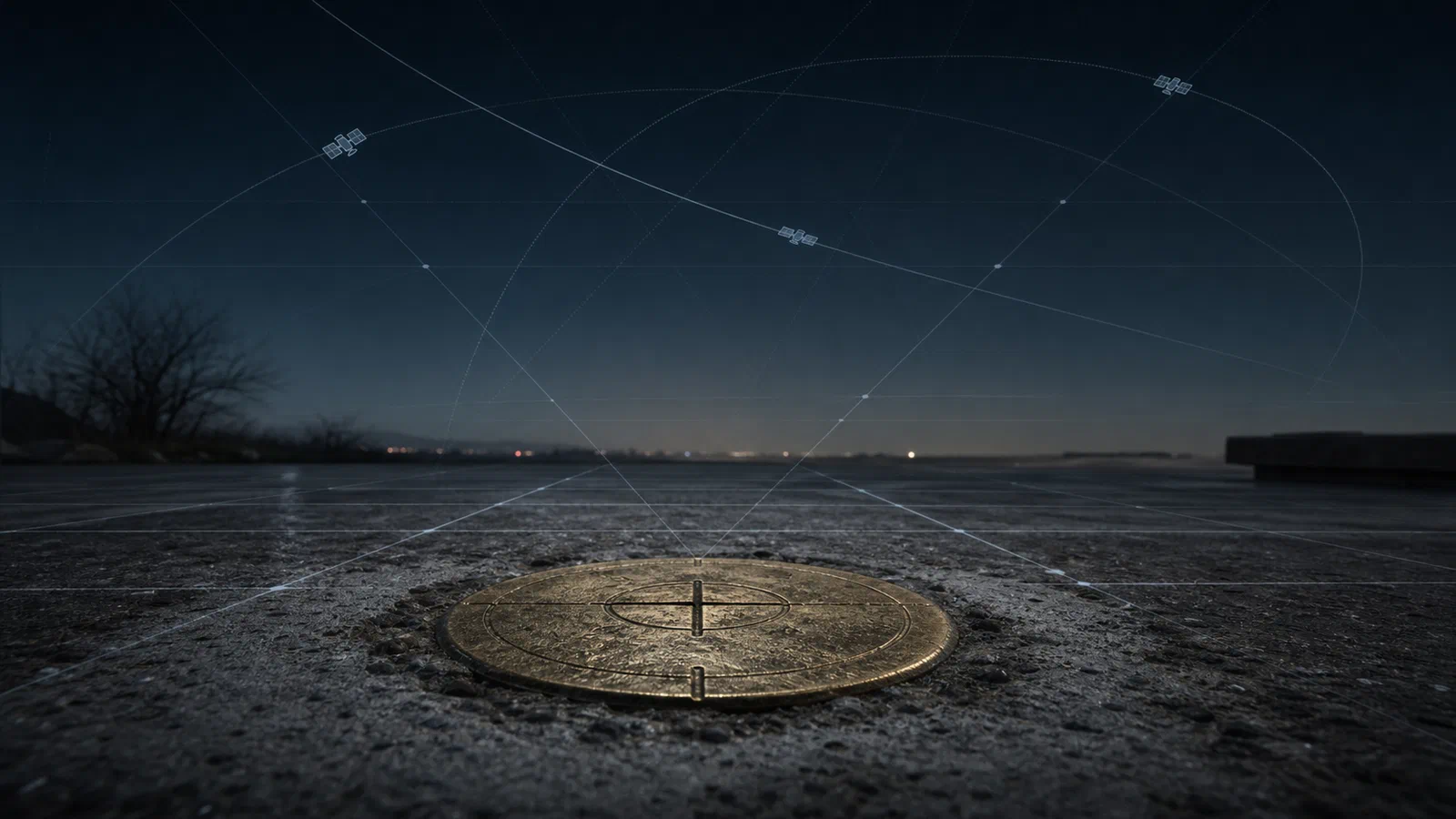
GPS makes location feel effortless, but the public frame beneath it needs custody.
Ground Truth
The brass disk survives by being boring.
It does not campaign for itself. It does not explain the history of the Coast Survey to the person stepping across it. It does not tell a homeowner which flood panel to trust. It does not tell a clerk whether a plat tied to an older datum needs a note. It does not settle a bridge design, a drainage dispute, a road alignment, or a property argument.
It does something smaller and harder to replace.
It gives the public a recoverable point in a system of points. It ties place to record. It reminds the country that location has custody. Someone measured. Someone adjusted. Someone published. Someone recovered. Someone may need to correct. Someone may need to explain the old number to the new system.
The phone in a pocket makes location feel private and effortless. The sidewalk disk says otherwise. Place becomes public through records, rules, marks, models, and shared obligations. The digital map inherits that bargain. The satellite signal inherits it. The flood map inherits it. The deed inherits it. The emergency plan inherits it.
The country will keep arguing about land, water, roads, property, risk, and public money. Those arguments will be hard enough on their own. They get worse when the parties cannot agree on where the ground is, which height is being used, or which record carries the frame.
Before the zoning hearing, the bridge plan, the flood appeal, the deed dispute, the construction bid, or the evacuation map, somebody has to make place legible enough for everyone else to fight over it honestly.
That work can begin with a brass disk underfoot.