The Card in the Catalog
A three-by-five record made public memory searchable before the search box made its judgments disappear.
In this article
A three-by-five library card looks too small for the work it carried.
It sits in a drawer with a round hole near the bottom edge, a typed title, a call number, a name, a place, a year, a subject heading, maybe a note. Pull the drawer too quickly and the cards press forward against the metal rod. Push it back and the library returns to quiet. The sound is plain. The system behind it is large.
The card catalog gave public memory a body. A reader could stand at the cabinet and search by author, title, or subject without knowing the whole collection in advance. A book could appear in several places at once. A new acquisition could slide into the alphabet without a new printed volume. A correction could move through the drawer by hand.
That made the card more than a filing device. It was a civic technology, built out of paper, standards, labor, shared language, and trust. The reader saw a small record. Behind it stood catalogers, printers, rules, public budgets, local exceptions, national ambition, and arguments over the words that should guide a stranger toward a book.
In April 2026, the Library of Congress announced that 56 retired card-catalog cases were traveling around the country as kiosks. The drawers no longer held the Library’s working catalog. They carried cards about Library services, along with QR codes pointing toward digital resources.
The gesture was easy to like. A retired cabinet became a friendly public object again. Yet the better lesson sits below the charm. Search has always depended on prior judgment. Someone has to write the card.
The Drawer
The drawer made a library feel legible.
A reader came with partial knowledge. A surname. A title half remembered. A subject. A date. A reference copied in a notebook. The cabinet gave that uncertainty a place to begin.
Older catalogs could serve a stable shelf well. A shelf list described books in shelf order. A bound catalog could give the public a printed inventory. Each had force. Each also hardened quickly as books arrived.
A single shelf order helped the person who already knew the shelf logic. Many readers came through another door, carrying a name, a subject, or a fragment. The card changed the grain of access by making each record movable, letting one book occupy several paths, and allowing the alphabet to absorb growth. It also made public search tactile. Readers handled the system. They could see the order, the blank space, the cross-reference, the worn edge, the hole and rod that kept the drawer from falling apart.
The Library’s own history of the card catalog, published in 2017, describes a long path that ran through European precedents, Harvard cataloging, Charles Coffin Jewett’s national-catalog dreams, Charles Ammi Cutter’s dictionary-catalog logic, and the Library of Congress’s growing collection after the copyright law of 1870 began sending deposits to Washington. Herbert Putnam arrived as Librarian of Congress in 1899, and the Library faced a collection too large for older habits. The point of that lineage is practical: every catalog experiment tried to connect a person with a record before the person knew the collection well enough to move through it unaided.
The card was useful because it solved a practical problem without shrinking it. Readers knew pieces. The library knew holdings. The catalog had to build several roads at once, then keep those roads open as collections grew.
That is why the little card deserves the same kind of attention given to maps, street signs, inspection stamps, ballot envelopes, water meters, and deeds. Each object makes a public system usable by ordinary people. Each looks modest after the system learns how to disappear inside it.
A Catalog That Could Move
The core advantage of the card was motion.
Bound catalogs had authority. They also had weight. Once printed, they resisted change. A card catalog could accept a new book, a revised heading, a corrected author form, or a cross-reference without breaking the whole order. The cabinet became a living index, and the index could grow one record at a time.
That feature made shared cataloging imaginable. Agree on the size of the card, the form of the entry, and the meaning of headings; a record written in one office could serve readers elsewhere.
The idea had tempted librarians for decades because repeated cataloging work in hundreds of towns was costly. Large libraries had expert staff. Smaller libraries often had thin budgets, small staffs, and growing shelves. The national version of the idea took shape at the Library of Congress. The 1901 Report of the Librarian of Congress explained that the Library was beginning to distribute copies of its printed cards for two linked purposes: to place knowledge of the national collection in local centers of research, and to let other libraries reuse the Library’s cataloging and printing work at a fraction of the independent cost. The report also included the October 28, 1901 circular that began the service. The Library said it was ready to furnish copies of cards it was currently printing and copies already in stock. It listed current copyrighted books, miscellaneous acquisitions, and reclassified parts of the existing collection. It explained how orders could use the weekly copyright list, the trade press, galley strips, printer’s numbers, or a precise handwritten memorandum.
The rates are the kind of detail that makes the public system visible. A single copy of a card would cost two cents. Additional copies could cost a half-cent, or four-tenths of a cent when ordered before printing. Remittances went to the Public Printer. The Librarian of Congress was acting inside the printing law and asking Congress for clearer authority to credit card-sale money back to the Library’s printing allotment.
This was no romance of books. It was public administration. The card catalog became scalable because someone had to price stock, handle orders, define acceptable descriptions, govern advance payment, route state library commissions, and decide how standard the card should be.
The civic promise came through the office work. A small library could buy a record for a book it already owned. A larger library could compare holdings with Washington. A state commission could gather smaller orders. A national collection could become visible outside the capital one card at a time.
The Card Leaves Washington
The service moved quickly.
The 1904 Library of Congress annual report said printed-card distribution had made satisfactory progress and had become established in the economy of American libraries. Subscribers had increased about 35 percent in the year. Card sales had increased about 20 percent. Complete files of the printed cards were available at 25 centers in the United States and Canada, with arrangements made for deposit sets in Brussels and Sydney.
By the 1907 report , the Card Section listed 952 subscribers. The classification of those subscribers tells the story better than a slogan. The list included 26 public libraries over 100,000 volumes, 75 public libraries with 25,000 to 100,000 volumes, 122 public libraries with 10,000 to 25,000 volumes, and 287 public libraries below 10,000 volumes. It also included colleges, universities, public schools, normal schools, state libraries, law libraries, art libraries, learned societies, booksellers, publishers, government departments, and foreign government libraries.
The national card had entered local practice.
One Pittsburgh example shows the local side of the story. The Carnegie Trusts’ history of the Carnegie Library of Pittsburgh records that the library became a depository for Library of Congress catalogue cards in 1908 . That line is brief, but it carries weight. Pittsburgh was no passive receiver. It had its own library ambitions, branch growth, school, local collection, and cataloging practice. The LC card entered a city library as part of a local public apparatus.
The Free Library of Philadelphia provides a physical trace of the same pattern. A Historic American Buildings Survey record for the Parkway Central Library identifies a first-floor west corridor as originally known as the “Library of Congress Card Catalog” . The phrase survives as a room name and architectural memory. The national card system occupied local public space.
None of this means local libraries surrendered judgment. Many libraries used LC cards as a starting point, selected cards that suited their collections, altered headings, added local notes, or kept local rules. The power of a shared record lived with local adjustment. A common card could save labor, but each library had to make the card work for its readers, shelves, staff, and catalog.
This is the bargain every shared public record makes. Shared standards lower cost and raise interoperability. Local realities create pressure on the standard. When the standard travels far enough, it can become the default language of public access, even for people who never agreed to its grammar.
The Labor Under The Drawer
The card catalog made search look orderly because a great deal of disorder had already been absorbed by workers.
The 1901 report is full of clerical detail that modern readers may slide past. Old manuscript author cards had to be revised. Subject cards had to be compiled. Titles cut out of old book catalogs had to be pasted on cards for temporary use. The public catalog in the Reading Room had to receive accessions, reclassified books, and corrected entries. The report counted 329,049 cards filed during the year.
Filing sounds minor until the scale appears. A single misplaced card could misdirect a reader. A missed subject card could hide a book under the wrong road. A new heading could demand many small acts: typing, prefixing, checking, filing, withdrawing, cross-referencing, and teaching staff how the change should appear. The drawer looked calm because the work was repetitive, exact, and public-facing at once.
The printed-card service added another layer. The Library had to receive orders, identify books precisely, print enough cards, keep stock, handle remittances, and ship cards to libraries that had different sizes and needs. The 1901 circular told libraries that a memorandum had to identify author, brief title, number of volumes, date, publisher, and place. The rule sounds fussy. It was the defense against ordering the wrong record.
The 1907 report named the Card Section’s work with the same practical texture. In addition to the Library of Congress series, cards were printed for the Department of Agriculture, the Geological Survey, Washington Public Library, and the War Department series. Different public bodies needed different slices of the record. The Post Office Department wanted cards on postal service. The Naval Observatory wanted astronomy, mathematics, and physics. The National Bureau of Standards wanted cards in scientific and technical fields tied to its work.
The detail carries force without needing grand language. The card was a shared form, but the demand for cards followed real public duties. A scientific bureau, a military school, a public library, and a small town branch did not use a catalog in exactly the same way. The shared record traveled because it could be adapted to many public jobs.
The printed card also created a new kind of dependency. A library that saved labor through LC cards depended on the pace, definitions, stock, and distribution rules of the national service. A local staff could revise a card, but the inherited description shaped the first draft of local access. A national saving became a local habit.
That is the normal price of shared infrastructure. No town wants to invent every road sign, postal route, accounting category, or catalog heading alone. Shared forms allow public systems to scale. They also create places where an error can travel farther than the office that made it.
This is why the old drawer should be read as a record of work, not as furniture. It gathered thousands of tiny administrative acts into a public surface. When readers found the right book, the card made the result feel simple. The simplicity had been manufactured.
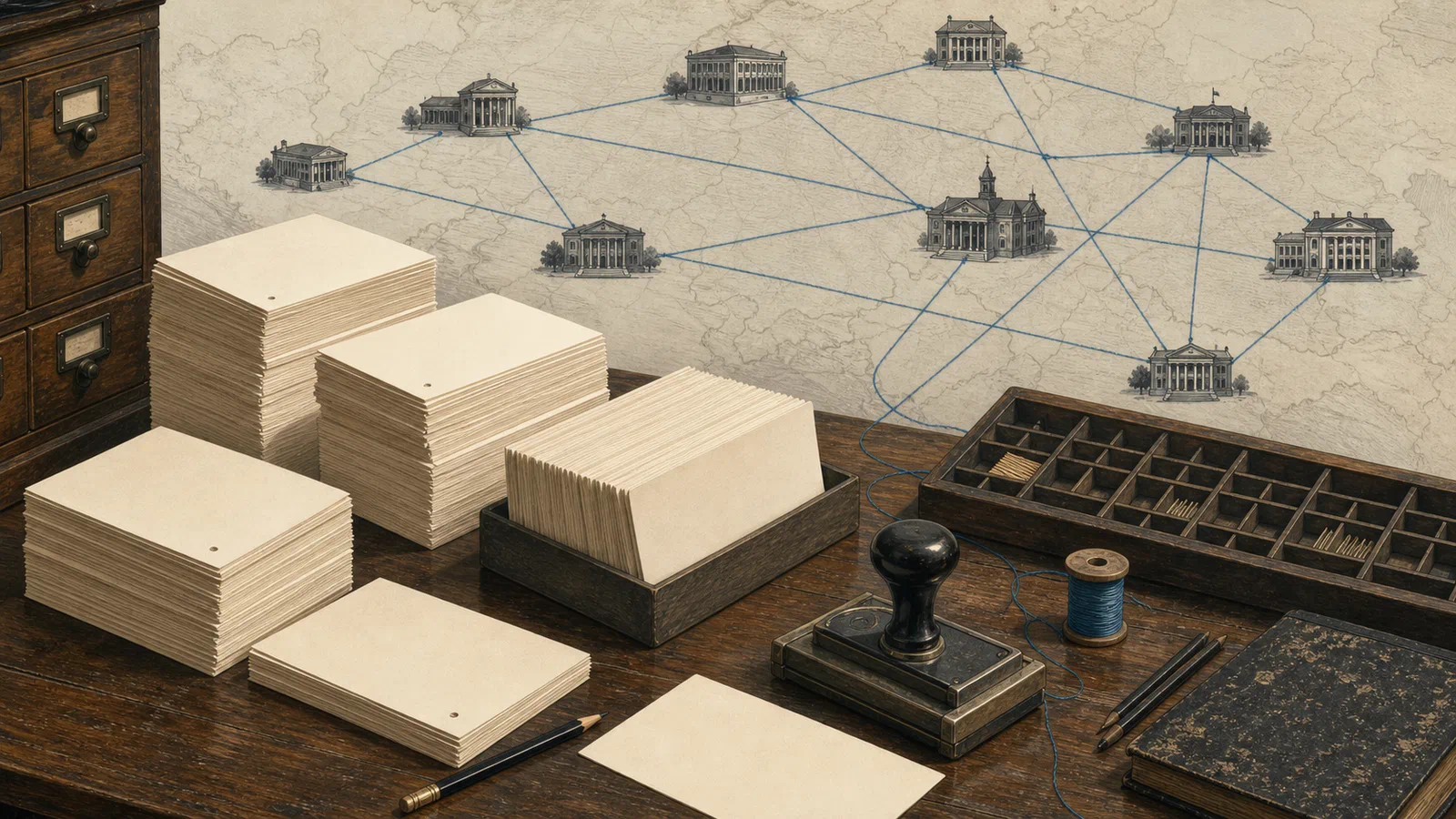
A shared catalog card turned local drawers into a national record system.
The Words On The Card
A catalog card looks factual. It also makes choices.
It has to decide the main entry. It has to choose a name form. It has to describe the item. It has to decide which subjects count. It has to choose the words that lead a reader toward the shelf.
The Library’s 1998 history of LCSH traced Library of Congress Subject Headings to the new dictionary catalog that began in 1898. In that dictionary catalog, author, title, and subject entries appeared together in one alphabet. The headings were built for the Library’s own catalog and later served thousands of other catalogs through printed cards and machine-readable records.
Controlled vocabulary gives search a public route. If every cataloger uses a different phrase, the reader has to guess each local habit. A controlled heading gathers related works under an authorized form. It also creates references, broader terms, narrower terms, and related terms that guide a reader through the collection.
The value is clear. A user searching one accepted term can find works that use many different title words. A subject heading can connect books, archives, images, recordings, maps, and reports under one path. It can protect a reader against synonym chaos.
The cost is equally real. The chosen word carries power. It can lag common use. It can mirror legal vocabulary that some readers experience as harsh. It can preserve older assumptions in thousands of records. It can make a public collection feel alien to the people described inside it. It can also change too quickly for local catalogs to keep up.
Cataloging therefore sits at the point where language becomes public infrastructure. A heading is never pure description. It is a decision about how readers will travel.
When A Heading Changes
The Library of Congress Subject Headings dispute over “Illegal aliens” shows how much pressure a few words can carry.
In March 2016, the Library’s Policy and Standards Division released a decision document explaining its plan to revise the heading “Aliens” to “Noncitizens” and cancel “Illegal aliens.” The old heading would become a former-heading reference to “Noncitizens” and “Unauthorized immigration.” The document said “Aliens” had become confusing because of conflicting dictionary meanings, and the phrase “illegal aliens” had taken on a pejorative tone.
The same document also shows why subject-heading work resists easy political sorting. Dartmouth College had requested “Undocumented immigrants.” ALA Council had urged the same term. LC staff concluded that phrase created its own descriptive problem because not all people covered by the topic intend to immigrate, and some have documents of a kind. The meeting included staff tied to law cataloging, the Law Library, Congressional Research Service, cooperative cataloging, and the subject-heading office. The result tried to separate a legal condition, a person category, and an act of unauthorized relocation.
Public comment followed. Congress also entered the picture. The Library’s FY 2017 Acquisitions and Bibliographic Access Directorate annual report said public feedback and added source consultation moved staff toward “Illegal immigration” in place of “Unauthorized immigration.” It also noted a House committee instruction that, as far as practicable, the Library maintain certain headings reflecting terminology in Title 8 of the United States Code.
The current published LCSH I volume shows the settled machinery in action. “Illegal aliens” appears as a former heading directing users to “Illegal immigration” and “Noncitizens” . The dispute left marks in the catalog. It left former-heading references, local decisions, policy explanations, anger, relief, and a record of how language enters and exits authority.
This case is easy to flatten into a culture-war symbol. The cataloging lesson is harder and more useful. Public search needs stable words. Public trust needs revisable words. Law uses one vocabulary. Communities often use another. Libraries hold both legal and human descriptions. Each revision has costs: staff time, record repair, user retraining, local disagreement, and national attention.
The card catalog made the cost visible because a change had to be filed. The online catalog can hide the same work behind a nightly batch, an authority update, a vendor display layer, or a local mapping. Hidden work remains work.
The Machine Reads The Card
The computer did not make the catalog card vanish. It made the card legible to machines.
MARC means Machine-Readable Cataloging. The Library’s own Understanding MARC Bibliographic explains the link directly: a MARC record is a machine-readable cataloging record, and the cataloging record contains the kind of information traditionally shown on a card. The fields identify authors, titles, editions, publication data, subjects, notes, identifiers, and access points. A program can then search, display, print, exchange, and sort the record because the pieces are marked.
Henriette Avram gave that translation its shape. The Library’s 2006 Information Bulletin obituary called Avram the “Mother of MARC” . She joined the Library of Congress in 1965 after work in early computing and systems analysis. With a small team, she completed the MARC Pilot Project in 1968. The format became the preferred library exchange format in the United States, later an international standard.
Avram’s work did more than type cards into a database. It created a structure where the old descriptive labor could travel through computers. A title field could be recognized as a title field. A subject field could be searched as a subject field. An authority-controlled name could stay consistent across records. A local system could receive a record written elsewhere and know what its parts meant.
That is why MARC belongs in the same story as the printed card. Both were exchange technologies. The printed card moved cataloging by mail and drawer. MARC moved cataloging through data files, tapes, networks, utilities, and online catalogs. Each promised savings through shared work. Each also spread shared assumptions.
The Library’s current MARC 21 Bibliographic Format keeps current force as a maintained technical record, with updates listed through May 2026. OCLC’s Bibliographic Formats and Standards carries the same inheritance into shared cataloging practice across libraries that exchange records through WorldCat and related systems.
The old reader saw a card. The modern reader sees a search result. Underneath, there are tags, indicators, subfields, authority records, holdings, local notes, vendor indexes, and display choices. The cabinet became an interface. The card became a record. The record became data. The human judgment did not leave.
The Name Behind The Name
A catalog needs more than titles and subjects. It also needs name control.
The same person can appear under initials, married names, pen names, transliterations, errors, and variant spellings. The same organization can change names, split into a new body, merge with another, or publish under an office that later disappears. Without authority control, a reader can miss half the record while searching the correct person under the wrong form.
The Library of Congress Authorities system gives the public a view into that layer. It contains name, title, subject, and name-title authority records. These records are dull in the productive sense. They do not perform for the reader. They tell systems which form should gather related records and which forms should point toward it.
Authority work is a democratic convenience with an expert spine. A reader should not need to know every variant name in order to find a writer, agency, court, song, treaty, or series. The system carries that burden. Yet the burden is never weightless. Someone has to decide which form becomes authorized, which variants become references, which relationship notes help, and which changes require repair across a catalog.
This has consequences outside libraries. Public databases often fail at names. One person can appear under several spellings in court records. A business can appear under trade names and legal names. A public agency can rename a program while older records keep the former label. A land record, permit file, hearing transcript, or budget line can become harder to find because the name bridge was never built.
The authority record is the bridge. It is quieter than the subject heading dispute because it rarely produces a public fight. Its civic value comes through ordinary relief: the user who finds a record without knowing the old spelling, the student who finds an author under a birth name and a later name, the researcher who follows an office through several reorganizations.
The card catalog taught this lesson in visible form. See-also cards told readers that the first phrase was only one path. Name references admitted that public memory has aliases. The online catalog can perform the same act faster and with richer links, but the principle is unchanged. Search depends on a maintained set of relationships among names, works, subjects, and records.
When those relationships are visible, the reader learns how to move through public memory. When they are hidden, the reader has to trust a system whose map remains offstage.
The Search Box And Its Owners
Digital search improves the reader’s life in obvious ways.
It reaches remote users. It searches more fields. It filters by date, format, place, language, and availability. It links a catalog record to a digital copy, a request button, a finding aid, or a different library. It lets a reader search at midnight instead of standing in one building during open hours. The gain is real.
The tradeoff is visibility. The card catalog put the system in the room. Online search places much of the logic behind the screen.
That logic is no longer controlled by the library alone. The modern catalog can sit inside a discovery layer that searches local records, licensed databases, repositories, ebook platforms, vendor indexes, and web services at once. The same page may authenticate users, personalize results, store histories, rank relevance, add recommendations, and route users through third-party code.
ALA’s Library Privacy Guidelines for Library Websites, OPACs, and Discovery Services describe this shift plainly. OPACs and discovery services may collect personal information for authentication, personalization, and analytics. Services may be managed by the library, a parent body, a consortium, a vendor, or a mixture of those actors. ALA warns that search histories should be opt-in, that data retention needs limits, and that third-party scripts and analytics can create privacy risk.
NISO’s Privacy Principles place the same problem in a wider systems setting. Libraries, publishers, and software providers share responsibility for privacy; transparency, data minimization, anonymization, informed consent, access to one’s own data, and accountability all need design attention.
These privacy sources may look distant from a card catalog. They are not. The old card made public search visible, but it also made certain searches public in the room. A patron standing at a subject drawer could be observed. A paper slip could be left behind. A circulation record could expose a reading life. Libraries developed privacy ethics because search and reading are intimate acts.
The digital catalog changes the scale of that problem. A search query can become a log entry. A click can become analytics. A discovery layer can call outside services. A patron account can hold requests, holds, fines, saved searches, and borrowing history. Search becomes more useful as it becomes more measurable, and more fragile as those measurements travel.
The public problem is not technology itself. The problem is invisible governance. Readers can argue with a heading they can see. They have a harder time arguing with an undisclosed ranking rule, an opaque vendor index, a retained activity log, or a search result that hides why one record surfaced above another.
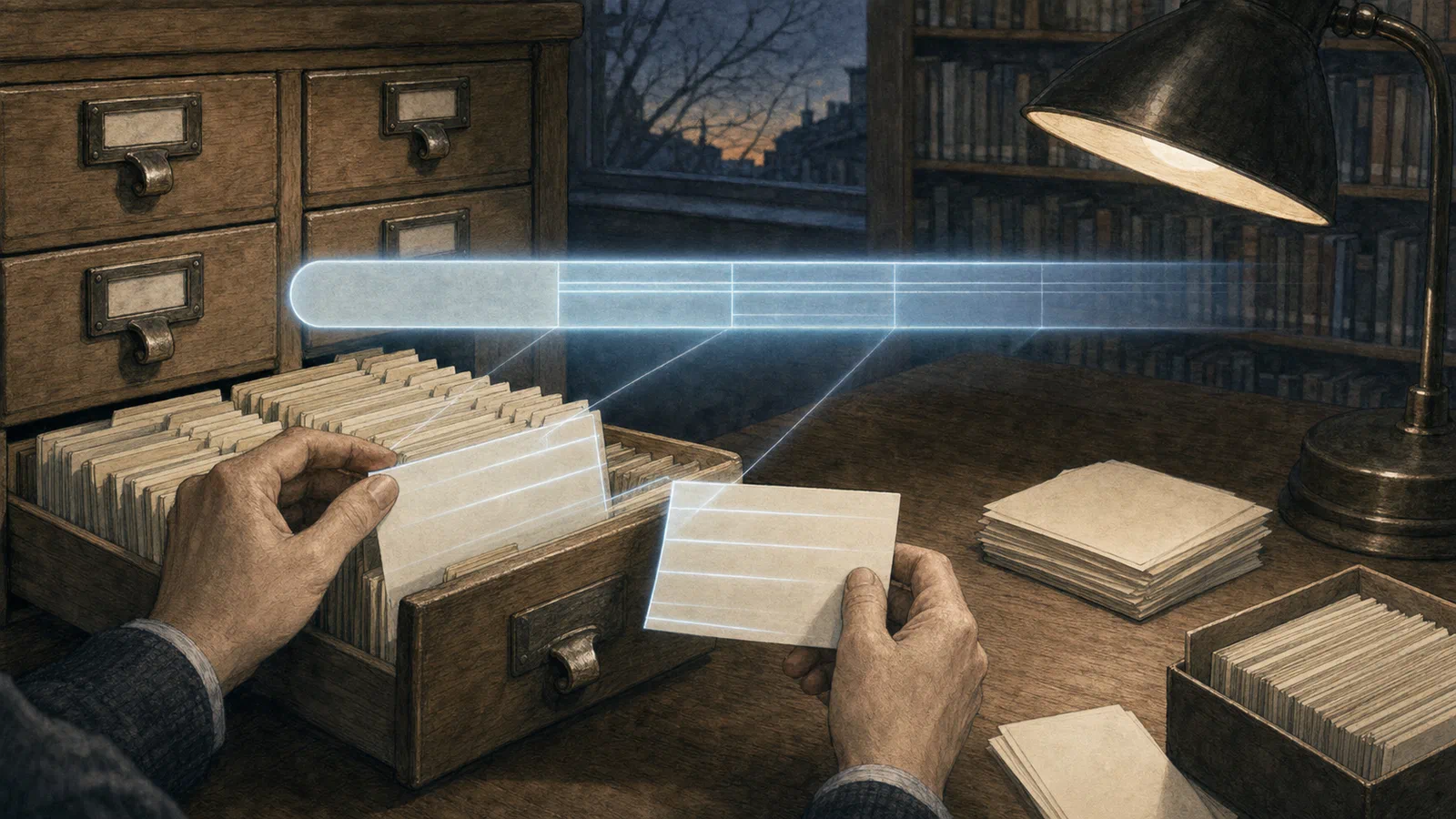
The search box inherited the card catalog’s old burden: public memory needs human description before it can be found.
What The Drawer Could Teach
The card catalog deserves respect without nostalgia.
It was slow. It occupied space. It required trained labor. It could preserve old language and make a user stand in line for a drawer. It gave readers only the paths the catalog had built. It could fail anyone who came with the wrong word.
The screen fixed many of those failures. It also weakened a useful public habit: the habit of seeing search as a constructed thing.
The drawer announced construction. Its very material said that the record had been made, filed, touched, corrected, and used. The cards wore down where readers handled them. Cross-references showed that one term had to point toward another. A handwritten correction proved that the record could be wrong.
Modern search often arrives as a blank field and a ranked list. Its clarity can make the record look natural. A reader types and receives. The path seems to come straight out of the collection, as if the system had no author.
That illusion spreads beyond libraries. Courts, land offices, archives, health agencies, schools, city governments, and public utilities all depend on searchable records. People need to find ordinances, deeds, budgets, hearing transcripts, maps, inspections, environmental records, case files, photographs, minutes, and forms. A public record buried behind a broken search tool may be public in law and hidden in practice.
The card catalog teaches a humbler rule. Access has layers. A record must exist. It must be described. It must be placed in a system. The language of the system must be visible enough to learn. The path must be maintained. Errors must be correctable. Power over the record must have a name.
The old card carried those layers on its face. It named the author, title, subject, date, place, and shelf. It pointed elsewhere. It did not pretend to be the book.
The Drawer Returns
The 2026 kiosk project works because the object remembers its old job.
The Library could have built a flat promotional display. It chose retired card cases. A visitor pulls a drawer, reads a card, and follows a route. The movement itself carries the lesson. Public knowledge asks for a path.
The project also risks a softer reading. A card catalog can become a prop for library nostalgia: oak drawers, brass pulls, typewriter letters, a slower age. That memory is harmless until it replaces the harder story. The harder story is labor and governance.
The card catalog was a public search machine. It worked through trained catalogers, steady public funding, printing contracts, common stock, subject rules, correction, local adaptation, and the willingness of libraries to accept shared records while keeping local responsibility. Its usefulness came out of discipline, not charm.
The same standard should apply to the search box. A good public search system has to disclose enough of its logic for users to trust and challenge it. It has to protect readers whose searches reveal thought, fear, politics, faith, illness, grief, curiosity, or dissent. It has to revise language without pretending revision is free. It has to respect local knowledge without sacrificing the shared road that lets records move.
None of those tasks will be solved by returning to drawers. The card catalog reached its physical limit. The Library’s main catalog once held millions of cards in thousands of trays. Searching across collections, formats, and places now requires machines. The question is what kind of public bargain the machines inherit.
A good search system needs the virtues of the card without the card’s constraints: visible description, shared standards, local correction, public stewardship, privacy, and a way for ordinary readers to understand why a result appears.
The Public Index
The three-by-five card was small because the public task had been compressed.
That compression can make the card seem quaint. It should make it look serious. A few typed lines carried a book into a public order. The card did not contain the book, judge the book, or finish the reader’s search. It created a path that another person could test.
The modern search box has the same duty with greater reach and weaker visibility. It can search more records than a physical drawer ever held. It can also hide more decisions than a card ever could.
Public memory depends on the difference. A society may hold books, laws, maps, budgets, archives, and names while failing to keep them truly findable. The loss rarely happens all at once. It happens through old headings left unrepaired, data formats no one maintains, vendor systems no one can inspect, privacy policies no patron reads, local records that cannot talk to shared systems, and interfaces that train people to accept whatever rises first.
The card catalog resisted that drift in its own plain way. It put the index in the room. It made the road to knowledge visible enough for ordinary hands to use, question, and wear down.
That visibility should be the inheritance worth keeping. A public search system earns trust when its records can be traced, its terms can be challenged, its privacy rules can be read, and its errors can be repaired. The wooden drawer has little use as operating equipment now. Its public discipline has plenty. The public needs search that admits its own workmanship, plainly and under scrutiny.
The drawer is gone for most readers. The bargain remains. Public memory has to be named by people, filed by people, revised by people, guarded by people, and made visible enough for people to argue with it.
The card in the catalog was never only a card. It was the public index made small enough to hold.