The Charge Ledger
One big number can hide several different columns.
On June 23, 2026, the Justice Department announced the 2026 National Health Care Fraud Takedown. DOJ said the action charged 455 defendants, including 90 doctors and other licensed medical professionals, in schemes involving more than $6.5 billion in false claims. HHS-OIG gave the same top-line frame and said the action reached 56 federal districts and 45 states and territories.
Federal and state enforcers announced charges alleging a large set of health-care fraud schemes. Some cases involved patient harm. Some involved medical professionals. Some involved billing for services the government says were not needed, not provided, or tainted by kickbacks.
The public has a real interest in stopping that.
The public also needs a clean receipt. Alleged money, seized money, settled money, proved money, and recovered money do not belong in one pile.
The Big Number
The claim is easy to understand: DOJ announced a large fraud takedown.
DOJ has support for scale as an announcement. It said the action involved cases in 56 federal districts, 45 states and territories, and 50 state Medicaid Fraud Control Units. It also said authorities seized more than $182 million in cash, luxury vehicles, jewelry, and other assets.
DOJ listed other categories too. CMS suspended 1,079 providers and revoked billing privileges for 1,403 providers. HHS-OIG had civil monetary penalty settlements totaling more than $73 million. DOJ also listed civil charges and civil settlements.
Those details are the receipt.
They show why a reader should take the announcement seriously. They also show why the labels matter. A charge starts a case. An allegation states what the government says happened. A seizure holds property. A settlement resolves a claim. A conviction, forfeiture, restitution order, or recovery may come later.
Different Columns
The premise is simple: the big number shows scale only if the labels stay clear.
DOJ gives the key warning near the end of its release. It says an indictment, information, or complaint is an allegation, and that defendants are presumed innocent unless proved guilty beyond a reasonable doubt.
Put that warning near the top of the ledger.
The government can say it charged people. It can say what those people are accused of doing. It can say what assets were seized. It can say what settlements were reached. It can say what payments CMS caught before they left the Medicare Trust Fund.
Readers should not have to guess which column they are reading.
“Over $6.5 billion in alleged false claims” is one column. “Over $182 million seized” is another. “More than $73 million in HHS-OIG settlements” is another. “Convicted,” “dismissed,” “forfeited,” “restituted,” and “recovered” are later columns.
Each column tells a different truth.
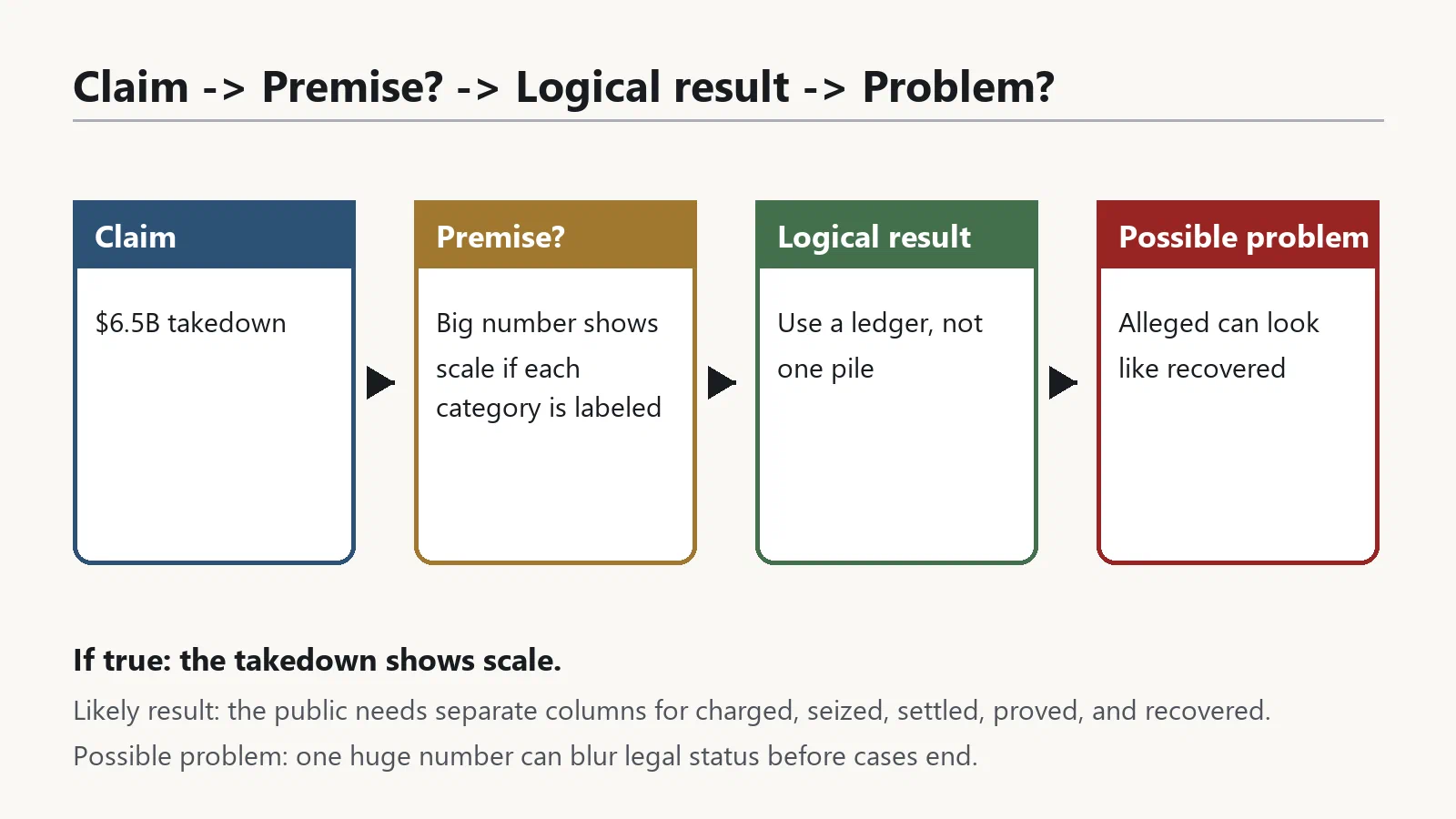
The big number shows scale only if the labels stay clear.
Why Early Action Can Be Fair
Fraud enforcement often needs early action. Waiting for every case to finish before suspending a suspicious biller could let bad claims keep moving. A seizure can preserve assets while a case moves forward. A civil settlement can resolve a claim even when a defendant does not admit liability.
Those tools have a reason.
They also make mixed columns easy. One press conference can include indictments, complaints, settlements, suspended payments, provider exclusions, seizures, and international arrests. That mix can be powerful and easy to misread.
If a reader hears “$6.5 billion fraud takedown,” he may think $6.5 billion came back. DOJ’s release does not say that. It says the cases involved more than $6.5 billion in false claims. Some claims may have been stopped before payment. Some money may never be collected. Some defendants may be convicted. Some may plead. Some may win. Some cases may narrow.
The public should want fraud stopped. It should also want clean labels.
The Simple Test
A blurred ledger rewards bad habits.
It rewards agencies for the biggest announcement number, even when the later recovery number is smaller. It rewards critics for dismissing every enforcement action as press theater, even when providers were suspended, assets were seized, and patients may have been protected. The reader gets applause without accounting, or cynicism without evidence.
Ask the plain questions.
What was alleged? What was charged? What was stopped before payment? What was seized? What was settled? What was proved? What was recovered? What was dismissed?
That list supports enforcement by making it easier to judge.
The government does need tools to fight health-care fraud. A payment system this large will draw false claims. Patients can be harmed when billing fraud changes care, drugs, tests, or access. Taxpayers can be robbed when public programs pay fake bills.
But enforcement does not become clearer by making every number do the same job.
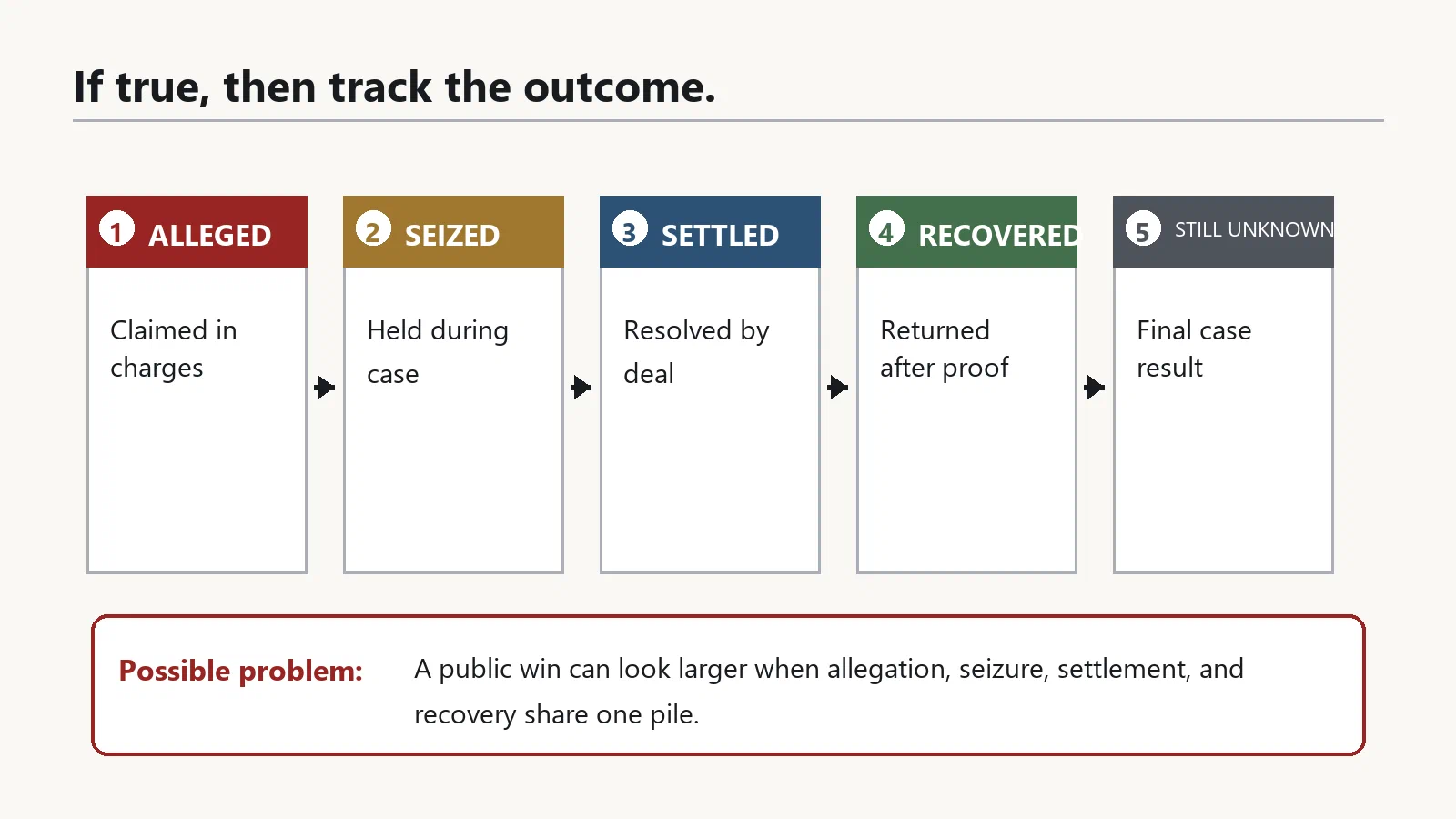
Alleged, seized, settled, and recovered are different outcomes.
Build the charge ledger before the victory lap. Put the allegation in one slot. Put the seizure in another. Put the settlement, conviction, forfeiture, restitution, and recovery in their own slots.
Then the public can see what happened.
Later, when the cases end, it can see what proved true.