The Clock by the Door
The time clock became a civic machine because it turned work into evidence, then left courts, employers, workers, and software systems to fight over who owns the minute.
A worker meets the clock before the foreman.
It waits near the entrance with a face for minutes, a mouth for cards, and a little rack of names or numbers. The gesture takes a second. Slide the card. Press the lever. Hear the mark land. Walk inside.
The machine looks petty at first. It polices lateness. It makes a line at the door. It gives the working day a hard edge.
Then the card starts to travel. It goes to payroll. It goes to a supervisor’s desk. It goes into a dispute over overtime, waiting, preparation, closing duties, meal breaks, walking time, rounding, and work performed after the scheduled day has ended. The clock becomes a witness.
That is the time clock’s deeper story. It began as a machine for making punctuality visible. It became a record of labor. Once work became a record, the missing minute became a legal fact with money attached.
The modern version may have no card and no doorway. It may sit in a phone app, a biometric scanner, a badge reader, a point-of-sale terminal, a warehouse scanner, a laptop login, or a scheduling platform. The old fight followed it there. The public problem is durable because wage law needs proof, and the proof often lives inside the system controlled by the employer whose conduct the proof may later test.
The time clock is a small machine. It opens into a large civic question: when work is measured, who gets to keep the measure?
The Card in the Slot
The old punch clock belongs with the ledger, the badge, the turnstile, and the factory gate. It converts a human action into a mark that someone else can sort, total, challenge, and pay.
Willard L. Bundy’s 1888 patent for a workman’s time recorder gives the mechanism in plain form. A worker used a key or card, the machine marked the time, and the resulting record could be kept for later use. The point was administrative before it was philosophical. A workplace with many people needed a way to reduce arguments over arrival and departure.
The mark was never neutral in practice. A time clock gives management a daily map of the workforce. It tells who came early, who arrived late, who stayed over, who missed a punch, who used a meal period, and who drifted near discipline. It also gives workers a record that can survive bad memory, bad arithmetic, a payroll mistake, or a supervisor with a private interest in shaving time.
The same mark serves power and protection. That tension explains why the machine survived.
The time clock did something older methods could not do as cleanly. A foreman could remember who was late. A ledger clerk could write a name. A bell could start the shift. The time recorder joined the moment, the worker, and the machine into one portable fact. A card could be filed. A card could be totaled. A card could be shown.
That feature made the clock useful in a larger workplace. Scale breaks personal trust. A small shop can run on memory, habit, and daily knowledge. A plant, a store chain, a hospital, or a warehouse needs records that outlive the morning. The time clock answered scale with paper. It let owners manage distance. It let payroll departments count workers they barely saw.
It also taught workers that the minute belonged to the machine before it belonged to the story of the day.
The doorway was the natural place for that lesson. The worker moved out of private time and into employer time. The clock stood at the threshold, converting presence into proof. Yet the doorway was always too simple for the real day. A worker could be present without working, working before the official start, waiting after a shift, cleaning tools, changing gear, walking a plant floor, booting up a terminal, closing a register, answering a supervisor, or standing under control while the card said nothing.
The machine made one truth sharp while leaving other truths disputed.
Bundy’s Promise
Bundy’s recorder grew out of a late nineteenth-century world that wanted work to be more countable. Factories, railroads, offices, and large firms were learning how to coordinate people through forms, files, cards, and clocks. The time recorder looked like a modest convenience, but it belonged to a larger change in how organizations saw people.
The worker became visible through records.
A stable museum trail helps keep the argument anchored in the thing itself. The Bundy Museum’s “It’s About Time!” exhibit preserves the time-clock story where the family name belongs. No single display case carries the argument. The patent record and museum exhibit together show the object as a real machine with a real administrative purpose: turn a worker’s presence into a durable mark.
That sounds fairer than memory. Often it was. Memory favors the person with rank. A card can give the lower-status person something to point at.
The card also created a new asymmetry. The worker made the mark, but the employer kept the system. The rack, the cabinet, the payroll desk, the edited totals, and the file belonged to management. A worker could point to a card only if the card was preserved, legible, accurate, and available. The record that protected the worker also gave the employer a tool for discipline, scheduling, and dismissal.
The time recorder therefore carried two promises at once. It promised order to the employer and proof to the worker. The machine could fulfill both promises, but only under a visible rule. When the rule disappeared inside private control, the mark became less like evidence and more like a company memory.
That is why a simple industrial object belongs in public history. It helped decide whose version of the working day would survive.
The Wage-Law Record
Federal wage law made the time record more than a private business practice.
The Fair Labor Standards Act of 1938 appears in the Statutes at Large at 52 Stat. 1060 . Its original design linked wage floors, overtime, child labor, and federal commerce power. The current U.S. Code places the FLSA in 29 U.S.C. Chapter 8 . The modern rulebook for employer records appears in 29 CFR Part 516 .
Part 516 is dry on purpose. It asks for records: identifying information, workweek, pay basis, regular hourly rate where applicable, daily and weekly hours for nonexempt employees, straight-time earnings, overtime premiums, additions, deductions, total wages, and pay periods. These are payroll facts, but they are also legal handles.
The law can promise a minimum wage only if someone can determine the hours. It can promise overtime only if someone can count the week. It can forbid child labor only if someone can identify the worker and the work. Wage law without records becomes a rule that depends on memory and fear.
The time clock did not create the FLSA. It gave the FLSA a practical surface. The worker’s card, the payroll ledger, and the employer’s files became part of the public bargain.
The original Act also shows why the record had to carry more than punctuality. The 1938 statute did not arrive as a single mature workplace code. It used phased wage and hour standards, created administrative duties, and pushed federal law into ordinary payroll decisions. The law had to translate national labor policy into the weekly facts of a shop, mill, store, hotel, plant, or office. That translation could not happen in speeches. It needed names, hours, rates, weeks, and totals.
The dry record is where the public rule touches the private day. A minimum wage is a number, but the number needs hours. Overtime is a premium, but the premium needs a week. Child-labor limits need age, occupation, and place. The whole structure leans on proof. That is why wage law turns toward records so quickly.
That bargain places burden where control sits. Employers control the workplace, the payroll system, the schedules, the edits, and the files. Workers may know what they lived, but they often lack access to the official record. A wage law that ignores that mismatch leaves workers to prove a day against the machinery that erased it.
The recordkeeping rule turns private management into public duty. It does not make employers guilty. It does require the employer’s version of time to be kept in a form the law can inspect.
That duty helps honest employers too. A clean record can defeat a false claim, resolve an error, and lower the temperature before a conflict becomes a lawsuit. A bad record creates a fog that hurts both sides, with one important difference: the employer usually built the fog.
The Missing Minute
The Supreme Court made that fog visible in Anderson v. Mt. Clemens Pottery Co. , a 1946 case about pottery workers and unpaid time around the edges of the day. Workers claimed time spent walking through the plant and preparing before productive labor. The employer’s records were incomplete for the contested activity.
The Court refused to let deficient records defeat the workers’ claim by default. If an employee proves that work was performed and offers enough evidence for a reasonable inference about the amount, the burden moves to the employer to produce evidence of the precise amount or to negate the inference. The rule matched the practical control of the workplace. The employer had the statutory duty to keep records. A missing record could not become an automatic shield.
Anderson gave the missing minute a legal shape. It also alarmed employers because the same reasoning exposed large retroactive claims around preparation, walking, waiting, and other edge-of-day activities.
Congress answered with the Portal-to-Portal Act of 1947, published at 61 Stat. 84 and now reflected in 29 U.S.C. Chapter 9 . The Act narrowed compensation for certain preliminary and postliminary activities unless they were made compensable by contract, custom, or practice, and it responded directly to the reach of post-shift and pre-shift claims.
That sequence puts the time clock inside a public argument. The problem reached past a simple choice pitting worker pay against employer certainty. The harder question asked where the working day begins when law, control, custom, and physical movement fail to line up neatly.
The factory doorway was no longer enough. A worker could punch in after walking a long path into the plant. A worker could punch out before finishing required cleanup. A worker could stand under control while the card showed no time. A worker could perform acts that were necessary to the job yet hard to fit into the employer’s neat boundary.
The clock gave the day a line. The law had to ask whether the line was honest.
That honesty can require more than a timestamp. A punch may show entry through a door, but the legal day may depend on a required act that happens after entry or before exit. The card may show the scheduled day, while the workday begins with required preparation. The employer may see a payroll rule, while the worker experiences controlled time. The law keeps asking for the same evidence: what activity, under whose control, for whose benefit, under what rule, recorded by whom?
The question sounds narrow because wages are paid in units. It is larger because the record allocates risk. A missing entry can move money away from the worker. A vague rule can move liability toward the employer. A bad system can move public enforcement costs onto everyone else. Timekeeping becomes public because private disorder spills outward.
The Edge of the Day
Later cases kept returning to the same edge.
In IBP, Inc. v. Alvarez , the Supreme Court dealt with meat-processing workers who used protective gear and equipment. The case joined the Portal-to-Portal Act with the “continuous workday” principle. Once a principal activity starts, later walking and related time may become part of the compensable day. The Court treated some waiting time differently, but the main lesson was clear enough: the workday can begin before the line starts moving.
In Integrity Staffing Solutions, Inc. v. Busk , warehouse workers sought pay for time spent in post-shift security screenings. The Supreme Court held the screenings were not integral and indispensable to the principal activities the workers were employed to perform. The workers were required to pass through the screenings, but the Court drew the Portal-to-Portal boundary in the employer’s favor.
In Tyson Foods, Inc. v. Bouaphakeo , pork-processing workers claimed unpaid time for donning and doffing protective gear. The Court permitted representative evidence in the circumstances of that case, with the employer’s failure to keep records again shaping the proof problem. The point was not that every estimate wins. The point was that missing employer records can make representative proof reasonable when the employer had the duty and ability to record the time.
These cases do not form a worker-always-wins story. They show the more serious pattern. Courts have to translate physical control, required activity, work preparation, employer records, and statutory boundaries into payable time. The clock helps, but the clock rarely answers the hard case alone.
The hard case gathers at the margin. A knife has to be sharpened. Gear has to be put on. A bag has to be checked. A register has to be closed. A system has to be booted. A supervisor asks for one more task. A worker is inside the employer’s world while the official clock says the day has a different shape.
The minute at the edge looks small until it repeats. Across one person, it may feel trivial. Across a department, it becomes payroll. Across years, it becomes liability. Across a labor market, it becomes a public question about the price of controlled time.
Each case also warns against easy moral sorting. The worker who passes through a security check may be under employer control, yet the Supreme Court in Busk held that the screening did not count as integral and indispensable work. The worker who puts on protective gear may have a stronger claim when the gear is tied to principal activity. The worker who lacks exact records may use representative proof in some settings, while another worker in another setting may fail. The law pays work, not every inconvenience. It asks how the activity connects to the work, how the rule allocates burden, and what evidence survives.
That is the reason the clock remains central even when the case turns on something outside the clock. The timekeeping system is the first draft of the legal record. If the first draft omits the disputed activity, the court has to decide what the omission proves.
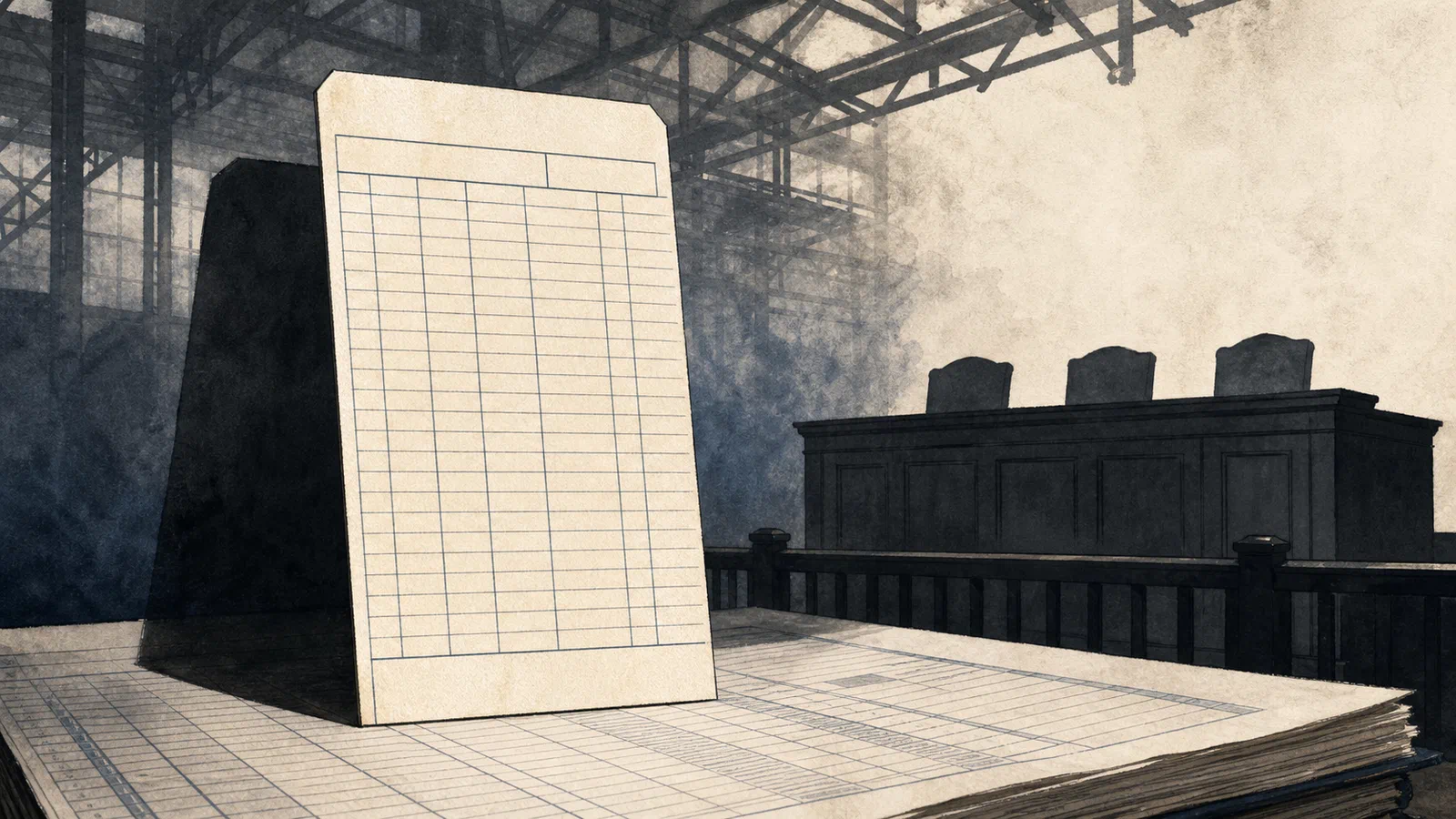
The card becomes most powerful when memory and authority disagree.
Rounding and the Edge of Arithmetic
The federal rule on time clocks and rounding, 29 CFR 785.48 , accepts a practical reality. Workers may punch a little early or late. Employers may use rounding practices in common increments if the practice averages out over time and does not deny workers pay for the time actually worked.
That is a reasonable administrative idea with a built-in risk. Rounding can reduce noise. It can also become a quiet wage cut if the pattern leans the same direction shift after shift.
The rule therefore tests arithmetic as behavior. A policy that looks neutral on paper may reward one side in practice. A seven-minute grace window, a quarter-hour increment, an automatic deduction, or an edit rule can seem harmless when viewed once. The pattern reveals the system. The law is asking whether the convenience stays neutral after it touches real schedules.
Auto-deducted meal breaks create the same problem. A system may subtract thirty minutes because most people take lunch. The record becomes false when workers keep answering calls, watching patients, cleaning equipment, handling customers, or covering a short-staffed floor during the deducted time. The software sees a meal. The worker lives a duty.
Off-clock work repeats the pattern in another form. The Department of Labor’s public guidance on hours worked, including its Fact Sheet #22 , describes compensable time through categories such as waiting, on-call time, rest periods, training, travel, and sleeping time. The guidance is general; the governing law and facts still control a particular dispute. The basic principle is simple enough: labels do not control the day; control and work do.
The time clock can therefore create false confidence. It produces rows. Rows look precise. Precision can be an optical effect if the system rounds, edits, deducts, or ignores the work that happens at the edge.
That is why the old card and the modern app share the same burden. A time record earns trust through its rule, its visibility, its edit trail, and its fit with work as performed. The record loses trust when it turns a hard day into a clean lie.
Rounding also shows why software cannot rescue a bad policy by sounding exact. A digital system can calculate to the second while applying a rule that drains time in one direction. It can show a clean dashboard while hiding edits, exceptions, and defaults. Interface precision and rule fairness are different things.
That creates a practical standard for any timekeeping system. A worker should be able to understand the rule. A manager should be able to explain the edit. A payroll department should be able to reproduce the calculation. A regulator should be able to inspect the record. If those four things fail, the system has created faith in a number without accountability for the number.
Guidance for Both Sides
The time clock creates different practical anxieties for workers and employers.
Workers need to know which hours count, how to challenge unpaid time, and where to take a complaint. The Wage and Hour Division’s How to File a Complaint page explains its confidential complaint process and provides a route outside the employer’s file cabinet for workers who may lack direct bargaining power.
Employers need something else: administrable payroll, schedules that close, audits they can answer, and rules that managers can follow without inventing wage law on every shift. Those needs are legitimate, but statutes, regulations, official guidance, and cases remain the controlling authorities.
A balanced account has to resist two simplifications. Not every edge case is deliberate theft, and not every edge case is merely a compliance workflow. The record beneath both frames matters more.
The employer has a real need for administrable time. A hospital, store, factory, warehouse, or restaurant cannot run payroll by memoir. The worker has a real need for a record that survives hierarchy. A person paid by the hour should not have to prove a week through courage alone. The regulator has a real need for evidence that can be inspected without reconstructing every shift through testimony.
The time clock sits where those needs collide. Good timekeeping is not sentimental. It is civic plumbing for the wage bargain.
The employer-facing record trail deserves more attention than polemical labor writing usually gives it. Employers need records because schedules change, managers leave, payroll staff make mistakes, workers transfer, software settings drift, and memory collapses under scale. A serious employer wants a record that can defend good conduct and expose bad local practice before it becomes a legal claim.
That interest is legitimate. It also makes the employer’s duty sharper. The side with the strongest reason to build the system has the strongest duty to build it well. Payroll software can offer convenience. A compliance manual can explain procedures. A manager can demand closure. None of those interests can replace the wage record’s public function. The record has to work when the person with less power challenges the person with more power.
Employer convenience belongs in the tradeoff column. It cannot end the argument by itself. A simple rule may be worth using if it is accurate enough and easy to inspect. A more detailed system may be worth using if workers can see and challenge it. A biometric clock may reduce fraud while raising privacy stakes. A mobile app may improve distributed payroll while shifting costs and access burdens onto workers. Every tool has a gain and a sacrifice.
When the Door Disappears
The digital clock breaks the old geography.
The worker may clock in on a phone while standing in a parking lot. A nurse may badge into a unit. A delivery worker may become visible only when the app accepts a task. A remote employee may answer messages before the formal workday. A warehouse worker may be tracked through scanners and rate systems while the payroll clock records a simpler truth.
The Department of Labor addressed part of this problem in Field Assistance Bulletin 2020-5 , which discussed telework and compensable hours under the FLSA. The guidance points employers toward reasonable diligence in tracking unscheduled telework hours. The shared workplace disappeared for many workers, but the record duty followed the work.
Remote work makes the old doorway harder to locate. The laptop opens in a kitchen. A message arrives after dinner. A supervisor sees an email timestamp. A calendar invite moves. A worker fixes a problem in minutes that never become a card punch. The official day may be defined by a timekeeping system, while the practical day leaks through screens.
The same issue appears in app-mediated labor, though the legal categories can differ by worker classification and platform design. A platform may know location, acceptance, route, task status, idle time, and customer interaction while denying that all recorded time has wage meaning. The system can know a great deal and owe little under the category it claims.
The old time clock was blunt. The modern system can be exquisitely detailed. More detail does not settle the burden. A record can become richer and less accessible at the same time.
That is the digital record’s central tension. It can protect workers by preserving proof that paper never could. It can protect employers by reducing payroll error. It can also make work measurable in ways that workers cannot inspect, challenge, or understand. The card rack was crude, but it was visible. The app may know more and show less.
The Body as Badge
Biometric time clocks extend the record into the body.
The worker who once carried a card may now use a fingerprint, hand geometry, face scan, or other biometric identifier. The administrative promise is obvious: fewer buddy punches, fewer lost cards, tighter identity control, cleaner payroll. The public risk is also obvious: the credential is part of the person.
Illinois became the central legal example because its Biometric Information Privacy Act, now listed through the Illinois General Assembly’s 740 ILCS 14 article page , created private duties around biometric identifiers and biometric information. It requires notice, a written retention policy, and a written release before collection or capture by a private entity, with limits on disclosure and retention.
The time clock was one of the ordinary workplace settings where that law became concrete. A scan taken for payroll turns an old punch-card problem into a privacy problem with a different key.
The Illinois Supreme Court’s Cothron v. White Castle System, Inc. involved employee fingerprint scans used to access work computers and paystubs. In 2023 the court held that claims accrued each time biometric data was scanned or transmitted without the required compliance. That interpretation created large potential exposure because repeated scans could multiply statutory damages.
Illinois later amended BIPA through Senate Bill 2979, with the Illinois General Assembly publishing the bill text through its 103rd General Assembly full-text page . The amendment moved the law toward a single violation per person per private entity for repeated collection or disclosure of the same biometric identifier or information. That change shows the tradeoff plainly. Privacy law had to punish unlawful capture without turning repeated workplace clock-ins into damages so large that the penalty could overwhelm the record problem itself.
The biometric clock therefore sharpens the original time-clock question. A paper card could be replaced. A fingerprint cannot be reissued in the same way. A face scan carries different stakes than an ordinary lanyard badge. The record has moved closer to the worker’s body, and the cost of mishandling it has moved with it.
Yet the employer’s interest did not vanish. Employers want reliable identity controls because payroll fraud, security, and timekeeping accuracy are real issues. The serious question is not whether identity control has value. It is who controls the biometric record, what notice the worker receives, how long the data survives, who can receive it, and what remedy exists when the system fails.
The body as badge is the old clock reaching its most intimate form.
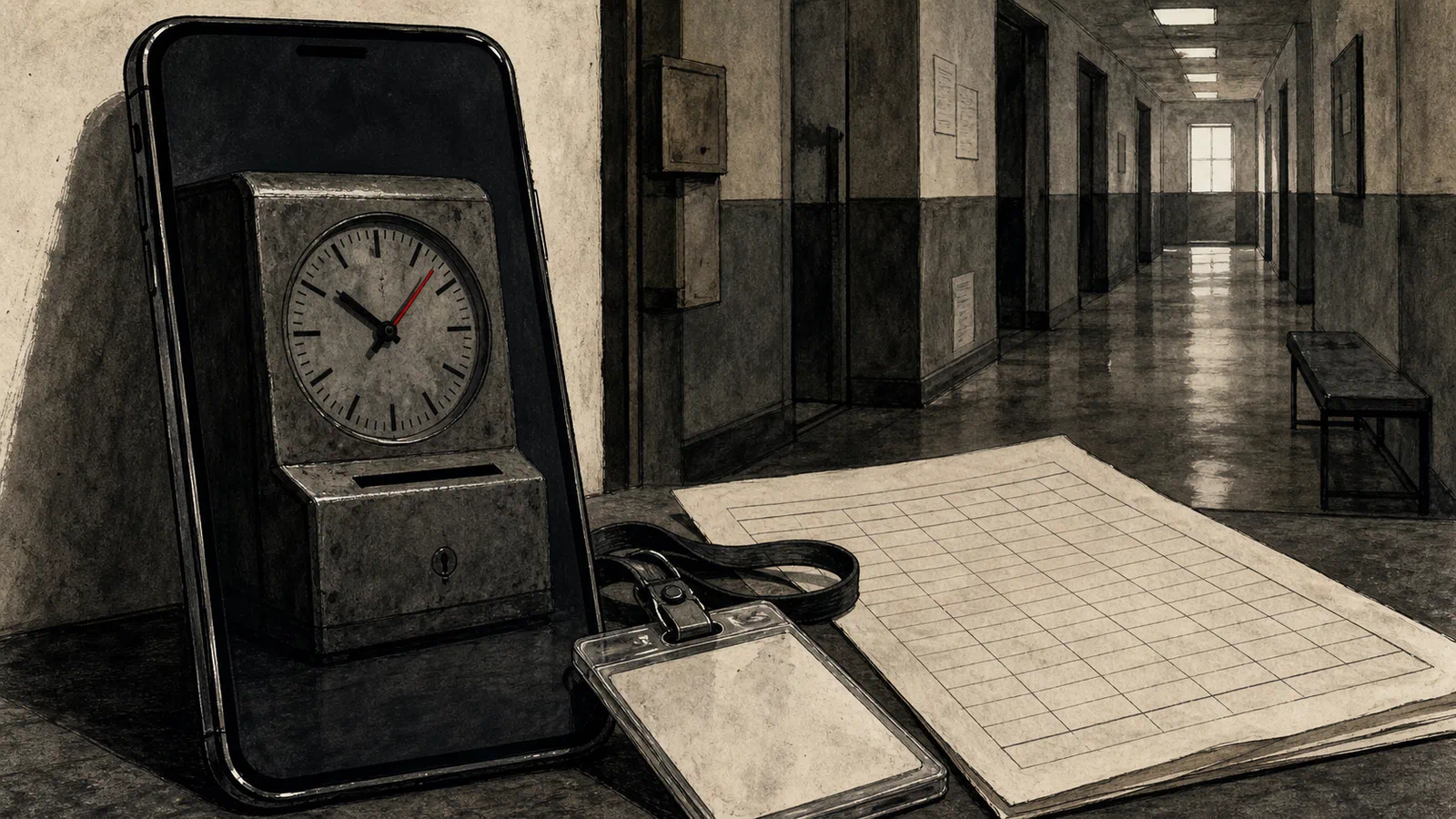
The doorway moved, but the record kept its old argument.
Enforcement Needs a Handle
The time record carries force because enforcement needs something to hold.
The Department of Labor publishes Wage and Hour Division data and enforcement materials showing that wage enforcement reaches beyond a private quarrel. The data describe administered enforcement activity rather than every workplace dispute, but their existence is itself part of the story: wage law is measured through back wages, penalties, industries, claims, and cases because the public rule has to be administered.
A bad record makes enforcement expensive. Investigators need payroll records, schedules, interviews, and comparisons. Workers may fear retaliation. Employers may face accusations that depend on estimates. Courts may have to decide which inference is fair. Every missing time record moves the dispute away from arithmetic and toward credibility.
That shift has consequences. Workers with low bargaining power may absorb losses because the proof burden feels too heavy. Honest employers may settle weak claims because their records are too poor to defend them cleanly. Bad employers may learn that weak records are useful. Regulators may spend public time reconstructing what a decent system would have preserved.
The plain record gives public law a handle on private work.
That handle has to serve several goods at once. Accuracy protects wages. Predictability protects payroll. Privacy protects the person. Transparency protects trust. Auditability protects the public rule. No single timekeeping system can maximize all of them. A serious workplace chooses its tradeoffs and records them honestly.
That is why timekeeping should never be treated as mere back-office housekeeping. The back office is where the law becomes a number.
Public enforcement also disciplines the essay’s own burden of proof. It would be easy to speak about wage theft as if every bad record proves theft. The record can show error, confusion, weak management, bad software, poor training, pressure to meet labor budgets, or deliberate underpayment. Those differences shape judgment. They do not erase the public cost of weak records.
The employer who keeps accurate records protects itself and the wage system. The worker who can see and challenge the record protects the value of the hour. The regulator who can audit the record protects the rule without needing to treat every workplace as a crime scene. The same object serves all three when it is designed as proof instead of theater.
Who Owns the Minute
The time clock’s strongest lesson is not that employers are cruel or workers are helpless. The record is more durable than that.
The employer owns the workplace system. The worker owns the labor. The law tries to define the price of controlled time. Payroll turns that definition into money. The time record joins all four.
That makes ownership of the minute a public question. If the employer alone can define, edit, store, and explain the record, the worker’s day becomes a company fact. If the worker alone can define the day after the fact, payroll becomes impossible to administer. Wage law needs a record with a rule, an edit trail, and a path for challenge.
The honest record disciplines both sides. It limits the worker who exaggerates. It limits the manager who shaves. It limits the software setting that quietly rounds against the same people every week. It limits the organization that treats privacy as an afterthought once a biometric clock seems convenient.
The dishonest record does the opposite. It hides power in arithmetic.
That is why the clock by the door belongs in a civic archive. It is a machine for counting, but it is also a machine for assigning trust. The mark on the card tells the workplace who was there. The file around the card tells the law whose story can be proven.
Modern work keeps inventing new doorways. The warehouse gate. The nursing station. The restaurant terminal. The laptop login. The biometric scanner. The delivery app. The remote message after dinner. Each doorway asks the same old question: when did work start, when did it end, who controlled the time, and who kept the proof?
The answer cannot come from the machine alone. The clock can stamp. Software can log. A supervisor can edit. A worker can object. A court can infer. A regulator can ask for records. The public bargain depends on all of it.
The card goes into the slot as a small private act. It comes out as evidence of a public rule: if a person’s labor can be measured, the measure has to belong to more than the person who owns the machine.