The Coin Slot on the Corner
A public payphone was a small civic contract: help had to be reachable, private calls had to be possible, and the sidewalk had to carry more than advertising.
The Small Machine At The Edge Of The Street
A payphone asked for almost nothing before it let a person begin. A coin. A finger in the dial or on the keypad. A number remembered, written on paper, or found in a directory chained nearby. The instrument could be filthy, vandalized, busy, or exposed to rain, but the promise was plain: a person standing outside could reach another person somewhere else.
That promise made the machine bigger than the call. The payphone sat where private life met the public street. A stranded traveler could call home. A teenager could call for a ride without asking a store clerk. A worker could tell a spouse the shift ran late. A person without a home phone could arrange work, medicine, childcare, or help. A person in danger could call without leaving a monthly bill in the household record.
The coin slot was the price of admission, but it was also a limit on the owner of the network. A public phone could collect money, yet it could not be treated as a normal private device. The FCC’s operator-services rulebook in eCFR shows the posted-information duties around pay telephones, and the payphone rules treat emergency calling as a special access problem. The old instrument had duties because it was placed where anybody might need it.
The federal rulebook grew around that fact. Section 276 of the Communications Act, now printed at 47 U.S.C. 276 , directed the FCC to promote competition among payphone providers and to create a system for fairly compensating payphone service providers. The rule was market language wrapped around a public-use object. Somebody had to pay for the box on the wall, the line, the maintenance, the vandalism, the billing, the right-of-way, and the calls that passed through it.
The payphone belonged to nobody in the sentimental sense. It belonged to a carrier, a store, a city franchise, an airport, a station, a hotel lobby, a hospital, a jail, or a roadside stop. Yet it performed a shared function. It made the communication network visible. People could see where a call began.
A Coin-Controlled Promise
The older story begins with hardware. William Gray’s 1889 coin-controlled telephone patent describes a way to make a telephone call conditional on a coin. The device solved a simple business problem: how to sell access to a network one call at a time.
That problem had a civic side almost immediately. A telephone network becomes more useful as more people can reach it. A pay station expanded the network to people away from home, people buying access one call at a time, and people who needed a call in a place where the telephone company had no household account to bill. The call was temporary. The access was real.
The invention carried an awkward tradeoff. Public access made the network more useful, but public placement made the device costly and fragile. A coin box invited theft. A public receiver spread wear, noise, and abuse. A booth could shelter a private conversation, but it also occupied sidewalk space. The same machine that helped a person without a telephone could become a nuisance to the business asked to host it.
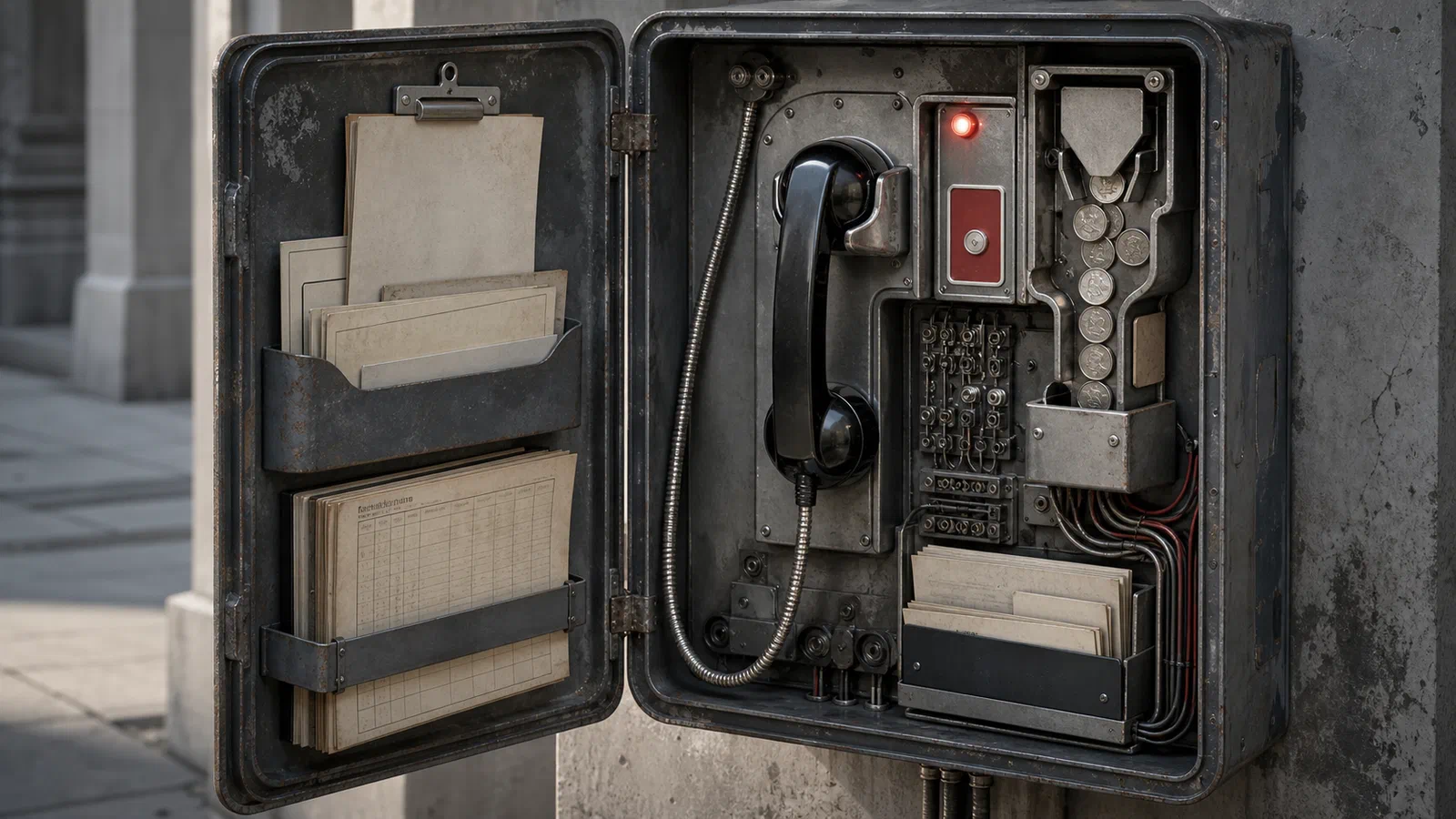
The coin mechanism was only one part of the public bargain.
The law tried to keep those tradeoffs legible. In the 1990s, federal policy treated payphone service as a competitive market that needed compensation rules, access protections, and limits on old local-exchange control. The FCC’s 2018 modernization order later described a market that had fallen hard as mobile phones spread and many payphone regulations had lost practical force. The agency removed or trimmed rules it saw as outdated while leaving core obligations around access and emergency use.
That arc invites a lazy obituary. Mobile phones made many payphones unnecessary for people who already owned charged devices, could afford service, and could carry a traceable account. The payphone’s old users remained scattered across harder cases: travelers, people in battery failure, people without service, people avoiding an abusive household record, visitors without domestic plans, people leaving jail or court, disaster victims, and people who simply needed an anonymous call. They lived in the space where private device ownership ends and public reachability begins.
The payphone was crude, but it made that gap visible.
The Sidewalk Becomes A Platform
New York made the replacement visible too. In 2022 the city’s technology office announced the removal of the last city-owned public payphones, describing the end of a streetscape era and pointing to LinkNYC kiosks as the successor system. The old booth and handset gave way to a sidewalk device that offers Wi-Fi, charging, maps, information, emergency calling, and advertising space.
That trade is not foolish by default. A modern kiosk can provide free connectivity to many more devices than a coin phone could. It can update maps, show public alerts, support charging, and use advertising revenue to finance a public franchise. The problem is that a public communications layer changes character when access assumes a private device in a pocket and a screen-funded platform on the sidewalk.
New York’s own oversight record shows how hard that bargain can be to govern. The state comptroller’s 2021 audit of LinkNYC examined contract monitoring, revenues, installations, and franchise management. The audit’s public-administration force is direct: sidewalk technology has to be managed as a public contract instead of a glowing appliance that happens to stand outside.
The older payphone concentrated the bargain in a physical act. Put in money, place the call, hang up. The newer kiosk spreads the bargain across devices, data practices, advertising contracts, public Wi-Fi management, private concessionaires, city oversight, and emergency features. The function can be broader while the civic terms become harder for an ordinary passerby to inspect.
The payphone also had a privacy logic the replacement has to rebuild in another form. Anyone nearby could observe a coin call, but the caller placed it without authenticating into a personal handset. Public Wi-Fi can help people without affordable data service, and the LinkNYC privacy policy shows the more complex world that follows when public access runs through network identifiers, device data, and service terms. The system may provide real service while shifting the bargain into documents most passersby will never read.
Emergency Is The Test
Emergency access is where the old object keeps its force. A public phone was one of the few pieces of street furniture whose highest use might belong to a person with no money, no plan, no power, and no time. The FCC payphone rules in eCFR treat emergency calls as a distinct duty. That rule treats a communications network as a public safety layer before it treats the call as a retail service.
Private mobile phones improved emergency calling for millions of people. They also moved the responsibility onto the individual. Keep the phone charged. Keep the account active. Keep the device dry. Keep it unlocked, nearby, and functioning. Keep the location services clear enough for help to find you. In ordinary life those burdens feel small. In a disaster, an arrest, a hospital visit, a dead battery, a lost bag, or a household emergency, they decide who has a route outward and who must ask strangers for access.
Cities have not lost the need for shared communication. They have changed the tools used to provide it. Public libraries, transit stations, shelters, hospitals, jails, schools, courthouses, airports, and city sidewalks all carry pieces of the old payphone function. Some are better than the old box. Some depend on staff, hours, passwords, cameras, contracts, or a device the user must already possess.
The payphone asks a useful question because it is plain enough to understand. Who can make a call without already being inside the private network? Who pays for that possibility? Who watches the contract? Who owns the device? Who bears the risk when the shared layer disappears?

The public layer did not disappear; it changed owners, shapes, and rules.
What The Corner Remembers
Nostalgia is the wrong tribute. The payphone could be broken, dirty, overpriced, predatory, and inconvenient. It could trap a caller in public view while pretending to offer privacy. It could turn a family emergency into a hunt for quarters. The booth offered a civic minimum with grime, exposure, and failure built in.
Its value was more specific. The payphone made a shared minimum visible. A city with public phones admitted that communication belonged in households, offices, consumer devices, and also on the corner. A call could begin outside the private account system.
That admission is harder to see when the public layer is absorbed into screens, concessions, Wi-Fi terms, and advertising panels. A person can stand on a modern sidewalk surrounded by signal and remain outside the practical network: no charged device, no account, no stable address, no private place to speak, no easy way to be reached back.
The coin slot was a primitive answer. It did not solve loneliness, poverty, violence, disaster, or neglect. It did one civic thing with blunt clarity. It gave the person on the corner a way to enter the communications system without first proving he already belonged to it.
The old phone is mostly gone. The question remains bolted to the sidewalk: when the private network becomes the normal way to live in public, what does the city owe to the person standing outside it?