The Cone in the Lane
A cheap orange marker turns a broken road into temporary public order, asking drivers, workers, pedestrians, cyclists, agencies, and contractors to share a route while the street is being repaired.
The Upright Warning
The cone sits in the lane with no engine, no foundation, no officer, no gate, and no speech. It leans a little in the wind. Tire grit gathers at the base. A reflective band catches headlights. A crew truck idles beyond it. The pavement ahead has been cut open, painted, swept, milled, patched, wired, washed, measured, or claimed for work that cannot happen while traffic behaves as usual.
The object looks almost unserious. A driver could crush it. A child could lift it. A storm could scatter it. A bored student could steal one and call it decoration.
Yet the cone changes the road.
It tells the driver that the ordinary lane has lost its ordinary meaning. It tells the worker that public space has been borrowed for a job. It tells the pedestrian that the usual path may have moved. It tells the cyclist that the edge of the lane may no longer be the edge of safety. It tells the public body or contractor that a promise has been made in plastic: the danger has been marked, the route has been shaped, and the public has been asked to cooperate before someone with more authority arrives.
The cone is a small public technology for temporary authority. It lets a city suspend ordinary road behavior without closing public movement. That is the point. A street cannot be repaired by treating it as permanently open, and a city cannot survive by closing every street whenever a crew needs ten feet of pavement. The work zone is the compromise. Public passage continues, but the ordinary rules of passage are edited for a few hours, days, or weeks.
Light plastic carries an old public works duty: make danger visible before harm arrives.
That duty is easy to miss because the cone is familiar. Most public authority announces itself with height, weight, uniforms, locked doors, printed seals, or fixed infrastructure. The cone does almost the opposite. It is short, hollow, portable, stackable, and replaceable. Its authority depends less on force than on recognition. The driver sees orange and adjusts. The pedestrian sees a changed path and looks for a safe route. The worker sees a boundary and works inside it. The agency sees a temporary condition and owes the public a plan.
The cone’s weakness is part of its civic grammar. It can be moved because the work moves. It can be struck because road users make mistakes. It can be stacked because repair repeats. It can be removed because the order it gives is supposed to expire. A poured curb or fixed sign cannot make that short promise.
That last fact is where the object becomes more than a roadside habit. A cone asks for patience only while the public reason exists. Its legitimacy depends on standards, accessibility, maintenance, prompt removal, and trust.
When the line is clean, visible, justified, and temporary, the cone helps a city keep moving while it repairs itself. When the line is careless, stale, or false, the cone spends public trust.
A Marker Built To Yield
The modern traffic cone belongs to practical invention, not civic poetry. Charles D. Scanlon’s 1943 Safety Marker patent described a marker for wet paint, pavement repairs, and similar highway hazards.
The public record is modest: Scanlon is identified as being from Los Angeles, California, the application was filed on February 17, 1941, and the patent was published on November 2, 1943. Later histories often add occupation details, but the strongest direct record for this essay is the patent itself.
That record is enough.
It describes the work problem. Older small wooden tripods were hard to see and easily broken. Larger wooden barriers created a storage and transportation problem, and they could become hazards when struck. Scanlon’s marker addressed a blunt public works need: crews needed a visible roadside object that could mark wet paint or pavement repair, survive field use, stack for transport, and yield to impact without turning a mistake into a harder crash.
The invention was physical before it became symbolic. A road marker had to stand upright. It had to be seen. It had to avoid smearing fresh paint. It had to return after a glancing blow. It had to travel by truck and come off the truck quickly. Scanlon’s patent even points to old automobile tires as useful resilient material. That detail places the cone in the material history of road work. It grew out of the same automotive world it was meant to discipline.
The useful bargain was about force.
Change behavior without punishing every error with metal or timber. Warn without walling off. Mark a hazard without becoming the main hazard. That physical bargain helped the cone spread. Crews could multiply it, read it at speed, move it as work moved, lay it out in the morning, shift it at noon, narrow it at rush hour, and pick it up at night. The road could be edited without being rebuilt.
The cone sits outside the barrier category. A cone does not stop a vehicle in the way a temporary concrete barrier, crash cushion, truck-mounted attenuator, or other positive-protection system may be intended to stop or redirect one. The cone is a signal and channelizing device. It gives the road user a line to read. Its job is to change behavior before force is needed.
This makes the cone honest only when the rest of the work zone is honest. If a lane contains a trench, drop-off, worker, disabled signal, or temporary pedestrian route, plastic alone cannot carry all the risk. The cone needs the sign upstream, the taper length, the buffer space, the lighting, the trained flagger, the accessible detour, the inspection, the police detail where needed, the truck-mounted attenuator where specified, and the person with authority to decide that a layout is wrong in the field.
The cone made temporary authority portable. It did not make temporary authority simple.
The Manual Behind The Plastic
The cone’s authority today comes through a much larger document. The Federal Highway Administration’s Manual on Uniform Traffic Control Devices is incorporated through federal regulation at 23 CFR 655.603 , which calls the MUTCD the national standard for traffic control devices on streets, highways, and bicycle trails open to public travel. The same regulation says state manuals and supplements must be in substantial conformance with the national MUTCD, and that states and federal agencies adopt FHWA changes within two years of a final rule.
The current edition matters. FHWA’s 2023 Federal Register final rule designated the 11th Edition of the MUTCD, with an effective date of January 18, 2024. That legal machinery is why the cone can be read across jurisdictions. A driver leaving Florida for Georgia, then Tennessee, then Ohio, should not have to relearn the grammar of road work at every state line. Orange means temporary. Reflective bands mean nighttime visibility. A taper means the lane is changing. A line of devices means the public should follow the path drawn through the disruption.
Part 6 of the 11th Edition MUTCD gives the broader name: temporary traffic control. Section 6A.03 defines traffic control devices as signs, signals, markings, channelizing devices, or other devices that use color, shape, symbols, words, sounds, or tactile information to communicate regulatory, warning, or guidance messages to road users. The same section says traffic control devices used for construction, maintenance, utility, or incident management on public-travel streets, highways, pedestrian facilities, bikeways, pathways, or site roadways must comply with the applicable MUTCD provisions. The cone is therefore a recognized device inside a public language. It is governed by more than the private judgment of the person who dropped it into the road. That language has grammar. It distinguishes standards from guidance, options, support, local discretion, and engineering judgment. A local crew may adapt to a narrow block, a driveway, a storm drain, a bus stop, a bridge joint, or a hospital entrance. The adaptation is supposed to occur inside a known frame.
This is bureaucracy doing useful work.
The MUTCD also makes a hard claim about the end of the order. Section 6A.03 says temporary traffic control devices are to be removed as soon as practical when no longer needed, and inappropriate devices are to be removed or covered during short suspensions of work. That rule keeps the cone from becoming a petty occupation force. Public movement is interrupted for repair, not for decoration, convenience, or inertia.
This is why a line of cones can feel legitimate even when it is annoying. The object does not ask the public to trust a contractor’s mood. It asks the public to recognize a shared manual, a legal hierarchy, and a temporary public reason. That is a thin form of trust, but thin trust is how most streets work. Every driver and pedestrian moves through hundreds of small signals without stopping to audit them.
The cone’s problem is the same as its power. Because the device is easy to deploy, the public sees both careful orders and lazy ones. A cone can express the MUTCD. A cone can also express a crew’s habit, a forgotten permit, a half-finished lane closure, or a risk transferred to everyone else. The manual gives the object language. It cannot by itself make the sentence true.
How A Lane Learns To Bend
A lane does not bend because one cone appears at its edge. It bends because a sequence of devices teaches road users a new path.
The MUTCD’s Part 6 breaks a temporary traffic control zone into areas: advance warning, transition, activity, and termination. The advance warning area tells road users what is coming. The transition area moves them out of their normal path. The activity area contains the work space, traffic space, and buffer spaces. The termination area returns traffic to ordinary operation.
The cone often lives in the transition area. Section 6B.08 explains that tapers are made from a series of channelizing devices or pavement markings that move traffic out of or back into the normal path. The manual gives formulas for taper length. For speeds of 40 mph or less, the taper length in feet is W times S squared, divided by 60. For 45 mph or more, the taper length is W times S. W is the width of offset in feet. S is the posted speed, off-peak 85th-percentile speed before work starts, or anticipated operating speed in mph. The rule is not decorative. A 12-foot lane shifted at 30 mph produces a very different taper from a 12-foot lane shifted at 55 mph.
The MUTCD also gives spacing guidance for channelizing devices. Section 6K.01 sets the interval for cones, tubular markers, vertical panels, drums, and barricades: no more feet than the speed limit in mph for taper channelization, or twice that distance for tangent channelization. In plain street terms, a 35 mph taper should not casually look like a few cones dropped wherever the truck stopped. Regular spacing turns separate objects into a readable path; bad spacing leaves a broken suggestion.
Local standard drawings turn that national grammar into field practice. Florida’s Standard Plans Index 102-600 , “General Information for Traffic Control Through Work Zones,” gives tables for work-zone sign spacing, taper length, buffer length, channelizing-device spacing, lane widths, clear zones, high-visibility apparel, sign supports, drop-offs, business entrances, pedestrian longitudinal channelizing devices, and the device shapes themselves. Sheet 1 lays out taper and spacing tables. Sheet 10 draws cones, drums, barricades, tubular markers, vertical panels, and pedestrian longitudinal channelizing devices. It also says cones are to be used only in active work zones where workers are present and to use approved reflective collars at night.
That local drawing is the essay’s best antidote to cone folklore. The field object is cheap, but the real order is planned. A standard drawing says where the cone belongs in relation to speed, taper, sign distance, clear zone, business access, pedestrian access, and the kind of device needed. If the plan calls for a barrier, the cone cannot pretend to be one. If the sidewalk route needs a detectable edge, a loose cone line cannot pretend to be one. If the work zone speed changes, the spacing and taper logic may change with it.
This is also where public patience begins. A driver sees a lane closed and often imagines wasted space. The plan may be preserving a buffer, a truck path, a curing surface, a hidden drop-off, a work-vehicle swing radius, a material staging area, an emergency route, or enough sight distance for a merge. The public cannot see all of that from the windshield.
That invisibility places a duty on the agency and contractor. The more a temporary order asks from the public, the cleaner its grammar should be. The taper should make sense. The signs should match the closure. The cones should be upright. The open lane should be wide enough for the expected vehicles. The business entrance should remain findable where possible. The pedestrian route should be real. The end of the job should end the order.
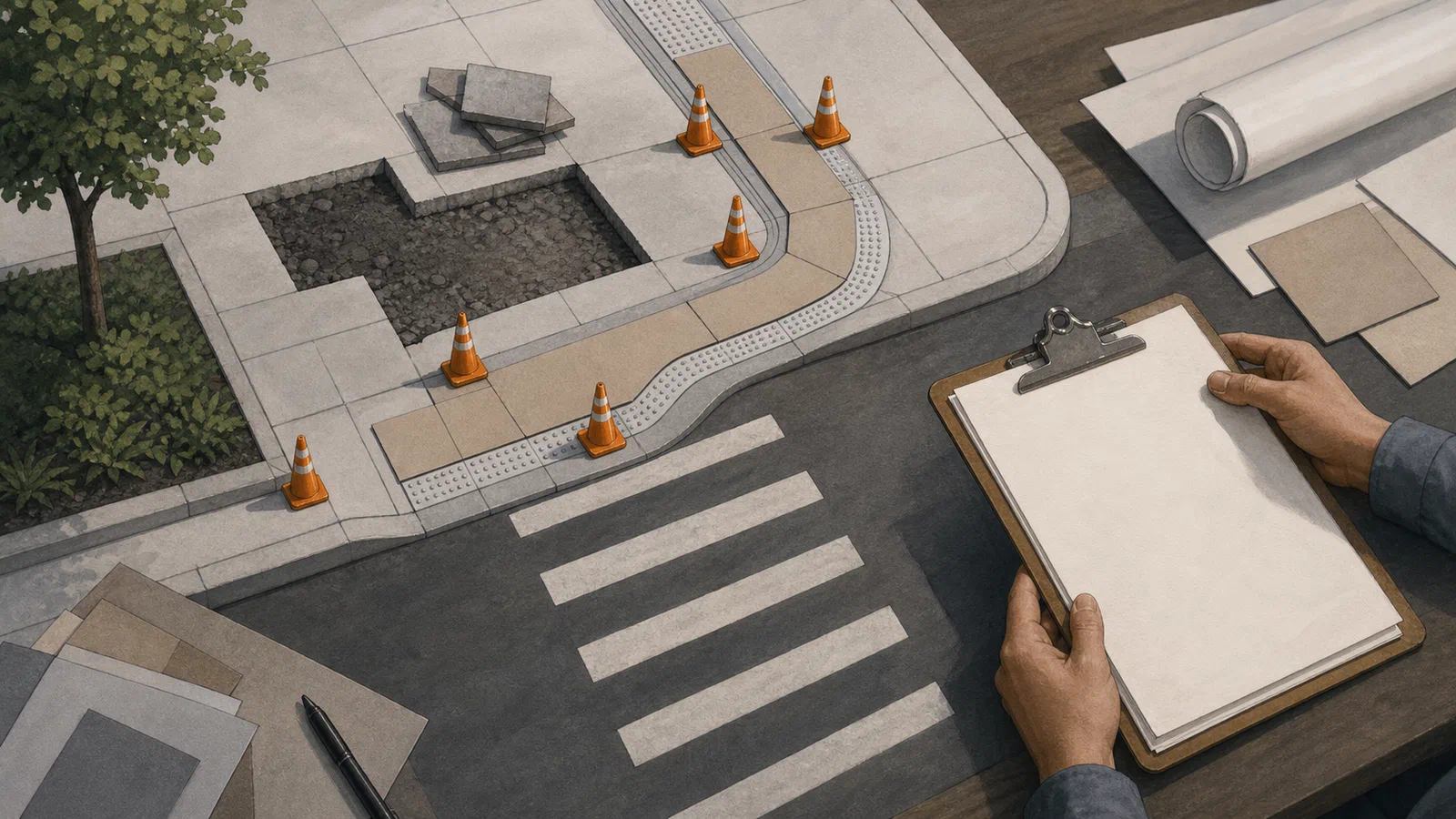
A good work zone draws more than a driver path; it has to account for every public body using the street.
Night, Speed, And The Worker In The Taper
The cone is most exposed when visibility gets worse and speed stays real.
The MUTCD is blunt about night work. Section 6A.05 says night work may reduce congestion and business disruption, but it also raises safety issues. Reduced visibility affects drivers and workers. Lower traffic volumes can mean higher speeds at the same time visibility is reduced. The manual also points to possible impairment, fatigue, or drowsiness at night.
The cone’s body has rules for that problem. Section 6K.03 says cones must be predominantly orange and made of material that can be struck without damaging the impacting vehicle. Daytime and low-speed-roadway cones must be at least 18 inches high. On freeways, high-speed highways, at night on all highways, or where conspicuous guidance is needed, cones must be at least 28 inches high. For nighttime use, cones must be retroreflectorized or equipped with lighting devices. Cones 28 to 36 inches high need a 6-inch white band near the top and an additional 4-inch white band below it. Taller cones need alternating orange and white retroreflective stripes with minimum stripe rules.
This is the unromantic part of the object’s authority. Color is not vibes. Height is not preference. Retroreflectivity is not decoration. A cone at night is a device built for headlights, distance, recognition, and reaction time.
The stakes are measurable. In a live download of NHTSA’s 2024 FARS National CSV file , the accident table contained 763 fatal crashes with a work-zone code and 850 fatalities. The file’s work-zone categories were construction, maintenance, utility, and work-zone type unknown. Of those 763 fatal crashes, 351 were recorded in daylight, 213 in dark and unlighted conditions, 157 in dark and lighted conditions, and the remainder across dawn, dusk, unknown lighting, reported unknown, or not reported. The file header available on June 25, 2026 showed that NHTSA’s 2024 national CSV archive had last been modified on April 1, 2026; I found no later modification on that public file during this run.
Those figures need restraint. FARS does not prove that a missing cone caused a crash. It does not turn every driver into a villain or every agency into a culprit. Work-zone crashes involve speed, exposure, sight distance, traffic mix, lighting, driver state, work staging, enforcement, vehicle size, weather, and many other factors. The cone is one device inside that system.
The worker-safety layer belongs in that same sober frame. OSHA’s construction standard for accident prevention signs and tags says construction areas at points of hazard must be posted with legible traffic control signs and protected by traffic control devices. It also says the design and use of traffic control devices for worker protection, including signs, signals, markings, barricades, and other devices, must conform to Part 6 of the MUTCD. OSHA’s highway work zones overview lists struck-by hazards and points workers and employers back toward MUTCD-based traffic control.
The cone can help mark the edge of risk. It cannot absorb the risk. That is why Part 6 distinguishes ordinary channelizing devices from positive protection. Section 6M.02 treats temporary traffic barriers as devices used to help prevent vehicle penetration into work spaces and protect workers, bicyclists, and pedestrians. Section 6K.10 says longitudinal channelizing devices have not met crashworthy requirements for temporary barriers and should not be used to shield obstacles or provide positive protection. That distinction should be kept clean: a cone line may guide, warn, and channelize. It has no authority to pretend to be a wall.
Human factors research points in the same direction. TRB’s NCHRP Report 600C, Human Factors Guidelines for Road Systems , treats sign legibility, nighttime visibility, and work-zone speed decisions as design problems, not morality plays. Its sign-legibility chapter notes that retroreflectivity, color, font size, and contrast affect drivers’ ability to perceive and understand signs, and it lists glare, poor lighting, headlights, fatigue, and night-driving visibility limits as factors that can compromise recognition. The lesson for cones is plain. Compliance begins before a driver decides to comply. The object has to be placed where it can be seen, understood, and acted on.
The Sidewalk Also Moves
The road worker is not the only person living inside the temporary plan.
Part 6 of the MUTCD spends real attention on pedestrians and people with disabilities. Section 6A.03 says the design and application of temporary traffic control devices should consider motorists, bicyclists, pedestrians, and people with disabilities. Section 6K.02 says pedestrian channelizing devices indicate a suitable path around or through a work zone. It also addresses detection plates, hand-trailing edges, contrast, and retroreflective sheeting. Section 6M.04 warns that individual channelizing devices, tape, rope, discontinuous barriers, and pavement markings are not detectable by people with vision disabilities and cannot provide detectable path guidance on temporary or realigned sidewalks.
That sentence is a useful limit on cone thinking. A line of cones may be visible to a driver and nearly useless to a blind pedestrian. A cone can narrow a lane and create a path for cars while creating a trap on the sidewalk. A loose tape line may look like control to a contractor and vanish for a cane user. A temporary route that solves traffic can fail the person asked to walk through it.
The manual’s language pushes the work zone beyond the windshield. It asks if a pedestrian can detect the route with a long cane. It checks signs or devices that project into an accessible path. It accounts for workers and equipment crossing the pedestrian path. It leaves room for a covered walkway or temporary traffic barrier when pedestrian and vehicle paths move closer together. It treats pathway usability as a separate question from pathway visibility.
The cone exposes two separate jobs. Marking names the hazard. Guiding gives the usable route. A serious work zone has to do both.
Cyclists and transit users raise their own versions of the same problem. A cone line that protects a repair crew may push a bicycle into mixed traffic with little warning. A bus stop may be swallowed by staging. A curb ramp may sit behind a barricade. A temporary path may preserve car throughput while forcing a wheelchair user into a driveway lip, a muddy shoulder, or a search for the next usable crossing. Emergency access can also be affected when a lane is narrowed, a shoulder is occupied, or a queue stretches through an intersection.
These are not special favors granted after the real work is done. They are part of the public way. The street is a system of bodies moving under different limits. Temporary authority has to account for those limits because the temporary order remains a public order.
Florida’s Index 102-600 makes this visible in a local form. It includes drawings and notes for pedestrian longitudinal channelizing devices, drop-off protection adjacent to pedestrian ways, sidewalk closure signs, crosswalk signs, and business-entrance channelization. The drawing cannot vouch for every field layout. It does put the sidewalk inside the standard grammar, where a bad setup can be judged against a known duty.
The cone is often the first visible sign that the road has changed. It should not be the last thought given to everyone outside the car.
The Good Argument Against The Cone
Every frequent driver knows the counterargument. Cones appear before work begins. Cones remain after work ends. Cones close a lane for a patch no one can see. Cones drift into gutters. Cones protect empty machinery on a weekend. Cones multiply until the road feels governed by a plastic guess.
That complaint deserves respect because public trust erodes when temporary orders look lazy. The cone asks for obedience without explanation. It asks the driver to slow down, merge, wait, or accept a worse route because some unseen job requires it. The public often gives that obedience because the claim is short, visible, and plausible.
When cones stay out too long or fail to match the work, they spend that trust.
The answer is not contempt for road crews. Work zones are hard places. Crews face weather, schedules, traffic, procurement rules, utility conflicts, impatient road users, inspection delays, and conditions discovered only after the surface opens. A line of cones may preserve space for curing concrete, a hidden trench plate, a delayed inspection, a sensor loop, a night pour, or a worker who has to return before dawn. The public cannot see every reason.
That uncertainty increases the duty to make temporary control legible. Dates, signs, covered devices, clean tapers, prompt pickup, and honest staging all carry public meaning. A cone that looks abandoned teaches the next driver to mistrust the next cone.
The standards agree. MUTCD Section 6K.01 says particular attention should be given to maintaining channelizing devices so they stay clean, visible, and properly positioned, and that no-longer-serviceable devices must be replaced. Section 6A.03 says devices are to be removed as soon as practical when no longer needed. Florida’s Index 102-600 repeats the removal rule for temporary traffic control devices and says inappropriate devices should be removed or covered when work is suspended for short periods.
Those are not niceties. They are the maintenance terms of temporary authority. A cone line works because road users assume it corresponds to a real condition. When that assumption fails often enough, drivers begin treating the next line as advisory clutter. A pedestrian may step around a closure because the last closure led nowhere. A cyclist may distrust a merge because the last taper was incoherent. A worker may inherit danger created by a previous sloppy setup.
The public argument against the cone, at its strongest, is an argument for better temporary government. It says a cheap order should remain a true order. It says public inconvenience should have a public reason. It says a device that can change a lane should also be governed by a duty to leave.
The Public Cost Of Lazy Temporary Orders
Lazy temporary orders create costs beyond delay.
The first cost is attention. A work zone asks road users to spend extra attention at a moment when the road becomes less predictable. The lane shifts. The shoulder disappears. The pedestrian crossing moves. The bus may stop in a different place. The pavement may change texture. A worker may stand close to traffic. A large truck may need more space than the cone line appears to provide. If the layout is confusing, road users spend attention guessing at the route instead of reading a clear path.
The second cost is compliance. People comply more readily when the order looks credible. A clean taper, matching signs, visible workers, covered irrelevant signs, and prompt removal all signal that someone is managing the interruption. A disorderly work zone sends the opposite message: no one owns this. That message is dangerous because the cone’s authority depends on voluntary behavior before enforcement arrives.
The third cost is equity. The burden of a bad temporary plan does not land evenly. A driver may lose five minutes. A wheelchair user may lose the route. A blind pedestrian may lose the detectable edge. A bus rider may lose the stop. A cyclist may lose the only comfortable part of the street. A delivery worker may be pushed into a moving lane. A worker in the taper may inherit the consequences of speed, glare, poor layout, and public resentment.
The fourth cost is institutional reputation. Cities and state DOTs ask the public to accept disruption because repair is necessary. That argument is sound. Pipes, pavement, signals, bridges, signs, drains, and cables require access. The city cannot be maintained from a distance. Yet a bad cone line can make all repair look like incompetence. The public sees plastic and generalizes.
Federal work-zone policy treats this as a management problem. 23 CFR Part 630, Subpart J , the Work Zone Safety and Mobility rule, defines a work zone as an area of a highway with construction, maintenance, or utility work activities, typically marked by signs, channelizing devices, barriers, pavement markings, or work vehicles. It defines a transportation management plan as strategies to manage work-zone impacts, with scope and detail depending on the agency policy and expected impacts. For significant projects, the rule points to project-level procedures and public information components.
That federal frame lifts the cone out of the pickup bed. A work zone is a managed public impact, with devices as its visible edge. Some jobs are small enough for standard applications and field judgment. Some demand traffic-control plans, detours, public information, incident management, signal timing, night operations, freight consideration, emergency access, or coordination with nearby projects.
The cone is the visible tip of that management system. When the system works, the cone feels almost boring. It says merge, and the merge is where it should be. It says sidewalk closed, and a usable temporary path is waiting. It says workers present, and the closure matches the work. It says road work ends, and ordinary movement resumes. The public remembers little because the interruption was legible.
When the system fails, the cone becomes a symbol of contempt. It may be doing less than the public thinks, or more than the public can see. Either way, the public relationship has weakened.
Standards, Trust, And The End Of The Job
The cone’s authority begins with placement and ends with removal.
That is the part public agencies should take most seriously because it is the part everyone understands. Most road users cannot audit taper formulas. They cannot know if a spacing table was followed. They cannot tell if a contractor used the correct device for a pedestrian route. They can tell when a cone has been lying in the gutter for a week. They can tell when a lane remains closed after the work has visibly ended. They can tell when the signs contradict the open road.
That everyday audit lacks technical authority, but it has public force. Public trust is built by repeated small confirmations. The sign matched the condition. The taper guided the merge. The sidewalk detour rejoined the sidewalk. The workers were protected by more than hope. The unused devices disappeared. The ordinary road returned.
The MUTCD’s structure helps explain why this matters. Its provisions separate “shall,” “should,” “may,” and support statements. Legal standards, guidance, options, and explanatory material do different kinds of work. A local agency or contractor needs discretion because no manual can see every driveway, storm, bus route, grade, utility conflict, emergency response need, or queue. That discretion is not permission to improvise without accountability. It is a demand for competent judgment.
Prompt removal is judgment too. A cone may remain after the visible work ends for a good reason. Fresh paint may be curing. A plate may sit below sight line. A utility cut may need inspection. A surface may look finished before it is safe. The public can cooperate without every technical detail when the temporary order carries enough signs of care to make patience plausible.
This is the public cost of the abandoned cone. It keeps speaking after its sentence has ended. It tells the road user that authority may persist without reason. It makes the next valid work zone harder to govern.
The end of the job therefore belongs in the beginning of the plan. Who picks up the devices? Who checks the route after the crew leaves? Who covers signs during suspension? Who reopens the sidewalk? Who confirms temporary markings do not fight permanent markings? Who reports damaged cones? Who answers when a member of the public asks why the lane remains closed?
The cone cannot answer. It can only stand there.
The Orange Grammar Of Repair
The cone belongs to a family of civic objects that do their work through small acts of recognition. A mailbox tells the carrier where the route touches private land. A curb ramp tells the city that access has to reach the corner. A catalog card tells the reader how public memory was described. A tamper-evident seal tells the buyer whether a hidden breach left a mark.
The cone tells the traveler that public movement has entered a provisional grammar.
That grammar is not sentimental. It is made of measurements, manuals, contracts, standards, crash reports, reflective sheeting, stackable plastic, liability, labor, and human impatience. It is also democratic in the plain sense that everyone can see the device and everyone is asked to answer it. The cone does not whisper to experts. It stands in the lane and gives a visible instruction to strangers moving at dangerous speed.
Its weakness is part of its meaning. A cone can be moved because the work moves. A cone can be struck because the road user may err. A cone can be stacked because public repair repeats. A cone can be ignored because public order always depends in part on habit before force.
This gives the cone a narrow dignity. It is an object of repair, not command for command’s sake. It does not own the lane. It borrows the lane. It makes a claim that should be measurable, inspectable, and temporary. It asks the public to slow down, move over, find the marked path, accept delay, and keep the worker and fellow traveler in view. In exchange, the agency or contractor owes a layout that deserves the request.
The best cone line is almost forgettable. It appears early enough to warn, bends the lane gradually enough to understand, leaves enough room to pass, protects people the plastic alone cannot protect, guides the pedestrian route in a detectable way, remains visible at dusk, survives ordinary weather, and disappears when the work is done.
The worst cone line lingers as a rumor of authority. It closes space with no visible reason, contradicts signs, blocks the sidewalk, hides in darkness, leaves workers exposed, or keeps ordering the public around after the job has moved somewhere else.
The difference is not the plastic. The difference is the system standing behind it.
The next time a lane bends around a row of orange cones, the object may look like clutter. Sometimes it is clutter. At its best, it is a small temporary constitution for a damaged road: authority light enough to lift, visible enough to obey, bounded enough to trust, and honest enough to leave when the public way is whole again.
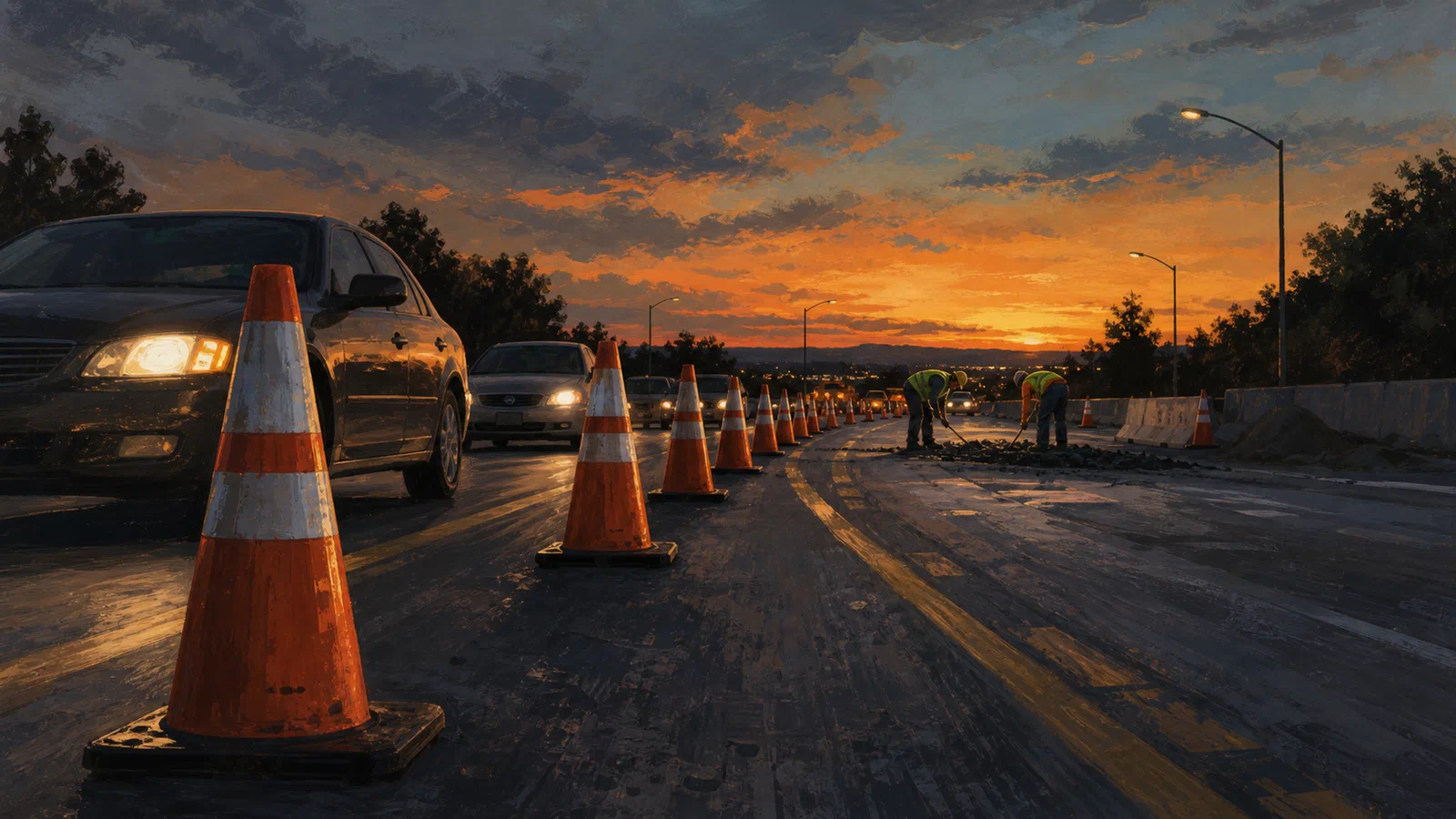
The cone works only while attention holds; after the repair, its authority should leave the lane.