The Courthouse That Ate the Republic
Boss Tweed, Tammany Hall, and the New York machine that joined poverty, patronage, contracts, courts, ballots, and belonging into one system of power.
A building with a bill attached
The New York County Courthouse stood north of City Hall like a public promise too heavy to move. The old record gives the address as 52 Chambers Street. John Kellum completed the design in 1858, but legal and funding fights slowed the work until the early 1860s, when Tweed had risen to the city Board of Supervisors.1 The courthouse was supposed to house law. It became the great exhibit in a case about law captured by office.
The ledger figures startle because they are so plain. The National Register nomination says the supervisors appropriated more than $3 million over four years after Tweed encouraged the board to fund the building. It states that the Ring profited from a 65 percent commission on shady contracts, that Tweed owned the quarry supplying the marble, and that by 1871 the unfinished courthouse had run up a $13 million bill. Some offices had no carpets, although the carpeting bill reached $350,000. The plasterer’s repair bill exceeded the cost of his original work.2
One figure turns the page into theater: $2,870,464.06 for plastering that the nomination says was worth at most $20,000.3 A courthouse wall became a receipt. A ceiling became an indictment. A corridor became a claim voucher.
The courthouse works as the opening record because Tweed’s corruption was not simply a back-room envelope. It used public forms. A bill could be padded. A claim could be approved. A department could be captured. A court could be friendly. A contractor could be enriched enough to stay loyal and exposed enough to stay afraid. The theft was not outside the civic order. It moved through the civic order.
The building was not ugly in itself. The same nomination says the courthouse had architectural merit, and its later completion involved the architect Leopold Eidlitz.4 The architectural merit sharpens the point. Corruption often hides inside real public need and real public work. New York did need courts, streets, water, transit, sanitation, parks, and jobs. Tweed’s machine did not invent those needs. It made them payable to the organization.
That is where Tweed’s direct reign comes into view. William M. Tweed did not invent Tammany Hall. He found an older political society already trained in ward organization, public favors, patronage, naturalization work, street power, and city contracts. Then he helped convert that society into a municipal finance engine. For a short, decisive period, the machine joined public office, party command, contractors, courts, city departments, newspapers, election workers, and neighborhood need closely enough to make New York City itself pay tribute.
This essay defines Tweed’s direct reign in two layers. The broad Ring period uses the National Park Service span of roughly 1866-1871, when its old New York County Courthouse nomination describes Tweed, A. Oakey Hall, Peter B. Sweeny, and Richard B. Connolly as the central men who ran New York City.5 The narrower reign begins with the political settlement around the 1870 city charter and the offices it strengthened,6 then ends with the public exposure and electoral collapse of 1871. The broad dates show the buildout. The narrow dates show the moment when finance, public works, contracting, party rule, and legal protection came nearest to one center of control.
The immigrant record resists a clean verdict. Tammany exploited immigrants. It protected immigrants. It converted dependency into political loyalty. It offered a door into American public life when other doors were closed, cold, slow, or openly hostile. It also made that door personal, conditional, and payable in votes. The available evidence does not establish that Tammany caused or financed mass immigration across the Atlantic as a general policy. The stronger claim is more exact: Tammany benefited from immigration, organized immigrant voters, helped some newcomers naturalize, used courts and ward agents to turn papers into ballots, and built power from the needs of people who required work, coal, rent help, legal aid, burial money, translation, and protection.
Money was the obvious cost to the republic, and the money mattered. The deeper cost was a change in the experience of citizenship. In theory, the citizen stood equal before law and chose representatives by consent. In Tweed’s city, many citizens met the republic through a ward captain, a judge, a policeman, a contractor, a foreman, a funeral benefit, or a ballot distributed by the organization. The machine did not abolish representation. It mediated it. That was its genius and its offense.
The society before the boss
Tammany began before Tweed, before the famine ships, before the courthouse, before the word boss attached itself to the large man from Cherry Street. The Tammany Society formed in New York in 1789. It named itself for Tamanend, a Lenape figure turned by white Americans into a republican emblem, and it adopted invented Native American titles: sachems, wigwams, council fires. The costume was theatrical. The politics were practical.
At the start, Tammany was not the immigrant machine of later memory. It belonged to the early republic’s local partisan world. It presented itself as democratic, anti-aristocratic, and hostile to Federalist social rule. Over time, suffrage expansion, ward organization, tavern politics, jobs, courts, and public contracts taught it how the city could be governed below the level of speeches.
The shift mattered. Gustavus Myers, a later reform historian whose account must be read with its own politics in mind, described the early nineteenth-century machine’s power in the language of regularity. Voters did not always choose among names they knew. They often received a prepared ticket, and party leadership treated the regular nomination as the real prize.7 A voter could be free in law and managed in practice.
The 1820s and 1830s changed the city. More white men could vote. Party rivalry grew more organized. The ward became a unit of command. A successful party had to know who lived where, who could be naturalized, who was unemployed, who owed rent, who belonged to which fire company, who drank at which saloon, and which judge might help when election-day violence or disorder brought a man into court.
By the 1840s, Tammany began to make immigrant politics systematic. Myers puts the turn bluntly. Whigs and Native American party men tried to limit the political place of foreign-born citizens. “The immigrant had no place to which to turn but Tammany Hall,” he wrote.8 That sentence is not neutral history. It carries Myers’s interpretation and the anti-Tammany tradition he wrote from. It also points to a real political fact: Tammany saw that newcomers excluded or insulted by rival politics could become loyal voters.
The machinery around naturalization took form early. In 1840, Myers writes, Tammany opened a bureau in the Wigwam, sent runners to bring immigrants there, drilled them in the advantages of joining Tammany, and helped provide the legal means for naturalization.9 He also reports that Tammany judges naturalized 895 men during January 14-April 1, 1840, with other courts adding to the total.10 The underlying court volumes are not cited here, so treat the precise count as Myers’s report rather than an independently established total. The pattern is the important fact: a legal event became a party operation.
This is where the story begins to complicate any simple story of American individualism. The immigrant did not meet the republic as an abstract citizen in an empty field. He met it at a desk, in a court, in a ward room, through a runner, a translation, a ticket, and a man who could make the process less bewildering. Tammany’s help could be real. So was the political price.
The city that needed an interpreter
Mid-century New York belonged to the port. It was packed with bargaining, disease, danger, work, and paper. Ships brought Irish, German, Jewish, and other newcomers into a city where the formal promise of citizenship could be delayed by hunger, language, housing, police encounters, low wages, and unfamiliar courts.
The machine answered needs that polite reform often treated as evidence of disorder. A ward man could help a newcomer find work. A district leader might speak to a police justice. A Tammany lawyer might explain a paper. A club might offer sociability. A foreman might put a man on a public works job. A leader might appear at a wake or a wedding. This could become dignity. It could also become obligation.
Tammany did not have to invent poverty. It had to be first to answer it.
The strongest version of the immigrant-client argument is not that foreign-born voters were passive. They made choices under pressure. They could accept help and understand its price. They could vote for Tammany because it defended them from nativists, because it was Democratic, because it supplied work, because a district leader had helped a relative, because reformers spoke of them with contempt, because the ward club gave them standing, or because local politics felt less abstract than national principle.
The machine’s strength lay in making these motives overlap. Need became access. Access became gratitude. Gratitude became habit. Habit became a ward vote.
This source boundary is why the claim that Tammany “imported voters” needs discipline. The cited sources support the claim that Tammany benefited from immigration and organized immigrants once in the city. They support the claim that Tammany used naturalization work as political machinery. They support allegations of fraudulent naturalization, repeat voting, intimidation, and ballot fraud in specific contests, especially in reform histories drawing on contemporary evidence. They do not establish a general program by named Tammany actors to finance, cause, or direct mass immigration to New York. Without letters, accounts, ship arrangements, recruitment records, payments, or testimony tying named actors to organized importation, that broader claim remains unsupported.
The rise of Tweed
Tweed was born in New York in 1823, the son of a chairmaker. He was a native-born New Yorker, Protestant, and more secure than many later Tammany voters. He came from the city itself. That gave him one kind of advantage. He understood the local ladders.
The first ladder was fire. A volunteer fire company fought fires and served as masculine club, street force, neighborhood brand, and political nursery. Tweed helped found Americus Engine Company No. 6, the famous Big Six, in 1848.11 Fire gave him visibility, command, noise, loyalty, and a route into ward politics. A fire company could pull an engine. It could also pull a crowd.
From there came office. Tweed was elected alderman in 1851 and served in the board later remembered as the “Forty Thieves.” He went to Congress in 1853 and lost his seat in the Know-Nothing reaction of 1854. He entered the Board of Supervisors in 1857, where the audit and appointment powers of the board became central to his political education.12
The Board of Supervisors taught him the lesson the courthouse would later display. Control over accounts was control over politics. A party did not need to hold every office if it could appoint election inspectors, influence departments, audit expenses, and distribute public work. Tweed learned that money moved through paper, and paper moved through men.
He then widened his base. He built business interests in printing, stationery, banking, railroads, real estate, and public works. He developed alliances with Hall, Sweeny, Connolly, judges, contractors, and newspaper men. The machine became less a single office than a portfolio of offices. Tweed’s power lay in combination.
The men around him had distinct parts. Hall, the mayor, supplied polish, language, and public respectability. Sweeny was a planner and patronage broker. Connolly, the comptroller, controlled accounts and had strong appeal among Irish Democratic voters. Judges such as George Barnard, Albert Cardozo, and John McCunn are repeatedly associated in reform accounts with the legal shelter around the Ring, though each specific claim requires careful separation of proved misconduct, impeachment record, and political accusation.13
Tweed was the emblem because he was large enough, visible enough, and vulgar enough for the whole system to be imagined through him. But the Ring was not one man. It was a set of offices joined to contracts and votes.
Naturalization, ballots, and the edge of proof
Naturalization sits at the moral center of the Tammany question because it is where equal citizenship meets party appetite. To help a lawful immigrant become a citizen can be a democratic good. To rush, purchase, counterfeit, pressure, or politically condition that process is a civic injury.
The record is mixed in the way machine politics is mixed. Tammany’s naturalization work began as aid and became an apparatus. Myers describes the 1840 bureau as a place where a committee assisted applicants free of charge.14 In the same passage, he says Tammany appealed to Irish, German, and French voters in their own languages and rewarded influential foreign-born men with nominations, petty jobs, and contract work.15
By the late 1860s, the allegations are much heavier. Myers’s chapter on the Tweed Ring reports that in 1868 the naturalization “mills” worked for six weeks through Supreme, Common Pleas, and Superior Courts, producing an estimated 25,000 to 30,000 citizens, with a large share voting the Tammany ticket.16 He also alleges fraudulent naturalization, repeat voting, vote buying, trading, and intimidation in the Seymour-Grant contest, and says at least 25,000 city votes were fraudulent.17
Those claims are serious. They should not be treated as courtroom proof by themselves. Myers was writing decades later as an anti-machine historian, using records and earlier reform materials. The strongest form of the conclusion is this: there is substantial contemporary and near-contemporary evidence that naturalization and election practices were politically manipulated by Tammany and allied actors in specific periods. The sources cited here do not establish the exact number of fraudulent votes, the chain of command, or the share attributable to immigrants, party workers, repeaters, judges, or inspectors.
The republican issue remains even where the exact number is contested. Naturalization became a party battlefield because New York was a hinge in state and national politics. A court paper could become a vote. A vote could become a mayor. A mayor could appoint men. Appointed men could approve claims. Claims could become money. The immigrant was not incidental to the machine. He was one of the points where the machine touched the future.
The Ring as a public business
The phrase “Tweed Ring” can make the system sound like a gang standing outside government. That is too simple. The Ring was organized public fraud conducted through offices, boards, courts, contracts, and elections. It used criminal acts where proved, civil fraud where documented, patronage where lawful or quasi-lawful, and political favoritism where politics itself supplied the cover.
The courthouse shows the method. So did printing and stationery contracts, public works claims, street openings, courthouse materials, and contractor kickbacks. The Ring did not need every payment to look illegal at the first glance. Its deeper art was making the illegal resemble city business.
A contractor could submit an inflated bill. Officials could approve it. The money could be divided. A judge could slow or shield a challenge. A friendly newspaper could receive printing or advertising. A party club could turn money into election labor. A ward captain could turn election labor into votes. A public works payroll could become both relief and discipline.
Ordinary patronage is too small a word. Patronage gives jobs to allies. The Ring used patronage, but it also used municipal debt, judicial protection, inflated invoices, legislative power, contractor tribute, and police influence. It deserves the phrase political racketeering in a nineteenth-century civic sense, not as a careless import from later organized-crime categories.
Organized criminal activity existed where the record shows coordinated fraud, bribery, extortion, illegal contracting, ballot fraud, and court manipulation. The exact label matters. It was not the later Mafia. It was a public-office machine that made crime and government hard to separate.
The Times gets the books
The Ring did not fall because respectable people suddenly discovered corruption. New Yorkers had heard rumors for years. It fell when a system that many had tolerated, feared, profited from, or mocked became legible in figures.
In 1871, accounts from inside the Ring’s financial world reached the New-York Times through a chain of men associated in later accounts with James Watson, Matthew O’Rourke, and James O’Brien.18 Those accounts do not settle every step in the documents’ passage, but the broad fact is central: the newspaper obtained records and began publishing the bookkeeping of municipal theft.
The July 24, 1871 Times article “The Tammany Frauds” turned ledgers into public language. Its sarcasm mattered because the numbers were already grotesque. In one line, the paper wrote: “As G. S. Miller is the luckiest carpenter in the world, so Andrew J. Garvey is clearly the prince of plasterers.”19 The sentence worked because it did not need to explain the whole scheme. Everybody understood the absurdity of luck so large that it looked like theft.
Picture the newspaper office as a workroom full of risk. Editors and compositors had to turn records into readable attack. The Times was not neutral in city politics. It was a Republican-leaning paper, hostile to Tammany, and its campaign served political as well as civic ends. That does not make the documents false. It means the documents had to bear weight.
The press did two things at once. It investigated and staged. It exposed records and built a public drama. Harper’s Weekly supplied images. The Times supplied columns, tables, names, and ridicule. Reformers supplied meetings, committees, lawsuits, and candidates. The Ring had lived by controlling the channels of public business. It began to die when hostile channels made the business visible.
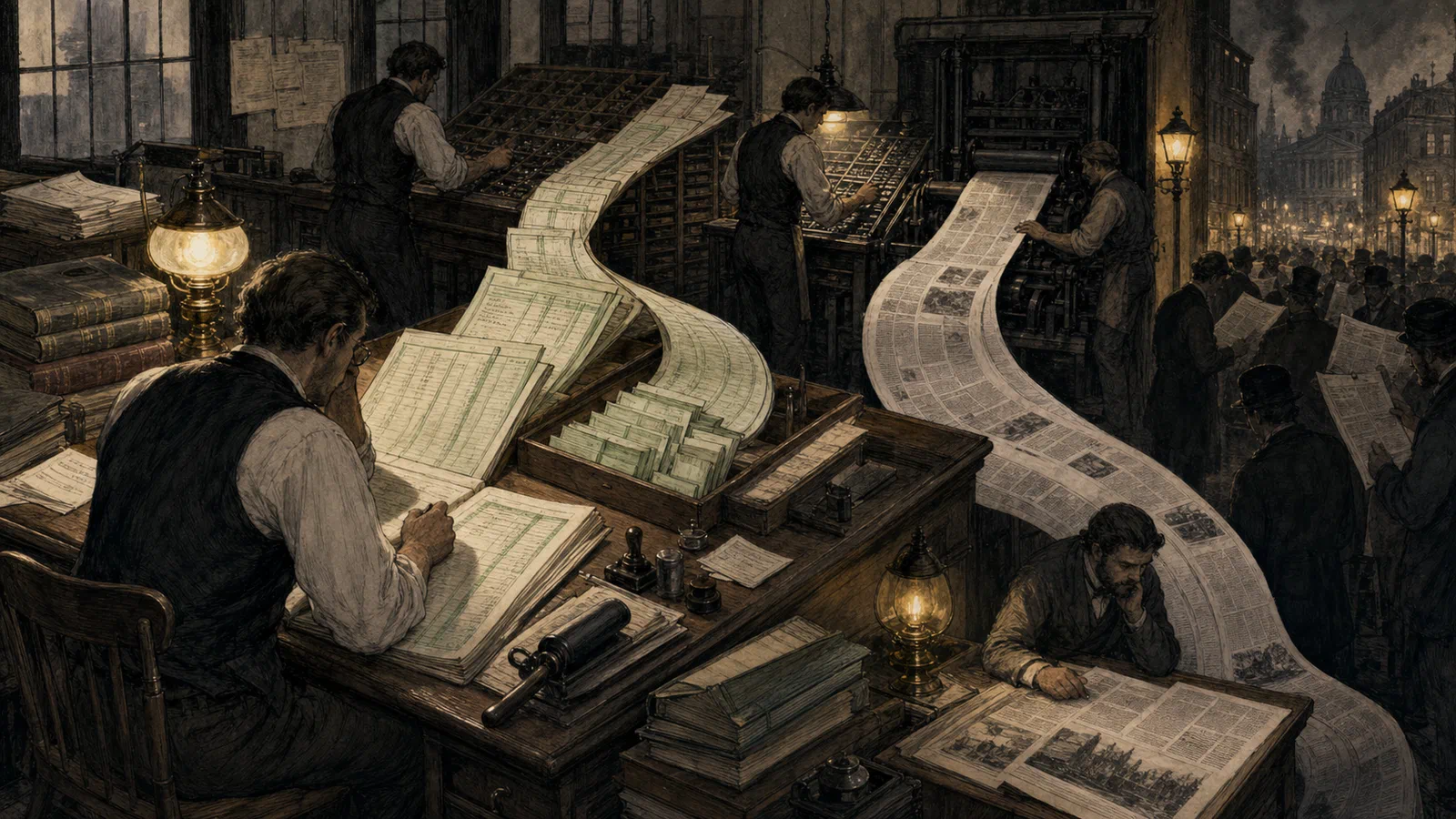
The Ring began to break when city accounts became public language.
Nast turns ledgers into faces
Thomas Nast did not prove the Ring’s accounts. He made them unforgettable.
In the August 19, 1871 Harper’s Weekly cartoon commonly remembered as “Who stole the people’s money?” the Ring points blame in a circle. Tweed, Sweeny, Connolly, and Hall are trapped in mutual accusation. The point is visual logic: a conspiracy is also a circle of denial.20
In October, Nast drew Tweed with a money-bag face under the caption “The ‘BRAINS’ that achieved the Tammany victory at the Rochester Democratic Convention.”21 It was a brutal simplification. It also caught a political truth. Tweed had become the face of faceless money.
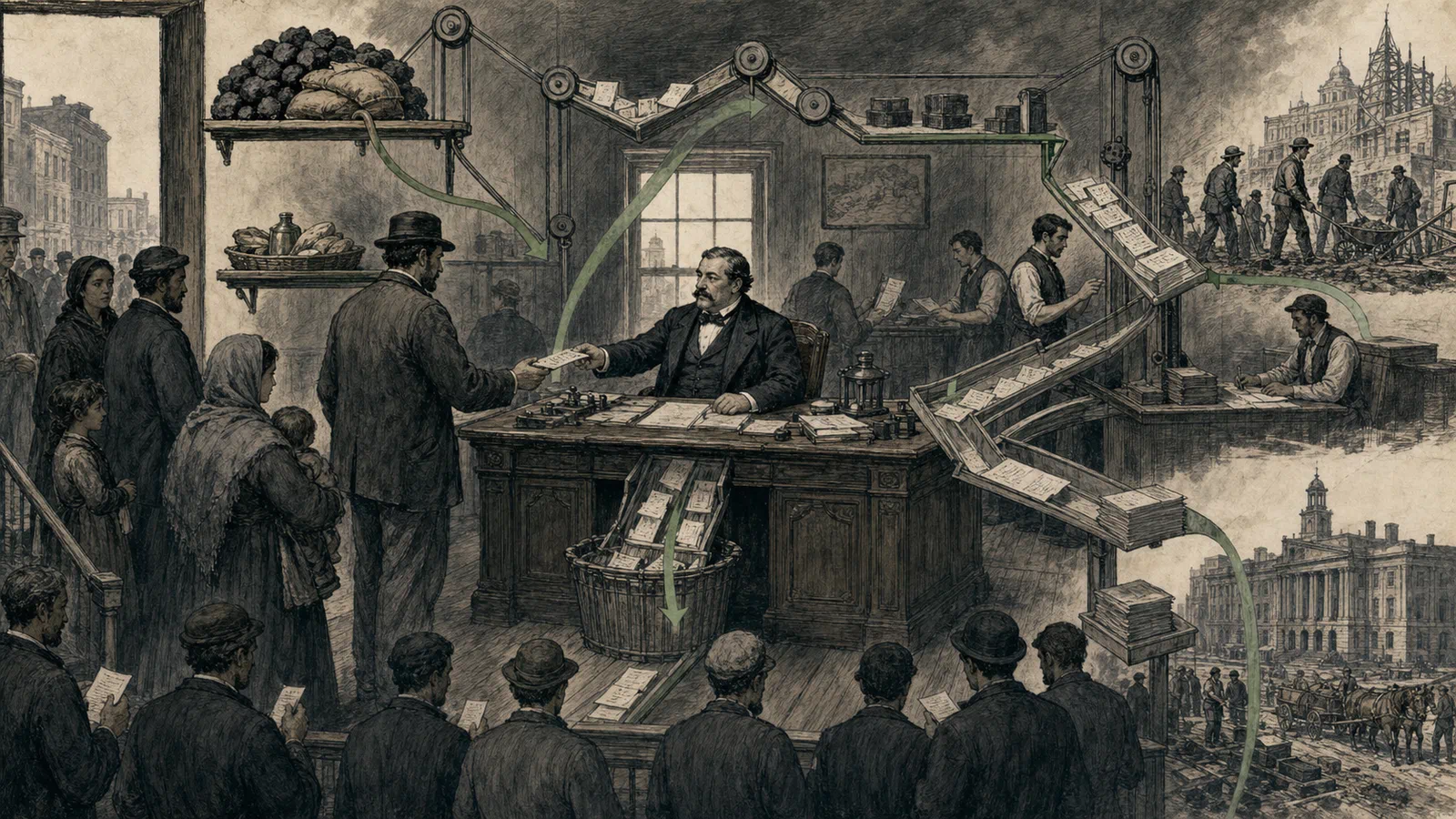
The ward machine made help concrete, then converted help into obligation.
This is the place where the famous “damned pictures” quotation usually enters the story. The line is often attributed to Tweed: he supposedly cared less about articles because many of his constituents were illiterate and more about pictures because they could see them. The remark is too useful to accept without proof. The cited sources preserve it only as a later reported anecdote; none ties it to a named witness and date as direct contemporary speech. It therefore remains an attribution rather than verified speech and is not quoted here as Tweed’s own words.
The downgrade does not weaken Nast’s importance. It strengthens the record. The cartoons mattered because the Ring feared a public that could see before it had mastered the accounts. The pictures gave form to what the ledgers showed.
The fall and the courtroom
The public campaign left the newspaper page and became organized reform. The Committee of Seventy formed in 1871. Samuel J. Tilden, Edwards Pierrepont, William M. Evarts, and other reformers joined the legal and political campaign. Connolly resigned. Andrew H. Green took over the comptroller’s office. The city’s books were examined. Arrests and indictments followed.22
Tweed did not vanish at once. He retained a district. A September 1871 pro-Tweed mass meeting in his Fourth Senatorial District declared itself “pleased with his past record” and proud of his leadership, according to Myers’s quotation of the resolutions.23 The line reminds the reader that Tweed meant something to constituents beyond the downtown reform imagination. Some support was bought. Some was coerced. Some was loyal. Some supporters had received help and saw reform as hostile to them.
The courtroom reduced the epic to counts. On the page, the city had been stolen through a system. In court, the prosecution had to assign acts, documents, signatures, and money. Later accounts differ on the exact number of counts and the exact fine. The National Register nomination says Tweed was convicted on 204 counts of fraud, sentenced to 12 years, and fined $12,750.24 Myers says the second criminal trial began on November 19, 1873, and that Tweed was found guilty on three-fourths of 120 counts, sentenced to 12 years, and fined $12,000.25 The nearer legal anchor is People ex rel. Tweed v. Liscomb, 60 N.Y. 559 (1875), where the Court of Appeals described an indictment containing 220 counts and convictions on 55 counts, then held that the trial court’s authority was exhausted after the first one-year sentence and $250 fine.26 That ruling leaves the popular twelve-year summaries needing careful wording and no rounded certainty.
The usable conclusion is firm: Tweed was criminally convicted after a first trial failed to reach a verdict, and his sentence was later reduced on legal grounds. The sources cited here do not resolve a single definitive count or fine. The courtroom scene turns on the civic meaning, not the arithmetical dispute: the man who had made accounts serve power was finally trapped in accounts.
Nast’s September 23, 1871 “Let Us Prey” cartoon belongs in the source record here as another visual indictment: the Ring rendered as vultures waiting over the picked-over city.
Tweed escaped confinement in 1875, fled through Cuba and Spain, was captured, returned to New York in 1876, and died in Ludlow Street Jail in 1878.27 The machine survived him.
What immigrants got, and what it cost
The most tempting falsehood about Tammany is that it was only theft. The second tempting falsehood is that it was only immigrant democracy. It was both more useful and more corrupt than either line allows.
The later Tammany voice of George Washington Plunkitt gives the machine’s self-defense in its own accent. Riordon’s 1905 Plunkitt of Tammany Hall is a self-advertising text by a machine politician, recorded by a journalist, full of performance. It is also invaluable because it says plainly what more polished men hid.
Plunkitt spoke from the New York County Courthouse bootblack stand, the same civic geography haunted by Tweed. In his chapter on holding a district, he said the leader must “go right down among the poor families” and help them.28 He told of fires where he and his captains arrived as fast as the engines, of burned-out families housed and clothed, of jobs found for men, of court help, funerals, weddings, church fairs, pushcart complaints, Catholic churches, synagogues, Italian voters, Hebrew voters, and poor widows receiving rent, coal, and flour.29
The daily scene is almost too perfect because it is so shameless. A district leader at 3 p.m. attends the funeral of an Italian as far as the ferry, then hurries back for the funeral of a Hebrew constituent. At 8 p.m. his election captains submit lists of voters, attitudes, needs, troubles, and the best ways to reach them. At 10 p.m. he buys tickets, promises a church bell subscription, hears police complaints by pushcart peddlers, and promises a Police Headquarters visit.30
Put the day in ward time. Before breakfast, a tenement fire sends a family into the street, and the leader’s captains find temporary rooms, clothing, and a landlord who can be pressed. Near noon, a man arrested after a street quarrel needs a word at police court. In the afternoon, the leader attends one funeral, then hurries to the next, making grief public enough to count. By evening, the captains bring voter lists: who is hostile, who is doubtful, whose rent is short, who has a cousin looking for work, who remembers the coal delivered last winter. Election day comes later, but the ballot has already been written in errands and memory.30
The scene reaches beyond bribery. It is a substitute social state. It is also politics all the time.
The immigrant voter in such a system could be victim, client, participant, citizen, and neighbor in one life. He might be exploited by the very man who helped bury his dead. He might vote from loyalty, gratitude, fear, identity, habit, interest, or conviction. The moral record cannot be assigned to an ethnic group. It belongs to named organizations, offices, leaders, contractors, judges, and voters acting under concrete conditions.
Tammany gave access. It also priced access. It gave belonging. It also disciplined belonging. It gave jobs. It also used jobs to bind men. It helped translate America. It also made America answer through a boss.
What reformers saw, and what they missed
The reformers were right about the theft. The courthouse bills, Times accounts, Nast cartoons, prosecutions, indictments, and convictions are not moral panic. The Ring stole from the city and weakened law.
Reformers were also men of class position, party interest, religious anxiety, and cultural prejudice. Some saw immigrants less as citizens than as material for demagogues. Some saw Catholic and Irish political strength as a civic danger in itself. Some businessmen wanted clean government partly because corruption injured credit, property, taxation, and their own power. Some Republican papers attacked Tammany with clean hands on one page and partisan advantage on the next.
That does not discredit reform. It locates it.
The best reform indictment was concrete: padded bills, friendly courts, ballot fraud, debt, bribery, public office used for private gain. The weaker reform habit treated the immigrant ward as the opposite of the republic and missed how often that ward marked a place where the republic had failed to arrive in usable form.
Tammany’s strongest defense was also concrete: a man without work could eat because a district leader intervened; a widow could bury her dead; a newcomer could find a court, a job, a club, and a ballot. Its weakest defense was the claim that service excused theft. Public need never excused public robbery. The poor had not consented to be used as cover for the Ring.
Tammany after Tweed
Tammany outlived Tweed because Tweed never explained all of Tammany. He exposed a system, but he did not create all the needs that system answered.
After the fall, John Kelly rebuilt Tammany with a cleaner public face and firmer internal command. Richard Croker later adapted the organization to a larger city and a more direct relationship with business. Charles Francis Murphy gave the machine a quieter twentieth-century discipline. The names changed. The method persisted: district organization, patronage, favors, jobs, legal help, social presence, ethnic and neighborhood loyalty, and periodic accommodation with reform.
The later machine could be less flamboyantly plundering than Tweed’s Ring and carry the same civic danger. Plunkitt’s famous honest-graft/dishonest-graft distinction was a defense of politics as opportunity. “I seen my opportunities and I took ’em,” he said.31 That sentence is the machine’s small gospel: office as vantage point, public information as private chance, loyalty as currency.
Tweed was not the end of machine politics. He was the scandal that taught the machine to change costume.
The republic inside the ward
America likes its clean symbols: the homestead, the frontier, the self-made man, the solitary conscience, the town meeting, the straight road west. These symbols are not false. They are partial.
Tammany is a counter-story. It is the story of the port, the ward, the tenement, the courthouse, the saloon, the police station, the public works office, the naturalization paper, the parade route, the newspaper cartoon, and the contractor’s invoice. It presents America as crowded dependency instead of open land: organized need, neighborhood obligation, and the citizen approached by a man who knows his landlord, his employer, his priest, his club, his country of origin, his court case, and the name of his cousin looking for work.
This does not make Tammany the immigrant soul. It was a power structure that used immigrant needs and responded to them. It was not Catholicism, Irishness, Germanness, Jewishness, or foreignness. It was a political organization with leaders, incentives, offices, methods, crimes, and defenses.
The republican indictment is concrete. Tammany weakened rule of law by making law personal. It distorted representation by binding votes to favors. It damaged accountability by hiding theft inside public bills. It burdened taxpayers with debt. It taught citizens to look to a boss where they should have been able to look to law.
The republican complication is also concrete. Formal law often failed the poor immigrant before the machine reached him. Reformers who wanted cleaner government did not always build warmer government. A ballot without access can be a thin kind of citizenship. Tammany thickened citizenship by corrupting it.
That is the tragedy. The machine supplied what the republic promised but did not deliver evenly: recognition, service, protection, and a route into public power. Then it charged the city for the privilege.
Ending at the courthouse
Return to the courthouse north of City Hall. It is easy to see it as a monument to theft. It is that. It is also a monument to a harder fact: the republic can be robbed through its own forms.
A public office can become a private counter. A court can become a shield. A contract can become a tunnel. A charity can become a hook. A naturalization paper can become a party asset. A job can become a ballot. A ward can become a kingdom. A newspaper cartoon can become evidence in the public mind before the court reaches judgment.
Boss Tweed’s fall did not end machine politics because he was not the source of every machine need. He was the man who made the structure grotesquely visible. The foreign-born laborer, the widow needing coal, the judge with debts, the contractor with a padded bill, the reformer with prejudices, the editor with documents, the cartoonist with a pen, the banker with city bonds, the politician with a district to hold: all of them belonged to the same city.
That city was not outside the American republic. It was one of the places where the republic showed what it could not yet handle.
Tweed leaves a harder question than the badness of corruption. What happens when the ward organization becomes the first institution to answer the citizen’s need, ahead of law, city, and equal republic?
He may mean it. He may also hand you a ballot.
Notes
Alexander and Christian, “Old New York County Courthouse,” description section, p. 2. ↩︎
Alexander and Christian, “Old New York County Courthouse,” p. 2. The cited figures are from the National Park Service nomination, which draws on Alexander B. Callow Jr. and related courthouse sources. They are treated here as verified report figures, not as a fresh forensic audit by this essay. ↩︎
Alexander and Christian, “Old New York County Courthouse,” continuation section, p. 8. The report states: “$2,870,464.06 was spent for plastering which was worth at most $20,000.” The unusual precision is retained because it appears in the report. ↩︎
Alexander and Christian, “Old New York County Courthouse,” pp. 2 to 3. ↩︎
Cathy A. Alexander and Ralph Christian, “Old New York County Courthouse,” National Register of Historic Places Inventory Nomination Form, National Park Service, December 1975, statement of significance, pp. 2 to 3, https://npgallery.nps.gov/NRHP/GetAsset/NHLS/74001277_text . The nomination states that from 1866 to 1871 Tweed, Hall, Sweeny, and Connolly ran New York City and gives a broad estimate of Ring theft. ↩︎
New York (State), An Act to Reorganize the Local Government of the City of New York, passed April 5, 1870, as amended by chapter 383, passed April 26, 1870, and chapter 574, passed April 18, 1871, New York Printing Co., 1871, Internet Archive scan: https://archive.org/details/acttoreorganizel00newy . The charter supports the office-power mechanism through the finance department’s claim-settlement authority, the mayor-appointed comptroller, the auditing bureau, mayor/comptroller warrants, and the amended estimate-setting board made up of the mayor, comptroller, commissioner of public works, and parks president. It does not use the literal phrase “Board of Audit.” Separate support for the audit mechanism appears in People v. Ingersoll, 58 N.Y. 1 (N.Y. 1874), which quotes Laws of 1870, chapter 382, section 4 and identifies Tweed as one of the act’s appointed auditors, https://www.casemine.com/judgement/us/5914cf6aadd7b049348218fe . Leo Hershkowitz’s documentary guide to Boss Tweed in Court describes the body as a “so-called board of audit,” supporting descriptive lower-case wording rather than treating “Board of Audit” as a verified formal statutory title, https://www.lexisnexis.com/documents/academic/upa_cis/10846_BossTweedinCourt.pdf . ↩︎
Gustavus Myers, The History of Tammany Hall, revised edition, Boni and Liveright, 1917, Project Gutenberg, chapter VIII, https://www.gutenberg.org/files/53115/53115-h/53115-h.htm . Myers writes from an anti-machine reform standpoint and is used here as a public-domain historical synthesis, not as neutral proof for contested claims. ↩︎
Myers, History of Tammany Hall, chapter XV. ↩︎
Myers, History of Tammany Hall, chapter XV. ↩︎
Myers, History of Tammany Hall, chapter XV. ↩︎
Alexander and Christian, “Old New York County Courthouse,” continuation section on Tweed’s career; Myers, History of Tammany Hall, chapter XXIII. ↩︎
Alexander and Christian, “Old New York County Courthouse,” continuation section; Myers, History of Tammany Hall, chapter XXIII. ↩︎
Alexander and Christian, “Old New York County Courthouse,” continuation section on Ring members; Myers, History of Tammany Hall, chapters XXIII and XXIV. These sources associate the named judges with the Ring, but they do not by themselves establish every allegation; impeachment and court records control the legal conclusions. ↩︎
Myers, History of Tammany Hall, chapter XV. ↩︎
Myers, History of Tammany Hall, chapter XV. ↩︎
Myers, History of Tammany Hall, chapter XXIII. ↩︎
Myers, History of Tammany Hall, chapter XXIII. The figures are not independently corroborated here by original election returns, court naturalization records, or legislative reports and are not used as settled quantitative findings. ↩︎
Alexander and Christian, “Old New York County Courthouse,” continuation section on the fall of the Ring; Myers, History of Tammany Hall, chapter XXIV. ↩︎
“The Tammany Frauds,” The New-York Times, July 24, 1871, p. 4, TimesMachine PDF: https://timesmachine.nytimes.com/timesmachine/1871/07/24/78769293.pdf . The quoted sentence was visually confirmed on the newspaper page; “clearly” is split across a line break as “clear- / ly.” This confirms what the newspaper printed, not the independent truth of its allegation. ↩︎
Thomas Nast, “Boss Tweed and the Tammany Ring,” Harper’s Weekly, August 19, 1871, Wikimedia Commons file page, https://commons.wikimedia.org/wiki/File:Tammany_Ring,_Nast_crop.jpg . Commons identifies the date, author, source, and U.S. public-domain status. ↩︎
Thomas Nast, “The ‘Brains’ that achieved the Tammany victory at the Rochester Democratic Convention,” Harper’s Weekly, October 21, 1871, Wikimedia Commons file page, https://commons.wikimedia.org/wiki/File:Nast-Boss-Tweed-1871.jpg . Commons identifies the title, date, creator, image summary, and U.S. public-domain status. ↩︎
Alexander and Christian, “Old New York County Courthouse,” pp. 6 to 8; Myers, History of Tammany Hall, chapter XXIV. ↩︎
Myers, History of Tammany Hall, chapter XXIV. Myers quotes resolutions of a September 22, 1871 Tweed mass meeting in Tweed Plaza. ↩︎
Alexander and Christian, “Old New York County Courthouse,” continuation section on prosecution and imprisonment. ↩︎
Myers, History of Tammany Hall, chapter XXIV. Myers’s count differs from both the National Park Service summary and the Court of Appeals record cited above. ↩︎
People ex rel. Tweed v. Liscomb, 60 N.Y. 559 (N.Y. 1875), hosted text at CaseMine, https://www.casemine.com/judgement/us/5914cf69add7b04934821887 . The Court of Appeals opinion states that the indictment contained 220 counts, that the jury convicted Tweed on 55 counts, and that the court’s power was exhausted by the first sentence of one year’s imprisonment and a $250 fine. ↩︎
Alexander and Christian, “Old New York County Courthouse,” continuation section; Myers, History of Tammany Hall, chapter XXIV. ↩︎
George Washington Plunkitt, Plunkitt of Tammany Hall: A Series of Very Plain Talks on Very Practical Politics, recorded by William L. Riordon, 1905, Project Gutenberg, chapter VI, https://www.gutenberg.org/files/2810/2810-h/2810-h.htm . ↩︎
Plunkitt, Plunkitt of Tammany Hall, chapters VI and XXIII. ↩︎
Plunkitt, Plunkitt of Tammany Hall, chapter I. ↩︎

