The Curb Cut at the Corner
A sidewalk ramp looks small until the city has to turn civil rights into surveys, standards, schedules, repairs, and a working corner.
In this article
The Edge
At a working corner, the curb gives way before anyone has to ask.
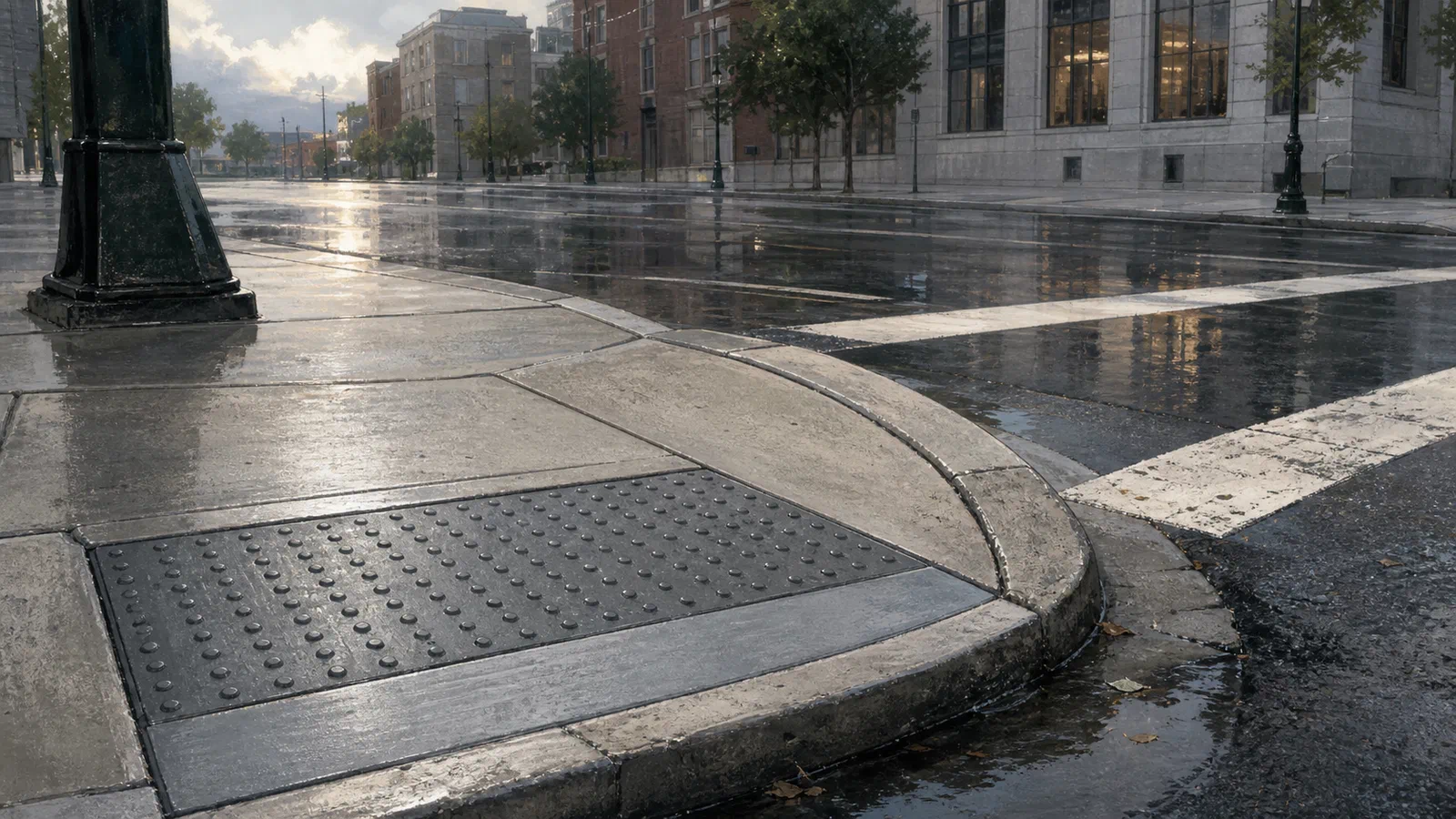
The sidewalk lowers toward the street. The slope is quiet. Its concrete face has no speech, no commemorative plaque, no ribbon-cutting photograph fixed to it. A field of raised domes catches the shoe, the cane tip, the wheel, the rain. A crosswalk line begins a few feet away. The gutter carries water toward an inlet. A sign pole stands just outside the path. A stroller rolls through. A wheelchair follows. A suitcase bumps once, then glides. A worker pulling a hand truck does not think about disability law while crossing the street. That is a sign the public work is doing its job.
The ramp seems simple because the city has hidden a long chain inside it. Law says the sidewalk belongs to more people than the old curb allowed. Engineering says how much slope a body can use without being thrown forward. A budget office says which corners can be rebuilt this year. A public-works crew pours the concrete. An inspector reads the slope. A snowplow, utility cut, tree root, storm drain, or rushed asphalt patch tests the corner again.
The curb cut is one of the smallest public works in American life. It may also be one of the clearest. A city once treated a six-inch edge as an ordinary street detail. The law learned to treat that edge as a barrier when it kept people out of the public way.
That change did not end at the moral insight. The moral insight had to survive a harder place. It had to survive the corner.
The corner is where public language stops floating. “Access” has to become a route. “Equal service” has to become a grade break, a clear width, a landing, a detectable warning, a repair ticket, and a schedule posted where residents can see it. The corner is also where good claims collide. Drainage has to work. Blind pedestrians need a clear cue that the sidewalk has changed into street. Wheelchair users need a slope that does not pitch them into traffic. Bus riders need boarding space. Drivers need sight lines. A neighborhood may need shade trees, older pipes, utility poles, bike lanes, parking meters, delivery zones, and a crosswalk in a right-of-way that never expected all of them at once.
The curb cut is therefore a test of civic seriousness. It does not ask if a public body can say the right thing. It asks if a public body can put the right thing into concrete, then keep it there after winter, traffic, water, repair work, and money have all had their say.
One City, Then Another
The curb cut has no single clean birthplace. That is a warning, not a disappointment. Public design often spreads through overlapping claims, local experiments, veterans’ needs, campus pressure, city engineers, and advocates who notice a barrier before the official record gives it a name.
Kalamazoo gives one of the strongest early municipal stories. The Kalamazoo Public Library’s local-history account places Jack H. Fisher, an attorney and injured veteran, at the center of a 1945 local campaign. Fisher represented disabled veterans and pressed the City of Kalamazoo to alter sidewalks and building entrances. The library account says Fisher testified before the city on September 7, 1945, on behalf of the Buck-Crosby Chapter of Disabled American Veterans. Kalamazoo then authorized cement ramps with safety rails in the central business district. The same account identifies the northeast corner of North Church Street and West Michigan Avenue as the site of the last known original curb cut with a handrail.
That is more than a charming origin note. Fisher’s argument, as preserved by later local-history work, was about employment, independence, and the cost of a city whose curbs turned war injury into daily dependence. A ramp could make the difference in whether a disabled person could reach work without help. The early curb cut was a labor policy in concrete, a veterans’ policy in concrete, and a public-space policy in concrete.
Berkeley gives another line of evidence, with a different civic texture. The UC Berkeley disability-inclusion timeline records campus access work in 1958, the formation of the Rolling Quads in 1969, and a 1970 agreement by the campus and the city on a curb-cut design standard. The Berkeley Revolution archive’s Hale Zukas oral-history excerpt places early official curb ramps on the first four blocks of Telegraph Avenue, near the university, after pressure by the Rolling Quads during the 1969 street rebuild. Zukas recalled developing a ramp design that Berkeley used for years before California’s later building standards caught up.
The Berkeley record adds a second lesson. Zukas described curb ramps as a cross-disability problem. A ramp that served wheelchair users could erase a curb cue used by blind pedestrians. Berkeley’s early design, as he remembered it, put ramps outside the ordinary crosswalk path so a curb edge would remain in the regular line of travel as a warning. That detail complicates the clean poster version of access. The city was trying to fit different bodies into the same corner without pretending one solution served every body the same way.
Berkeley also left a paper trail with council language, map work, and route planning. The Wheelchair Ramps 1973 Location Map archived by The Berkeley Revolution cites Council of the City of Berkeley Resolution No. 45,605 and describes 125 new ramps planned after Ruth Grimes, Hale Zukas, and Eric Dibner surveyed intersections in 1972. The map selected routes along Telegraph Avenue, Shattuck Avenue, downtown Berkeley, Ashby BART, and other places where access could form a useful path instead of isolated concrete islands.
The word path carries the practical burden. A single curb cut is helpful. A line of curb cuts is a route. A route lets a person plan the day without knowing which corner will force them into the street.
The surviving records do not justify a one-birthplace story. Kalamazoo, Battle Creek, Berkeley, UC Berkeley, and other places belong in a shared account. Each case pulls the same object toward a larger system. The curb cut became real because disabled people, veterans, students, local officials, and engineers made the curb visible as a public barrier.
The Law Finds The Corner
The Americans with Disabilities Act turned many local claims into a national duty. Title II applies to state and local government services, programs, and activities. The public sidewalk belongs inside those duties when it carries people through civic life. When a sidewalk is part of a public pedestrian route, the route is part of civic life.
The duty has two different faces. One face concerns existing services. The official Title II regulation at 28 C.F.R. section 35.150 says a public entity must operate each service, program, or activity so that, viewed as a whole, it is readily accessible to and usable by individuals with disabilities. The rule does not require every existing facility to be rebuilt in every detail. It does require real access to the service as a whole, and it places the burden on the public body when it claims that a change would fundamentally alter a program or create undue financial and administrative burdens.
The same section turns street access into a schedule. If a public entity with 50 or more employees will make structural changes and has authority over streets, roads, or walkways, its transition plan must include a schedule for curb ramps or other sloped areas where pedestrian walks cross curbs. The regulation gives priority to walkways serving covered entities: state and local government offices and facilities, transportation, places of public accommodation, employers, then other areas. The plan must identify physical obstacles, describe the methods for making facilities accessible, specify a schedule, and name the official responsible for implementation.
That is dry language. It is also the part of civil rights that residents can audit. A city has to say where the barriers are. It has to say how it will remove them. It has to say when. It has to say who is responsible. The ramp belongs in a public plan, not in a paving crew’s private discretion.
The second face concerns new construction and alterations. 28 C.F.R. section 35.151 requires newly constructed or altered streets, roads, and highways to contain curb ramps or other sloped areas at intersections with curbs or other barriers to entry from a street-level pedestrian walkway. Newly constructed or altered street-level pedestrian walkways need curb ramps or sloped areas where they meet streets, roads, or highways.
The Department of Justice and the Federal Highway Administration put that rule into road language in their joint technical assistance on resurfacing . State and local governments must provide access to pedestrian routes in the public right-of-way. When streets, roadways, or highways are altered, curb ramps are required where street-level pedestrian walkways cross curbs. Resurfacing can count as an alteration. Filling potholes does not. An overlay stretching through a block can trigger curb-ramp work. Crack sealing, striping, certain chip seals, and similar protective maintenance may not.
That distinction sounds technical until a public-works director builds the paving calendar. If the street is altered, the corner comes with it. If the work is maintenance, the duty may wait. A civil-rights right therefore meets the calendar of asphalt.
The Department of Justice’s city-government guidance makes the local stakes plain. It calls curb ramps providing access to streets and sidewalks a basic city service. It also rejects the common belief that old facilities are grandfathered out of Title II or that small cities have a general exemption. The law allows flexibility. It does not let a public body pretend the old curb is neutral just because it has been there for decades.
The Drawing Board Is A Rights Record
The curb cut entered another phase when technical standards caught up with the legal duty. A judge, advocate, or resident can say the corner must be accessible. A person in a wheelchair, a person using a cane, a parent pushing a stroller, and a worker hauling a cart will find out whether the drawing worked.
The U.S. Access Board’s Public Right-of-Way Accessibility Guidelines are the technical map for that problem. The complete PROWAG technical text covers pedestrian access routes, curb ramps and blended transitions, detectable warnings, pedestrian street crossings, accessible signals, transit stops, on-street parking, and other pieces of the public way. The rules are specific because a corner fails specifically.
For pedestrian access routes, PROWAG sets a minimum continuous clear width of 48 inches in most settings. For curb ramps and blended transitions, the provisions govern running slope, cross slope, grade breaks, landings, clear spaces, surfaces, flares, and detectable warnings. Perpendicular curb ramps generally have a maximum running slope of 1:12, or 8.3 percent, with exceptions when existing conditions force a longer ramp. Detectable warning surfaces use truncated domes in set sizes and spacing.
Those numbers carry practical force. Slope is force. Cross slope is drift. Width is whether a route allows a device and a body to pass through without scraping a pole or sign base. Grade breaks are where small wheels catch and bodies pitch. A puddle at the gutter can become an impassable strip. A landing with a signpost in the middle can turn compliance into a joke.
The federal record also changed in December 2024. The Department of Transportation published a final rule in the Federal Register adopting PROWAG, without modification, as DOT’s regulatory standards for new construction and alterations of transit stops in the public right-of-way. The rule was published on December 18, 2024, and took effect on January 17, 2025. Its scope matters. DOT’s independent ADA authority here reaches public transportation facilities, so the final rule applies PROWAG to transit stops in the public right-of-way within that authority. Title II and DOJ rules carry the wider curb-ramp duty for streets and walkways.
That layered structure can be frustrating for the reader who wants one clean rule. It is also how American public works often function. DOJ rules define state and local duties. FHWA and DOJ explain how resurfacing changes the duty at streets. The Access Board writes technical minimums. DOT adopts those standards within its transportation authority. States, cities, and counties then produce their own details, inventories, standard drawings, funding plans, and inspection forms.
The corner is small. The legal machinery around it is large.

The right becomes real only when the project list, budget, and corner detail agree.
The Dome And The Drop
A curb ramp can help one person and confuse another. That is the part many easy stories skip.
For a wheelchair user, the curb is a wall. For a blind pedestrian, the curb is also information. The edge says the sidewalk is ending and the street is near. When the city lowers the curb, it removes the wall and also removes a warning. The same concrete change can open a route and erase a cue.
This is why detectable warnings have become such a familiar part of American corners. The small truncated domes at the foot of the ramp are a tactile signal. They warn that the pedestrian route is reaching a vehicular way, rail crossing, or other hazard edge. Their job is warning. A smooth ramp can turn a warning edge into a silent slope.
Hale Zukas’s Berkeley recollection shows how early advocates recognized this problem before a national standard gave it a uniform shape. His account said Berkeley placed some early ramps outside the main crosswalk path to leave a curb in the regular path of travel for blind pedestrians. Later standards took a different route by requiring detectable warning surfaces. The principle stayed: access cannot mean solving mobility by ignoring vision.
The corner must read to many bodies at once. A person using a manual wheelchair feels slope through shoulders and hands. A power-chair user feels turning radius, lip height, and cross slope. A blind pedestrian feels edge, texture, traffic sound, and signal timing. A person with low vision sees contrast or fails to see it. An older pedestrian feels a landing as rest or risk. A delivery worker feels whether the load pulls sideways. A child feels the curb as a place to stop or a chute into the road.
Good design does not make those experiences identical. It reduces needless conflict among them. The technical details are a public attempt to do that.
The corner also has to work in weather. Rain turns a bad gutter into a pool at the exact place where wheels need traction. Ice hides the grade break. Snow storage can bury the ramp the city paid to build. Leaves, sand, and broken asphalt collect at the bottom. A snow-cleared sidewalk can reach a snow-packed curb cut and strand the user at the street edge. The ramp is then present in the inventory and absent in life.
This is why maintenance belongs inside the civil-rights story. The legal right continues after the pour. It has to survive the next repair, storm, plow pass, and utility trench. A city that counts a ramp once and never checks it has recorded a promise and left the keeping unfinished.
A City Makes A List
A transition plan is where the curb cut becomes boring on purpose.
The City of Lake Stevens, Washington , gives a useful current public record because its ADA Self-Evaluation and Transition Plan page puts the practical pieces in one place. In March 2023, the city published an ADA transition plan to comply with federal and state law. The page says the plan self-evaluated public facilities, identified barriers, developed a transition plan and schedule, and named the official responsible for implementation.
Then the page becomes concrete. Lake Stevens reports a physical inventory of 2,679 sidewalk segments totaling about 137 miles, 3,095 curb ramps, and 97 signal pushbuttons. It estimates the cost of removing all noncompliant features and barriers in the public right-of-way at $37,628,000 in 2023 dollars. It also keeps the public-facing process visible: an ADA Coordinator, a grievance and complaint process, an ADA Grievance/Complaint Form, and an ADA Accommodation Request Form.
That is the civil-rights machine stripped of drama. Count the assets. Mark the barriers. Price the work. Set the priority routes. Create a request path. Name the officer. Keep future capital projects, permitted development, and other construction from adding new barriers while the old ones are being repaired.
The plan also admits the hard part. Removing every noncompliant feature will take years. Some curb ramps may be technically infeasible under existing site constraints. Lake Stevens requires designers to submit Maximum Extent Feasible documentation for those cases, reviewed by Public Works and approved or denied by the City Engineer or designee. A noncompliant ramp can be accepted only under those conditions.
This is where a serious access argument has to be fair without becoming soft. Cost is real. Geometry is real. Old streets have slopes, drainage, driveways, tree roots, vaults, poles, and property lines that make a perfect ramp hard or impossible at a given corner. The ADA does not demand fantasy engineering. It demands a public record of why the city chose one method, one schedule, one exception, and one responsible official.
The Lake Stevens number also shows why rights can vanish inside a budget if no one watches the list. Thirty-seven million dollars is a large city obligation. It also cannot serve as an open-ended license to leave every barrier in place. The plan has to turn a large obligation into phases that can be funded, built, and checked. A resident should be able to see whether a requested route is in the queue, whether the city is using capital projects to remove barriers when streets are opened anyway, and whether the public body is closing gaps or simply refreshing the plan’s cover page.
The dullness is the point. A transition plan is a public map of promised corners.
The request form belongs in that map. It is easy to dismiss a complaint form as paperwork, but for a person blocked by one missing ramp, paperwork may be the first tool that turns a private barrier into a public record. The form creates a date, a location, a description, a contact path, and an obligation to answer. It gives the city a way to separate a maintenance problem from a capital barrier, a design exception from a construction defect, and a request for accommodation from a general service complaint.
The form also disciplines the city. If five residents request the same corner, the corner has become evidence. If requests cluster near a bus stop, clinic, senior housing site, school, or government office, the priority map should see that pattern. If the same ramp appears in the inventory as compliant while users keep reporting a problem, the city has learned something the spreadsheet missed. A ramp can pass a design drawing and fail a person’s trip because water pools at the bottom, a pole narrows the path, or the opposite corner never received its companion ramp.
The request system cannot replace the transition plan. A city should not make disabled residents discover every barrier one painful trip at a time. The better plan starts with surveys and priorities, then lets resident reports correct the official picture. The public list and the lived route have to speak to each other.
That exchange is one of the quiet civic benefits of the curb cut. It forces government to admit that the street is a service used by specific bodies, at specific places, under specific conditions. The service fails at an address, not in the abstract.
A Ramp Can Fail After Concrete Sets
The corner can fail before it is built, during construction, or years after final inspection.
It can fail on paper if the city does not inventory barriers. It can fail in design if the ramp points away from the crosswalk or lacks a usable landing. It can fail during construction if field conditions are ignored or the contractor pours a slope steeper than the drawing. It can fail after a utility cut leaves a lip across the path. It can fail when a sign base sits in the clear width. It can fail when detectable warnings loosen, spall, or disappear under snow.
Public records often show this as a work order or project page instead of a civil-rights drama. Minneapolis gives a modest example. The city’s 50th Street ramp project states that work in the summer and fall of 2025 made more than 50 pedestrian ramps ADA-compliant along 50th Street, naming the corridor segments and noting completed status. A companion city project page for Dinkytown notes another curb-ramp improvement project in design. Those pages are ordinary capital-project records. They show access moving through location lists, construction seasons, and project status lines.
That is useful because the public usually encounters access this way. A resident does not ask for a theory of disability law when the ramp at the corner of a transit stop ponds after rain. The resident asks the city to fix a place. The city then has to sort the request. Is this a resurfacing-triggered alteration? Is it in the transition plan? Is it part of a larger corridor? Is it a complaint? Is it a maintenance problem? Is the ramp present but noncompliant? Is the ramp compliant on paper and unusable after damage?
The enforcement record shows what happens when public promises do not hold. In April 2024, the Department of Justice entered a Title II settlement with Virginia Beach . The DOJ case page says the city agreed to ensure accessibility of facilities, curb ramps, websites, and emergency-management procedures, plus effective communication and ADA training. The page links a settlement agreement and attachments for new construction, altered construction, existing facilities, and certification of architectural compliance.
That kind of settlement is an access-management record. It reminds readers that a city can fail through neglect, misunderstanding, bad inventory, weak inspection, underfunding, or old design habits. It can also improve through the same channels. A transition plan, capital program, inspection form, standard drawing, grievance process, and settlement agreement all share the same boring purpose: make the public way usable.
The maintenance problem is especially unforgiving because it blurs the line among departments. A street crew may handle resurfacing. A sidewalk program may handle panels. A utilities contractor may cut pavement. A traffic team may place signal poles. Parks may manage a trail crossing. A private developer may rebuild the corner as part of a permit. A snow contractor may clear the route badly. If no one owns the final pedestrian route, every one of those actors can leave the ramp a little worse.
Civil rights become fragile when every department can say the broken corner belongs partly to someone else.
The Curb-Cut Effect Needs A Hard Edge
The curb cut became famous for a reason larger than the ramp. It is the example people reach for when they explain how design for disability can benefit the public at large.
The example is true. Parents with strollers use curb cuts. Workers with dollies use them. Travelers with rolling luggage use them. A child learning to ride a bicycle uses them. A runner with an ankle injury uses them. An older pedestrian uses them on a day when lifting a foot six inches is hard. In that sense, the curb cut is a public answer that exceeds its first use.
The easy lesson can also flatten the history. If the story becomes “a feature built for disabled people helped everyone,” the center of gravity can drift toward everyone. The disability-rights demand becomes a clever design hack. The people who faced the barrier become a footnote to a cheerful management lesson.
That is too soft for the record. Kalamazoo’s early campaign was tied to disabled veterans and people who could not reach work without accessible sidewalks and entrances. Berkeley’s early curb ramps grew out of the independent living movement, the Rolling Quads, and a campus-city fight over ordinary movement. ADA curb-ramp duties exist because inaccessible public routes excluded people from civic life. The public spillover is a gain. The disability-rights claim comes first.
The harder lesson is better anyway. A society often finds public value only after a marginalized group forces the system to see a barrier. The curb cut did not become good because it helped everyone. It helped everyone after disabled people made a false “ordinary” condition visible.
The same warning applies to nostalgia. The old curb is easy to romanticize as a piece of sturdy city fabric. The ramp is easy to romanticize as a small triumph of kindness. Neither frame is enough. A curb can organize a street and block a person at the same time. A ramp can symbolize inclusion and fail in the gutter. Kindness did not build the ADA. Enforceable rights, organized pressure, local records, design standards, and budgets did the work.
The curb-cut effect needs a hard edge because access is an enforceable public obligation measured at the corner.
The Budget Inside The Right
No city builds every curb ramp at once. That fact should not be used as an excuse, and it should not be waved away.
The ADA’s transition-plan structure is one of the better public tools because it refuses both evasions. It accepts that a city has to schedule capital work. It also requires the city to name barriers, methods, timing, priorities, and responsibility. It turns “we care about access” into a list residents can inspect.
The cost question is where bad arguments gather. One side can treat any municipal cost claim as bad faith. Another side can treat cost as a magic phrase that ends the duty. The regulation does neither. When a public body claims a fundamental alteration or undue financial and administrative burden, the decision has to be made by the head of the entity or a designee after considering all resources available for the service, program, or activity, with written reasons. Even then, the public body must take another action that avoids the burden while giving people with disabilities the benefits or services.
In plain terms, the budget is part of the right. A plan that cannot be funded is a wish. A budget with no barrier list is a hiding place. A schedule with no request process turns access into guesswork. A complaint process with no capital plan turns residents into repeat petitioners. A standard drawing with no maintenance budget creates a compliant corner for one inspection day.
The practical path is less dramatic. Cities can attach curb ramps to paving work, street reconstruction, transit-stop upgrades, downtown projects, school-route improvements, signal replacements, sidewalk-repair programs, and private development permits. They can publish inventories with condition ratings. They can set priority corridors that connect homes, bus stops, government offices, schools, medical sites, grocery stores, and civic buildings. They can keep a resident request system for corners that the city has not yet reached. They can file Maximum Extent Feasible decisions where old geometry prevents full compliance, then make those decisions visible.
They can also stop counting a ramp as finished when the concrete is poured. The usable corner includes the crosswalk alignment, signal timing, drainage, snow clearance, surface condition, detectable warning, and the route on both sides of the street. A ramp ending at a broken sidewalk is a fragment. A compliant ramp leading to a missing opposite ramp is an invitation to enter the street and lose the route.
The public body that handles those details does more than obey a rule. It gives residents a readable account of how rights reach the ground.
A city keeps the promise at the corner, or it lets the curb rise again.
The Corner As Public Record
Return to the corner after rain.
The ramp looks small again. Cars pass. A dog pulls at a leash. A bus sighs at the stop. A delivery worker checks the address. The warning domes hold a little water in their pattern. The crosswalk paint is wearing thin at the center of the lane. The landing is clear. The slope does not throw the chair sideways. The gutter does not swallow the wheel. The ramp lines up with the opposite corner.
If the corner works, it will disappear into the day for many people. That disappearance is an achievement. It means a civil-rights claim survived conversion into concrete, rule text, inspection, and maintenance.
If the corner fails, it will also disappear for many people. Drivers may not see it. Able-bodied pedestrians may step over the bad lip, dodge the puddle, or hop down the curb. The failure becomes obvious mainly to the person whose route ends there.
That is why the curb cut remains a good civic object. It is too small to hide behind rhetoric for long. You can go look. You can measure. You can watch how bodies move across it. You can read the plan and then stand at the promised corner. You can ask whether the city built a route or only poured a symbol.
The curb cut began as a demand against ordinary exclusion. It became a design standard. It became a transition-plan line item. It became a capital cost. It became a request form, a complaint, a settlement term, a repair project, and a snow-removal problem. It became a place where blind pedestrians, wheelchair users, stroller pushers, workers with carts, and hurried walkers all test the same square of public ground.
The ramp at the curb is therefore a small public work with a large paper trail. It records whether the law reached the street. It records whether the city counted the bodies that use the corner. It records whether the budget kept faith with the plan. It records whether maintenance was treated as enforcement or left as an afterthought.
The person at the curb does not need the whole file. The person needs the route.
The rest of us need the file because the route will not keep itself.