The Factory in the Footnote
The SEC climate-disclosure retreat asks where investor materiality ends and carbon governance begins.
In this article
The Footnote
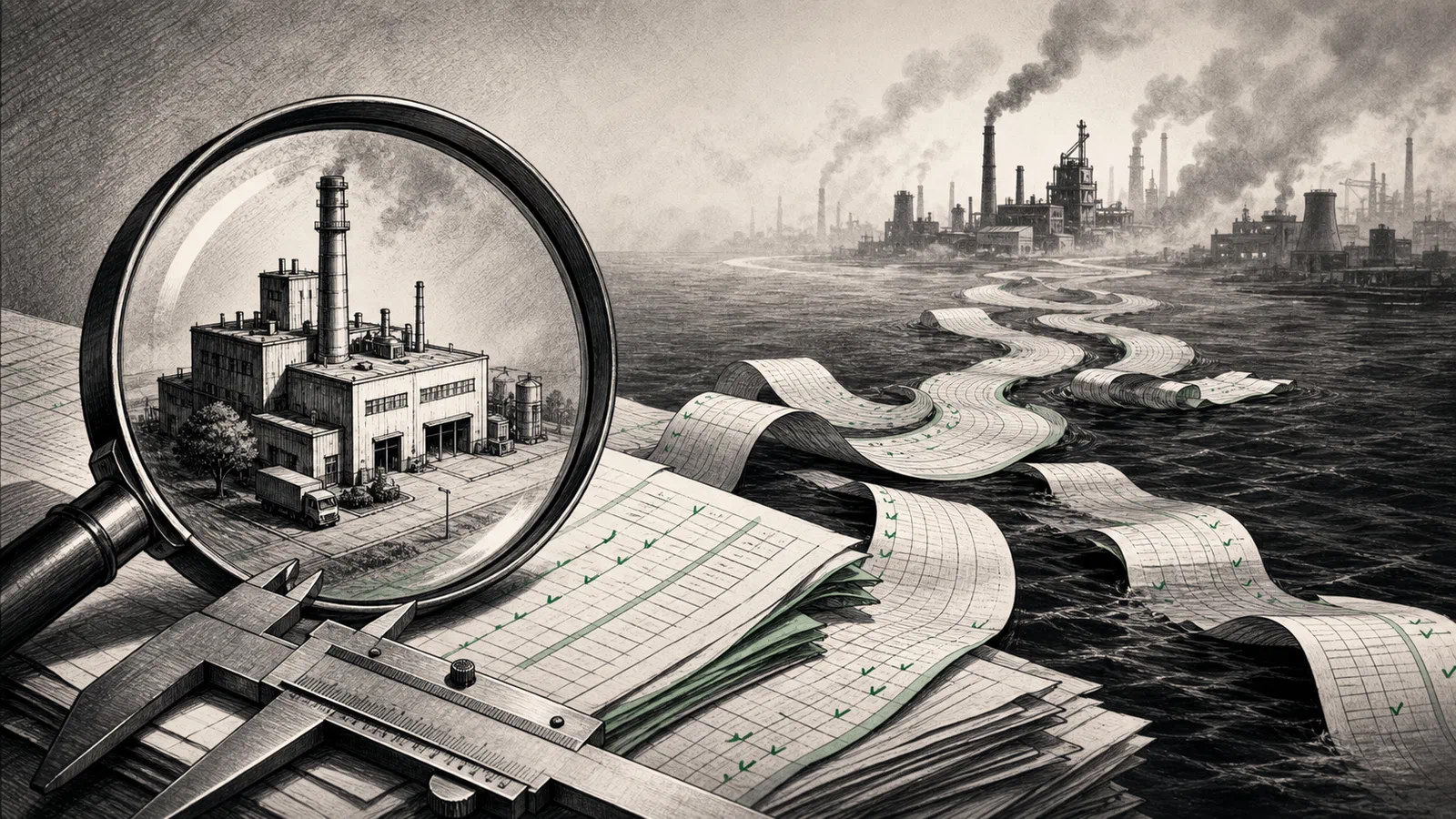
A factory can disappear into a footnote.
The smokestack remains. The workers punch in. The power bill arrives. The supplier needs heat, freight, steel, cement, plastic, ammonia, glass, or electricity. Then a new line appears in the annual report. A risk table expands. A climate target becomes an accounting object. A consultant measures the stack. A lawyer asks what a reasonable investor may later claim the company should have known.
That is the civic shape of the Securities and Exchange Commission’s climate-disclosure rule.
On May 5, 2026, Reuters reported that the SEC was preparing regulations to undo the dormant Biden-era rule. The rule had been adopted on March 6, 2024. It was stayed by the SEC less than a month later while litigation moved through the Eighth Circuit. The agency has now moved toward rescission, according to Reuters, after saying the disclosure system should return to information material to investors.
The fight sounds technical because securities law often hides public power inside technical nouns. Registration statement. Annual report. Scope 1. Scope 2. Limited assurance. Reasonable assurance. Material risk.
Each word seems smaller than a smokestack.
The dispute beneath those words is larger. It asks how far a disclosure agency can go when the disclosed fact is a global atmospheric problem, the compliance cost lands inside domestic companies, and the climate benefit depends on behavior by countries beyond American law.
That question can be asked while taking climate risk seriously without accepting global abstraction as a substitute for domestic accounting. The serious question concerns power. Who pays? Who gains power? What changes in the real economy? What happens when a rule written as information becomes a pressure system for production?
The Rule As Written
The 2024 SEC rule arrived through the language of disclosure, far from the visible world of smokestack limits.
The agency said the final rules were meant to give investors more consistent and reliable information about the financial effects of climate-related risks, company operations, and risk management. The SEC’s own summary said large accelerated filers and accelerated filers, when covered and when emissions were material, would have to report Scope 1 and Scope 2 greenhouse-gas emissions. Some filers would also need assurance reports.
The rule had already been softened before adoption. The final version dropped the broad Scope 3 supply-chain emissions requirement that had drawn heavy opposition. It also built emissions reporting around materiality. Even so, litigation arrived almost immediately. The SEC stay order listed petitions filed in multiple courts by states, energy companies, business groups, and environmental organizations.
The stay turned the rule into a legal object more than an operating regime. It was effective on paper. It was paused in practice. It became a warning about where American securities disclosure might go.
Chairman Paul Atkins has framed the broader SEC project as a return to materiality. In February 2026 testimony , he said the agency should re-anchor disclosures in economic signals and avoid regulatory noise. He argued that public companies spend billions of dollars on annual reports and that disclosure documents can obscure when they grow too long. In an April 2026 version of the same argument , published at the Harvard Law School Forum on Corporate Governance, he wrote that the SEC’s disclosure regime works best when it elicits information material to investors and lets markets drive additional disclosure.
That view has limits. Some climate information is plainly material for some companies. A coastal insurer, a utility with wildfire exposure, a refinery facing state rules, a shipping company using vulnerable ports, or a manufacturer with energy-intensive inputs may face real climate-related financial risk. Investors can reasonably ask how management prices that risk.
The harder question concerns standardization. Once the SEC requires carbon data, assurance, footnotes, governance description, targets, and transition spending, the agency helps build the carbon-accounting machine through which lenders, boards, insurers, proxy advisers, consultants, activists, and litigants can apply pressure.
Disclosure can become governance by other means.
Local Smoke, Global Carbon
American environmental law is strongest when the pollutant and the public share the same air.
The Clean Air Act’s criteria-pollutant regime rests on a direct civic bargain. The EPA explains that the Act requires national ambient air-quality standards for six common outdoor pollutants that are harmful to public health and the environment. Fine particles, sulfur dioxide, nitrogen oxides, lead, carbon monoxide, and ground-level ozone belong to a familiar public-health logic. A plant emits. A town breathes. A child with asthma, an older neighbor, or a worker downwind bears the risk.
That logic is local enough for law to see clearly.
Greenhouse gases work differently. The EPA’s 2009 endangerment finding treated six well-mixed greenhouse gases as threats to public health and welfare because of their atmospheric effect. The phrase “well-mixed” carries the problem. Carbon dioxide emitted in Ohio joins a global stock; lead, soot, benzene, and sulfur dioxide can injure people through the local air they breathe. Carbon’s effect depends on cumulative global emissions, atmospheric concentration, feedbacks, technology, adaptation, and national choices made elsewhere.
This difference changes the accounting of obligation.
If a domestic rule cuts local lead exposure, Americans nearby receive a measurable benefit. If a domestic rule raises the cost of American production in order to reduce global carbon, the public return depends on a chain of assumptions. American emissions must fall. Production must avoid migrating to a dirtier jurisdiction. Other countries must keep their own promises. Energy substitutes must arrive at scale. The cost must avoid landing hardest on people with the least room in the household budget.
That chain may hold in some cases. It cannot be assumed as a moral shortcut.
The European Commission’s 2025 climate progress report shows the tension. The EU has reduced emissions sharply compared with 1990 and says GDP has grown at the same time. That is real progress. The same report says global emissions continued rising in 2024. It also records industrial-output pressure, noting a 2.6 percent decline in EU industrial output in 2024 compared with 2023.
Europe’s problem resists cartoon treatment. Energy shock, Russia’s war, Chinese overcapacity, aging demographics, regulatory complexity, investment lags, and climate policy all sit in the same ledger. The useful lesson is narrow: industrial capacity is a public good, and decarbonization policy can damage it when cost, energy supply, and foreign competition are handled as afterthoughts.
The EU recognizes this through its own policy architecture. The Commission’s Clean Industrial Deal says European industries face high energy costs and fierce global competition. It singles out steel, metals, and chemicals as sectors needing urgent support to decarbonize, switch energy sources, and deal with high costs, unfair competition, and complex rules. The Commission’s carbon leakage page states that leakage risk may be higher in energy-intensive industries and that the 2021-2030 list covers sectors and sub-sectors representing about 94 percent of industrial emissions under the EU ETS.
That is the policy system admitting its own tradeoff.
The Jurisdiction Problem
The United States can regulate American issuers. It can regulate American markets. It can regulate American air. It cannot command the industrial policy of China, India, Russia, Vietnam, Indonesia, Brazil, or any other sovereign economy.
That fact should discipline climate policy more than it often does.
The European Commission’s EDGAR-based 2025 climate progress chapter estimated that in 2024 China produced 29 percent of global greenhouse-gas emissions, the United States 11 percent, India 8 percent, the EU 6 percent, and Russia 5 percent. Global emissions rose 1.3 percent that year. EDGAR’s 2024 report , using 2023 data, had already identified China, the United States, India, the EU, Russia, and Brazil as the largest emitters and reported that global greenhouse-gas emissions reached 53.0 gigatonnes of carbon-dioxide equivalent.
Those numbers set the scale of American power.
An American rule can reduce American territorial emissions and fail to lower global emissions if production moves to a higher-carbon grid or if foreign growth swamps domestic savings. A disclosure rule can make American companies cleaner on paper while moving marginal investment toward jurisdictions with cheaper energy, weaker reporting, or state-backed industrial policy. A rule can reward firms that outsource their dirty inputs while penalizing firms that keep production visible inside the United States.
That is the factory-in-the-footnote problem.
The public sees a cleaner filing. The atmosphere may see a smaller gain. The worker may see the factory’s next investment move abroad. The investor may see a compliance line item, a consultant contract, and a risk paragraph that says less about the future than it appears to say.
The SEC is a strange place to settle that tradeoff. It can ask public companies to disclose material financial risk. It cannot build a national energy system. It cannot negotiate a carbon bargain with Beijing or New Delhi. It cannot guarantee that disclosure will reduce emissions instead of changing where emissions occur.
What Investors Can Fairly Ask
The case for climate disclosure deserves a clean hearing.
Investors own companies exposed to physical risk, transition risk, regulatory risk, litigation risk, and capital-cost risk. Floods can damage assets. Heat can disrupt labor. Wildfire can alter insurance markets. Carbon rules can change the value of reserves, plants, fleets, and contracts. Companies that make public climate targets can mislead investors if those targets rest on weak assumptions. A market built on disclosure has a legitimate interest in information that changes enterprise value.
That is the best argument for the rule, and it deserves a clean answer.
The best argument against the rule begins at the same place: materiality. If a climate fact is material to enterprise value, existing securities law already gives investors a path to demand it. The SEC has long expected companies to disclose material risk. The agency also has antifraud tools when a company misstates its exposure, targets, spending, or transition plan.
The 2024 rule moved toward a more prescriptive regime. It did so in a public environment where carbon accounting often carries an ambition beyond investor protection. Carbon disclosure is used by capital providers, ratings systems, activists, procurement offices, insurers, and corporate boards to rank firms by climate alignment. The filing becomes a node in a wider discipline system.
That discipline may be desirable to people who want capital markets to accelerate decarbonization. It may be dangerous to people who think capital markets should disclose economic risk while elected branches decide climate policy.
The distinction is material. A securities filing belongs to a different constitutional and civic category than a ballot, an environmental statute, or a treaty. When the SEC uses disclosure to shape industrial behavior, it moves public choices into a room where the key actors are lawyers, auditors, index providers, consultants, large asset managers, and boards.
Ordinary citizens enter later, through prices, wages, energy bills, and fewer choices.
Poverty, Prices, And The Hidden Cost
Climate policy often speaks in planetary terms. Domestic policy has to keep account by household and by nation.
A country can rationally decide to pay real costs for a global good. Americans may accept some costs to reduce future climate risk, support cleaner technology, or lower the chance of severe damage later. But that decision should be made in the open, through elected government, with a fair accounting of costs, probabilities, alternatives, and distribution.
The cost side is easy to hide.
If compliance raises audit fees, the line item looks small. If climate reporting changes a lender’s appetite for a plant, the cost appears as a project that never happens. If electricity prices rise, the cost shows up in rent, groceries, and utility bills. If a factory expands in Asia instead of Pennsylvania, the emissions may remain global while the payroll leaves the local tax base. If the domestic economy grows more expensive while foreign emissions keep rising, the policy can become sacrifice with little bargaining power.
That is why public debate should treat local pollutants and carbon emissions as different policy problems.
Local pollution rules protect citizens against nearby harm. Carbon rules ask citizens to bear domestic costs for a global atmospheric benefit whose size depends on foreign behavior. Both can be justified. They need different proof.
The proof required for a securities-disclosure rule should be especially strict because the SEC’s mandate is narrower than the climate problem. The agency protects investors, maintains fair and orderly markets, and supports capital formation. Unresolved climate diplomacy, industrial strategy, and moral aspiration need political ownership before they become filing obligations.
The Rule After The Rule
Rescinding the SEC climate rule would leave climate risk, voluntary disclosure, state rules, European rules, bank demands, insurance pressure, shareholder proposals, and material-exposure questions in place. It would remove one federal template from the center of the public-company reporting system.
That may be enough to shape behavior.
The better replacement is sharper discipline. Companies should disclose climate risks when those risks are material to enterprise value. Regulators should punish false climate claims, invented targets, hidden liabilities, and misleading transition plans. Environmental agencies should regulate pollutants within their statutory lanes. Congress should own national climate choices that impose national cost. Trade policy should account for carbon leakage instead of pretending borders disappear whenever the word climate appears.
The word “global” should leave the citizen visible.
The American public can support clean air, demand honest markets, protect industrial capacity, and refuse symbolic rules that shift costs without changing the world’s emissions path. Those positions fit inside one serious policy argument.
The factory in the footnote asks for that seriousness. A climate disclosure line can look like information and become a chain. Before law tightens the chain, the country should know what it is fastening, where the other end leads, and whether the people carrying the weight receive anything solid in return.
The Material Question
The SEC’s climate rule may be rescinded before it ever governs an annual reporting season. Its public meaning will last longer.
It exposed a question that will keep returning under different names. Climate risk. ESG. Materiality. Carbon border adjustment. Industrial policy. Clean technology. Energy affordability. Corporate governance.
The question is simple enough to survive every label.
When a rule asks American companies to price the atmosphere inside their securities filings, does it give investors information they need, or does it use investor protection to discipline the physical economy?
The answer will vary by company, sector, and risk. That variation is the point. A refinery, a bank, a software company, a utility, a steelmaker, and a grocery chain do not share the same climate exposure. A useful disclosure regime admits difference. A political climate regime tends to hunt for a single moral vocabulary.
Outside In Print should be suspicious of that second instinct.
The anti-ideological posture here starts with the record. Climate change creates real risks. Global emissions continue rising. American jurisdiction is limited. Carbon leakage is recognized by climate regulators themselves. Industrial weakness carries public costs of its own. A serious rule has to survive all of those facts at once.
That is enough to make the SEC retreat worth more than a partisan headline.
The old rule tried to put climate inside the footnote. The rescission fight asks who gets to decide what the footnote is for.