The Ladder Outside the Window
How New York made one iron escape carry law, rent, preservation, inspection, and public trust.
The ladder hangs where everyone can see it.
On an old New York block, the fire escape lives in a strange civic place. It belongs to the apartment window, the wall, the owner, the tenant, the inspector, the firefighter, the preservation map, and the person walking below. It is tempting to call it a balcony. It is safer to call it a promise that rusts.
Most days, the promise looks inert. Black iron, chipped paint, bolts in brick, a drop ladder above the sidewalk, small platforms stacked outside small rooms. It casts hard shadows on masonry. It collects flower pots, air conditioners, chairs, snow, memory, and suspicion. Anyone who has looked up at one has done a little private engineering. Will those anchors hold? Does the ladder lower? Who checked it? Who paid for that check?
New York’s Landmarks Preservation Commission guide to fire escapes says these structures began appearing on city buildings in the 1860s, when emergency egress requirements reached tenements. The same guide now treats some old fire escapes as significant features of historic streetscapes. In that shift, a hard safety device became a city image.
That double life gives the fire escape its force. It began as law reaching for an outside route after dense private housing had already produced danger. It became a working surface for crowded domestic life. It entered labor history through the fatal meaning of blocked or damaged egress. It reached preservation as a piece of old-city texture. It remains in modern violation records as a recurring object of owner duty, tenant use, inspection, and repair.
The New York fire escape is a visible contract among private property, public safety, housing density, inspection capacity, preservation memory, and emergency trust. Its history shows how cities retrofit public promises onto buildings they cannot quickly replace.
The Outside Route
Fire-escape law in New York did not begin with charm. It grew out of a physical problem: too many people living above too few reliable exits.
Before the fire escape became the familiar iron stair outside the window, New York law had already tried other routes. A public-domain Tenement House Commission history, Tenement-House Legislation in New York, 1852-1900 , traces early scuttle, ladder, roof, and egress provisions through building laws and health laws. Its first historical point is easy to miss. The word “tenement-house” appears in New York statute in 1862, yet earlier building laws had already dealt with houses occupied by many families.
That pressure came before the icon.
The early law was learning what density did to escape. A roof scuttle offered one path. Ladders offered another. A separate tower fire escape was discussed before the exterior iron balcony became the more common compromise. The law was not drawing an aesthetic. It was trying to make a route out of buildings already divided into rooms, halls, shafts, stairways, and leases.
The 1862 law made that problem explicit. In Chapter 356, Section 27, the statute required certain dwelling houses in New York City to have a “practical fireproof fire escape” approved by the building authority. It also addressed front and rear tenements on the same lot, requiring an iron bridge over the roof where those paired buildings created another egress problem.
The provision reads as pressure before it reads as invention.
New York had reached a point where ordinary multi-family housing had to be treated as an emergency system. A house was no longer only a private structure. It could become a public hazard because of the number of people sleeping above the street.
In 1867, Chapter 908 created the first special tenement-house law. The 1900 commission history says it required every building used as a tenement or lodging house to have a proper fire escape in a form approved by the Inspector of Buildings. The rule turned the tenement itself into a legal subject. Density was no longer a private inconvenience. It had a name, a category, and an egress duty.
Then came the slow work of detail.
The 1879 amendments belonged to the larger tenement reform sequence of light, air, rooms, yards, ventilation, and enforcement. That distinction is important. Fire safety in tenements was larger than the ladder. Smoke moved through halls, shafts, stairs, windows, partitions, dumbwaiter openings, overcrowded rooms, and poorly maintained structures. The outside route could help only after the rest of the building had already shaped the emergency.
The fire escape therefore entered a wider legal argument: how much old private housing could a city discipline after construction? The answer came in layers. Require the escape. Define who approves it. Require repair. Require paint. Keep it clear. Punish encumbrance. Force old buildings to add equipment. Write separate rules for new buildings. Return to the same wall after each failure.
The 1900 Record
The strongest pre-1901 evidence comes through government reform work written beside the buildings themselves.
In 1900, Hugh Bonner, chief of the New York Fire Department, and Lawrence Veiller, secretary of the Tenement House Commission, prepared Special Report on Tenement House Fires in New York . They used Fire Department records. The numbers are stark: during the period they examined, Greater New York had 16,948 fires, and 7,943 occurred in tenement houses. The report put the tenement share near one-half of all fires.
The same public-domain volume includes a separate fire-escape investigation. Its opening premise is devastating in its simplicity: the law had required adequate fire escapes for tenement houses since 1862, and thousands of buildings remained with inadequate means of escape.
That finding breaks the usual habit of treating a law as the end of a story. A requirement written in 1862 did not become a safe balcony on every building by itself. The remaining work belonged to owners, tenants, inspectors, building departments, police officers, fire officers, courts, appropriations, and ironworkers. It also belonged to practical decisions: front or rear, stair or ladder, iron or wood, balcony or grating, paint or rust, clear route or crowded platform.
Bonner and Veiller inspected portions of Manhattan and Brooklyn. In Manhattan’s Seventeenth Ward, the report found 665 tenement houses with no fire escapes on the front. It said those buildings housed 4,306 families, or 21,626 people. In the Brooklyn sample, 283 of 661 tenement houses lacked any fire escape of any kind. Many were wooden buildings.
The numbers are old, but the mechanism is durable. A city can declare a route mandatory and find, decades later, that a route exists in law more reliably than in metal. It can tell itself that a department has authority and then discover that authority is spread across agencies, inspectors, police, firemen, courts, and owners. It can enact a penalty and then discover that the city also needs people to find the violation, serve the notice, return to the building, prosecute the case, and make the work happen.
That is why the fire escape is a useful object. It strips reform down to its physical test. If people must climb it during smoke, the essay cannot stop at the good intention.
The 1901 System
The 1901 Tenement House Law did more than repeat the demand for fire escapes. A scanned contemporary text of the law, published by the Tenement House Department , shows how specific the public promise had become.
Section 12 required every new non-fireproof tenement, unless served by fireproof outside stairways directly accessible to each apartment, to have fire escapes located and built according to the section’s rules. The law specified front and rear placement, apartment access, public-highway projection limits, open iron balconies and stairways, stair angle, step dimensions, balcony width, railings, brackets, drop ladders, goose-neck ladders, painting, and warning plates against encumbrance.
Section 29 carried the rule to existing non-fireproof tenements, with qualifications for structures that already had fire escapes. Section 30 narrowed what counted as sufficient. It rejected wood in fire-escape balconies and wooden outside stairs as lawful fire escapes. Section 31 let the Department of Buildings order more egress where existing means were insufficient. Section 35 made the owner responsible for keeping fire escapes in good order and repair, with paint when rust appeared, and it barred encumbrances.
This is the moment when the ladder becomes a system. The statute is not simply saying, “add an exit.” It is describing who gets access, where the iron goes, how far it can project over public space, what materials count, how the route reaches the roof and ground, and how ordinary objects can defeat the whole promise.
The warning plate is especially revealing. The law required a small notice on fire-escape balconies telling occupants that encumbrance could bring a ten-dollar fine. It is a little public document attached to a private wall. The balcony itself became a piece of law visible through the window.
That also shows why fire escapes became domestic space. The law could command clear egress. Daily life could defeat it. A crowded tenement room made the outside platform attractive on any day without smoke. Air, heat, storage, children, laundry, privacy, a chair, a flower pot, a box, a mattress, a milk bottle, a conversation across the shaft: ordinary use kept pressing into the emergency route.
Paint, Rust, And The Old Penalty
The repair provisions show how quickly lawmakers learned that installation was only the first step.
The 1900 legislative history says fire escapes were required on buildings as early as 1860, yet a specific duty to keep them in repair and painted arrived in 1871. That is a revealing gap. The city had reached the stage where it could require an outside route before it had fully written the maintenance obligation that would keep weather and rust from consuming the route.
Once that duty appeared, it kept returning. The history says the 1871 repair-and-paint rule was reenacted in later legislation. The object made that repetition necessary. An interior stair decays inside the building’s private space. An exterior iron stair advertises decay to the whole block, but it also receives rain, snow, heat, salt, and vibration. Maintenance was never a cosmetic afterthought. Paint was part of the rescue system.
Encumbrance followed a similar path. The same history says the law did not bar encumbering fire escapes before 1871. After that, the law prohibited objects on the fire escape but needed a remedy, an enforcing official, and a person responsible for removal. By 1885, the responsibility had been placed on occupants in New York, with enforcement roles assigned to firemen, policemen, and building officials. Brooklyn later placed responsibility on owners as well as occupants.
This small history is more than administrative trivia. It shows the ladder becoming a three-part problem: the city had to require the structure, preserve the structure, and protect the clear space on the structure. Each part could fail without the others failing. A building could have a fire escape that rusted. It could have a strong fire escape covered in furniture. It could have a clear fire escape too far from the relevant window. It could have rear escapes where the fire started in the rear. It could have vertical ladders that satisfied an approval process while leaving children, older tenants, and panicked families with a cruel climb.
Bonner and Veiller understood that geometry mattered. Their report criticized vertical ladders on tenement escapes and argued for stairs with flat steps and handrails. That argument sounds technical, but it is also moral in the practical sense. During a fire, design decides who can use the promise. A route usable by a young adult in daylight can fail a child, an older woman, an injured worker, or a parent carrying someone else in smoke.
The penalty plate also tells a story about who the law could reach. A ten-dollar fine for placing objects on the balcony is a small sentence with a large assumption behind it: the occupant is close enough to the obstruction to remove it, the officer can see it, the magistrate can punish it, and the threat will compete with daily life. The law looked out the window and saw the object. The tenant looked out the same window and saw space.
The Overflow Room
The photograph explains the law’s problem.
A Library of Congress photograph titled “Typical tenement fire escape serving as an extension of the flat” captures that pressure in one phrase. The caption names the social history built into the iron.
A fire escape that serves as an extension of the flat is doing two jobs at once. In law, it is an emergency route. In life, it is borrowed space. That borrowing belonged to the building conditions around it. Rooms were hot, crowded, and poorly ventilated. A window opening onto iron could feel like relief after hours inside.
The same feature that made the fire escape useful in danger made it tempting in ordinary life. It was outside the room. It had air. It had a rail. It connected neighbors by sight and sound. It gave the tenant a few square feet of platform in a city that sold indoor space by the inch.
That daily use did not make encumbrance safe. It explains why encumbrance kept returning. The platform was a safety device grafted onto a housing system where people needed more living space than the apartment gave them. The law’s warning plate asked tenants to preserve a future emergency route. The room’s heat and tightness asked them to use the route today.
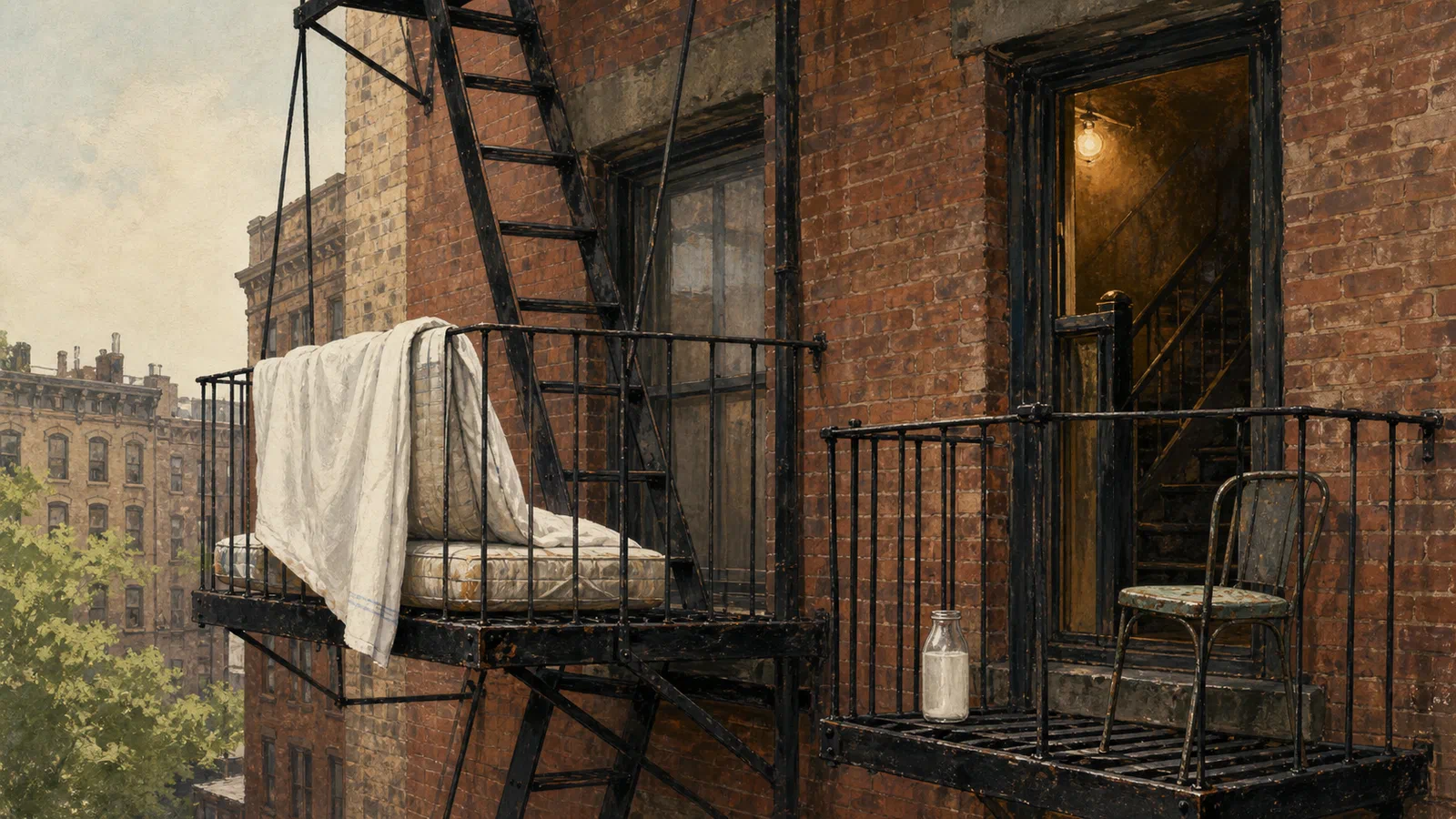
The emergency route also became a record of crowded rooms and improvised urban life.
The fire escape is therefore a material footnote to tenement reform. It tells us that a city cannot solve overcrowding with egress alone. It can add rescue equipment. It can improve stairs, windows, yards, courts, shafts, toilets, plumbing, and light. It can inspect and penalize. The old building will keep revealing what the law has left under pressure.
The Factory Window
The fire escape also moved beyond housing. Loft buildings and factories made egress a labor question.
The Triangle Shirtwaist fire on March 25, 1911, killed 146 workers. Cornell’s Triangle Fire archive preserves the disaster as labor history, legal history, and urban history at once. A Library of Congress Brown Brothers photograph identifies a damaged fire escape at the Triangle Shirtwaist Company building after the fire.
The image should be used carefully. Triangle does not need to become shorthand for every fire-escape argument. The disaster involved doors, stairways, elevators, windows, panic, height, work rules, fire department reach, and the material limits of a building filled with workers. The damaged exterior escape is one piece of that record.
Its importance lies in the meaning of egress under industrial discipline. A tenant in a tenement needed a way out of a private apartment. A worker in a loft needed a way out of a workplace governed by production, supervision, wage pressure, locked or controlled exits, and crowded floors. In both cases, the public promise depended on routes that had to function before anyone had time to debate them.
Triangle enlarged the moral audience for egress. Fire escape law had already existed. Tenement reform had already created a language of light, air, and exits. Yet the factory fire showed how the same city could build wealth in tall rooms while relying on emergency movement as an afterthought. A route that fails under panic is a route that existed too late, too weakly, or too narrowly.
The lesson is not that exterior iron alone could have saved everyone. The better lesson is harsher. Safety cannot live only in a fixture. It has to live in design, maintenance, supervision, inspection, rules, training, and enforcement. A fire escape is visible because the rest of the system is often hidden until the stair fills with smoke.
The Many Custodians
A fire escape has many custodians, which means it can have no single owner in practice.
The building owner owns the wall and has the legal duty to maintain the structure. The tenant needs the route clear. The firefighter needs the route usable as access as well as escape. The inspector needs standards that can be seen and enforced. The preservation reviewer may need the old iron kept because the district’s appearance depends on it. The pedestrian below needs gravity taken seriously.
That diffusion was already visible in the 1900 commission hearings. The report describes divided responsibility for encumbrance enforcement among police and fire authorities. It also records testimony about violations, limited legal capacity, and uncertainty over how many buildings lacked proper escapes. The old administrative problem is recognizable: a physical risk can be everybody’s concern while being nobody’s simple job.
The modern city has more tools, more data, and more specialized agencies. The structure of the problem survives.
New York’s HPD Violations Open Data includes current notices that mention fire escapes. A live query on June 15, 2026, found 23,276 HPD violation rows mentioning “fire escape” with inspection dates in 2025 through June 14, 2026. The recent rows are ordinary in a telling way. They include flower pots obstructing egress, household items on balconies, missing window sashes leading to a fire escape, and drop-ladder shoes needing secure placement.
Those records need care. The dataset is a complaint, inspection, and violation record, a partial administrative view of fire-escape trouble. It is useful because of the language. More than a century after the tenement reformers worried about encumbrance, modern notices tell people to remove objects from the same kind of emergency route.
New York City’s FISP rule, 1 RCNY 103-04 , also folds fire escapes into the broader inspection of exterior walls and appurtenances. The rule’s definition of appurtenance includes fire escapes among things attached to or protruding from a facade. That placement is revealing. The fire escape is egress, and it is exterior wall hardware that can fail outward toward the public.
The sidewalk completes the system. A fire escape can threaten the tenant if it is blocked, rusted, or badly attached. It can threaten the firefighter if it fails under use. It can threaten the pedestrian if pieces fall. A single structure distributes risk upward, inward, outward, and down.
The Modern Complaint
Modern violation language can sound small because it often names small objects. Flower pots. Household items. Missing sash. Loose ladder shoes. A blocked balcony on one story. A condition at one stack on one side of one building.
That smallness is the point. Emergency systems often fail through ordinary accumulation. Nobody has to abolish a fire escape for it to lose value. A planter placed for a little color can narrow the passage. A chair can make a landing harder to cross in smoke. A window that no longer opens correctly can turn an exterior route into a view. A drop ladder without a secure shoe can turn a descent into a question.
The old law treated those small objects with theatrical severity because it had to. The plate on the balcony translated a public safety problem into a warning someone could see from the room. The modern notice does the same work in bureaucratic form. It writes the condition, names the code section, classifies the violation, sets a correction period, and returns later if the system works.
The scale is ordinary.
HPD’s recent rows also show how fire-escape safety moves through ordinary housing administration. A Class A item can concern equipment detail. A Class B item can concern egress obstruction. A Class C item can involve a window condition that affects access to the escape.
The classes give a limited account. They also show how one exterior stair enters multiple enforcement channels: metal condition, egress path, window access, tenant use, owner repair, and agency follow-up.
The recurrence of these notices does not prove that New York’s old fire escapes are broadly unsafe. It proves something narrower and more useful: the same mechanism that worried nineteenth-century reformers remains active. A lawful route requires clear space, working hardware, accessible windows, and timely maintenance. The city can store the evidence in a public dataset now. The underlying bargain is older than the database.
The Price Of Seeing Enough
Inspection is often described as if it were a switch. A city has a rule. An inspector sees a condition. A violation is issued. A repair follows. The fire escape shows why that sequence can be slower and more fragile.
First, the city has to see enough buildings. The 1900 record was already candid about that problem. Inspectors used samples, wards, blocks, and testimony because the whole housing stock exceeded the practical reach of one investigation. A violation system can only catch what a complaint, inspection, survey, accident, or filing brings into view.
Second, the city has to see enough of each building. A fire escape has visible pieces, hidden pieces, and moving pieces. Rust on a railing can be obvious. Weak anchorage can be harder. A drop ladder can look present while failing under use. A window can look like a window until someone needs to pass through it. A balcony can be clear during inspection and blocked a week later.
Third, the city has to move the cost of repair onto someone with the legal duty and financial ability to act. That sounds simple in the abstract. In old rental housing, the owner may dispute the condition, delay the work, seek permits, coordinate access, face cash limits, or calculate that penalty risk is cheaper than immediate repair. Tenants may fear retaliation, need the platform for daily relief, or lack control over exterior work. Agencies may have enough authority to cite the problem and too little capacity to guarantee fast correction at every address.
The fire escape compresses those limits into one object. It makes the city dependent on ordinary maintenance before the emergency. It makes the tenant dependent on someone else’s work. It makes the owner dependent on code clarity, contractor availability, agency approvals, and money. It makes the firefighter dependent on decisions made months or years earlier.
This is the unglamorous core of public safety. The dramatic moment is smoke at the stair. The actual system is inspection notes, paint, bolts, window sashes, landing clearance, repair contracts, violation mailings, reinspection access, and the willingness to treat an old outside stair as emergency equipment every day.
Preservation After Safety
By now the New York fire escape carries a cultural burden its first users never assigned to it.
It is part of the city’s visual shorthand: brick, iron, laundry, jazz-club mythology, heat, movie scenes, apartment listings, streetscape rhythm, old-law tenements, cast-iron lofts, and narrow lots. A feature added to discipline dangerous housing became one of the features people use to recognize the city.
The Landmarks Preservation Commission knows this double meaning. Its fire-escape guide says permits are required to install, modify, or remove fire escapes on landmark properties. It tells owners that fire escapes may be significant architectural features, especially on primary facades or in historic districts. It also gives staff standards for matching materials, profiles, dimensions, color, and location.
The old iron becomes evidence.
The same agency can approve repairs because safety requires them, protect the old appearance because district character depends on it, and limit removal because the iron has become part of the public face of a building. None of that cancels the fire escape’s original purpose. It complicates the maintenance duty.
The East Village and Lower East Side offer a strong example because the old law tenement, the immigrant district, and the visible fire escape overlap there. The East 10th Street Historic District designation report treats rows of nineteenth-century buildings as part of a larger streetscape story, where old tenements, stoops, cornices, fire escapes, and storefronts carry memory of urban settlement and change. Preservation here concerns decorative value and the legibility of a built system.
SoHo gives another version. Cast-iron buildings and lofts made exterior iron part of a different urban face: work, storage, manufacturing, conversion, artists, galleries, and real estate. Fire escapes on those facades can read as period detail even when their first obligation remains egress or exterior safety.
This creates a tension worth holding. A city can preserve a fire escape because it tells the truth about an older city. A city also has to keep the same device safe, clear, anchored, painted, inspected, and usable. Memory cannot replace maintenance.
The Code Retires New Escapes
The familiar exterior fire escape survived most visibly on old buildings because modern code moved away from relying on it for new construction.
New York City’s 1968 Building Code , Section 27-368, states that fire escapes shall not be permitted on new construction, with an exception for group homes. The same section allowed fire escapes as exits on buildings existing on December 6, 1968, when altered, subject to approval. Section 27-380 then set specifications for fire escapes used on existing buildings or allowed group homes.
That provision confirms the common claim, but it also narrows it. The code did not make every fire escape disappear. It drew a line around new construction while keeping a route for existing buildings. The fire escape became, legally, an old-building solution. New construction had to use other means of egress. Existing buildings carried a grandfathered or approved form of the older promise.
This is the city’s retrofit logic in statute. New buildings can be designed with enclosed stairs, protected exits, sprinklers, alarms, fire-rated assemblies, and access routes as part of the plan. Old buildings often receive safety through alteration, repair, exception, permit, and inspection. The exterior ladder remains where replacement would be too expensive, too disruptive, too legally complex, or too historically damaging.
The fire escape therefore marks a boundary in time. Before the modern code line, an exterior iron route could be a normal answer to a dense building. After that line, it was increasingly evidence of inherited housing stock and inherited obligation.
That inherited obligation is not inherently bad. Old cities live by adaptation. The danger comes when adaptation is mistaken for completion. An old fire escape can remain lawful, useful, and historically legible. It can also become a dangerous relic if the bolts, treads, rails, window access, and drop ladder are treated as scenery.
The Non-New York Warning
New York inherited and amplified a wider urban answer to fire risk. A national account by historian Sara E. Wermiel, “No Exit: The Rise and Demise of the Outside Fire Escape” , treats the outside fire escape as an urban technology shaped by law, building practice, and changing ideas of safety. Philadelphia’s reform history also shows that exterior escape was a recurring city problem, a shared concern of dense American cities.
The comparison sharpens New York by contrast. The outside fire escape appears where dense urban buildings outpace safer interior design. It spreads because it is cheaper and faster than rebuilding. It recedes in new construction when codes, fireproofing, stairs, sprinklers, and building science change the standard.
New York remains special because the older solution stayed so visible. The scale of tenement construction, the preservation of older neighborhoods, the cinematic power of brick and iron, and the density of pedestrian streets made the fire escape a public object. In another city it may be a technical appendix. In New York it is part of the civic face.
That visibility is useful. It keeps the compromise honest. The building did not magically become safe. The city added an outer route and then had to keep returning to it.
The Street Under The Ladder
Every fire escape asks the same practical question: who bears the risk created by an old building?
Sometimes the tenant bears it through a blocked route, a bad window, a ladder that will not lower, or a platform that feels unsafe. Sometimes the owner bears it through repair costs, filings, fines, permits, insurance, and liability. Sometimes the firefighter bears it through emergency reliance on equipment maintained by others. Sometimes the pedestrian bears it because private metal projects over public space. Sometimes the city bears it through inspection capacity, legal delay, inconsistent records, preservation choices, and the credibility of rules.
The answer changes by building and by day. A clean platform can become blocked after one move-in. A painted railing can rust after years of weather. A historically significant facade can need hidden structural work. A tenant can need air. An owner can postpone repairs. A city can write a rule faster than it can enforce it. A firefighter can arrive after all those prior decisions have become one emergency condition.
That is the deeper reason the fire escape belongs on the outside of the essay as well as the building. It makes the distribution of public trust visible.
The city asks the tenant to trust the owner. It asks the owner to obey code, maintain metal, keep records, and pay before catastrophe. It asks the inspector to see enough. It asks the preservation body to value history without freezing hazard in place. It asks the firefighter to rely on the route under pressure. It asks the pedestrian to walk below private attachments that public law has allowed over the street.
No one actor can make that whole system honorable alone. The owner who repairs the iron cannot by himself solve overcrowding. The tenant who keeps the platform clear cannot by herself maintain anchors. The inspector who writes a violation cannot by himself complete the work. The preservation reviewer who protects a facade cannot by herself make the old device safe. The firefighter arrives after the bargain has already been tested.
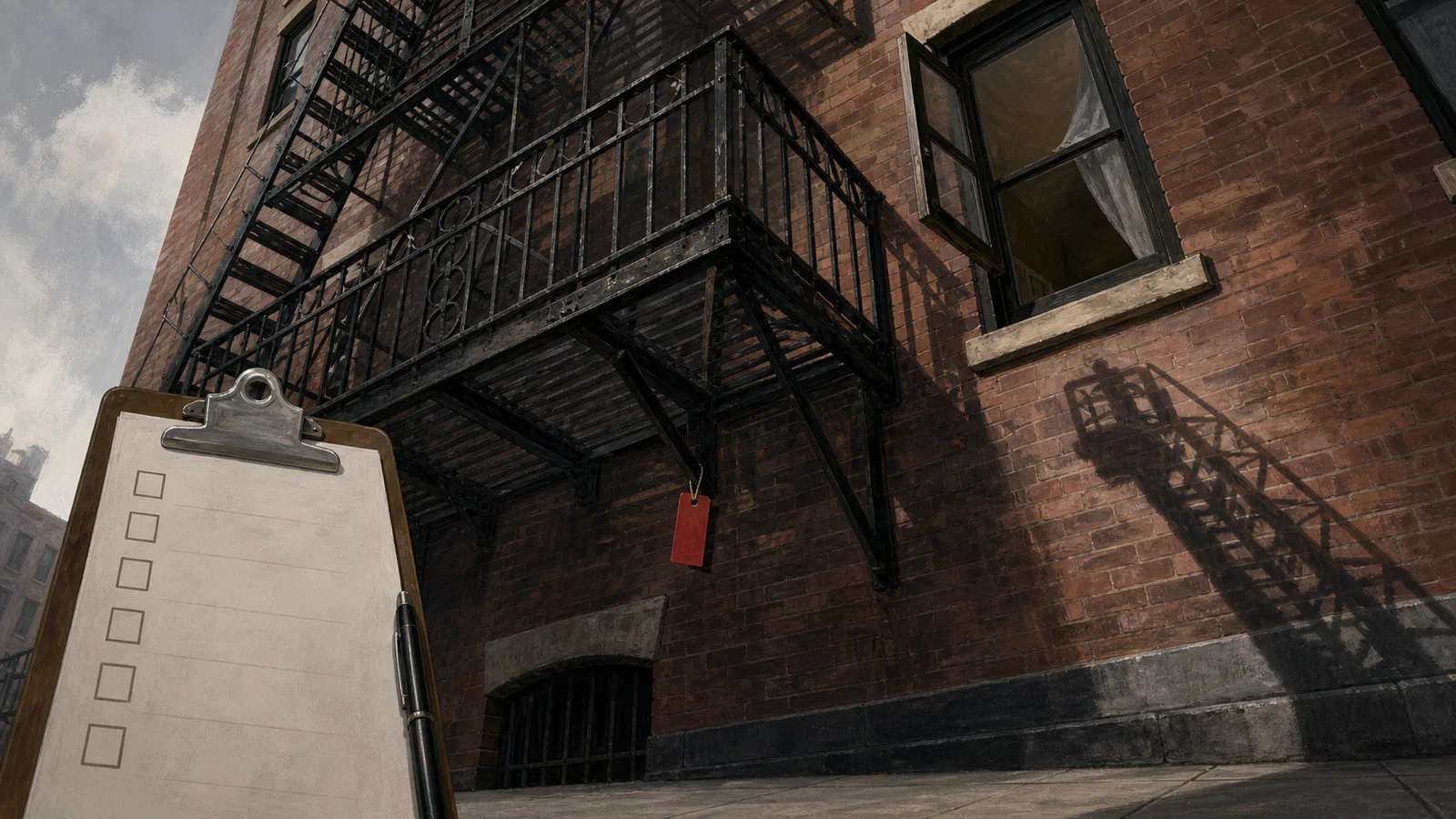
Public safety often depends on private maintenance completed before anyone calls for help.
The ladder outside the window is easy to romanticize because it has such a strong shape. The better reading is heavier. It is a piece of public safety bolted to private brick, a legal promise exposed to weather, rent pressure, human use, agency capacity, and time.
Cities rarely get clean redesigns. They inherit buildings, codes, disasters, owners, tenants, inspectors, firefighters, preservation districts, sidewalks, budgets, and political patience in uneven amounts. Then they attach the next promise to the old structure and hope the bolts hold.
The fire escape keeps that hope in view. It is old iron, but it is also a civic test. A promise on paper has to become a path under foot.