The Little Machine in the Glass Case
The nineteenth-century patent model turned invention into a public bargain: a small machine, a written claim, a temporary right, and a record the rest of the country was supposed to learn from.
A Machine Small Enough for the Office
The old patent model first looks like a curiosity. It is small enough for a shelf, made of wood, brass, iron, glass, wire, leather, and patient hands. A latch moves. A wheel turns. A needle rises. A plow blade angles through imaginary soil. A shuttle passes thread through cloth that is no longer there.
The object seems modest because its scale is modest. That is the trap. A patent model was never only a miniature. It was a public act compressed into a thing. An inventor carried it or shipped it to Washington because the federal government was being asked to grant power: the legal right to exclude others from making, using, or selling an invention for a limited time. The model stood at the edge of that bargain. Before the inventor received a right, the public office demanded a showing.
In the nineteenth century, that showing had weight. The applicant sent words, drawings, and, for many inventions, a model. The model did work that a paragraph could not always do. It gave the examiner a small machine to inspect. It gave later visitors a way to understand the claim without entering a factory. It gave rivals and imitators something to measure themselves against. It told the public that invention was not magic or personality. Invention had parts.
Hagley Museum and Library , which now preserves a major patent-model collection, describes the old requirement plainly: from 1790 until 1880, U.S. patent applicants submitted scale models along with descriptions and drawings. Hagley also notes that the model era generated hundreds of thousands of miniature artifacts and that many were displayed in the Patent Office’s public galleries. Those cabinets were full of private ambition, but they were built inside a public institution.
That is the useful starting point. The model in the case is a pretty object only after it is a legal instrument. It belongs to the same civic family as a land plat, a court exhibit, a filed deed, a ballot box, a public docket, and a safety inspection tag. Each object says that private action has crossed into public consequence. The patent model did the same thing with invention. It told the inventor: if you want the law to protect your claim, make the claim legible.
Patent talk often treats cleverness as the whole story. The older model points to the bargain underneath. The government grants a temporary exclusion because the inventor gives the public a usable disclosure. The inventor receives time to profit. The public receives knowledge that can be searched, challenged, improved, and eventually used freely when the right expires. The bargain can work. It can also fail. A right can be too broad, too vague, too expensive to contest, or too detached from what the inventor actually taught.
The nineteenth-century model cured none of those failures. Its contribution was smaller: it made mechanical claims harder to hide.
The First Patent Bargain
The Constitution gave Congress the power to secure exclusive rights to inventors for limited times in order to promote progress. The first federal patent law followed quickly. The Patent Act of 1790 set up a small Patent Board made up of the Secretary of State, Secretary of War, and Attorney General. The USPTO’s patenting milestones identifies Thomas Jefferson, Henry Knox, and Edmund Randolph as the early officials who examined patent petitions under that first statute.
The machinery was small; the authority was large.
The 1790 law already carried the old American tension. The applicant asked for an exclusive right. The public officers first had to decide whether the invention seemed useful and important enough. The law required a written specification and called for a draft or model to be filed in the office of the Secretary of State. The first patent system acted as a gatekeeping office. It asked public officers to judge a claim before handing out an exclusion.
The setting was small. No Patent Office stood behind the petition.
The early patent system worked through petitions, handwritten descriptions, drawings, models, and official judgment. It was fragile because its records were physical and few. It was also legible in a way that later systems would struggle to preserve. A person with an invention had to describe it and, when possible, show it.
The model requirement made sense in that world. A claim about a machine could be slippery on paper. A model left truth unsettled while disciplining language. A hinge either moved or it stayed fixed. A gear either touched another gear or missed it. A sewing mechanism either carried thread in a particular path or failed at the decisive moment. The model forced the invention into relationships of part, motion, and scale.
The demand also had a democratic flavor. The record belonged to the office, and eventually to the country.
That exchange is easy to praise in the abstract and hard to administer in practice. The federal government had to decide what counted as new, useful, and sufficiently disclosed. It had to compare new applications against old ones, hold the records, protect them from loss, and preserve enough openness that patents did not become private laws hiding in public files.
The little model sat near the center of those problems. It helped the office see. It also made the office store.
The Office Learns to Examine
The Patent Act of 1836 rebuilt the system. The USPTO timeline marks July 4, 1836, as the moment when Congress introduced a new numbering system, required examination before grant, and created a professional examiner corps. The new system began counting patents from No. 1. Older patents were later treated as “X-patents,” a category that would matter tragically before the year ended.
The 1836 statute also gave the new Commissioner of Patents charge of the books, records, papers, models, machines, and other things belonging to the office. Its application section kept the physical burden alive. Before receiving a patent, the inventor had to deliver a written description clear enough for a skilled person to make and use the invention, and in all cases that admitted representation by model, the inventor had to furnish one of convenient size to show the parts advantageously.
The timing is the point. The model traveled with the application. It gave the examiner a working or representational object while the written description laid out the broader teaching. The two forms checked each other. The words could explain principle, method, and claim. The object could expose false comfort in the words.
The new office also created a public collection almost by accident. Every application brought materials. Every grant left records. Every model occupied space. The same act that professionalized examination enlarged the institution’s memory problem. A modern database hides that burden behind search bars and server rooms. The nineteenth-century office had shelves, cases, corridors, labels, drawers, and fire risk.
The Patent Office became a place people visited. The USPTO timeline says that the first purpose-built Patent Office opened in 1840 and became the first federally funded museum collection in U.S. history, a tourist attraction filled with rows of patent models. That is a striking institutional fact. The office that examined private claims also displayed the country’s practical imagination. It was a bureau and a museum at once.
This dual role changed the meaning of the model room. The models were evidence for examiners, but they also became civic theater. Visitors could walk through cases of small machines and see a republic telling a story about itself: ordinary people invent, the government records, the office classifies, the public learns. That story flattered the country. It also disciplined it. If invention was a national virtue, then the records of invention had to be kept where the public could inspect them.
The 1836 reform also exposed a hard fact about public memory: it can vanish overnight.
Fire and the Missing Record
On December 15, 1836, fire destroyed the Patent Office records kept since the earliest days of the republic. The USPTO’s history of the lost X-patents says the blaze destroyed specifications and scale models for nearly 10,000 pre-numbering patents. The agency also describes a reconstruction effort in which about 2,800 patents could be rebuilt from information sent back by patentees, while over 7,000 remained unrecovered.
The numbers keep the story from becoming decorative. The loss damaged the operating memory of the patent system, not antique material alone. Examination depends on prior art. A new claim must be judged against what came before. When the records burn, the office loses part of its ability to say whether an applicant has truly added something new.
The public also loses the return it was promised. If a patent grant gave the inventor a temporary right in exchange for disclosure, then the destroyed record meant the exchange had partly failed. The inventor had received legal protection. The public had received knowledge. Then the knowledge burned.
The Patent Office tried to recover. The later “X” numbering system was itself a repair tool, a way to separate pre-1836 patents from the new sequence and make the damaged archive searchable again. But repair did not restore everything. Some patents survived through copies held by inventors, families, lawyers, companies, archives, or collectors. Some never came back.
The 1836 fire gives the model room its first warning label. Physical proof feels sturdy until the room burns. A wood and brass model can make a claim clearer than a vague sentence, but it cannot protect itself from a stove pipe, a spark, a bad roof, or a crowded attic. Public knowledge needs architecture, budgets, clerks, indexing systems, duplication, and disaster planning. A cabinet is a record only if the institution can keep it alive.
The office learned that lesson, but not fully. Four decades later, it burned again.
The Museum That Became a Storage Problem
The 1870 Patent Act shows the model room at its most public and its most strained. The public copy of the act says the Patent Office held records, books, models, drawings, specifications, and other things pertaining to patents. Section 13 directed the Commissioner to classify and arrange models, specimens, fabrics, manufactures, works of art, and designs in suitable cases, in rooms and galleries kept open during suitable hours for public inspection.
That phrase, public inspection, is the civic core of the old model system. The patent did not disappear into a private file after grant. It entered a public room. The public could look. Inventors could compare. Examiners could consult. Tourists could admire. Competitors could learn where a claim began and ended.
The same 1870 law also reveals the pressure. Section 14 let the Commissioner return models from rejected applications or sell or otherwise dispose of them after the application had been finally rejected for one year. Congress was no longer speaking as if every object could remain forever. The office had too many things.
Section 29 sharpened the shift. Instead of the 1836 command that an applicant “shall” furnish a model in all representable cases, the 1870 law required a model only if the Commissioner required it. That is the turning point in the statutory path. The model remained legally available, but it was no longer framed in the same way as an ordinary universal burden.
The change was practical. The country had more inventions, more applications, more technical fields, more paperwork, and more demands on space. The model worked best for certain mechanical devices. It worked less well for chemical compositions, processes, systems, and later electrical or abstract methods. It could mislead by shrinking what mattered or making a nonworking principle look plausible. It could also cost inventors time and money before the office had decided whether the claim deserved a grant.
The public gallery looked democratic, but it had a maintenance bill. It needed cases, floors, labels, attendants, classification, access rules, and room for growth. The model room made invention visible, but visibility had volume. Every public record has an afterlife. Someone has to house it.
The Patent Office fire of September 24, 1877, made that burden visible in smoke. A contemporary public account preserved by IP Mall describes a model room on the third story, fitted with cases and visited yearly by thousands of people. It reported about 200,000 models in the wider gallery and described rejected models stored near an inflammable loft. When the fire was contained, the north and west halls had been destroyed. The loss section counted 87,000 models in the two burned halls and noted that many papers and drawings had to be saved under pressure.
The account is vivid, but the civic lesson is plain enough without melodrama. The same institution that made invention public had created a concentrated risk. Models, cases, wood, roof, attic storage, and public records met in one building. The fire did not disprove the patent bargain. It showed how much institutional work the bargain required.
What the Model Could Teach
The best patent models are tempting because they seem to settle arguments. Here is the machine. Look at it. But the stronger lesson is subtler. The model did not eliminate dispute. It gave dispute a shared object.
Take Elias Howe Jr.’s sewing-machine model. The Smithsonian’s object record describes Howe’s 1846 patent model and the lockstitch mechanism it represented: an eye-pointed needle, thread, a loop, and a shuttle carrying the second thread. The model is useful here because the sewing machine was a coordination problem. The needle, shuttle, feed, cloth, and thread had to move in relation to one another. The model let the office see those relations.
Five years later, Isaac Singer brought another sewing-machine model into the same public world. The Smithsonian’s Singer object record identifies Singer’s 1851 patent model and patent number 8,294. Singer’s machine used a straight needle in a vertical motion and was designed for commercial sewing. The object is useful for this essay because it shows patent models operating inside fields of competition, improvement, and conflict. One model did not end the story. Later models entered the same space, claimed different arrangements, and helped shape a larger industry.
A third example pushes the point beyond the famous sewing-machine fight. The Smithsonian/Google Arts record for Margaret E. Knight’s paper-bag machine model describes a model used to demonstrate a machine that folded and pasted flat-bottomed paper bags, with an 1879 patent following an earlier 1871 patent. The model is a small artifact of a large everyday change. The flat-bottom paper bag became ordinary. The model shows the machinery behind that ordinariness.
These examples should be handled carefully. They can easily become heroic miniatures, each one a little shrine to a named inventor. That framing is too thin. The model room functioned as a public sorting machine for competing claims. Howe, Singer, Knight, Lincoln, and thousands of less remembered inventors entered an office that asked the same basic questions. What did you make? What do you claim? How does it work? What can others learn from your disclosure? What should the law exclude others from doing?
The model gave those questions a body. It made the abstract boundary of a patent easier to imagine. It also made the limits of physical proof clearer. A model could show mechanism, but it could not always show durability, cost, scale, safety, labor impact, market conduct, or whether a broad claim would fence in too much future work. The model helped the examiner and the public inspect the invention. It did not tell the country whether the resulting legal power would be wise in every application.
That distinction carries into the present. The old model is attractive partly because it looks like honest proof. Modern patents, by contrast, can look like dense claims and lawyerly fog. But nostalgia can lie. Nineteenth-century models could be polished to impress. They could simplify the hard part. They could turn a costly industrial system into a charming desktop object. They could make invention look individual even when it depended on shops, workers, suppliers, capital, and prior work.
The useful model is not the nostalgic model. The useful model is the one that asks for public legibility.
Abraham Lincoln’s Little Boat
Abraham Lincoln’s patent survives because Lincoln became Lincoln. The USPTO’s Lincoln page explains that his 1849 patent covered a device intended to lift boats over shoals and obstructions, and that he remains the only U.S. president to have received a patent.
The anecdote is charming, but charm can flatten it. Lincoln’s model belongs in this story because it reduces status. A future president had to submit to the same public practice as anyone else. His idea had to be described. A model had to show the parts. The Patent Office could receive it, number it, preserve it, and later display it as part of the public record.
Lincoln also helps explain why patent rhetoric in America often sounds moral. His famous line about the patent system adding the fuel of interest to the fire of genius is quoted often, including by Hagley. It is a compact defense of incentive. Give inventors a chance to profit, and more useful things may be made. The line has force because it understands self-interest as usable public energy.
But incentive is only half the bargain. A society can reward invention without making every reward just. The public has to ask what it gets back. The model room gives the other half of Lincoln’s line. It says: if private interest is the fuel, public disclosure is the chimney, flue, grate, and ash pan. The system needs a way to direct heat without burning the house down.
That metaphor is not decorative. The Patent Office literally burned. Twice. The problem was larger than fire. It was the full life of public knowledge: creation, filing, indexing, display, access, copying, preservation, disposal, recovery. The model was one device in that life cycle. It helped turn an idea into a record. It also created records that had to be saved from the conditions of their own accumulation.
The End of Routine Models
By the late nineteenth century, the model requirement had outgrown the whole patent system. The 1870 law had already made ordinary models discretionary. Hagley gives the conventional endpoint as 1880, when the routine submission era ended. After that, model law remained at the margin.
The modern trail shows the same pattern. Current 35 U.S.C. 112 carries the disclosure duty through words: the specification must describe the invention and how to make and use it in full, clear, concise, and exact terms, and the claims must particularly point out and distinctly claim the invention. Current 35 U.S.C. 114 keeps the model power as a discretionary tool: the Director may require a model of convenient size to show the parts advantageously.
The old physical demand faded because the main site of disclosure moved. The governing object became the specification, claim, drawing, amendment, office action, citation, classification, and searchable file. Patent trust settled into the document system.
That was not simple decline. Written disclosure can do things models cannot. A model can show a mechanical relationship. It cannot honestly represent a chemical process, a method of manufacture, a pharmaceutical compound, a semiconductor architecture, a software method, or a genetic sequencing reagent by merely sitting in a case. A written specification can teach steps, conditions, alternatives, measurements, and best modes. Drawings can isolate parts better than miniature carpentry. Databases can connect millions of records across time and classification.
The modern system also spreads copies. A nineteenth-century cabinet could burn in one building. A digital patent file can be replicated, searched, mirrored, and downloaded. The old model room was visible to whoever could enter the Patent Office. The modern database is potentially visible to anyone with an internet connection and enough patience to search.
Yet the turn toward language created its own civic risk. Language can hide boundaries while seeming precise. Claims can grow abstract. Technical terms can become weapons. A patent file can be public in law and unreadable in practice. A database can contain the record and leave ordinary citizens, small inventors, journalists, judges, students, competitors, and policymakers unable to tell what has been claimed.
The old model room asks a useful question of the modern system: public to whom?
The Public Room and the Specialist File
The old Patent Office gallery was public in a literal way. People could walk through it. They could look into cases. They could see machines arranged by type. The display left them laypeople while giving them an entry point. A visitor could understand that invention involved mechanisms and claims filed with the government. The museum function was imperfect, but it gave the public a physical relation to the patent bargain.
Modern patent records are open differently. They are more complete, more technical, more searchable, and more remote. They preserve legal history with a precision the old gallery could not. But the public relation is thinner. Most people encounter patents only when a product is advertised as patented, when a company sues another company, when a drug price fight appears in the news, or when a technology platform mentions intellectual property as an asset. The public record exists, but the public may not feel invited into it.
That distance has consequences because patents are public power. A patent can shape prices, competition, investment, research agendas, licensing markets, product design, and litigation risk. It can help a small inventor attract capital. It can help a large firm defend a product line. It can support disclosure. It can also create thickets, tolls, threats, and strategic paperwork. The system’s legitimacy depends on its public return, not its constitutional pedigree alone.
The model room did not make that return perfect. It did make it visible. A patent model was a receipt for the bargain. It said that the inventor gave the office something teachable before receiving an exclusion. A modern patent file has to do the same job under harder conditions.
Section 112 now carries much of the old model-room burden. It demands written description and enablement. It demands claims that point out and distinctly claim the subject matter. Those words are the gate through which private ambition enters public law. If the disclosure is weak, the public pays for a right without receiving enough knowledge. If the claim is unclear, competitors cannot know where lawful work begins. If the examination record is too hard to search, the public archive grows without becoming public understanding.
The patent model therefore remains useful as a civic standard, even when it no longer works as a routine filing requirement. It asks the modern record to do what the small machine did at its best: show the work, expose the parts, make the claim testable, and leave knowledge behind.
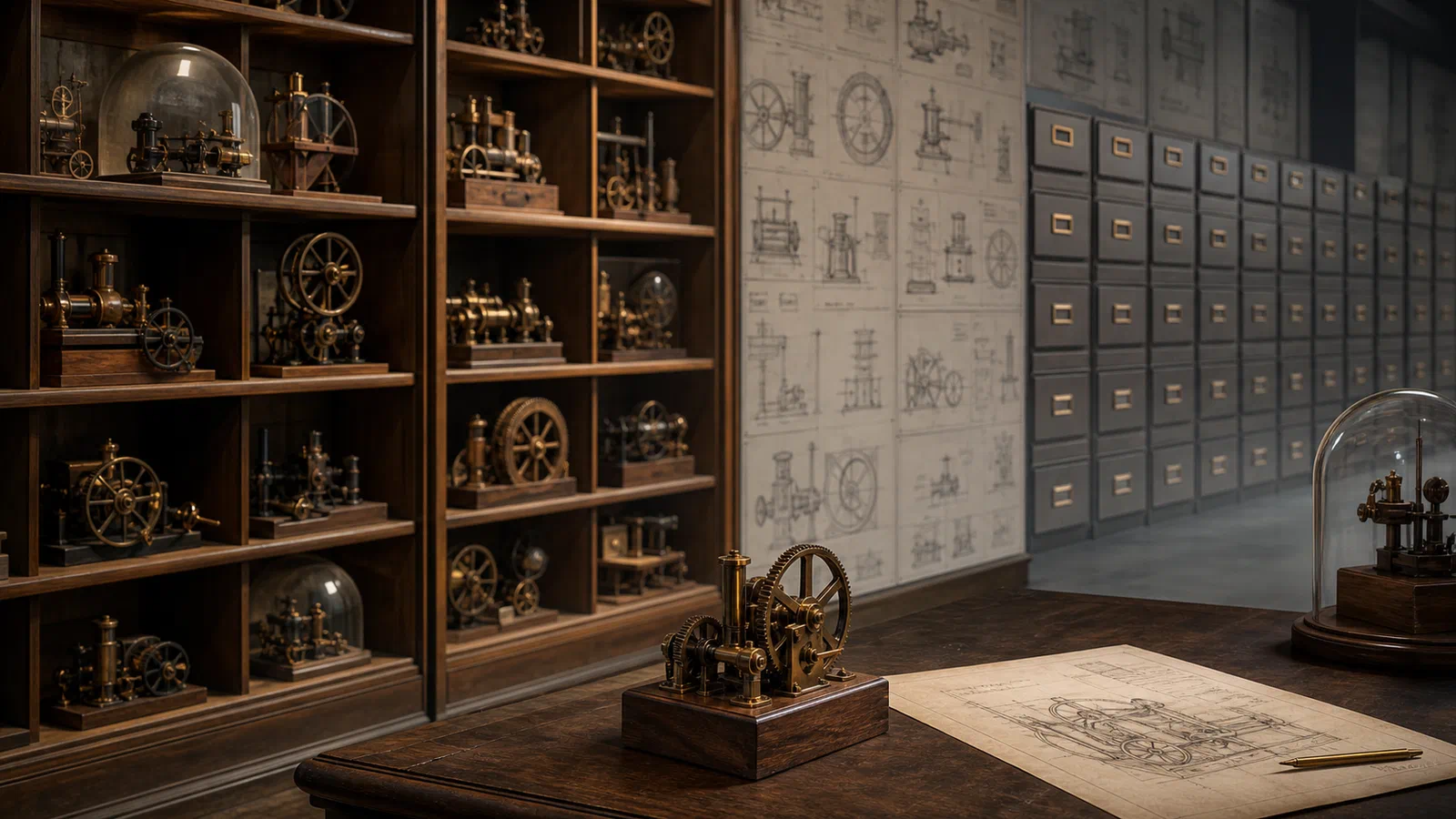
The old model room slowly gave way to drawings, files, and search.
Disposal Is Part of the Story
The end of routine models did not end the models. It created a new problem: what should be done with the accumulated objects?
Hagley’s summary is blunt enough. Many models failed to survive the nineteenth century. The 1836 and 1877 fires destroyed or damaged large numbers. In 1893, the models were removed from the Patent Office and placed in storage. In the early twentieth century, the Commerce Department gradually disposed of the collection. Some models went back to descendants. About 10,000 were accessioned by the Smithsonian. The remaining models were sold at auction.
That disposal history belongs in the main story. It is the life cycle of public memory. The public office had demanded models for decades. The same office later lacked the room, purpose, or budget to keep all of them in the old way. Objects that had once helped secure legal rights became museum holdings, family relics, auction lots, private collections, educational displays, and lost things.
This is the fate of many civic artifacts. They begin as instruments. Time changes them into evidence. A ballot box stops counting votes and starts showing how elections used to be administered. A streetcar transfer stops moving passengers and starts explaining urban fare systems. A patent model stops helping an examiner and starts explaining how a country once made invention visible.
The disposal path also complicates easy public/private categories. A model could begin as private work, enter a federal office, sit in a public gallery, move into storage, transfer to the Smithsonian, return to descendants, sell at auction, and finally appear in a private or nonprofit collection. The public bargain survived in scattered form. Some parts stayed institutional. Some parts became market objects.
That should make us cautious with the word “public.” Public access is a policy, a budget, a building, a catalog, a preservation decision, and sometimes an accident. A record can be legally public and practically hidden. An artifact can be privately held and publicly useful if cataloged, digitized, loaned, or studied. The patent model system reminds us that openness is a verb.
The Anti-Nostalgia of a Beautiful Object
Patent models invite nostalgia because many are beautiful. Their makers sometimes used fine woods, careful brass, tiny screws, and polished motion. The small size can make industrial change look gentle. It can make patent law look like a gentlemanly world of careful artisans and honorable examiners.
That frame should be quarantined. The model room also contained conflict, inequality, cost, legal maneuvering, failed applications, rejected models, missing records, office crowding, fires, and monopoly power. It sat inside a society that did not give everyone equal access to education, capital, shops, lawyers, travel, or the credibility needed to press a claim. The charm of the objects must not wash those conditions away.
The opposite frame also needs quarantine. It is easy to treat patents as nothing but state-backed monopoly and the model room as a museum of private fences. That frame is too blunt. The patent bargain did create exclusion, but it also created records. It could reward useful disclosure. It could help an inventor make an idea legible enough to attract investment or challenge copying. It could move practical knowledge into a searchable public system.
The old model is most useful when it resists both frames. It is neither a saint’s relic nor a tollbooth souvenir. It is a witness. It saw the exchange. It tells us that the patent system has always been a mixed institution: incentive and restriction, public learning and private market power, open record and technical gatekeeping, democratic myth and bureaucratic workload.
That mixed character should push harder questions. A mature patent system should be judged by the quality of the exchange it creates. Does the disclosure teach? Are the claims bounded? Can the public find and understand the record? Can new inventors work around old claims? Can examiners compare applications against prior work? Can courts interpret the boundary without rewriting the invention? Can the public see what power has been granted in its name?
The patent model does not answer those questions. It keeps them from becoming abstractions.
The Machine in the Database
The modern patent record is a machine too. It has inputs, outputs, moving parts, frictions, failures, and users. Applicants file specifications, drawings, claims, declarations, fees, amendments, and responses. Examiners search, classify, reject, allow, and explain. Lawyers interpret. Competitors design around. Courts construe. Investors value. Databases store. Searchers miss. Licensing departments negotiate. Public users try to understand what has happened.
The machine is larger than the Patent Office because patents now live in global technical and financial systems. A patent can support venture funding, corporate acquisition, standards battles, pharmaceutical exclusivity, university technology transfer, defensive portfolios, and ordinary product labeling. The old glass case has become a network of claims, images, PDFs, forms, citations, and legal events.
That scale gives the old model new force. As the system grows more abstract, it needs concrete tests of legitimacy. A patent should answer a version of the model-room demand. What is the invention? How does the disclosure teach it? Where is the boundary? What will the public know because this right was granted? What remains free for others?
Those questions matter beyond patent law. Modern public systems often ask citizens to accept specialized records they cannot easily inspect: algorithms, procurement contracts, environmental permits, financial disclosures, zoning models, risk assessments, medical billing codes, utility rate cases, police technologies, and legislative amendments. The patent model belongs to a broader civic problem. Public authority often depends on technical records. Technical records often defeat public understanding.
The answer cannot be to make every record simple. Some subjects are hard. A chemical patent cannot become a toy model for museum visitors without losing the truth. A public database cannot turn every claim into a picture. Expertise is not the enemy. The enemy is authority without legibility.
The old model room held out one standard: if the public grants power, the public should receive a record capable of being inspected by the right people and explained to the wider community. That standard can survive the death of routine models. It can apply to patent databases, regulatory filings, public algorithms, infrastructure plans, and any other place where private advantage moves through public authorization.
What the Little Machine Asks
The patent model asks a narrow question first: what did this inventor claim? It asks a broader question next: what does a public system owe when it turns private knowledge into legal power?
The nineteenth-century answer was tactile. Bring the machine. Bring the drawing. Bring the written description. Let the office examine. Let the public inspect. Keep the record. That answer worked unevenly and then broke under scale, fire, new technologies, and storage. But its underlying demand remains clean.
Show the work.
The phrase is ordinary because the principle is ordinary. A student shows work in arithmetic. A builder shows permits. A lab shows methods. A court shows reasons. A public office shows records. A patent applicant, asking the state to restrain everyone else for a time, should show enough that the public can learn what it has bought.
The old model in the glass case can no longer carry that burden for the patent system. It should not be revived as a universal requirement. Too many inventions cannot honestly be miniaturized. Too many useful disclosures live in procedures, formulas, code, data, circuits, and manufacturing conditions. A model-only nostalgia would make the system less truthful.
The model can work as an emblem of institutional seriousness. It reminds the modern patent system that disclosure carries the public side of the bargain. It reminds museums and archives that artifacts need context along with admiration. It reminds inventors that a patent claim is a public act as well as a private asset. It reminds citizens that legal exclusion should come with a teachable return.
The little machine survives because it once made that return visible. It sat in a public room and forced the claim to take shape. Around it gathered the whole system: inventor, examiner, rival, visitor, clerk, statute, cabinet, fire, archive, auction, database, and memory.
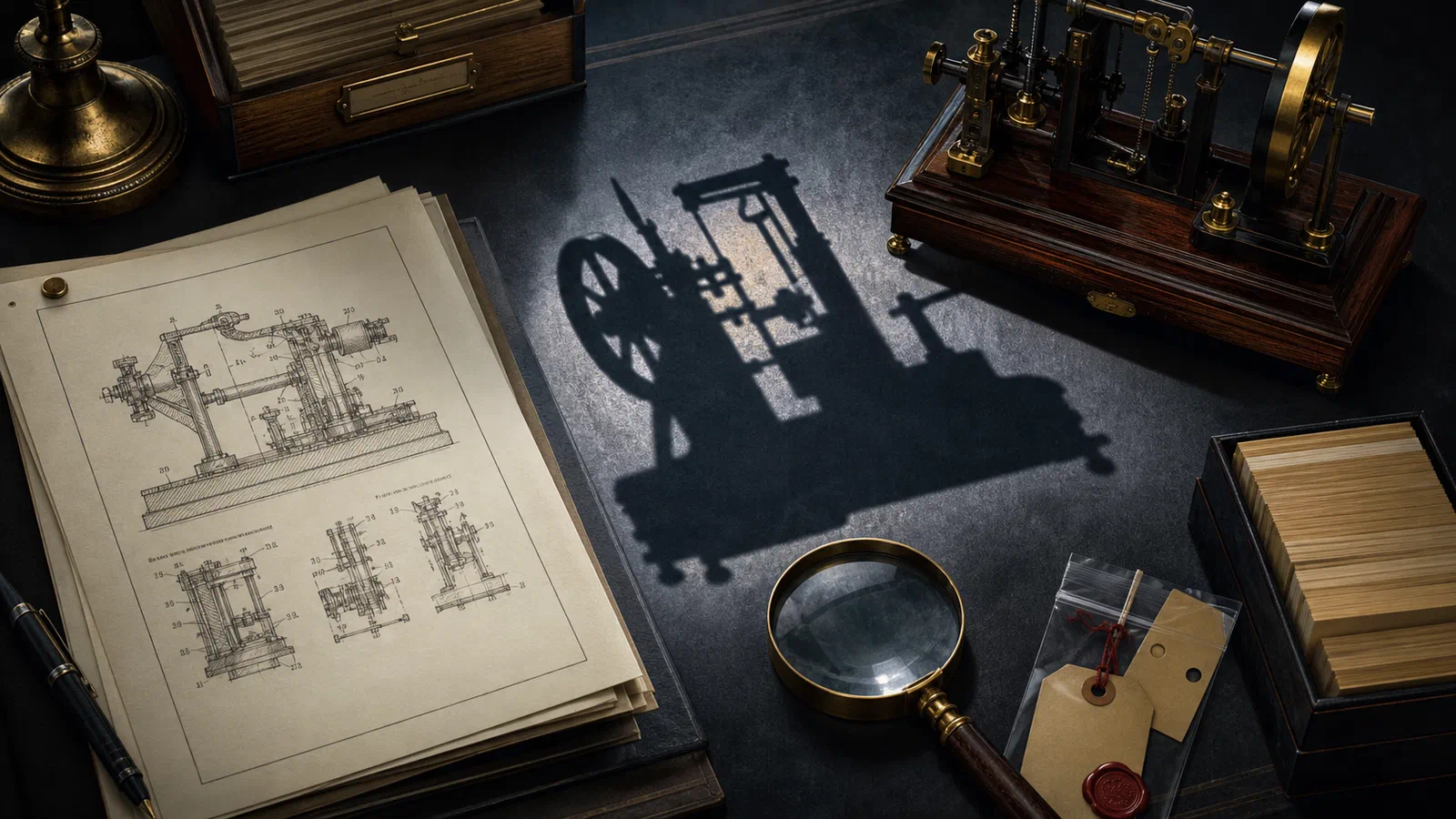
Modern patent trust moved onto claims, drawings, and records.
The Bargain in the Case
Look again at the little machine. Its polished parts are not the point. Its charm is not the point. The point is the exchange it preserves.
Here is the invention, or at least a claim about one. Here is the public office. Here is a temporary right. Here is a record that others may study. Here is the risk that the record will burn, crowd, scatter, privatize, or become unreadable. Here is the pressure that turns a simple object into a system.
The patent model belongs to the nineteenth century, but its question is current. When private ambition asks for public power, what must it show? When the government grants that power, what must the public get back? When the record is open, who can really read it? When knowledge is filed, who keeps it alive?
The model does not let us answer with slogans about genius or monopoly. It asks for a harder civic accounting. A good patent bargain is not proved by the inventor’s cleverness, the office’s seal, or the beauty of the miniature. It is proved by the quality of the public return.
The little machine in the glass case is a relic of an older technology of proof. It is also a standing rebuke to every public system that asks for trust while hiding the parts. Public power should require private claimants to show their work. When the showing is clear, the bargain can be judged. When the showing becomes opaque, the right starts to look like a lock without a key.