The Mailbox at the Edge of the Road
Benjamin Franklin's post roads, Rural Free Delivery, and the little metal box show how national service depends on standards, roads, cost, and local patience.
The Little Metal Boundary
“Every little makes a mickle.”
~ Poor Richard, 1737
The rural mailbox waits where private land gives way to a road. It is usually plain: a black or silver box on a post, door facing traffic, flag folded down, gravel beneath it, grass trying to swallow the base. It looks like a small convenience. In American public life, it is closer to a negotiated boundary marker.
The box says the government will come near the house, though usually not all the way to the porch. It says the resident has duties too: choose an approved receptacle, place it where the carrier can reach it, keep the approach clear, move the box when the road changes, and accept that the public service arrives through a standardized object. The arrangement is ordinary because it worked its way into the scenery.
Before Rural Free Delivery, rural mail often required a trip. The farmer, storekeeper, teacher, or household member went into town, asked at the post office, and made the journey part of market day, church business, court business, or gossip. The old postal system reached rural people through a network of small post offices and contract routes. It did not give most farm homes a daily curbside encounter with the federal state.
The U.S. Postal Service’s own history of Rural Free Delivery puts the first experimental routes in 1896. The Post Office Department began with a few rural routes in West Virginia and expanded after Congress funded experiments. By 1902, Rural Free Delivery became a permanent service. By then, the small mailbox had already begun turning distance into an administrative problem.
Franklin’s Postal Country
“Well done is better than well said.”
~ Poor Richard, 1737
Benjamin Franklin did not invent Rural Free Delivery. He died more than a century before the rural mailbox became the ordinary roadside sign of a federal route. His postal work belongs earlier, when the American system was a line of post roads, post offices, riders, newspapers, ledgers, and political information moving across colonies that were learning to think like a country.
The National Postal Museum gives the useful sequence. Franklin became postmaster of Philadelphia in 1737. In 1753, the Crown named him joint postmaster general for North America with William Hunter. He surveyed post roads and post offices, tightened accounting, moved riders by night and day, encouraged penny-post delivery, and pushed newspapers into the mails for a small fee. The postal system was communications infrastructure in working clothes.
Then came the break. In 1774, the Crown dismissed Franklin as joint postmaster general after judging him too sympathetic to the colonies. In 1775, the Second Continental Congress created the position of postmaster general and elected Franklin to it. If “the nation’s first Postmaster General” means the office created by the Continental Congress, Franklin is your guy. If it means the first postmaster general under the Constitution, that title belongs to Samuel Osgood, appointed by George Washington in 1789.
The distinction matters for the mailbox story because Franklin’s postal country was already a public machine for distance. He thought in routes, accounts, speed, and circulation. RFD later carried that logic beyond the town counter and along the farmhouse road. For a fuller OIP portrait of Franklin’s life and self-improvement machine, see Benjamin Franklin: How America’s Funniest Founder Made Greatness Feel Possible .
Delivery Needed A Road
“Drive thy business; let not that drive thee.”
~ Poor Richard, 1738
Rural Free Delivery was never only about mail. A carrier could not reliably serve scattered homes without passable roads, named or numbered routes, regular schedules, and households willing to gather at the roadside. The new service pushed rural communities to improve the road beneath the carrier’s wheels.
The Post Office Department did not invent rural-road politics, and it did not pave America by itself. Local roads had their own tax fights, labor duties, mud seasons, county habits, and engineering limits. Yet RFD created a direct incentive: if a route could not be traveled, service suffered. If a road improved, the farm household gained more regular access to letters, newspapers, parcels, catalogs, money orders, government notices, and commercial life.
The mailbox belongs in the history of roads as much as the history of letters. It gave the household a fixed point on the public route. A person did not have to ride into town to see if a letter had arrived. The carrier’s circuit carried a bit of the town out to the farm, then carried rural replies back into the national stream.
The current legal promise rests on old republican language. Federal postal policy says the Postal Service must provide “postal services to bind the Nation together” and must serve “patrons in all areas” under 39 U.S.C. § 101 . The phrase is grand. The daily form is modest: a carrier, a route, a road shoulder, a receptacle, and a schedule that makes the promise measurable.
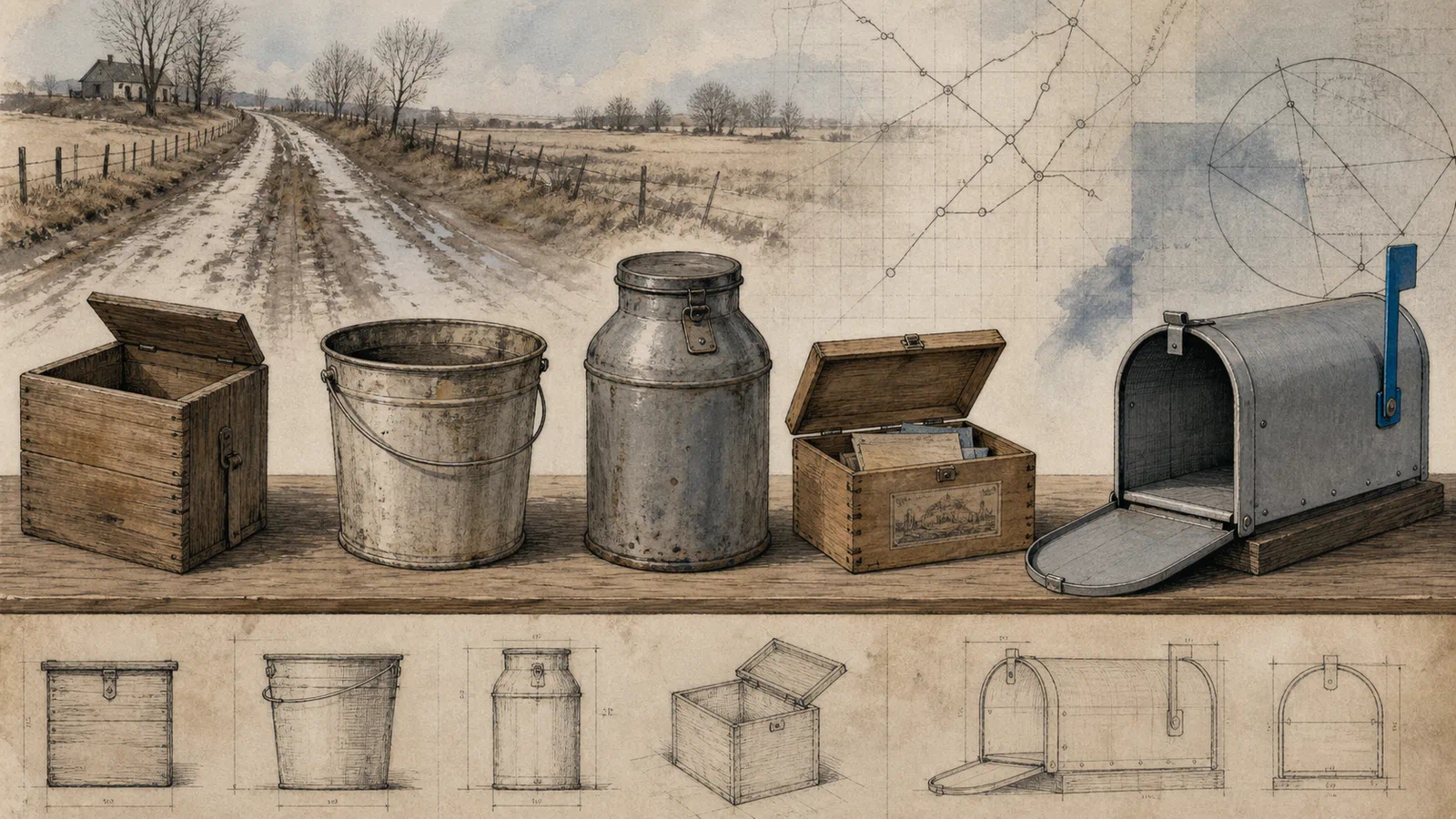
Standardization turned household improvisation into a postal interface.
The Standard Box
“Beware of little Expences, a small Leak will sink a great Ship.”
~ Poor Richard, 1745
The early rural mailbox was a lesson in public administration. People used what they had. USPS’s own RFD history describes farmers putting out lard pails, syrup cans, old apple boxes, soap boxes, and cigar boxes before approved manufactured boxes became common. The point was not decoration. A carrier needed a receptacle that could hold mail, protect it, identify a stop, and work at speed.
The current rules are more exact than the casual passerby might guess. USPS tells customers installing a curbside mailbox to place the bottom of the box 41 to 45 inches above the road surface and the front of the box 6 to 8 inches back from the curb, with adjustments for road conditions and local postmaster approval where curbs are absent. The customer installation guidance is mundane, which is precisely its force. The public system turns a farm lane or subdivision edge into a repeatable service point.
The same logic appears in the domestic mail rules. USPS customer mailbox standards treat the mailbox as a regulated customer-owned fixture in a public delivery network. The owner buys, installs, and maintains the receptacle. USPS recognizes the approved form, serves it through route operations, and can require a correction when placement or condition interferes with delivery.
That split is easy to miss. The mailbox is private property, but it belongs to a public routine. It is on or near private land, but it faces the public road. It is purchased by the customer, but its shape and placement answer to postal standards. It holds private correspondence, but its ordinary meaning depends on a federal carrier treating it as a known stop in a national system.
What The Box Replaced
“Lost Time is never found again.”
~ Poor Richard Improved, 1758
RFD also changed the small post office. Before home delivery reached deep into rural America, a country post office was often a social and commercial node. It might sit inside a store. It might anchor a village. It gave a postmaster work, a place local people recognized, and a reason for neighbors to pass through the same room. Bringing mail to rural roads made service easier for many households and weakened the need for some old stops.
There is no honest way to treat this only as progress or only as loss. The household gained time, reach, privacy, news, and commercial access. Rural merchants gained customers and competition. Catalog houses gained readers. County roads gained another reason to improve. Some postmasters and town centers lost traffic. The federal service became more personal at the house and less personal at the counter.
The mailbox made that tradeoff physical. A household that once waited at a window inside town could now check a box at the road. A post office that once gathered the neighborhood might become less necessary. The route knit more homes into national life, and the same route loosened one older local habit of gathering.
The system also changed the rhythm of attention. A flag raised on the side of the box became a quiet signal: outgoing mail. A lowered flag and closed door became a small suspense. A person could walk out after the carrier passed and read the day’s connection to debt, kinship, politics, law, commerce, church, school, military service, illness, and inheritance. The mailbox condensed public reach into a few steps down a driveway.
Universal Service Has A Shape
“Waste neither Time nor Money.”
~ Benjamin Franklin, 1748
Universal service is easier to praise than to run. A law can declare national reach. A budget has to move carriers, vehicles, fuel, scanners, sorting equipment, labor contracts, facility costs, and route adjustments across a country that is unequal by design. Dense neighborhoods are efficient. Remote houses are expensive. The system cannot pretend those facts disappear because the service carries a public purpose.
The Postal Regulatory Commission’s work on the universal service obligation and the Postal Service’s own annual reporting treat this as a recurring problem of cost, coverage, quality, and legal duty. The old mailbox at the roadside carries that arithmetic in miniature. Someone pays for the route. Someone designs the standard. Someone drives the miles. Someone waits. Someone decides whether the current arrangement is enough.
Postal service has always carried a democratic idea that is more practical than sentimental. A country spread across distance needs a common circulation of notices, ballots, newspapers, medicine, business records, household goods, legal papers, and private words. The system is never innocent. It has exclusions, delays, price fights, labor conflicts, surveillance questions, and budget pressure. Yet the common route remains one of the plainest ways a large republic makes itself physically present without asking every resident to live near a courthouse, depot, or city hall.
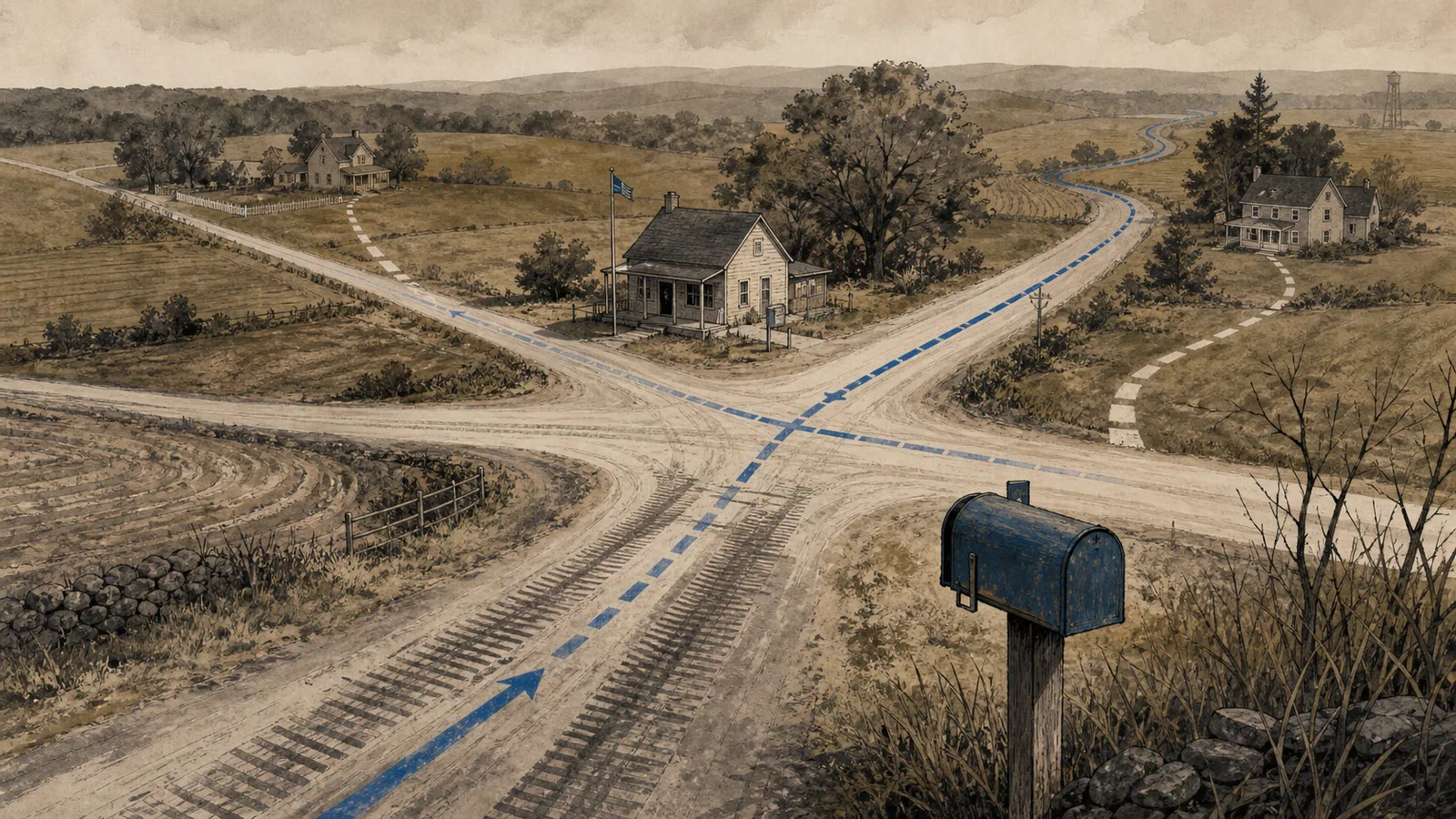
The mailbox gathers road policy, household time, and federal reach into one stop.
The Roadside Bargain
“The Things which hurt, instruct.”
~ Poor Richard, 1744
The roadside mailbox survives because it is neither fully public nor fully private. It asks the resident to meet the carrier at a workable edge. It asks the carrier to treat that edge as a real civic address. It asks the road to hold up under rain, snow, dust, ditch work, and school-bus traffic. It asks the national service to see a dispersed household without pretending the house is cheap to serve.
That bargain can fray. Boxes rot, get hit, lean, vanish, freeze shut, or fall outside new road geometry. Routes consolidate. Post offices close or change hours. Package volume changes the job. Digital communication shrinks one kind of mail and expands another kind of delivery expectation. A mailbox can become a target, a nuisance, a code dispute, or a forgotten object at the end of a driveway.
Its meaning is clearest when it is ordinary. The rural box does not announce a theory of government. It waits at a measured height, a few inches off the road edge, with a door that opens toward a carrier. It is a small act of standardization in a large country.
The old farm trip into town did not disappear in one reform. It was replaced by millions of repeated stops, each one modest enough to vanish into habit. A person walks down the drive, opens the box, and finds the nation reduced to paper, parcel, form, card, bill, medicine, notice, letter, or absence. The road remains public. The house remains private. The mailbox is the hinge.