The Meter at the Curb
The parking meter began as a small clock for a public edge. It became a ledger for scarcity, revenue, enforcement, and trust in the street.
The parking meter is a modest object with an immodest claim. It tells a driver that the edge of the street belongs to the public, that a private car may occupy it only for a measured span, and that the city has the power to price that span.
That claim can feel petty when it arrives as a ticket under a windshield wiper. It can feel clever when a crowded shopping district suddenly has open spaces. It can feel arbitrary when the rule is hidden in a phone app, or predatory when late fees and towing turn a short errand into a household problem. The meter is small enough to dismiss and durable enough to explain a century of city government.
The familiar origin story begins in Oklahoma City. The Oklahoma Historical Society places the first Park-O-Meter installation on July 16, 1935, and credits Carl C. Magee with the invention. The local complaint was plain: cars stayed too long near stores, merchants wanted turnover, and the public curb had become a private holding pen. The machine answered with a coin slot, a timer, a signal, and a post.
Magee’s patent record is worth reading because it lacks the later political drama. It describes a coin-controlled parking meter in mechanical terms. A driver deposits money. A timing mechanism starts. A visible indicator shows the authorized parking period. The object stands beside the street so the rule can be seen by the user and by the officer who enforces it.
There is a public philosophy inside that machinery. A meter says that access to common space can be made legible through time. It also says the city may convert that time into money. Every later curb fight lives inside those two statements.
The First Nickel Clock
A curb without a meter looks simple. It is a strip of pavement near the sidewalk. A driver arrives, parks, and leaves the car. A merchant wants customers. A resident wants access near home. A delivery driver wants a few minutes at the door. A bus wants the edge clear enough to serve passengers. A person using a wheelchair wants a ramp free of obstruction. A firefighter wants the hydrant open. The curb appears ordinary because the conflicts arrive one at a time.
The first parking meter made those conflicts visible in one narrow way. It did not widen the street. It did not create more curb. It put a clock on one claim.
The device became a civic machine because a watch measures private time while a parking meter measures public permission. The driver buys a limited interval in publicly owned space. The city gains an instrument for making turnover enforceable. The merchant gains a better chance that a customer can stop near the store. The officer gains a simple test: time remains or time has expired.
Early parking-meter fights understood that the object carried more than a nickel. In Ex parte Duncan , the Oklahoma Court of Criminal Appeals considered a challenge to Oklahoma City’s parking-meter ordinance in 1937. The case treated the meter under police-power reasoning, the legal language of health, safety, welfare, and traffic order. That is a better starting point than the casual language of modern irritation. A parking meter is not simply a charge. It is a traffic rule with a cash drawer attached.
That cash drawer creates the permanent problem. If the meter is a traffic rule, the money should serve the public purpose. If the meter is a revenue source, the traffic purpose can become cover. The machine does both at once, and the city must prove which purpose governs its use.
The old nickel clock offered one defense: visibility. A driver could see the space, the rate, the coin slot, and the expired signal. A city could abuse a visible rule, but the object at least made the public bargain plain. The later history of the curb is a history of that bargain becoming more complex.
Carl Magee And The Merchant Complaint
Carl Magee was an odd candidate to become a street-machinery inventor. He had been a newspaperman, a lawyer, and a civic reform figure. His Oklahoma City meter answered a merchant complaint before it answered grand transportation theory. Storefront business needed turnover. The street edge had become too valuable for the oldest rule, which was arrival first and occupancy until departure.
That older rule had the charm of informality. It also hid power. A curb space left “free” is allocated by time, luck, stamina, local knowledge, and tolerance for circling. A driver who can arrive early and leave a vehicle all day receives more of the public curb than a shopper who needs ten minutes, a worker who needs access for a task, or a person whose body makes a long walk difficult. The price is absent at the meter, but the cost has been moved into waiting, circling, exclusion, and blocked use.
The merchant complaint keeps the story practical. The first meter began with a block that could not turn over, long before later arguments about emissions, data, or car culture gathered around the curb. That problem is humble, but it is a real public problem. Streets serve movement and access. When parking consumes the edge without limit, movement and access lose.
The meter’s answer was also humble. It did not choose a perfect allocation. It chose a measurable allocation. That distinction runs through the whole subject. Public officials often defend a curb rule as if it solved the social problem. Usually it has done less. It has selected the conflict that can be measured.
The meter measured duration. It did not measure need. It did not know the difference among a wealthy leisure shopper, a repair worker, a disabled visitor, a parent collecting a child, and a delivery driver on a tight route. It made one rule enforceable across all of them. That is both the appeal and the limit of the machine.
The Smithsonian’s parking meter object record places the object in material history, which is where it belongs. A parking meter sits with turnstiles, traffic signals, toll booths, public clocks, and fare boxes. These are ordinary objects that translate common space into administrable behavior. They reduce an argument into a routine.
Every routine hides a judgment. The meter judged that an all-day private claim on a crowded public edge was worse than a timed, priced, and enforced claim. That judgment can be defended. It should not be forgotten.
Patent Mechanics
Magee’s patent is dry in the way useful public documents are dry. The drawings and claims do not argue about the soul of the city. They describe a device that accepts a coin, starts a timing operation, and displays whether parking time remains.
The shared visibility of the rule is more important than the coin. The driver and officer see the same object. The meter’s signal turns a dispute over memory into a dispute over a dial. That difference carries less weight in a world of apps, license-plate readers, and payment databases, but it helps explain why the old meter had civic power.
The machine did three things at once.
First, it standardized a block-by-block rule. A curb sign can state a limit, but a meter makes each space a separate account. A city can enforce the one-hour rule through patrol and chalk marks. A meter creates a small visible contract at each space.
Second, it put a cost on occupancy. The cost might be modest, but it changed the feel of the claim. The curb was no longer governed only by patience and priority. The driver had to make a small decision: is this use worth the coin?
Third, it gave the city a stream of information, even before digital data. Coins, expired meters, complaints, and turnover patterns told officials where demand pressed hardest. A city did not need a dashboard to learn that one block was crowded and another was not. The meter created a crude account.
Modern systems add precision. They know payment time, location, plate numbers, occupancy estimates, rate changes, and enforcement events. Precision can improve management. It can also expand the reach of government beyond what the public understands. The old meter showed its claim in metal. The new curb often shows its claim in software.
That shift deserves caution. A visible machine can be unfair. An invisible system can be fair. Visibility by itself falls short of justice. Yet visibility disciplines public power. It makes the rule easier to inspect. A city that moves curb governance into apps, sensors, and variable rates owes the public a clearer explanation than the old metal head required.
Custom, Conflict, And Hidden Allocation
Before meters, the curb did not lack rules. Cities had ordinances, signs, police power, and informal habits. What they lacked was a cheap, space-level way to ration short-term occupancy. That gap made custom do the work of policy.
Custom often feels humane because nobody has to name the winner. The regular knows where to stop. The shop employee knows which space will be empty in the morning. The delivery driver knows how long a hazard-light pause will be tolerated. The officer knows which violations draw complaints. The system works until too many people need the same edge.
When scarcity grows, informal rules become less innocent. The driver who circles for twenty minutes pays in fuel, time, and irritation. The bus that cannot reach the curb pays in slower boarding. The wheelchair user pays when the curb ramp becomes storage for convenience. The merchant pays when a prime space is occupied by one car through the day. The resident pays when a visitor’s access rule is written only for the visitor.
The parking meter did not eliminate these conflicts. It selected one conflict for formal treatment: the length of a private car’s curb claim in paid spaces. That made the curb easier to govern and easier to misunderstand.
The misunderstanding comes when cities treat parking spaces as the whole curb. A curb is also a loading dock, a transit platform, a drainage edge, a visibility buffer, a fire lane, a social space, and an emergency access line. The meter is powerful because parking is visible and politically sensitive. The curb’s less visible jobs can be squeezed because they do not feed the meter.
That is where modern curb management begins. The term can sound like a consultant’s euphemism, but the underlying issue is real. Delivery trucks, ride-hail pickups, buses, bike lanes, outdoor dining, accessible loading, and hydrant clearance all compete for the street edge. A paid parking stall is only one piece. The Institute of Transportation Engineers curbside management guide and public-agency guidance make the same basic point in technical language: the curb has become a managed asset.
The OIP version is simpler. The curb is public property where private convenience, public movement, city revenue, safety, and access collide at walking speed.
Turnover Machines
The cleanest defense of the parking meter is turnover.
If a commercial block has ten curb spaces and each space is occupied all day, the public has ten daily claims. If each space turns many times, the same curb serves many more trips. The city has not created land. It has increased access by limiting duration.
This is the meter at its best. It keeps one person’s convenient storage limited enough for the next user to have a chance. It gives merchants a reason to support the rule. It gives cities a tool for reducing circling. It gives drivers a signal that a short visit may be possible. The meter’s first civic virtue is churn before revenue.
The Federal Highway Administration’s parking-pricing primer explains the transportation logic: pricing can manage demand, reduce congestion, and influence travel choices. The sentence describes a mechanism before it expresses any ideology. If a scarce curb space is free at the moment of use, demand can exceed supply. If the price rises enough to leave some spaces open, a driver may find parking faster or choose another mode, destination, or time.
The famous version of this argument comes through Donald Shoup, whose work on the high cost of free parking pushed cities to see curb spaces as underpriced public assets. Shoup’s argument should be used with care. It can become a slogan in the hands of people who enjoy the elegance of pricing more than the hardship of payment. Yet the central point is difficult to dismiss: free curb parking is often a subsidy delivered through scarcity, and its costs are hidden in cruising, land use, congestion, and blocked alternatives.
The danger is converting Shoup into a policy catechism. A city has to ask which curb is scarce, which user is burdened, what alternatives exist, how money is used, and how enforcement behaves. A price can reveal scarcity. It can also punish people who lack substitutes.
Turnover is strongest where the public purpose is narrow and visible: a retail block with high short-term demand, a loading zone with clear delivery windows, a passenger pickup zone with short dwell times. It becomes weaker when the city uses the same parking logic to avoid harder choices about transit, housing, access, work schedules, street design, and the location of daily life.
The meter is a good servant for a defined curb problem. It is a poor substitute for a city plan.
Revenue Machines
The meter collects money as naturally as it measures time. That fact has shaped its politics since the beginning.
Revenue is not inherently corrupt. A city owns and maintains the street. Managing curb access costs money. Enforcement, signs, payment systems, sidewalks, lighting, street cleaning, transit stops, and public works all require funds. A curb that produces revenue can support the district around it.
The problem starts when revenue becomes the point and turnover becomes the story told to the public. A meter can be defended as a traffic tool while being managed as a cash instrument. A fine can be defended as enforcement while being budgeted as income. A city can design a rule that catches violators more efficiently than it solves the curb problem.
Parking benefit districts try to answer this suspicion by tying meter revenue to visible local improvements. Pasadena’s Old Pasadena Parking Meter Zone Advisory Commission is one official example of a city treating meter-zone revenue as a district governance question. Austin and Houston have used parking-benefit district models as well, though current municipal-code text should be pulled and checked before a publish version leans on exact legal percentages or fund formulas.
That caveat is important. Revenue dedication can be oversold. A city may promise a neighborhood that meters will pay for improvements. The neighborhood may then support pricing because the money appears to return. Yet the arrangement can also make local interests dependent on continued parking charges. A district may come to prefer the revenue stream even when curb needs change.
Chicago shows the harsher side of meter revenue. The city’s parking meter concession became a national cautionary tale because the public right to meter revenue was sold into a long private contract. The Chicago Inspector General’s parking meter report is the source to read before turning that case into folklore. Privatization was the surface problem. The deeper lesson is that a curb rule can be converted into a financial asset, and once converted, public flexibility can become expensive.
That is the civic risk. Public curb time is a civic resource before it is a commodity. It sits inside a street that must serve many public purposes. When meter revenue is pledged, privatized, securitized, or locally captured, the curb’s future uses can be constrained by yesterday’s bargain.
The old meter asked for a coin. The modern revenue machine asks for governance.
Tickets, Chalk, Towing, And Household Risk
The meter needs enforcement because a visible rule without consequence becomes a suggestion. The same enforcement creates the meter’s most personal harm.
For many drivers, a parking ticket is a small penalty. For others, it can become a chain. The ticket is followed by a late fee. The late fee makes payment harder. Nonpayment may feed vehicle immobilization, towing, storage charges, registration trouble, or collection pressure, depending on local law. The original curb problem may be gone long before the household problem begins.
The flagship version of this essay needs more local official evidence before making broad claims about household burden across cities. That is why the source checklist flags fines, towing, license, and employment records as a follow-up need. The responsible claim is narrower: parking enforcement can become a larger household risk when penalties compound, and any city using meters must keep that escalation tied to a clear public purpose.
The law has noticed the meter’s enforcement edge. In Taylor v. City of Saginaw , the Sixth Circuit held that tire chalking for parking enforcement was a search under the Fourth Amendment. The court did not erase parking enforcement. It asked a more precise question: what happens when the government physically marks a vehicle to track compliance?
The answer matters because parking enforcement often hides under triviality. A chalk mark seems minor. A ticket seems minor. A boot may seem like a consequence for ignoring the rule. A tow may seem like the next step. The scale changes when a person needs the car for work, school, caregiving, or medical appointments.
That does not make enforcement illegitimate. It makes enforcement accountable.
Cities need ways to keep curb rules credible. Without enforcement, the honest driver pays and the strategic driver occupies. Without late penalties, some people ignore the first notice. Without towing, some spaces may remain blocked. These are real administrative problems.
The public question is proportionality. What violation occurred? What public harm did it cause? How quickly do penalties compound? Who reviews errors? Where does the money go? What happens to a person who cannot pay at once? Does the city measure success by access restored or money collected?
The meter began with a problem of turnover. The enforcement system should be judged by the same standard. If enforcement restores public access, it can be defended. If enforcement creates a debt machine only loosely connected to curb access, the meter has changed jobs.
The Price Of Free Parking
Free parking is one of the most misleading phrases in city life. It usually means the user pays no price at the moment of parking. It does not mean the curb is costless.
Someone paid for the pavement. Someone maintains the street. Someone absorbs the circling traffic. Someone loses the curb when a private car occupies it all day. Someone walks farther because the nearest spaces are full. Someone loses a bus stop, a loading zone, a sidewalk extension, a tree pit, or a safer corner because parking remains politically easier than reallocation.
Shoup’s work became influential because it forced that hidden account into view. Free curb parking can make scarcity look like a personal inconvenience instead of a public allocation. Drivers blame other drivers, merchants blame city hall, city hall blames congestion, and the curb remains underpriced because every explicit price is politically visible.
Yet the price of free parking should not become an excuse for contempt. People often rely on cars because the built environment was built around them. A worker may need to drive because the job is across a region with weak transit. A caregiver may need a close space because time and mobility are limited. A small merchant may fear that a price will send customers elsewhere. These are not imaginary objections.
The meter’s job is to make the trade visible. If a district needs turnover, a price may serve access. If a neighborhood lacks alternatives, a blunt price may burden residents and workers without solving much. If curb space could serve buses, loading, disabled access, and emergency clearance better than all-day storage, a free-parking rule may be the least honest choice.
The phrase “free parking” hides a public account. The phrase “priced parking” reveals only part of it. The full account asks who gains access, who pays, who loses time, who receives the revenue, and which uses of the curb are being displaced.
SFpark And Flexible Pricing
The old meter charged a fixed rate for a fixed period. Modern performance-pricing programs ask a more ambitious question: can the city adjust the price so a block usually has open spaces?
San Francisco’s SFpark pilot evaluation remains a key public source because it treated parking price as a management tool. The program used sensors, data, and rate adjustments to pursue availability. Seattle’s performance-based parking pricing program uses a similar public logic, setting rates in response to observed occupancy so paid spaces work as access tools.
The appeal is obvious. A fixed meter rate is often wrong. If every space is full, the price may be too low for turnover. If many spaces sit empty, the price may be too high, the time rule may be wrong, or the curb may be assigned to the wrong use. Variable pricing lets the city treat the curb as a living asset.
The danger is also obvious. The clearer the model becomes to transportation staff, the less legible it may become to the public. A driver can understand a nickel meter. A driver may have more trouble understanding a curb where price changes by block, time, app, event, permit, or demand band. A resident may suspect the rate is being tuned for revenue. A small business may suspect the city is experimenting on its customers. A delivery company may learn the system faster than the public does.
Performance pricing can be good policy. It needs public discipline. The city should explain the target, the data, the rate-change schedule, the appeals process, and the use of revenue. It should state when a curb should stop being a paid parking space because another use serves the public better.
The meter’s old virtue was that it forced a simple answer: time has expired. The new curb must answer harder questions: why this price, why this block, why this hour, why this use, and who checked the result?
The Curb After Parking
A curb that is managed only for parked cars will fail the modern street.
Look at a busy block in sections. One piece may need short-term paid parking. One may need a delivery zone. One may need a bus stop. One may need a curb ramp clear of obstruction. One may need hydrant clearance. One may need passenger loading. One may need outdoor dining. One may need bike parking, scooter parking, stormwater treatment, a street tree, a parklet, or a wider sidewalk.
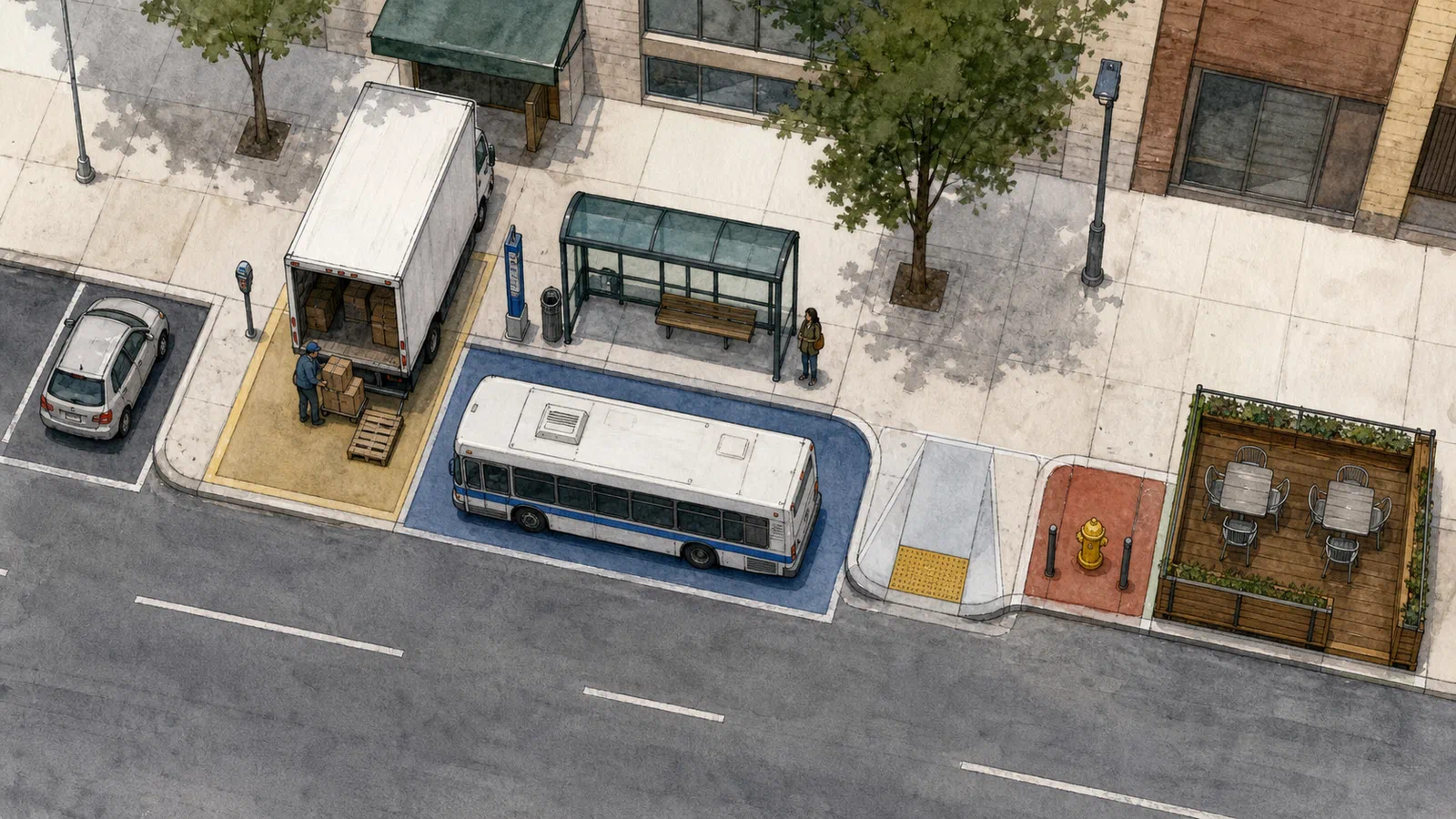
The curb is narrow, but it carries a city’s argument over access.
The meter is only one instrument in that larger score. It handles the car that stops and waits. It does not by itself decide when a bus should have priority, when delivery demand should displace parking, when a sidewalk cafe improves a block, when a disabled loading zone needs protection, or when a fire hydrant deserves a wider buffer.
Public curb management should stay larger than software. Software can help schedule, price, reserve, enforce, and study the curb. It cannot decide the civic hierarchy by itself. Cities need to say which public goods outrank which private conveniences.
The curb is a small place where city slogans meet geometry. A city may say it values transit, but the bus needs the edge. A city may say it values small business, but deliveries need a legal place to stop. A city may say it values accessibility, but curb ramps need physical respect. A city may say it values public space, but outdoor platforms displace parking and must be chosen openly. A city may say it values safety, but hydrants, sightlines, and corners require empty space.
The meter taught cities how to price time. The next curb question is how to rank uses.
The Digital Meter And The Trust Problem
The digital curb can do things the old meter could not. It can change prices quickly. It can accept remote payment. It can show spaces on a map. It can reserve loading time. It can connect enforcement to payment records. It can generate data for planners. It can reduce the need for coin collection and mechanical repair.
Each improvement also changes the public relationship.
The old meter was inconvenient, but it was inspectable. The new system may be convenient, but it often asks the public to trust an account held elsewhere. The driver sees an app screen, a kiosk, a plate number, a zone code, a rate table, and a receipt. The officer or camera may see a different layer. The city may see a database. The vendor may see transaction records. The public sees only pieces.
That trust problem leaves digital systems possible, while demanding public discipline. The city must govern them as public authority, with procurement underneath. Who owns the data? Who can inspect errors? What happens when the app fails? How are rates changed? What records are retained? What private vendor receives? What public report is issued? How does the city prevent enforcement convenience from becoming enforcement hunger?
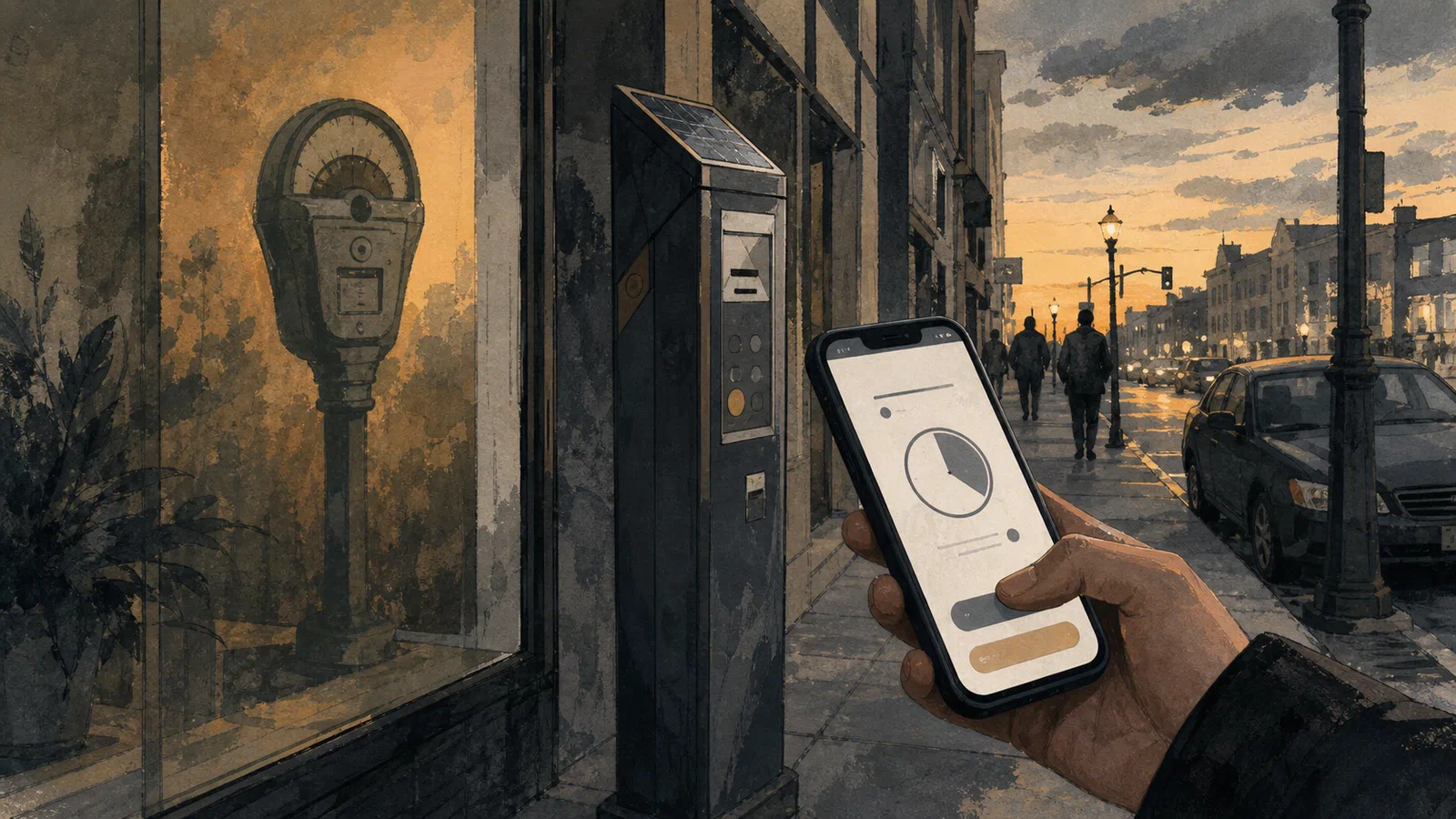
The meter’s face moved into software, but the public bargain did not disappear.
The old metal meter was never innocent. It priced public space. It funded city activity. It authorized enforcement. It could annoy, burden, and confuse. Yet it made a civic promise in plain view. The driver could see the device and the time. The public could understand the rule.
Modern curb systems should aspire to at least that much legibility. A city may need flexible prices, app payments, loading reservations, and curb data. It should not ask the public to accept a black box at the street edge.
The Meter’s Public Account
The parking meter asks a few questions that never age out of city life.
Who gets to occupy common space? For how long? At what price? With what penalty? Under whose discretion? For whose benefit? With what account of the money?
Those questions are too large for the meter to answer alone. That is why the meter remains useful as an object. It makes the questions concrete. A person can stand beside one curb space and ask what rule is being enforced there. The answer might be turnover. It might be revenue. It might be safety. It might be access. It might be habit.
That habit is the easiest answer and the weakest one. A curb rule deserves periodic public inspection because the street around it changes. What served a shop block in 1935 may serve a bus stop poorly in 2026. What looks like efficient pricing on a spreadsheet may look like unexplained authority to the person at the pay station.
The public deserves to know which answer governs.
The best meter policy begins with scarcity and ends with an account. The city identifies the curb conflict, chooses a rule, explains the price, limits enforcement to the public purpose, reports the revenue, and revisits the use when conditions change. That work is ordinary civic competence.
The worst meter policy begins with a public purpose and quietly changes into extraction. It defends itself with traffic language while designing itself around money. It adds complexity without explanation. It lets penalties compound faster than public harm. It treats the curb as a budget patch or a vendor contract. It forgets that a public street is more than an asset class.
The first parking meter turned a curb space into a clock. The city learned to sell time by the minute. The harder task, then and now, is to show the public what the city is buying with that time.
The old meter face had a needle, a slot, and an expired flag. It was blunt, imperfect, and legible. Cities now have better tools and weaker excuses. If they want the public curb to carry more work, they must make the public account as visible as the old clock.