The Seal Around the Cap
How a strip of plastic on a medicine bottle became a small public trust machine.
In this article
The Bottle That Asks To Be Broken First
The medicine bottle asks for damage before it offers help.
A thumb catches the edge of the band. A fingernail worries the perforation. The cap resists for a second, then the strip tears. A thin ring of plastic falls away. Only after that small destruction does the ordinary ritual continue: open, shake, count, swallow, close.
Most people barely notice the sequence. The motion belongs to the background machinery of private life. Morning pills, fever medicine, allergy tablets, pain relievers, antacids, cold capsules, sleep aids, vitamins, drops, gels, and blister cards all carry some version of the same demand. Before trust, check the witness.
That witness is easy to mistake for packaging clutter. It is really a record. The torn band says someone opened this package. The unbroken band says no breach is visible at the place the package told you to inspect. The foil inner seal says the bottle mouth has not been entered in ordinary handling. The blister card says each dose carries its own small chamber, and each chamber has to be ruptured before use.
The seal is a public trust machine because it gives a private buyer a small piece of public evidence. The factory, distributor, store, regulator, police power, and shopper all meet at the cap. No one actor can watch the whole chain. The seal gives the package a memory of entry.
That memory came from a breach.
In 1982, poisoned capsules in the Chicago area broke open the ordinary assumption that a product resting on a drugstore shelf was safe because it looked new. The best-known public story became the Tylenol poisonings, the unsolved crime, the product recall, and the corporate case study. Those stories have their own record. The cap holds a quieter civic history: a society unable to watch every hand near every bottle built a rule requiring entry to leave a mark.
The result now sits on millions of shelves. It is humble, repetitive, and often irritating. It adds cost. It creates waste. It shifts a little work onto consumers, including people whose hands, eyes, memory, pain, or patience make that work harder. It does not make medicine untouchable. It does not turn a retail shelf into a secure facility. Its promise is narrower and more honest. If someone has entered, the package should help the next person see.
That narrow promise changed the bottle.
The 1982 Breach
The original federal rule did not hide its origin.
In the November 5, 1982 Federal Register , FDA wrote that it was establishing tamper-resistant packaging requirements for most over-the-counter human drug products after recent malicious adulteration cases that resulted in seven deaths in the Chicago area. The rule also covered certain cosmetic liquid oral hygiene products and vaginal products. It required a label statement alerting consumers to the specific tamper-resistant feature of the package.
The preamble described the 1982 poisonings in plain regulatory language. Authorities had been told on September 30, 1982 that several people in the Chicago metropolitan area had died from cyanide poisoning after taking Extra-Strength Tylenol capsules. Capsules from victims’ bottles were chemically analyzed by local authorities, and some contained lethal amounts of potassium cyanide. By October 1, the known deaths had reached seven.
The package detail is the hinge. The capsules were sold in plastic snap-top bottles, with cotton wadding in the neck, inside individual cardboard cartons. FDA wrote that the products complied with existing requirements, but neither the bottles nor the cartons were sealed or made so access would require destruction or visible disturbance of the package. A package could look commercial, complete, and ordinary after someone had entered it.
Shelf trust collapsed because the object could not testify.
The immediate response was wide and uneven. Illinois authorities and federal agencies investigated while Chicago banned the sale and use of Tylenol products. FDA sampled and analyzed products. McNeil withdrew capsules and warned against use. State and local jurisdictions took precautionary measures, poison-control centers fielded calls, and local governments considered seal requirements. Cook County approved an ordinance requiring OTC drugs to be sold only in sealed containers; Chicago considered a similar ordinance.
National pressure moved quickly after that. Secretary of Health and Human Services Richard Schweiker asked FDA to begin drafting a regulation, several members of Congress said they planned legislation, and a House health subcommittee held an October 15 hearing on packaging security. FDA asked the Proprietary Association, the trade association for OTC manufacturers, to convene a Joint Committee on Product Security. An industry expert committee met and transmitted recommendations to FDA.
FDA chose a final rule without the normal delay of proposing and waiting because, in the agency’s view, public health required speed. At the same time, it avoided a single technical design mandate. Manufacturers could use available technologies if the result gave consumers visible evidence of tampering.
The rule turned trust into a design requirement. The package could allow a determined attacker to enter. The legal demand was narrower: entry had to show.
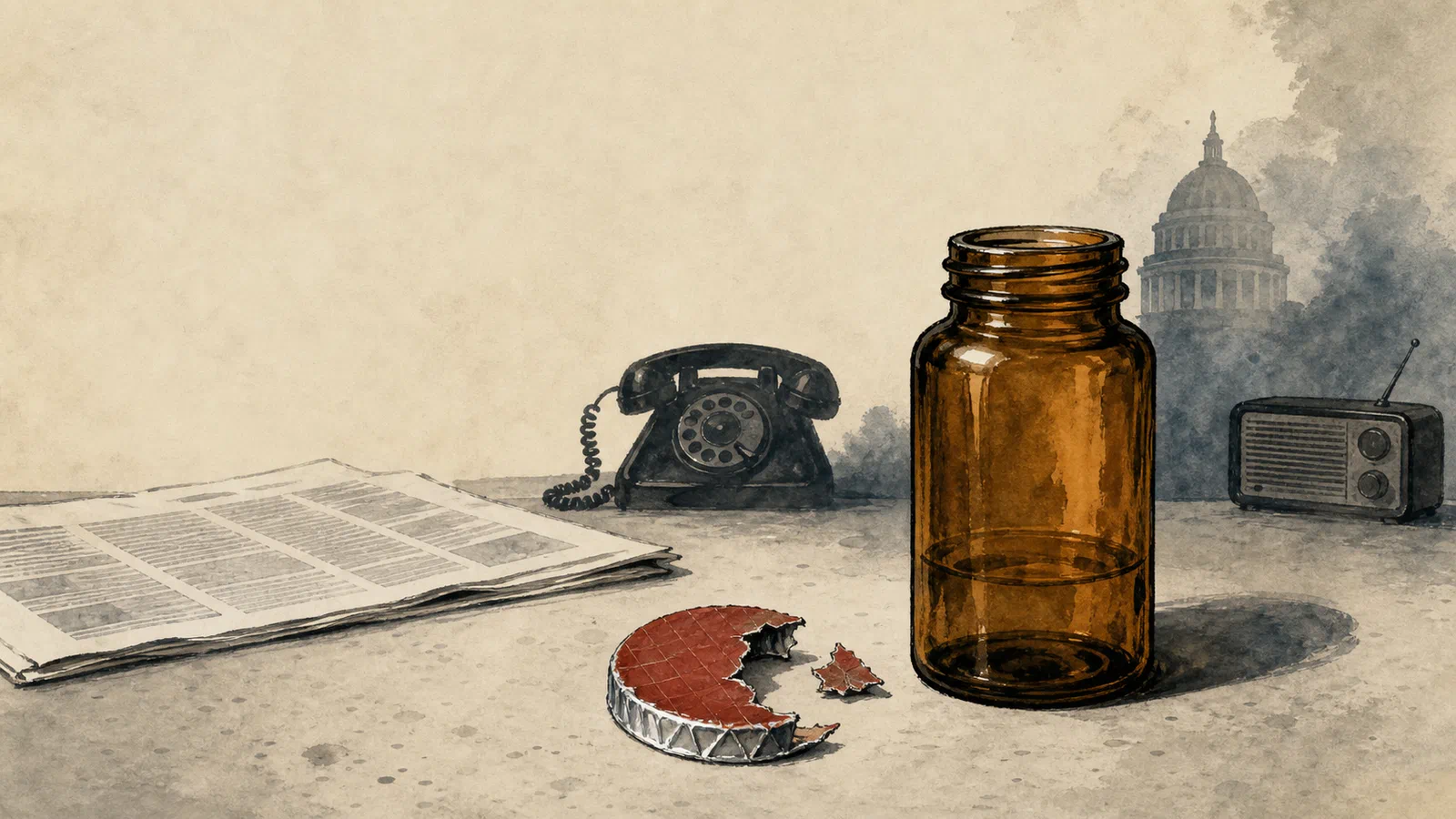
The public panic became a quieter rule about visible evidence.
Reputation Into Evidence
Before the 1982 rule, a retail package could lean on reputation. A buyer trusted the manufacturer, the store, the look of a new carton, the habit of buying the same product, and the presumption that ordinary commerce had ordinary safeguards. Those forms of trust did useful work. They were also fragile once a package could be opened and restored without visible change.
FDA’s 1982 rule changed the grammar of trust. The agency defined a tamper-resistant package as one with an indicator or barrier to entry which, if breached or missing, could reasonably be expected to give consumers visible evidence that tampering had occurred. The feature could be part of the immediate container, the closure, a carton, or some combination; it had to survive reasonable manufacture, distribution, and retail display, then fail in a way a consumer could see. FDA’s examples were guides, not safe harbors. A listed technology could fail the rule if it was poorly matched to the product or faulty in design. An unlisted feature could pass if it met the standard. That detail gave manufacturers flexibility while keeping the legal question fixed on performance.
The FDA’s compliance policy guide later summarized the logic and listed common systems: film wrappers, blister or strip packs, bubble packs, heat-shrink bands or wrappers, foil, paper, or plastic pouches, bottle mouth inner seals, tape seals, breakable caps, sealed metal tubes, sealed cartons, aerosol containers, and cans. The materials differed. The civic function stayed constant: a barrier had to make entry visible. FDA also rejected the most tempting word. In 1982 it stressed that tamper-proof packaging was impossible. The agency said requirements could reduce the potential for tampering but could not eliminate it, and that any labeling suggesting a package was tamper-proof would be false or misleading.
That is the most disciplined sentence in the whole story. The seal does not promise purity. It promises evidence.
The label rule is the second half of the mechanism. If a seal exists but the consumer does not know where to look, the package has not completed its job. FDA required the label to alert consumers to the specific tamper-resistant feature. A generic warning was weaker than a specific instruction. A buyer needed to know which barrier was supposed to be present and what a missing or broken one meant.
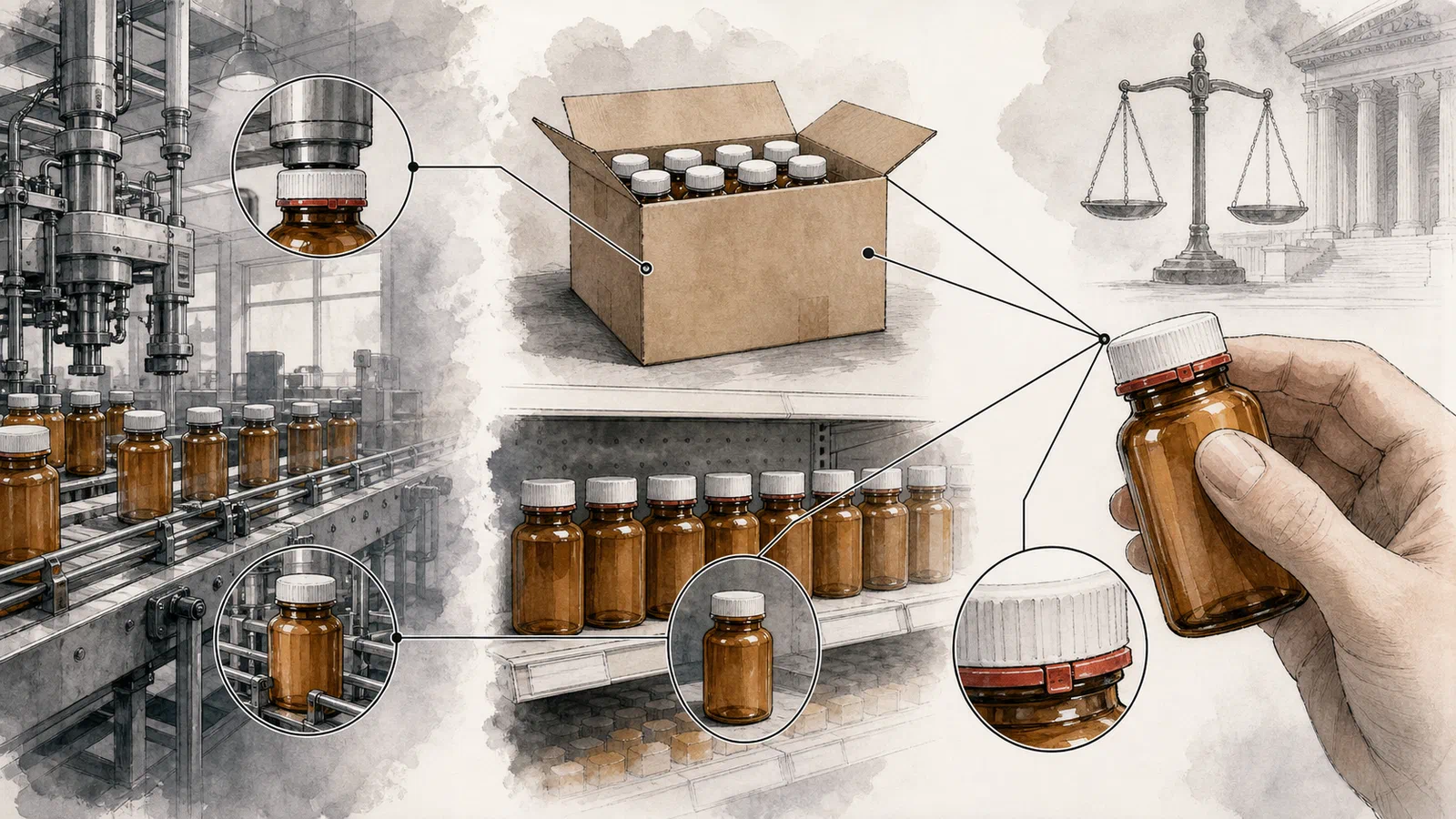
The chain of custody ends with a hand checking the cap.
The current regulation, 21 CFR 211.132 , preserves that same structure. Covered OTC human drug products that are accessible to the public while held for sale must be packaged in a tamper-evident package. A tamper-evident package must have one or more indicators or barriers to entry that, if breached or missing, can reasonably be expected to give visible evidence to consumers that tampering has occurred. The package must be distinctive by design or use an identifying characteristic where common materials are used. The labeling must identify all tamper-evident features and place the statement so it remains unaffected if the feature is breached or missing.
The warning cannot disappear with the very thing it describes.
What The Rule Actually Built
A rule about packaging can sound minor because the object is minor. Section 211.132 is short. Its force comes from the way it arranges responsibility.
First, the covered package is the retail package. The rule applies when the OTC product is accessible to the public while held for sale. That phrase places the problem in public commercial space. The product is no longer only in a factory or warehouse. It sits where strangers can stand beside it, pick it up, return it to a shelf, hide it, compare it, buy it, or leave it behind.
Second, the evidence has to be visible to consumers. The rule does not rely only on a professional inspector, pharmacist, police officer, or store employee. The buyer becomes part of the detection system. That is both the strength and the weakness of the design. A package can carry evidence into the hand of the person most at risk. It can also fail if that person is rushed, distracted, impaired, poorly instructed, or never taught to look.
Third, the feature has to be distinctive enough to resist easy restoration. FDA was concerned that plain tape, plain paper, or clear plastic could be replaced after entry. A feature made from common materials needed a distinctive design or identifying characteristic. The seal is therefore more than a barrier. It is also a signature.
Fourth, the label statement must identify the feature. A bottle may say the inner seal is printed, the cap band is intact, the carton is glued, or the blister card is sealed. That statement is not decorative. It is part of the safety apparatus. The consumer compares the package in hand against the promised condition.
Fifth, violation can turn into adulteration or misbranding. The FDA compliance guide treats failure to use required tamper-evident packaging as an adulteration issue and failure to bear the required label statement as misbranding. The agency’s enforcement interest is not theoretical. In a 2007 CDER enforcement summary , FDA described a warning letter in which some OTC drug products failed to bear required labeling and were misbranded because their labeling did not fully comply with OTC drug labeling rules and the tamper-evident packaging labeling requirement in 21 CFR 211.132.
The rule built a small chain of proof. The manufacturer chooses and applies the feature. The package tells the buyer what to inspect. The feature breaks or disappears if entered. The agency can treat missing packaging or missing label statements as legal defects. The retail shelf becomes a place where ordinary people participate in a federal safety design.
That participation invites romantic language, so the limits need to stay visible. A consumer cannot detect poison by looking at a sealed bottle. A torn band leaves no name. A sound band gives no proof of every prior condition in the manufacturing and distribution chain. The rule delegates a narrow inspection task because a narrow task can be performed at the point of use.
The cap asks one question: does the promised evidence remain?
Capsules And The Second Lesson
Capsules kept testing the system.
The 1982 rule responded to a crisis involving capsules, but the dosage form posed a more specific problem. A two-piece hard gelatin capsule is a small container itself: cap and body joined around powder or granules. If a person can separate it, adulterate the contents, and rejoin it without visible evidence, the outer package is carrying the whole burden. That makes the inner medicine form relevant to the outer law. FDA’s 1989 final rule, published in the February 2, 1989 Federal Register , revised Section 211.132 for certain OTC products. The current compliance guide summarizes the result: any two-piece hard gelatin capsule covered by the rule must use two tamper-evident packaging features unless the capsule itself is sealed by an acceptable tamper-evident technology.
The 1989 tightening shows the rule learning from form. A liquid, tablet, blister, sealed tube, and two-piece capsule do not invite the same kind of interference. Visible evidence has to follow the physical vulnerability of the product.
FDA reconsidered capsules again after later fatalities. In a 1994 proposed rule , the agency said OTC products marketed in two-piece hard gelatin capsules remained vulnerable to malicious tampering. It considered banning the dosage form but gave reasons for leaving capsules available. FDA said a ban could give consumers a false sense of security because other dosage forms could also be tampered with. It also noted that capsules could be useful: some consumers preferred them because they were easier to swallow, some medicines suited the form, and timed-release products could require it. That is a good example of safety policy resisting a clean-looking answer. The regulator tried to reduce the vulnerability while preserving a useful medicine format. The result was an argument about sealing capsules, consumer education, performance, and the limits of package design.
In the 1998 final rule , FDA replaced the regulatory vocabulary of “tamper-resistant” with “tamper-evident” and required sealing technology for covered two-piece hard gelatin capsules, along with at least one outer tamper-evident package feature. The word change was more than editing. “Resistant” points toward keeping someone out. “Evident” points toward leaving a visible record.
The agency also made an unusually candid statement in 1998: because it is impossible to make a tamper-proof package, the success of the antitampering regulatory program depends in part on consumers’ attention. That is the visible security bargain in one sentence. The package can be designed. The line can be inspected. The agency can enforce. At the last step, the buyer has to look.
The same final rule gives the cost and machinery side of the story. FDA cited an industry estimate that a capsule sealing or banding machine could cost about $150,000 to $250,000, and that fitting new equipment into a capsule filling line could add a per-capsule cost for some firms. FDA concluded the number of affected products was small, because two-piece hard gelatin capsule OTC items had declined and many remaining items were already sealed or banded. The agency did not say the cost vanished. It argued the cost was limited against the public health benefit.
That is how the cap holds both sides of the bargain. It is a safety feature and a manufacturing burden. It can preserve a useful dosage form and add expense to that form. It can give the consumer evidence and make the consumer part of the process.
The Criminal Law Beside The Cap
Packaging law and criminal law solve different problems.
After the 1982 poisonings, Congress passed the Federal Anti-Tampering Act. The enacted law, Public Law 98-127 , amended Title 18 of the U.S. Code and created a federal offense for tampering with consumer products affecting interstate or foreign commerce, including a product’s labeling or container. The law also covered attempts, false information, threats, and conspiracy. It gave the FDA and the Department of Agriculture investigative authority for products under their regulatory jurisdiction.
The current text appears at 18 U.S.C. 1365 . It defines consumer products broadly enough to include foods, drugs, devices, cosmetics, and other products customarily produced or distributed for individual consumption or use. Penalties rise sharply when tampering causes injury or death.
Congress had to answer a punishment question: what federal crime fits a person who tampers with a product in commerce and puts strangers in danger? FDA had to answer a detection question: what should a package show before someone uses it?
Those questions overlap, but they are not the same.
Criminal law looks backward and outward. It asks who acted, what they did, whether the product affected commerce, what risk they created, and what harm followed. It can investigate, charge, punish, and deter. Its tools are police power and court judgment.
Tamper-evident packaging looks forward and inward. It asks what the next buyer can see before swallowing, applying, inserting, inhaling, or handling the product. Its tools are material, label, break, and attention.
A harsh criminal penalty does not help a shopper in the aisle if the bottle looks untouched after entry. A visible seal does not punish anyone after a poisoning. The law beside the cap and the seal on the cap are companion systems. One says society will treat tampering as a serious federal offense. The other says a package should warn before the harm reaches the body.
The distinction keeps the essay from turning into a true-crime story. The unsolved mystery is real, and the deaths were real. The civic lesson at the cap is different. Public safety often works through layered, incomplete tools. Criminal law punishes and deters. Manufacturing rules standardize. Retail practice screens. Consumer inspection interrupts. None of those tools is enough by itself.
The seal is the quiet layer because it operates before anyone calls it a case.
Retail Shelves As Public Space
A pharmacy shelf is a strange kind of public space. It is private property, but it receives public bodies. It holds regulated products, but shoppers handle them without supervision. It carries brand names, price tags, store labels, coupons, warnings, and locked cabinets, but most objects are available to any hand that reaches.
That openness is part of the convenience. It is also part of the risk.
Modern retail depends on a choreography of trust. Manufacturers produce sealed units. Distributors move cartons. Stores stock shelves. Customers compare products. Employees face shelves, remove expired items, respond to returns, and watch for obvious damage. Cameras may record aisles. Pharmacists may stand nearby. Cashiers scan. The ordinary system tolerates many moments when no one is watching a specific bottle.
Tamper-evident packaging accepts that reality. It does not try to turn every aisle into a secured chain of custody. It lets the package carry evidence through an open space.
This is why the rule focuses on products accessible to the public while held for sale. A medicine bottle behind a controlled counter presents one risk profile. A bottle in a self-service aisle presents another. The object sits in a public-handling zone before it enters the privacy of a home. The seal bridges those zones.
The bridge is physical. A shrink band around the cap may survive stocking, shipping, and ordinary shelf handling. It should tear when a person opens the bottle. A foil inner seal may survive a cap being removed, but it should show entry at the bottle mouth. A carton flap may be glued or otherwise sealed so entry disturbs the package. A blister card makes each dose separately visible. These designs are not philosophy. They are the practical grammar of a product saying, “look here.”
Retail trust also explains why the label has to name the feature. A buyer cannot inspect a seal that the package never identifies. If a carton says “do not use if printed inner seal is missing or broken,” the buyer has a specific reference. If the cap band is absent, the buyer can ask whether it was supposed to be there. The label turns an object’s condition into a decision rule.
There is a social humility in that design. The package does not ask the buyer to know the entire production chain. It asks the buyer to check the one visible feature that the producer chose and the regulation requires. A small task is more likely to be performed than a grand one.
The weakness is also obvious. Many consumers do not read packaging carefully. Some buyers never learn the difference among a child-resistant cap, a tamper-evident band, a freshness seal, and a marketing wrapper. Some stores may restock returned products poorly. Some warnings are hard to see. Some seals are so routine that people stop treating them as records.
The rule therefore turns a public shelf into a public habit. It works best when the habit survives familiarity.
The Consumer As Last Inspector
The consumer became the last inspector because no one else could stand at the final point.
FDA recognized this in stages. In 1982, the agency said consumers had to protect themselves by inspecting the condition of the packages they buy and the products they take. In 1994, FDA discussed consumer education and research into consumer behavior. It asked how consumers select, purchase, and use OTC drugs and how tamper-evident packaging and labeling affect behavior. In 1998, FDA said consumer attention was part of program success.
That is a large civic transfer hidden inside a small motion.
Inspection labor usually sounds professional. Inspectors check factories. Quality units check batches. Regulators inspect plants. Stores inspect shelves. Tamper-evident packaging adds the untrained buyer to the system. The buyer does not perform expert inspection. The buyer performs a simple presence-and-condition check: seal present, seal intact, label statement matched, package undisturbed.
The task is small enough to be fair in many cases and meaningful enough to change conduct. A missing seal can stop a purchase. A broken blister can stop a dose. A torn carton can trigger a return. A suspicious package can cause a store to remove a batch from a shelf. The seal works through interruption. Ordinary commerce pushes a buyer along: choose, pay, leave. The tamper-evident feature creates a legitimate pause. A customer who sees a torn band can break the transaction on that visible condition alone.
That is a public benefit with hard limits. The consumer cannot know whether a sealed product was manufactured correctly. The consumer cannot see microbial contamination inside an intact bottle. The consumer cannot detect counterfeit material by cap inspection alone. The consumer cannot rescue a product that was compromised before the seal was applied. Tamper evidence is one layer, aimed at a particular class of risk. The best version of the system teaches a person to notice a breach while refusing to pretend that package inspection equals complete safety. It gives a buyer a reason to reject a product without requiring expertise. It also gives regulators and manufacturers a concrete point for instruction, quality control, and enforcement.
This is why the seal belongs in civic history. It is a physical compromise after a failure of ordinary trust. Risk remains, but part of its management moves into an object and a habit.
The bottle asks the buyer to become part of the record.
Access, Hands, Eyes, Pain
The same package that protects one person can obstruct another.
Some of that difficulty comes from child-resistant packaging, a different safety system often stacked onto medicine bottles. A child-resistant cap tries to keep small children out. A tamper-evident feature tries to show that entry occurred. A single package may carry both requirements, plus dosage labeling, warnings, lot numbers, expiration dates, and pharmacy or store marks.
Federal child-resistant packaging rules acknowledge adult usability. The current CPSC protocol in 16 CFR 1700.20 includes senior-adult use testing. The senior panel consists of adults ages 50 to 70 in specified age groups, and the protocol records opening and closing times. The same protocol says selected adults should have no obvious physical or mental disability. That exclusion makes the test cleaner. It also leaves a real access gap for people outside the test model.
Medication-use literature fills in the lived side. A patient-safety review summarized by AHRQ PSNet described opening medication packaging as a neglected barrier and reported that all 12 studies in the review found some participant difficulty with packages such as blister packs and child-resistant containers, while also noting weak and inconsistent evidence across the literature. A qualitative study of home-care nurses, available through PubMed Central , reported that older patients often struggled with child-resistant bottles, hard-to-press blisters, peel-off features, and small pills that were hard to see. Another study of practical medication-use problems in older people found that 95 percent of participants experienced at least one practical problem, including reading instructions, handling outer packaging, handling immediate packaging, preparation, and taking the medicine.
These sources do not turn the seal into a villain. They make the bargain visible.
The buyer who can easily tear a band may see only safety. The person with arthritis may see another painful task. The person with tremor may fear spilling pills after finally opening a cap. The person with low vision may struggle to find the exact seal described by the label. The caregiver may become part of the system because the package assumes hands or eyes the patient does not have. Safety packaging has real work to do: children are poisoned by medicines left within reach, tampering risk exists, and product integrity matters. The design problem is discipline. A package that cannot be opened by the intended user can turn safety into dependence. A package that opens easily for everyone may fail a child-resistance or tamper-evidence purpose.
The 1998 FDA rule record shows this tension inside the agency’s own reasoning. FDA said it did not intend the capsule-sealing requirement to make drug products more difficult to open, particularly for elderly people and people with disabilities. The agency also believed sealing capsules would add protection against malicious tampering. That is the shape of the tradeoff. The regulator wanted visible evidence without new physical exclusion. The actual package in a patient’s hand decides how well that aim survives.
The cap, then, is also an access test. A seal asks to be broken by the same hand that may be tired, hurting, or weak. A serious account of public trust has to include that hand.
Material Left Behind
Every visible witness becomes trash.
A shrink band has to be discarded. A foil inner seal goes somewhere. A glued carton may exist partly because the bottle needed another visible layer. A blister card leaves plastic and foil behind after each dose. If the public wants physical evidence of package integrity, the public also accepts extra material in the waste stream. The environmental question should stay specific because medicine packaging has many jobs at once. Moisture barrier, light protection, product identity, dosing, child resistance, theft deterrence, and tamper evidence can sit in the same package. Removing material carelessly can damage safety or stability. Adding material carelessly can turn a modest safety device into routine excess.
The strongest waste evidence in the source set concerns blister packaging. A 2023 study available through PubMed Central described blister cards as multilayer laminates of aluminum foils and plastics bonded together. It noted that these composite materials are difficult to separate and reuse. In a German market analysis of commonly prescribed solid oral dosage forms, the authors estimated substantial annual blister waste and argued that better arrangement of blister chambers could reduce avoidable material. The study is European and focused on prescription market data, so it cannot be copied wholesale onto the American OTC shelf. Its value here is material explanation: a package that provides protection and tamper evidence may rely on fused materials that ordinary recycling systems do not easily separate. Safety leaves a physical trace after the safety function ends.
FDA’s 1982 and 1998 records also show the manufacturing side. The 1982 rule allowed flexibility because manufacturers needed to adapt technology, materials, and machinery to particular products. The 1998 rule discussed capsule banding equipment costs, labeling changes, and packaging line changes. The public usually sees only the band. The manufacturer sees procurement, machine fit, rejected units, quality checks, label revisions, and shelf presentation.
These costs do not defeat the safety case. They keep the case from becoming myth.
The seal is worth defending only as a bargain. It gives consumers visible evidence. It supports enforcement. It preserves trust in open retail channels. It also creates friction, cost, waste, and access burdens. A mature public system admits those burdens and works to reduce them without pretending risk has disappeared.
There are better and worse versions of the seal. A clean perforated band that tears predictably and visibly is better than a confusing wrapper. A label that names the exact feature in legible type is better than vague safety language. A blister that protects the dose and avoids unnecessary empty space is better than a sprawling card. A package tested only on ideal hands is weaker than a package designed for a wider range of users.
The material history belongs inside the argument. It is the evidence of how safety moves into objects.
Why Visible Evidence Became Normal
A strange thing happened after the seal became common: it disappeared into normal life.
The first time a public safety feature appears, it can feel like an alarm. After years of repetition, it becomes part of the product’s grammar. A missing seal now draws attention because the seal is expected. The intact band reassures because the buyer has learned the ritual. The design has done its cultural work when people stop seeing it as new.
That normalization carries public memory in a muted form. Many younger shoppers know the seal before they know the 1982 history. They may never connect the cap band to cyanide capsules, local panic, FDA emergency action, congressional crime legislation, or later capsule-sealing debates. The object preserves the lesson without requiring the story to be retold every morning.
Civic systems often settle into that background after their original alarm fades. A catastrophe exposes a gap, a rule closes part of it, manufacturers redesign, courts and agencies define limits, and consumers learn a habit. The next generation experiences the habit as common sense. Then common sense can lose its reason. A shopper may tear a band without knowing why a broken band should stop the purchase. A company may treat the seal as a package-cost nuisance. A regulator may treat the label statement as routine boilerplate. A designer may copy a familiar feature without checking visibility for users with low vision or grip demands for users with weak hands.
The reason needs occasional recovery. The seal around the cap exists because an open retail shelf cannot protect itself by reputation alone. It exists because a product can move through a chain of custody with unobserved gaps. It exists because hidden entry into medicine is uniquely intimate: the evidence disappears into the body if the package does not preserve it first. The 1998 vocabulary change captures the mature lesson. “Tamper-evident” is better than “tamper-resistant” because it promises a sign instead of victory over malice. It says public safety sometimes depends less on making breach impossible and more on making breach legible.
That principle extends beyond medicine. Ballot envelopes, evidence bags, aircraft panels, utility meters, food jars, software hashes, security stickers, chain-of-custody forms, and sealed records all share versions of the same idea. A system that cannot keep every actor honest tries to make dishonest entry visible. The seal is one small member of a larger family of public proofs.
Medicine gives the idea special weight because the final act is bodily. The buyer protects more than money or paperwork. The buyer is about to ingest something made somewhere else, handled by strangers, and trusted by law.
The cap is the last public boundary before private risk.
The Small Gate At The Edge Of Private Life
The seal around the cap is quiet after the first day, a small gate that millions of people break without ceremony. That gate deserves attention because it shows how public order often works in practice. The law lives in courtrooms, but also in bottle mouths, bands, seals, carton flaps, blister cards, label statements, machinery, store shelves, consumer habits, and the right to refuse a product that looks wrong. The seal also shows the limits of public order. A rule can force visible evidence of entry, but it cannot abolish every threat. A statute can punish tampering, but it cannot undo a swallowed dose. A manufacturer can add barriers, but each barrier may add material, cost, and effort. A consumer can inspect, but attention is uneven and bodies differ.
The honest account is a layered system with a modest claim. After a breach of shelf trust, the United States made part of consumer safety visible. The medicine bottle became a tiny inspection record. Its condition before opening became a fact the buyer could use. There is something severe and democratic in that arrangement. Severe, because the rule was born from death and fear. Democratic, because it puts a small piece of evidence into ordinary hands instead of hiding the whole trust decision inside expert systems. The buyer does not need to know the chemistry of the tablet or the history of the warehouse. The buyer needs to know whether the promised seal is present and intact. The buyer is the last witness in a chain that began far upstream.
The next time the plastic band resists, it may feel like needless friction. Sometimes it is friction. It is also the sound of a rule meeting a hand. A breach produced a law. The law produced a design. The design produced a habit. The habit now rests at the edge of a cap.
Then the strip tears, the bottle opens, and the public system retreats into private life.