The Sewer Under the Sidewalk
How an old Boston-area brook became a test of what America is willing to pay for yesterday's pipes in tomorrow's weather.
Ann McDonald thought the water was safe enough.
Several weeks after a 2024 rainstorm, she took a kayak onto Alewife Brook outside Boston. The waiting period was not the problem. Public health officials recommend avoiding contact with receiving waters in the Massachusetts Water Resources Authority’s combined sewer overflow network during rain and for 48 hours afterward, and she had waited much longer than that. When her kayak got caught in debris, she reached into the water to free it. Later that day, she got sick. She told the Associated Press she attributed the illness to sewage in the brook.
That is not proof that the brook made her sick. It is a scene that gives the issue its human shape.
A person sees water. A public rule says the danger should have passed. The pipe below the neighborhood tells a messier story.
Alewife Brook runs through Cambridge, Arlington, and Somerville. It is not a postcard river. It is the kind of urban water that sits at the edge of daily life, near paths, dogs, runners, wildlife watchers, apartment buildings, roadways, parking lots, and backyards. AP reports that the brook receives millions of gallons of untreated sewage pollution each year from an older combined sewer system.
That phrase sounds technical by design.
Combined sewer overflow.
CSO.
Outfall.
Variance water.
The language is tidy. The problem is not.
Every infrastructure story has two versions. One happens above ground, with public meetings, renderings, ribbon cuttings, rate charts, and official plans. The other happens below ground, in old brick, concrete, groundwater, pipe diameter, and pressure looking for a weak point.
Alewife Brook sits between those two stories.
What Is a Combined Sewer Overflow?
A combined sewer system does something simple: it puts stormwater and sewage in the same pipe.
In dry weather, that pipe can usually carry the mixture to a treatment plant. During heavy rain, the pipe can fill beyond capacity. When that happens, the extra water needs an escape route.
Too often, the escape route is a brook, river, harbor, or bay.
The EPA describes combined sewer systems as networks that collect rainwater runoff, domestic sewage, and industrial wastewater in one pipe. When runoff exceeds system capacity, untreated stormwater and wastewater can discharge into nearby water bodies. MWRA’s own CSO notification page gives the same basic logic: a large storm overwhelms the sewage system, rainwater mixes with wastewater, and the mixture discharges to nearby water.
That is not a malfunction in the ordinary sense. It is a planned failure mode.
The pipe was built with a release valve.
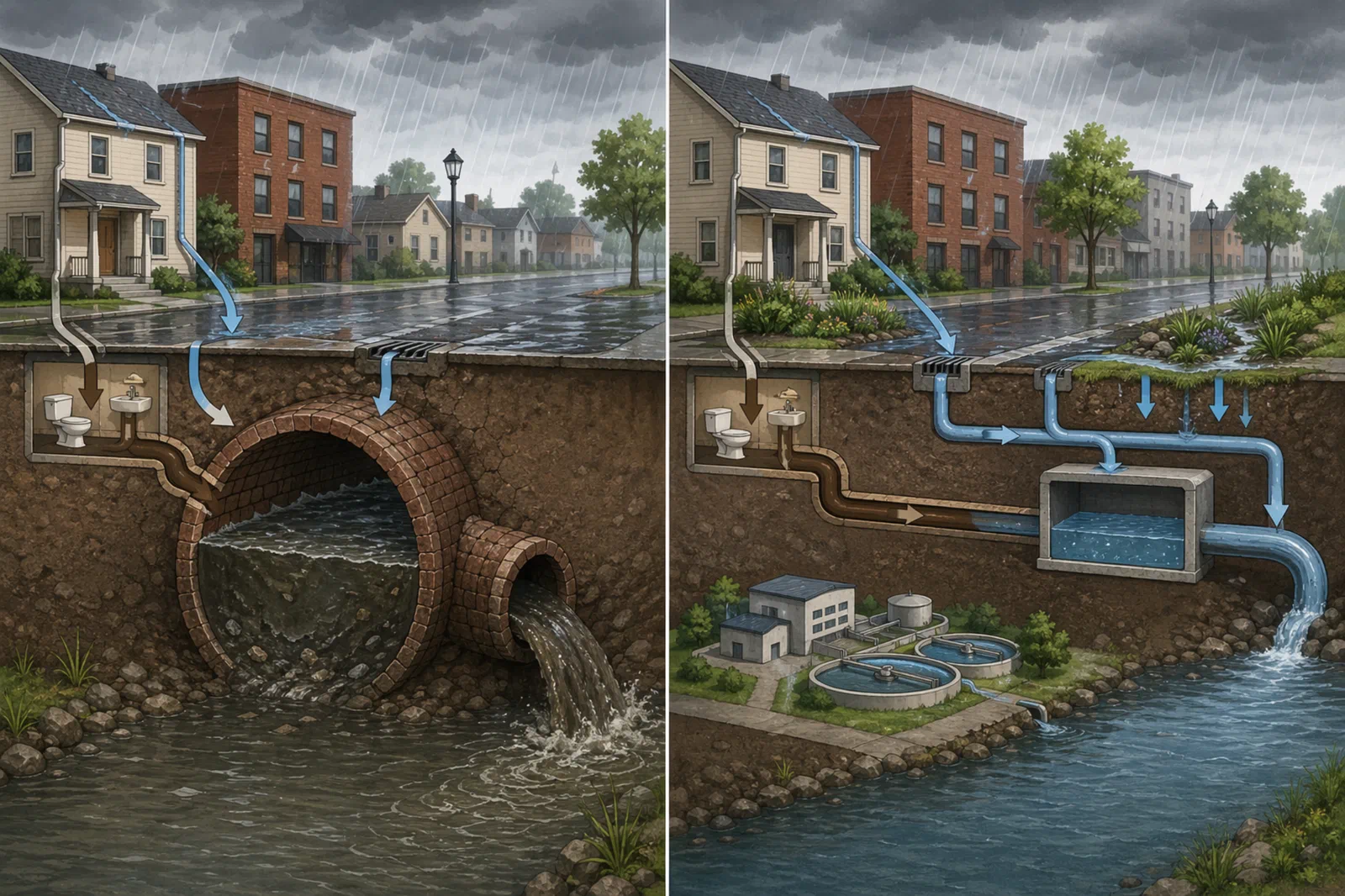
A combined sewer is not just an old pipe. It is an old bargain about where the city sends water when the storm arrives.
This old bargain once looked practical. One pipe was cheaper than two. Streets drained. Toilets flushed. The city kept moving. The river or brook absorbed the rest.
That bargain came from a different urban world: fewer paved surfaces, different water quality expectations, less recreation along urban waterways, and rainfall patterns that seemed more predictable than they do now.
A century later, the bargain is showing its age.
The EPA says roughly 700 U.S. communities have combined sewer systems and experience CSO discharges, mostly in the Northeast and around the Great Lakes. Alewife Brook is one named place in a national inheritance.
Old cities have old pipes.
Old pipes have old assumptions.
Rain has started asking new questions.
What MWRA Chose
MWRA is not pretending the problem does not exist. That part deserves credit.
The agency has spent decades reducing sewer overflows across the Boston region. In its February 2026 board materials , MWRA staff wrote that the region has cut CSO discharges by 88 percent since the late 1980s, closed or effectively closed 41 of the 86 outfalls active at that time, and treats 94 percent of remaining CSO discharge at CSO treatment facilities.
That is real progress. A cleaner Boston Harbor did not happen by accident.
Progress is not the same as completion.
AP reports that Alewife Brook alone had 23 discharges in 2025. Local groups want full sewer separation, which would keep sewage and storm runoff in different pipes. MWRA’s current proposal takes a narrower path. The plan would use storage tanks, partial sewer separation, and related upgrades to reduce discharges through 16 outfalls owned by MWRA, Cambridge, and Somerville.
The price tag is about $1.28 billion.
The technical standard is the real fight.
MWRA staff evaluated four control levels for the future 2050 planning year: limited CSOs in a 2050 typical year, zero CSOs in a 2050 typical year, zero CSOs in a 2050 5-year, 24-hour design storm, and zero CSOs in a 2050 25-year, 24-hour design storm. Staff recommended a plan aimed at zero CSOs in a “2050 Typical Year” for the affected waters.
That sounds stronger than it is.
Zero in a typical year does not mean zero in every future storm. It means zero under a representative future rainfall year, not under the larger storm events that advocates want the system built to handle.
That is the hinge of the whole story.
A typical year is useful for planning. It gives engineers a benchmark. It lets a model test a sequence of rain events rather than one dramatic hypothetical.
People do not experience sewer failure as a typical year.
They experience it as a storm.
They experience it as a closed path, a smell, a wet basement, a warning sign, a child reaching toward water that a parent does not trust.
The Agency’s Strongest Case
The fairest version of this essay has to say that MWRA has a real argument.
The agency is not saying untreated wastewater in a brook is fine. It is saying full control is costly, disruptive, and not the only source of water pollution. Full separation would mean digging up streets and parking lots. It would redirect large volumes of stormwater, which can carry bacteria, nutrients, oil, trash, and other runoff from an urban watershed. The brook itself has limited capacity during wet weather.
MWRA’s board materials make a second point that is easy to miss in a simple sewage-versus-clean-water story. The agency’s water quality modeling suggests that stormwater and upstream sources are the main causes of water quality exceedances on many wet-weather days. In its model, even eliminating CSOs in a 2050 typical year would not remove most water quality exceedance days without major reductions in other bacteria sources as well.
The distinction changes the repair question.
A separated sewer system does not magically clean every road, roof, lawn, streambank, parking lot, illegal connection, cracked pipe, and upstream channel in the watershed. Even if combined sewer overflows were eliminated in a typical year, Alewife Brook would need broader repair.
This is the strongest version of MWRA’s case: do not spend huge sums on the most expensive form of one fix while other pollution sources keep the water unsafe after rain.
That argument deserves to be taken seriously.
It does not end the debate.
A combined sewer overflow is not just another source of pollution. It is a permitted release of untreated wastewater and stormwater into public water. Even if the measured water quality gain is smaller than residents expect, the civic meaning is larger.
A city can tell people not to touch the water for 48 hours after rain. Fine.
But if rain is heavier, and rainy stretches come more often, how often does that warning turn public water into look-but-do-not-touch scenery?
At what point does a greenway become a drainage easement with benches?
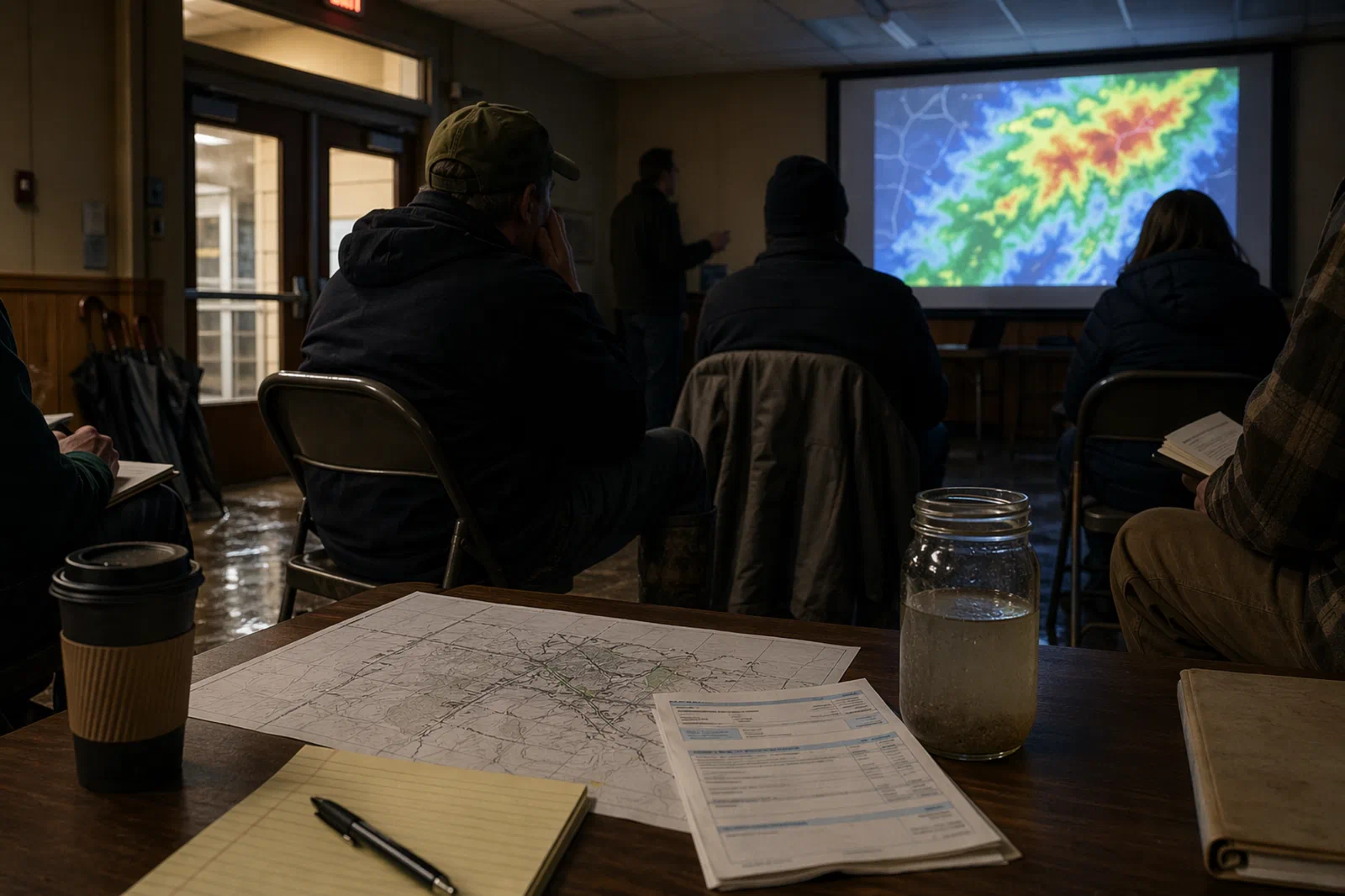
The argument is not only technical. It is about bills, trust, models, and what counts as clean enough.
The $46 Question
The number that makes the Alewife fight feel real is not only $1.28 billion.
It is $46.
AP reports that eliminating CSOs during stronger, less frequent storms would cost households an estimated $82 more per year in 2050, or $46 in today’s dollars.
That number is small enough to sound unserious and large enough to matter.
For a household already squeezed by rent, insurance, groceries, childcare, utilities, medical costs, and debt, another charge on a bill can feel like one more hand in the pocket. Public finance has a habit of turning real households into averages. That can make the pain look cleaner than it feels.
Yet forty-six dollars a year is less than four dollars a month.
So the question is not whether the money matters. It does.
The question is what kind of problem the region is willing to leave in the water to avoid charging it.
That is where sewer planning stops being only engineering. It becomes moral accounting with pipes.
One cost shows up on a bill.
The other shows up after rain.
One bill has an envelope. The other has a watershed.
Climate Does Not Sit in a Side Room
Public debates often treat climate change like a separate chapter at the back of an infrastructure report.
First the sewer.
Then the climate section.
That separation is fake.
A sewer pipe has a diameter. A storm has a volume. When the storm volume rises and the pipe does not, the math does not care about anyone’s preferred timeline.
MWRA deserves credit for using a 2050 planning horizon rather than pretending the old rainfall record is enough. Its board materials say the 2050 Typical Year accounts for projected climate change and higher intensity rainstorms. That is better than planning for yesterday’s weather while claiming to prepare for the future.
The dispute is about how much future weather to buy protection against.
A typical future year?
A larger storm?
A rarer, punishing event?
This is the same confusion that makes the phrase “100-year flood” so dangerous. People hear a calendar. The math means probability. One percent in a given year does not sound terrifying. Over the life of a 30-year mortgage, the risk stacks up into something harder to shrug off.
Sewer risk works in a similar emotional register. Annual averages soften the thing people fear: the ugly event that arrives all at once.
The pipe does not fail as an average.
The brook receives the overflow in a storm.
Why This Is Bigger Than Boston
Alewife Brook has a name, which helps. People defend named places more fiercely than abstract systems.
Yet the pattern travels.
About 700 U.S. communities have combined sewer systems. That map is partly a map of age. It points to older places built before separated stormwater and wastewater systems became the norm. It also points to an American habit: build the public system, postpone repair, then act startled when deferred maintenance comes back with interest.
The politics are familiar.
Everyone wants clean water.
Fewer people want construction outside their house.
Everyone wants climate readiness.
Fewer people want rates to rise.
Everyone wants agencies to plan for the future.
Fewer people trust the model, the consultant, the contractor, the timeline, or the fine print.
That distrust is not irrational. Big infrastructure projects can run over budget. Agencies can hide behind technical language. Residents have heard “temporary disruption” enough times to know temporary can stretch.
But distrust does not make the pipe larger. It does not separate stormwater from wastewater. It does not turn contaminated water into clean water.
At some point, the public has to choose between paying for work it can inspect and living with overflow it can smell.
Portland Is a Clue, Not a Copy
There are places that made the expensive choice.
Portland, Oregon spent decades on what became known as the Big Pipe project. The city’s own public works history describes a package of tunnel projects, downspout disconnections, stormwater sumps, sewer separation, treatment plant upgrades, and green infrastructure. After the Big Pipe was completed, Portland says average annual combined sewer overflows dropped from 50 to 3.3.
That does not mean Boston can copy Portland.
No city gets to copy another city’s geology, streets, rate base, legal history, or politics. Copy-paste urban planning is how you get expensive nonsense.
Portland matters for a narrower reason: it shows that old sewer bargains can be renegotiated at scale.
Not cheaply.
Not quickly.
Not without construction, disruption, debt, and public irritation.
But it can be done.
The lesson is not “build exactly what Portland built.” The lesson is that a city can choose to stop treating its waterways as overflow space.
The Brook Remembers
Alewife Brook is easy to underestimate because it is small.
It is not Boston Harbor. It is not the Charles River. It is not the kind of waterway that gets turned into a postcard for the region.
That may be why it reveals the system so clearly.
Small urban waters reveal what a city really believes. Not what it says in climate plans. Not what it prints on park signs. What it builds, funds, tolerates, delays, and explains away.
Save the Alewife Brook was formed in 2020 by Kristin Anderson, whose home flooded with untreated sewage more than once after rainstorms, according to AP. The Mystic River Watershed Association has volunteers collect water samples from the brook for lab testing. David Stoff, who lives near the waterway and sits on Save the Alewife Brook’s steering committee, told AP he had stopped his children from playing in the yard after sewage flooding.
Those are not abstract stakeholders. They are people living next to the escape route.
This is the part of the story that can get lost in the technical frame. A sewer model does not have a backyard. A rate chart does not have a child. A “2050 Typical Year” does not smell like anything.
The brook does.
For decades, Greater Boston has been cleaning up the consequences of older water decisions. The harbor cleanup was one chapter. The remaining combined sewer outfalls are another. Alewife Brook now asks the next version of the question.
How clean is clean enough?
How much future storm risk should be built into today’s project?
How much should households pay to keep untreated wastewater out of public water?
Who gets to decide when the answer is “enough”?
There is no painless version of this decision. Full separation disrupts streets and costs money. Storage tanks and partial fixes may leave residents feeling that the region bought a cleaner version of the same old bargain. Broader stormwater pollution means even a major CSO fix will not make the brook pristine overnight.
That is the frustrating part.
Also the honest part.
Public works rarely gives anyone the satisfaction of a clean ending. There are plans, revisions, public comments, court filings, budgets, rate hearings, construction seasons, angry meetings, and technical models that make normal people’s eyes glaze over.
Then, one rainy day years later, the reward is supposed to be absence.
No overflow.
No warning sign.
No parent pulling a child back from the water.
No resident wondering why a public brook has to absorb the city’s waste.
A cleaner water system does not look heroic when it works. It just works.
That is the strange dignity of infrastructure. The highest compliment is silence.
A brook can look harmless until the rain starts.
Then it tells you what the city thought it could hide.