The Siren on the Pole
A public warning siren can interrupt a whole town, but the civic test begins when that sound has to become instruction.
The test usually arrives at noon. People know it by the day before they know it by the policy. First Wednesday, clear sky, middle of lunch, the old horn begins its long steady note over a parking lot, a school field, a courthouse square, a subdivision edge, a bike path, a road crew, a bus stop.
For three minutes the town receives the same sound. It lands on the person unloading groceries and the person walking a dog. It enters a baseball diamond, a construction site, a municipal garage, a cemetery, a gas station canopy. It ignores phone numbers, passwords, notification settings, subscription lists, and private feeds. The pole does one public thing well. It interrupts.
That interruption is the siren’s power. It is also the beginning of its trouble. A siren can say danger, attention, shelter, check a source. It cannot say why the danger exists, which road closes first, which part of the county sits inside the polygon, how long the threat lasts, what the source knows, how certain the warning is, which language a household needs, where a wheelchair user can go, which shelter accepts pets, or why the official message changed after the first signal.
The siren on the pole is one of the few public machines that can speak to everyone within reach at once. Its weakness is that it has almost nothing to say.
The outdoor warning siren has survived because public risk creates two needs that often fight each other. People need a fast interruption. They also need a clear instruction. Sound can do the first job. It cannot carry the second job by itself. That gap explains why the old pole remains visible inside a warning system built out of software, federal rules, cell towers, radio networks, weather offices, county budgets, public drills, and local trust.
A warning system is often judged after an event, when the costs have names and addresses. The better way to read it is before the sky changes. Look at the device in ordinary light. Ask who owns it, who activates it, what rule governs the tone, what map it covers, what backup reaches the house, what happens for people who do not hear well or read English, what officials do when new evidence arrives, and how the public has been taught to answer the sound.
The siren looks like hardware. It is really a public bargain.
What The Sound Can Do
The National Weather Service says the blunt part plainly. Its Quad Cities office explains that outdoor warning sirens are meant to alert people outdoors, and anyone who hears one should go inside and seek more information through radio, television, NOAA Weather Radio, or another trusted source. The same NWS siren FAQ says no national rule dictates every local siren policy. Local officials decide when the horns sound.
That local authority gives the siren much of its practical value. It also makes the national picture uneven. One jurisdiction may activate for a tornado warning. Another may add destructive thunderstorm warnings, chemical release, flood danger, or local fire calls. One place may test monthly through the full tone. Another may run silent diagnostic checks. One county may use storm-based activation tied to a National Weather Service warning polygon. Another may sound every siren inside a political boundary because the control system has not caught up with storm-based practice.
The public hears one category: siren. The actual machine may belong to a city, a county, a university, a military installation, an industrial plant, a state agency, or a special district. A network may contain old electro-mechanical heads beside newer electronic controllers. The pole may carry a radio receiver, battery backup, a cabinet with aging boards, a rotating horn, or a fixed array. The tone may be one signal in a larger file of maps, triggers, permissions, repair calls, and test logs.
Sound can reach a park without knowing who is in the park. That is no small thing. Public alerting often struggles with address lists, phone ownership, opt-in habits, dead batteries, weak coverage, app fatigue, carrier settings, and the plain fact that people move through places as workers, visitors, students, drivers, shoppers, patients, and neighbors. A siren does not care who belongs on the tax roll. It reaches the body in public space.
Its reach also has a hard edge. Outdoor sirens are outdoor devices. Walls, windows, air conditioners, traffic, factories, wind direction, hills, trees, and simple distance change the sound. Hearing ability changes it again. A person asleep indoors may never hear the same horn that feels overwhelming on a sidewalk. A siren is loud enough to feel public. It fails as a reliable indoor alarm.
Dane County Emergency Management makes this warning unusually explicit. Its public siren page tells residents that the horns are intended for outdoor warning and should not be a primary source for tornado warnings. Its FAQ says the sound may not penetrate buildings well, especially with closed windows and interior noise. It tells residents to use NOAA Weather Radio, smartphone apps, and broadcast media as alternate warning sources.
That is a strange civic object: a costly machine that announces its own limits.
The honest version of siren policy has to do that. It has to tell residents that the shared sound is an entrance, not the whole message. It has to tell them that the warning stack contains several imperfect channels. It has to keep the old device visible without letting visibility become false confidence.
A public warning succeeds when interruption and instruction find each other before time runs out.
The Old Public Voice
The outdoor warning siren carries old fears in new weather. The form belongs to the age of air raid drills, civil defense, blast maps, fallout shelter signs, and public authorities trying to make danger audible before private communication could move fast enough. The same shape later served tornado country, tsunami coasts, fire districts, chemical corridors, industrial towns, and flood-prone lowlands.
The historical record shows that indoor warning was a problem almost as soon as outdoor warning became a system. The University of Pennsylvania’s Online Books Page lists a Federal Civil Defense Administration technical manual called Outdoor warning device systems , published by the Government Printing Office in 1951. Google Books identifies a 1953 Stanford Research Institute report for the Federal Civil Defense Administration, The Effectiveness of Sonic Outdoor Warning Devices , also printed by the Government Printing Office. Dane County’s own FAQ quotes a 1956 report to Congress noting the problem of people inside homes and buildings where outdoor devices may not be heard.
The device did not migrate out of civil defense because the old issue vanished. It migrated because the same practical question kept appearing under new hazards. How can a public authority reach people who are not gathered around a radio, not watching television, not checking a phone, and not expecting trouble?
Hawaii offers the clearest long arc. The Hawaii Emergency Management Agency traces its statewide outdoor warning system through wartime air raid history, the 1946 tsunami, later tsunami losses, and the growth of an all-hazard siren network . A coastal siren differs from a Midwestern tornado siren. Both show why the horn survives. Public danger often arrives with geography. A wave, funnel, plume, flood, or fire line moves through places. A public machine fixed in place can make that geography audible.
The old civil-defense ancestry should not turn the siren into a relic story. Nostalgia weakens the analysis. So does easy contempt for older public works. Age is the wrong measure. Task fit is the useful one.
A siren handles a narrow task: break public routine fast. It does that without a carrier, app, subscription, password, or screen. It can reach a child in a field, a roofer on a house, a lifeguard, a person working a roadside stand, a driver with the radio off, and a crowd outside a stadium. It can also make the same mistaken promise to someone indoors who never hears it.
The older record gives the modern siren two obligations. First, do not pretend outdoor sound has become indoor warning because the technology is familiar. Second, do not confuse a public tone with a public message. Those limits were known in the civil-defense period. They remain inside every county FAQ that tells residents to use another channel.
The siren did not become obsolete when phones arrived. It became one layer in a warning stack where each layer fails in a different way.
A County With A Ledger
The fastest way to strip romance out of the siren is to read a county page. Dane County, Wisconsin, maintains a useful public file because it says the quiet parts out loud. Its emergency-management page lists policy, testing, trouble calls, maps, range caveats, and activation rules. The page turns the siren into local administration.
Dane County says its system has 144 outdoor warning sirens, placed in the most densely populated areas. The county posts a siren system map and a site list . The map uses circles for estimated outdoor effective range, then warns that those circles are planning tools. Sound output, weather, wind, humidity, hills, trees, buildings, and background noise can change what a person hears.
The county test rule is just as concrete. Sirens are tested year-round on the first Wednesday of each month around noon, weather permitting. The tone is three minutes. Actual tornado warning activation also uses a three-minute steady tone. The county says the system gives no all-clear signal. The absence of a second tone matters because some residents may expect a machine that tells them when danger ends. Dane County tells them to use other sources for that.
The activation rule is local, even when the warning record begins at the National Weather Service. Dane County says the Weather Service issues severe weather warnings, but it does not decide local siren activation policy. The county operates its system. County policy governs how sirens are used. For tornado warnings, Dane County uses storm-based activation. It usually does not sound the whole county. It sounds sirens with warning coverage in the area identified by the Weather Service.
That local choice carries a theory of public trust. Countywide activation can reach people who might otherwise miss the tone, but it can also teach residents far outside the danger area that sirens over-warn. Storm-based activation reduces unnecessary alarm, but it depends on maps, control software, warning polygons, and public understanding. A person who does not hear the siren cannot assume no danger exists. Dane County tells residents to act on television, radio, phone, and observed weather even when a siren is silent.
Maintenance enters the same public file. Dane County says a siren site may send an error message to control software. A repair contractor may run a brief audible test to diagnose and confirm repairs. The county says the need can be urgent enough that residents are not notified in advance. That small note reveals the machine behind the ritual. The monthly test is the public version. The real system also contains error messages, contractors, diagnostics, components, cabinets, and the risk of breaking a thing that exists only for rare moments.
Money enters the file as well. In April 2023, Dane County announced a $3 million upgrade to its outdoor warning siren network . The county said the money came through the 2023 budget and would replace hardware and software used to trigger when and how sirens sound. The same announcement said the network then linked 141 sirens, with 79 county-owned and 62 owned by local governments. The county framed the upgrade around faster warning, aging hardware, new central-control software, and automatic activation of appropriate sirens in areas the Weather Service identifies as at greatest risk.
The numbers changed slightly in the public page after the upgrade period, which lists 144 sirens. That is normal for local infrastructure. Poles are added, repaired, relocated, retired, or reclassified. The important fact is the shape of the public obligation: a county funds a network, joins county-owned and locally owned equipment, maps coverage, publishes limitations, tests monthly, uses repair contractors, and ties activation to Weather Service warning records.
The horn is the visible part. The ledger is the system.
The ledger also shows why local warning cannot be treated as a one-time purchase. A siren head may sit in public view for years, giving the impression of permanence. The control software ages faster. The radio path changes. The battery weakens. A neighborhood grows beyond an old coverage assumption. A new apartment block changes audibility. A road project moves people through a work zone where nobody lives, so address-based warnings may miss them. A warning map that once looked sufficient can become stale through ordinary development.
The public usually sees none of this. Residents see a pole and hear a test. The county sees assets, ownership splits, control points, repair logs, software licenses, monthly diagnostics, and the problem of spending money on equipment that will be most valued on the day it is needed and least visible on every other day. That is a hard budget argument. It competes with ambulances, culverts, dispatch systems, shelters, road work, radios, staff, and the many public goods that also fail loudly when neglected.
Public education belongs in that same ledger. A test schedule has little value if residents treat the tone as noise and never learn what follows. A map has little value if households do not know that the circles show outdoor range. A storm-based policy has little value if silence is misread as safety. A no-all-clear policy has little value if residents wait for a second tone. A repair test has little value if it is mistaken for a warning and no explanation is easy to find afterward.
The siren therefore needs a civic maintenance plan as much as a mechanical one. The county has to maintain the hardware. It also has to maintain the meaning.
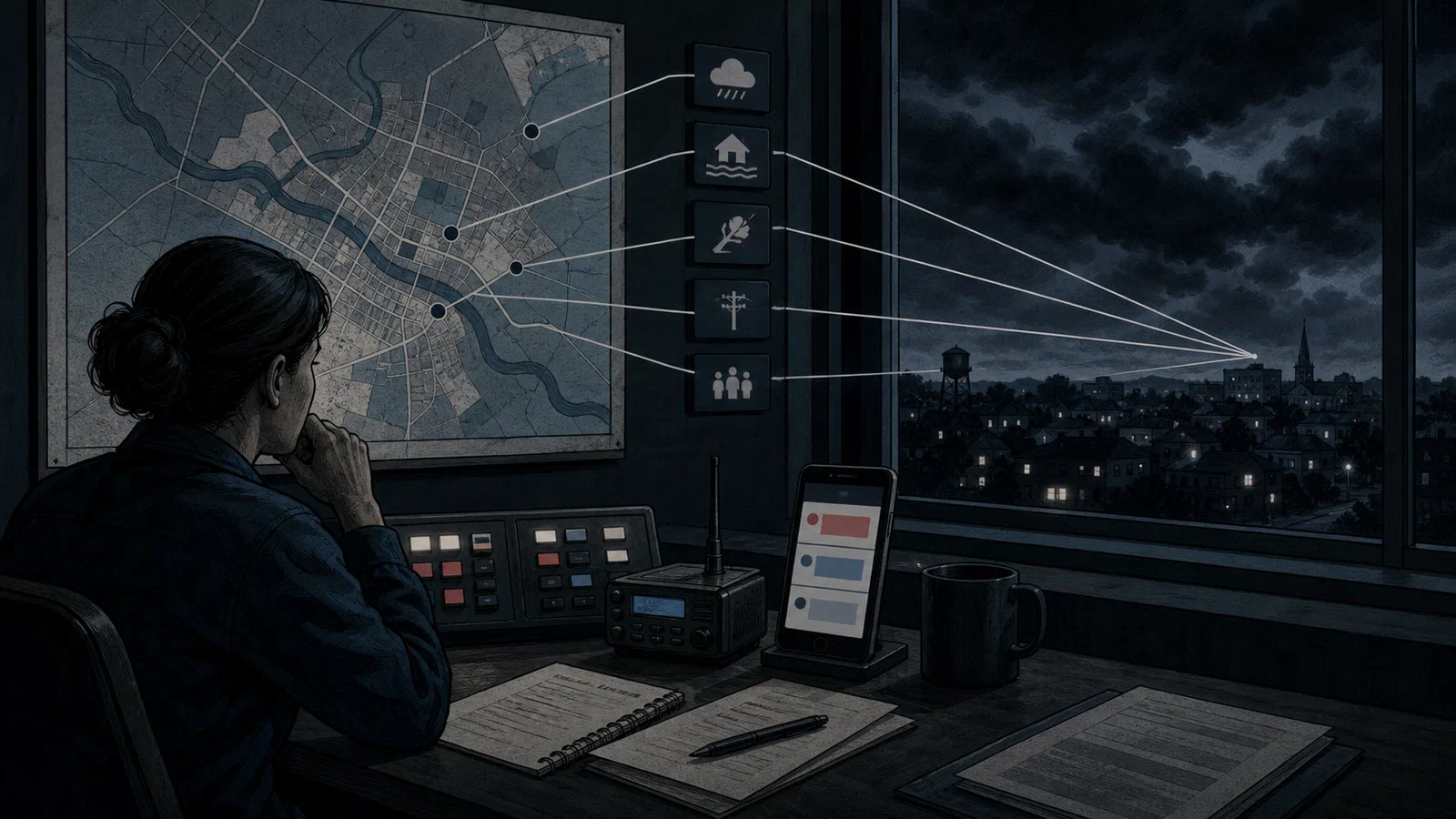
The pole is only the visible end of the warning chain.
The Federal Stack
Local authority sits inside a national alert architecture. The federal system does not replace the county siren. It surrounds it with channels that can carry more than sound.
In 2006, President George W. Bush issued Executive Order 13407 , directing federal agencies to build an effective, reliable, integrated, flexible, and comprehensive public alert and warning system. The order called for common protocols, geographic targeting, training, testing, public education, and access for people with disabilities or limited English proficiency.
That order became part of the road toward FEMA’s Integrated Public Alert and Warning System, or IPAWS. FEMA describes IPAWS as a national system that lets authorized alerting authorities send authenticated emergency messages through several public channels. FEMA’s best practices for Wireless Emergency Alerts are aimed at public-safety officials who need to write short alerts that prompt protective action.
The public sees pieces of IPAWS under separate names. Wireless Emergency Alerts, or WEA, appear on compatible mobile phones through participating wireless providers. The FCC’s consumer guide describes them as short emergency messages sent by authorized public-safety officials through participating carriers. Title 47, Part 10 of the Code of Federal Regulations establishes the rules for the voluntary Wireless Emergency Alerts system .
The Emergency Alert System, or EAS, reaches radio, television, cable, satellite radio and television, and wireline video providers. The FCC says its EAS role includes technical standards and procedures for EAS participants. Title 47, Part 11 contains the Emergency Alert System rules . EAS is older in feel than WEA, but it carries a different public function: broadcast interruption and relay through media infrastructure.
NOAA Weather Radio occupies another place in the stack. The National Weather Service describes NOAA Weather Radio All Hazards as a nationwide network broadcasting official warnings, watches, forecasts, and hazard information twenty-four hours a day, seven days a week. A household weather radio can wake, alarm, and deliver a specific official weather message without waiting for a phone app or commercial broadcast.
Those channels do different civic jobs. Sirens interrupt outdoor public space. WEA interrupts a phone inside a targeted area. EAS interrupts broadcast and cable channels. NOAA Weather Radio gives a dedicated receiver a continuous official feed. Local apps, websites, social media, reverse telephone systems, door knocks, police loudspeakers, transit signs, school messages, and shelter pages add more paths.
This can look redundant. It is. Redundancy is the point.
Redundancy also creates a second problem. If channels conflict, arrive out of order, use different place names, carry too little instruction, or give residents too many signals without a clear action, the system can train people to search instead of act. A siren followed by a vague phone alert sends people into the internet. A phone alert without a trusted source sends people into group texts. A television warning without a street-level instruction sends people to the window. A county map without public education sits unread until the review after a storm.
The federal stack makes warning more capable. It does not remove the local burden. Somebody has to decide when to send, which area to target, which message fits the time, which languages and access needs are covered, which local channel the public trusts, and what residents have been taught during the quiet months.
A national protocol can move a warning. It cannot by itself make the warning understood.
The Five Pieces Of A Warning
The siren’s message poverty makes the wording around it more important. Once a sound pushes residents toward a second source, that source has to do the work the horn cannot do.
NIST has treated warning as a design problem instead of a slogan. Its technical note Outdoor Siren Systems says the Joplin tornado investigation found no widely accepted standards for emergency communications in tornado events, especially policies involving outdoor sirens. The note says siren use, testing, education, training, and all-clear procedures vary widely across the United States, creating confusion and distrust around emergency communications.
NIST’s public-warning research points toward a plain message discipline. A warning needs a source, a hazard, a location, a time frame, and guidance. Those pieces sound almost too basic. They are exactly what panic and ambiguity destroy.
Source answers the first public question: who says this? People evaluate warnings through trust, prior experience, local identity, official status, media habits, and what neighbors are doing. A message that names the National Weather Service, the county emergency office, the city, the sheriff, or another authorized source reduces the guesswork. It also creates accountability. A warning without a source becomes rumor with official punctuation.
Hazard answers the second question: what is happening? A tornado warning, destructive thunderstorm warning, flash flood warning, wildfire evacuation order, chemical release, law-enforcement emergency, or tsunami advisory demands a different action. Sirens compress these differences into sound. The next message has to reopen the difference.
Location answers the third question: am I inside it? County names help some people. Neighborhoods, roads, rivers, schools, evacuation zones, polygons, landmarks, and maps may help others. Location is where technical precision can collide with public language. A Weather Service polygon may be exact in a way the listener cannot use. A citywide label may be easy to understand and too broad. A good alert bridges the two.
Time answers the fourth question: how long do I have? A warning without time leaves residents to invent a clock. Some hazards demand immediate shelter. Some demand preparation. Some demand evacuation before a road floods or a fire front shifts. Time uncertainty should be stated honestly because false precision can corrode later trust.
Guidance answers the fifth question: what should I do now? The answer must fit the hazard. Go indoors. Move to a basement or interior room. Leave a floodway. Do not drive through water. Evacuate through a named route. Shelter in place and close windows. Avoid a bridge. Check on someone nearby. Keep phone lines clear. Listen for the next update. The instruction is where warning becomes action.
The five pieces are not decorative. They are the bridge after the siren.
Short-channel limits make that bridge hard. WEA messages can carry more text than early cell-broadcast alerts, though screen space, attention, and the crisis moment constrain them. EAS can carry audio and visual message components, though people have to be tuned in. NOAA Weather Radio can provide official detail, though the household must own and program the receiver. A county website can hold maps and FAQs, though a website is a poor first alarm. A social post can travel fast, with copies, screenshots, stale information, and bad context close behind.
This is why the old horn remains useful as an entrance. It is also why it cannot be left alone on the pole as proof that the public has been warned.
Joplin And The Behavior Gap
The 2011 Joplin tornado is a hard record to use well. It was a human disaster and deserves more care than a neat moral. On May 22, 2011, an EF5 tornado struck Joplin, Missouri, killing 158 people and injuring more than 1,000, according to the National Weather Service service assessment . The same assessment described it, in NWS terms, as a warned event: advance notice existed, critical information was communicated and received, and many people sought shelter.
That is why Joplin is important for sirens. Warning absence is too simple a diagnosis. The problem lay in the path linking received warning with personal action under uncertainty.
NIST’s final technical investigation, Special Publication 1139 , examined tornado characteristics, building performance, emergency communications, and public response. NIST found that the city’s outdoor sirens sounded twice before the tornado struck, and its later siren review noted that more than half of interviewees did not perceive personal risk after hearing them. Some people sought confirmation. Some waited for another cue. Some looked outside. Some relied on prior experience. Some interpreted the first signal through the long history of warnings that had not touched them personally.
That behavior is easy to condemn after the fact and hard to judge honestly. People do not act on raw information. They act on perceived threat, social cues, confirmation habits, physical options, family obligations, work duties, transportation, shelter access, and the meaning that past warnings have taught them. A siren can start that process. It cannot finish it inside a listener’s judgment.
Joplin’s lesson is not that sirens failed and phones would have solved the problem. WEA was not the same mature channel in 2011 that it is now. It is also not that officials did everything possible because warnings existed. The better lesson is more uncomfortable: even timely warning can fail to become protective action when the public does not personalize risk quickly enough, when messages lack decisive clarity, when confirmation takes too long, or when the safest action is not obvious.
NIST’s recommendation work after Joplin pushed toward standards and research for public alerting, including outdoor siren systems and emergency communication. That is the right scale of response. A disaster review that stops at “people should have listened” misses the public-warning problem. A review that stops at “officials should have warned” also misses it when warnings were issued. The civic question sits in the middle: how does a system make the right action more likely for people who are busy, skeptical, frightened, disabled, alone, working, driving, caring for children, or translating the message while time closes?
The siren exposes the behavior gap because it is dramatic and incomplete. It can command attention without creating personal belief. It can make a public threat audible without making the threat feel local to a person in a specific room. It can tell people to seek more information, then depend on the rest of the system to be clear enough that the search does not become delay.
That is why a warning system needs practice before danger. Public education, monthly tests, school drills, broadcast habits, weather-radio programming, workplace shelter plans, multilingual outreach, disability-access planning, and local maps are not side work. They are how the siren’s meaning gets stored before the tone.
Who Can Hear The Instruction
The phrase “public warning” can hide the people it fails to reach. A siren may fail a deaf resident, a person wearing hearing protection at work, a night-shift worker asleep indoors, a driver with windows up, a person inside a sealed apartment, a person unfamiliar with the local siren culture, a tourist, a child, a resident without a phone, a resident with an older phone, a resident whose device language lacks support, and a person who receives the alert while needing help to act.
Executive Order 13407 named people with disabilities and limited English proficiency as part of the national alert mission in 2006. That clause carried more than courtesy. It recognized reach and equity as technical facts inside warning design.
The system has moved, unevenly. The FCC has a current public page on multilingual Wireless Emergency Alerts . In January 2026, the Federal Register published an FCC final-rule notice announcing a compliance date for Wireless Emergency Alerts and the Emergency Alert System , including multilingual WEA template requirements. The FCC’s public notice says participating mobile service providers have a June 12, 2028 compliance date for American Sign Language and multilingual WEA templates.
The date has practical value, even if it should not become the essay’s hook. On June 29, 2026, multilingual WEA support remains a live regulatory transition, short of a finished civic fact. A county siren page telling residents to use phones and broadcast media has to live with the reality that phone alerts are uneven across language, device, carrier, and user setting. A warning plan that assumes perfect phone comprehension is no better than a siren plan that assumes every wall is thin.
Accessibility reaches beyond translation. A warning may need audio, visual display, vibration, screen-reader compatibility, clear language, mapped evacuation zones, shelter information, transportation information, and enough repetition that a caregiver, neighbor, or workplace supervisor can act. It may need preparation materials in advance because the emergency moment is too late for explanation. It may need community partners who are trusted by people who do not treat a county account as their primary source.
The siren helps here only at the first step. It can make danger public to anyone who can hear it outdoors. It cannot say the instruction in ASL. It cannot translate itself. It cannot adjust for a resident who has hearing loss. It cannot tell a medically fragile person which shelter has power. It cannot tell a worker without a car which bus route is safe. It cannot tell a household that the alert on one phone is meant for the school, not the house.
None of this makes the siren useless. It makes the rest of the system morally and practically necessary.
The public bargain is broader than sound. It asks public agencies to interrupt residents in time, to explain the threat in forms people can use, and to admit limits before those limits become casualties. It asks residents to keep more than one warning path, learn local policy, respond to credible alerts, and avoid treating every false alarm as proof that the next one is false.
Both sides can fail. The system has to be built with that fact in mind.
The Bargain After The Tone
The siren on the pole has a strange civic honesty. It does not promise comfort. It does not sound like customer service. It does not flatter the listener. It takes a public authority’s judgment and makes it physically unpleasant.
That unpleasantness is part of the bargain. Government must sometimes interrupt ordinary life before ordinary senses can confirm the danger. It must do that early enough to matter, with enough detail to guide action, and carefully enough that residents do not learn to treat public warning as background noise. Residents, in turn, have to accept that warning arrives inside uncertainty. The sky may not look dangerous yet. The phone may buzz before the storm is visible. The siren may sound for a warning area whose edge is a few blocks away. The official source may update the instruction as evidence changes.
Trust does not mean the system is always right. Trust means the system has earned attention when it asks for it.
That trust is made during quiet months. It is made when a county publishes clear activation rules and maps. It is made when an emergency manager says plainly that outdoor sirens are for outdoor warning. It is made when budgets replace aging controllers before failure. It is made when tests occur on a predictable schedule and false alarms are explained. It is made when warnings name the source, hazard, location, time, and action. It is made when officials design for people who cannot hear, cannot read English, cannot drive, cannot shelter alone, or cannot trust one channel.
It is also made when officials resist the temptation to sell one technology as the answer. Sirens are blunt and public. Phones are targeted and private. EAS is broad and media-bound. NOAA Weather Radio is official and household-specific. Websites are detailed and slow as first alarms. Social media is fast and unstable. Door knocking is human and labor-intensive. No single channel deserves romance. No single channel deserves contempt.
Public warning works as a stack because public life is scattered. People are indoors and outdoors, awake and asleep, online and off, English-speaking and not, able-bodied and disabled, local and visiting, skeptical and trusting, prepared and improvising. The system has to meet more than the average resident. It has to meet the resident who is hard to reach when the clock is short.

A warning succeeds when the noise becomes a usable instruction.
The pole keeps doing its narrow work. It lifts a horn above the street and waits for a test, a storm, a plume, a wave, a fire, an error message, a repair contractor, a budget hearing, a map update, a public complaint, a survivor’s memory, a new subdivision, a new rule, a new phone standard, a new failure.
When it sounds, the public hears a command with missing words.
The next words are the civic system.