The Stamp on the Meat
A small inspection legend turns hidden slaughterhouse judgment into a portable public fact, then asks shoppers to know where official trust ends.
The Mark At The Counter
The stamp looks too small for the job.
On a package of ground beef, it may be a round legend printed beside the weight, price, and safe-handling box. On a carcass or primal cut, it may be ink applied at the plant. In either place, the mark does more than decorate the package. It turns an invisible judgment into a public fact that can move. Its quiet is part of the design: the mark should be boring only after the public work behind it has become trustworthy.
The shopper sees the end of the sentence. The animal, inspector, plant floor, rail, cooler, ledger, sanitation record, label approval, and truck have already passed out of sight. The meat arrives as a cold retail object, sealed in plastic, arranged under light, sorted by cut and price. The official mark sits there quietly. It says that someone with public authority entered the plant before the customer entered the store.
Current federal law gives that sentence a legal grammar. The Federal Meat Inspection Act compilation defines an official mark as the inspection legend or another symbol set by regulation to identify an animal or article’s status under the Act. It defines the official inspection legend as the symbol showing that an article was inspected and passed. The current U.S. Code chapter on meat inspection carries the same modern statutory frame. The Code of Federal Regulations part on official marks, devices, and certificates supplies the working shapes and ties the legend to the establishment number.
That number is the part the eye often skips. It is a small code, sometimes inside the mark, sometimes nearby with the prefix EST. It points back to the official establishment where the product was prepared. The stamp makes no promise that the steak will be tender and offers no moral certificate for the whole food economy. It is a controlled claim: this product moved through an official inspection system at an identifiable place.
Modern meat shopping depends on many claims. Some are private brands. Some are prices. Some are marketing words. Some are voluntary grade shields. The inspection legend is different. It does not speak for flavor, tenderness, ranch romance, local pride, animal welfare, worker conditions, or the absence of every possible hazard. It speaks for a public decision inside a system the shopper cannot inspect at the counter.
That distinction sounds narrow until the alternative becomes visible. In a small-town slaughterhouse, a local buyer once might know the butcher, see the animal, judge the shop, and carry memory across purchases. Industrial meat broke that chain. Scale and distance let a city family eat beef from an animal it never saw, killed in a plant it could not enter, packed by workers it would never meet, shipped through carriers it could not name. The stamp grew out of that loss of sight.
It is one of the quietest marks in American public life, and one of the most practical. It lets a private product carry a public status across a national market.
Before The Shopper Had A Supply Chain
Before the modern inspection legend could mean anything, meat had to become a thing that moved farther than trust.
Fresh meat once punished distance. Animals could travel better than cuts of meat. A butcher’s shop, a stockyard, a rail spur, a city market, and a household kitchen were close enough that judgment had a local form. The public could smell some failures. Buyers could punish some shops. City governments could inspect some spaces. A carcass hanging in a market did not arrive from nowhere.
Refrigerated rail, concentrated slaughter, canning, packing, rendered byproducts, and national retail changed the scale of the question. A carcass could be broken down long before dinner. Meat food products could enter cans, casings, barrels, tins, and shipping containers. A consumer did not need to know how the chain worked in order to depend on it. That was the problem.
Trust did not disappear. It changed address. It left the butcher’s face and moved into inspection rules, labels, certificates, establishment records, federal jurisdiction, and the power to stop product from entering commerce. The mark on the meat is one visible survivor of that transfer.
The story is often flattened into a single book, a single scandal, or a single reform moment. Upton Sinclair’s The Jungle gave readers a powerful image of Chicago packinghouse life, and it mattered as a public force. Yet the inspection system did not spring only from literary shock. Export markets, interstate commerce, diseased animals, canning, adulteration, chemical treatment, and the limits of old law were already part of the record.
Reform moved because meat had become a national information problem.
In June 1906, President Theodore Roosevelt sent Congress a special report on Chicago stock yards by James Bronson Reynolds and Charles P. Neill. The House document is available through GovInfo . Roosevelt’s message said the conditions disclosed by the short inspection in Chicago demanded federal action for products entering interstate or foreign commerce. It also described a legal gap. Existing law could address some slaughter inspection and export meat, yet prepared meat food products moving through domestic commerce were another matter.
The report makes the inspection stamp less sentimental. Public authority appears there as a practical answer to distance, processing, and label claims, not as an object of admiration. A mark had to stand for something more durable than the consumer’s glance. Meat could be transformed after slaughter. Labels could travel where inspectors and buyers could not. A can could carry public confidence into a pantry long after the animal and plant floor disappeared.
The 1906 statutory response sits in the public-domain Statutes at Large volume 34 , in the Agriculture appropriation act approved June 30, 1906, with the meat-inspection provisions commonly cited in the 34 Stat. 674 sequence. The law gave federal inspection a broader place in interstate and foreign commerce. It made ante-mortem inspection, post-mortem inspection, marks, labels, destruction of condemned meat, and plant access part of the legal machinery. Later codification and amendment changed the statute’s shape, yet the basic conversion remains recognizable: official judgment inside the plant becomes an official mark outside it.
That conversion is the stamp’s true subject. The mark is ink with a legal memory. It is a public record made portable.
1906 And The Public Loss Of Sight
The most important word behind the stamp may be “passed.”
It sounds simple, almost ceremonial. Yet “inspected and passed” only makes sense after the government decides what must be inspected, when inspection occurs, who may apply the mark, what must be withheld, what must be destroyed, and what counts as adulterated or misbranded. The words compress a sequence of official acts into a phrase small enough to fit on meat.
The 1906 crisis revealed why that compression was needed. Industrial slaughter had split public confidence into pieces. The buyer needed confidence in the live animal, the killing floor, the carcass, the trimming, the can, the sausage, the label, the storage, the transport, and the claim on the package. No household could check all of that. Even a city inspector could not follow all product once it entered a national stream.
Roosevelt’s June 1906 message on the Neill-Reynolds report highlighted the issue. Labels on prepared meat food products could imply more than the old system had actually inspected. The report pushed toward inspection across the chain of preparation, beyond a glance at the carcass. That is the point at which the inspection mark begins to look like a modern answer. It needed to travel with the product because the product had already traveled away from public view.
Federal inspection also had to attach to jurisdiction. The national government did not become the inspector of every meal in every kitchen. It asserted authority where meat and meat food products entered interstate or foreign commerce, foreign commerce, import, or federally inspected channels. The mark therefore speaks from a legal boundary as much as a sanitary one.
This helps explain the stamp’s restrained language. It does not say pure. It does not say humane. It does not say delicious. It does not say organic, local, grass-fed, prime, family farm, climate friendly, or worker safe. It says inspected and passed because the public problem was narrower and harder: a private product moving through commerce needed a public status that could be seen after the plant was gone.
The same phrase also carries a warning. A mark can earn trust only when the public knows what it was built to say. Once shoppers ask it to certify every question in the food system, they turn a specific legal mark into a general feeling. That is when the stamp begins to carry too much.
Inside The Inspected Establishment
The inspection legend begins before the package exists.
Federal rules organize meat inspection around the official establishment. That phrase is easy to flatten into a building. In practice, it is a legal and operating space where inspectors, plant management, equipment, labels, records, sanitation systems, animals, carcasses, parts, and finished products meet under federal requirements.
Inside the plant, the public mark is earned, controlled, withheld, or lost. The consumer cannot see that room, so the room has to leave a trace the consumer can use.
Current law gives inspectors authority to examine animals and carcasses, and it treats adulterated and misbranded products as legal problems. The regulations fill in the shop-floor architecture. 9 CFR part 312 prescribes official marks, devices, and certificates. 9 CFR part 316 governs marking products and containers. 9 CFR part 317 governs labels, marking devices, and containers. 9 CFR part 320 requires records, registration, and reports. 9 CFR part 416 covers sanitation. 9 CFR part 417 covers hazard analysis and critical control point systems.
Together, those parts describe a system larger than a single inspector’s glance or a stack of plant paperwork. Animals receive inspection before slaughter. Carcasses and parts receive inspection after slaughter. Official marks and labels are controlled. Sanitation standard operating procedures must be written, implemented, monitored, and recorded. HACCP rules require official establishments to analyze food-safety hazards and maintain plans, records, corrective actions, and verification procedures for critical control points.
By the time the shopper sees the stamp, the visible mark has become the surface of a deeper system. That system includes public employees, plant employees, controlled devices, approved labels, records, and a continuing power to retain, reject, condemn, detain, or recall product when something fails.
The mark deserves more than mockery and less than worship. It has force because law and operations back it. It has limits because law and operations work through defined tasks, evidence, sampling, plant controls, and judgment. Inspection cannot suspend biology, make commerce frictionless, or turn every package into a perfect product. It reduces a set of public risks and gives the product a legal status.
That status can be carried, read, traced, and challenged.
The Stamp, The Number, And The Law
The official inspection legend is not free artwork.
The current regulation in 9 CFR part 312 says the prescribed marks, devices, and certificates are official for purposes of the Act and must be used as the regulations provide. The legend for inspected and passed products of cattle, sheep, swine, and goats is tied to the official establishment number. The sample number in the regulation is only an example. The number of the establishment where the product is prepared must be used instead.
That small requirement changes the mark’s meaning. It makes the stamp more than a phrase. It points to place.
A label may place the establishment number inside the legend, or 9 CFR part 317 may allow it nearby on the exterior container or labeling when it remains prominent, legible, and tied to the product. That is why recall notices often tell consumers to look for an establishment number instead of an abstract brand name alone. Brands can be complicated. Contract packing can be complicated. Product lines can be complicated. The establishment number gives the public a regulatory handle.
The devices that apply the mark are also controlled. 9 CFR part 316 requires authorization and approval for devices bearing official marks, prohibits unsupervised use of official marks, and controls marking devices furnished by official establishments. It also reaches the most literal part of the stamp: ink.
Under 9 CFR 316.5 , the operator of each official establishment furnishes ink for marking products with official marks. The ink must be made with harmless ingredients approved for the purpose by the Administrator. Samples may be submitted to the Program laboratory as the inspector in charge deems necessary. The section excludes ink containing F.D. & C. Violet No. 1, bars green ink for cattle, sheep, swine, goat carcasses and fresh cuts, allows approved colors in specific cases for processed cuts, reserves green ink for equine carcasses and parts, and requires legible, permanent markings with acceptable contrast.
That is a practical rule and a cultural one. The mark must be edible enough for contact with meat, legible enough to be read, durable enough to travel, and distinct enough to avoid confusion. A stamp that smears into decoration cannot do its civic work.
The 2019 Federal Register rule on carcass marking shows how the mark also adapts to plant design. In a final rule published March 18, 2019 , FSIS removed the requirement that certain livestock carcasses be marked “U.S. Inspected and Passed” at the time of inspection when the carcasses would be further processed in the same establishment. The agency treated the mark as unnecessary at that exact internal stage when product was not leaving the establishment and remained under inspection control. The rule did not dissolve the public mark. It clarified where the mark needed to do public work.
The stamp becomes important at thresholds. It matters when meat leaves an official establishment, moves in commerce, enters a container, appears on a label, crosses a border, enters a recall notice, or becomes evidence in an enforcement record. Inside a controlled plant, the public fact can be maintained by inspection control. Outside the plant, the fact needs a portable sign.

Inspection happens out of sight, then leaves a public trace.
The Grade Shield And The Market’s Second Language
Meat packages often carry more than one official-looking signal.
The inspection legend and the grade shield are the easiest pair to blur. They both use government marks. They both can appear near meat. They both sound like public assurance. Yet they speak different languages.
Inspection is the baseline safety and wholesomeness system for meat entering covered commerce. The grade shield is a voluntary market language about quality traits. The USDA Agricultural Marketing Service page on quality grading and inspections describes grading as a service offered through AMS. The AMS Remote Beef Grading program page makes the point in modern form: images submitted through the program are reviewed, graded, and certified by USDA graders. Grading is a separate service, not another word for inspection.
A shopper who reads “Prime,” “Choice,” or “Select” is seeing a market judgment about quality grade instead of a second inspection legend. The inspection mark asks if meat has been inspected and passed under the federal meat inspection system. The grade shield asks where beef falls in a voluntary quality scale. One opens the public-safety door. The other helps buyers sort eating expectations and price.
That distinction is the point. A package can be inspected and passed without being Prime. A cut can carry a grade shield without making the grade shield do the inspection legend’s job.
The same caution applies to private claims. “Natural,” “no antibiotics ever,” “grass-fed,” “local,” “regeneratively raised,” and similar claims raise their own proof questions. Some may be reviewed through labeling processes. Some may depend on producer records, audits, or definitions outside the inspection legend itself. The inspection stamp does not swallow all of those claims. It supplies a public status for the meat, then leaves other questions to other systems.
That can frustrate shoppers. The modern consumer wants one mark to solve many worries. Is the meat safe? Is it tender? Was the animal treated well? Were the workers treated well? Did the label tell the truth? Was the plant clean? Did the product move through a fair market? Would the shopper support the place behind it? A single stamp cannot carry that whole bundle, because the bundle belongs to several legal, commercial, ethical, and household systems at once.
Its narrowness can be a strength when the shopper understands it. Trouble starts when the mark’s public authority is mistaken for a universal blessing.
The grade shield makes the problem easier to see because it is official yet voluntary. It belongs to a market conversation in which sellers ask USDA to evaluate quality traits and buyers decide if the grade is worth the price. The inspection legend belongs to a legal conversation in which covered meat must pass through inspection before it moves as eligible product. Both marks can sit on the same package, and both can be useful. They answer separate questions. A buyer who wants to understand the public signal on meat has to keep the safety baseline, the quality grade, the brand promise, and the private marketing claim in separate boxes.
State Inspection, Local Slaughter, And The Line On The Map
The stamp also carries geography.
Federal inspection is not the only inspection system Americans encounter. States operate meat and poultry inspection programs, and local slaughter may exist inside exemptions and state channels. The public line is commerce. Products prepared under state inspection generally stay within the state unless a federal pathway opens interstate movement.
FSIS describes state meat and poultry inspection programs as operating under requirements that must be at least equal to federal inspection standards, and its state inspection program pages identify participating states and review processes. The Cooperative Interstate Shipment program creates a narrow bridge: eligible state-inspected establishments in participating states may ship meat and poultry products in interstate commerce under federal oversight and special conditions.
That program exists because geography can distort trust. A small plant may serve a local region well and face a hard barrier at the state line. A buyer near a border may live closer to a state-inspected plant in another state than to a federally inspected plant in the same state. A local farm or processor may want access to a broader market without becoming a large federal establishment. CIS tries to join state inspection capacity to interstate commerce while keeping the public status legible.
The line also protects meaning. Without a clear jurisdictional line, the same words could mean different things in different markets. The inspection mark has to tell the next buyer what public system stood behind it. State inspection marks, federal inspection legends, and CIS marks all depend on control of that meaning.
This is a civic problem hiding inside a grocery case. The United States does not have one food market because every town knows every butcher. It has a food market because law lets distant strangers treat certain public facts as portable. Inspection status is one of those facts.
The System Learns To Watch Itself
Inspection began with eyes, knives, animals, carcasses, and visible signs of disease. It now includes records, sanitation systems, hazard analysis, verification, and a different understanding of risk.
The older image is an inspector standing near a line, examining carcasses and condemning what fails. That image remains part of the system. Yet modern hazards do not always present themselves like a visible lesion. Pathogens, process failures, sanitation lapses, temperature abuse, cross-contamination, and mislabeling can require records and systems as much as eyes.
This is where parts 416 and 417 connect back to the stamp. 9 CFR part 416 requires official establishments to develop, implement, and maintain written sanitation standard operating procedures. Those procedures must be monitored. Corrective actions must address failed sanitation controls. Records must document implementation, monitoring, and corrective actions.
Part 417 then moves the plant toward a written risk map. 9 CFR part 417 requires each official establishment to conduct or have conducted a hazard analysis to identify food-safety hazards reasonably likely to occur, then develop and implement a HACCP plan when such hazards are identified. A HACCP plan must list critical control points, critical limits, monitoring procedures, corrective actions, recordkeeping, and verification procedures. It must be signed, dated, reassessed, and supported by records.
In 1996, the Pathogen Reduction and HACCP final rule marked a major shift in federal inspection. The public system moved toward plant responsibility for systematic hazard control under FSIS oversight. Inspectors remained public actors, and the inspection legend remained a public mark. The rule added a deeper demand: the plant had to know its own process risks, control them, record them, and face verification.
Two kinds of trust meet at the counter. One is trust in direct official judgment. The other is trust in a public system that forces a private establishment to build, document, and operate controls. Those are different, and both can fail.
No shopper is asked to read the HACCP plan. The mark asks the shopper to accept that the plan exists where required, that it is subject to oversight, that records can be reviewed, and that failures can trigger official response. The consumer receives a symbol because the underlying file would be useless in a grocery line. The symbol does its work only because the file exists somewhere else.
When The Mark Fails Or Gets Overread
The stamp is strongest when its limits are visible.
It does not guarantee zero pathogens. It does not guarantee perfect plant behavior. It does not prove that every later handler kept the product at the right temperature. It does not certify every private claim on the label. It does not settle labor, animal-welfare, environmental, antitrust, nutrition, or price questions. It does not promise tenderness. It does not replace cooking instructions.
A defined public mark matters because its job is bounded.
The harder problem is that the grocery case encourages overreading. It gathers many signals in one cold rectangle: official inspection legend, establishment number, grade shield, brand, price, sell-by date, safe-handling instructions, nutrition panel, cooking suggestion, private production claim, and sometimes a retailer’s own promise. The shopper has seconds to sort them. The package does not announce which signal belongs to federal inspection, which belongs to voluntary grading, which belongs to a label review, which belongs to brand reputation, and which belongs mainly to advertising.
That confusion can be useful to sellers even when no one lies. Official design has borrowed authority because it looks disciplined. A shield, a seal, a code, a serif word, or a plant number can make the whole package feel supervised. The inspection legend supplies one real form of supervision. It does not transfer that supervision to every other claim beside it. A shopper who sees “inspected and passed” near a quality word or pastoral claim may read the whole label as a single government sentence, when the law has written several different sentences in different hands.
The stamp needs boundaries in plain sight. It makes one fact portable: eligible meat from an identifiable inspected establishment entered commerce with inspection status. The rest has to be checked somewhere else. A disputed label claim, a grading question, a sanitation record, a process failure, or a recall notice may involve the same package, but none of those questions live inside the stamp. The mark fails culturally when the public treats its narrowness as deception. Narrowness is how public marks stay honest. A permit does not certify good architecture. A license plate does not prove careful driving. A courthouse file stamp does not prove a claim true. The inspection legend does not make the whole food economy worthy of trust. It records a defined public inspection fact that can be followed.
Food safety systems accept that hazards can escape control. That is why the legal system includes detention, recall, enforcement, records, public notices, and traceability. The mark is part of that response as well as the original entry into commerce.
FSIS recall notices show the establishment number doing public work. In 2025, FSIS announced that C&S Beef Packers LLC recalled ground beef products that may have been contaminated with E. coli O145. The FSIS recall notice and its public bulletins directed attention to products bearing an establishment number inside the USDA mark of inspection. That is the stamp functioning after confidence has been disrupted. The same mark that signals entry into commerce also helps identify the product that must leave commerce or be handled with special caution.
Recalls can make the stamp look weak because they announce failure in a system that shoppers associate with safety. A better reading is more precise. Recalls reveal that inspection status and risk control are continuous public facts, no one-time charm. A product can be inspected and passed, then later become part of a recall because new evidence, sampling, outbreak information, mislabeling, undeclared allergens, contamination, or process records show a problem.
That is a system with memory.
The establishment number is memory in compact form. It gives public notice a place to point. It helps distinguish one product from another product on the same shelf, one plant from another plant under the same corporate umbrella, and one lot from another lot in the same category. It gives consumers, retailers, distributors, regulators, and newsrooms a common reference.
The public often wants recall notices to name brands because brands are what shoppers remember. The regulatory system also needs plant identity because plant identity is where public control can attach. The stamp connects those languages.
Labels, Records, And Traceability
The inspection legend works only because other records exist.
A mark without a record is a decoration. A number without a registry is a riddle. A recall without label images, lot codes, dates, and distribution details is a public warning with no handle.
9 CFR part 317 requires labels and certain required features. It regulates official inspection legends on labels, prohibits false or misleading labeling practices, and controls labels and containers bearing official marks. 9 CFR part 320 requires records, sets places and periods for maintaining them, provides access for inspection of records, facilities, and inventory, and requires reports in specified circumstances.
This record layer is easy to miss because it lacks the stamp’s graphic simplicity. Yet it is the reason the stamp can keep meaning after the product leaves the plant. A label can be checked against an approval. A product can be tied to an establishment. A mark can be challenged as unauthorized. A lot can be traced through distribution. A recall notice can show images and identifiers. A plant can be required to supply records.
Traceability has no magic in it. Meat can move through complex channels, and recalls can be slow, incomplete, or confusing. Consumers throw away packaging. Restaurants may prepare product before a notice reaches them. Distributors may split cases. Freezers can hold old product long after a sale. A household may remember a brand while forgetting the plant number.
The stamp helps because it gives the public system a fixed point. It cannot solve every traceability problem by itself, yet it gives the chain a legal anchor. That is one reason it remains powerful despite its size. It lets a later fact travel backward.
When a recall notice tells shoppers to look for an establishment number, the stamp stops being background. The circle becomes a map marker.
The Public Fact That Can Travel
The inspection stamp belongs to a class of civic objects so ordinary that their public design is almost invisible.
A notary seal, a license plate, a building permit, a courthouse filing stamp, a passport stamp, a tax receipt, a county seal on a deed, a calibration sticker on a gas pump, and an inspection legend on meat all perform a related act. They let strangers rely on a controlled public fact outside the room where that fact was made.
The meat stamp may be the most intimate example. It sits on food. It enters the kitchen. It lives beside hunger, habit, budget, family, celebration, dieting, memory, and disgust. It is a legal mark on something a person will put in the body.
That intimacy gives it symbolic force. It also tempts overstatement. A shopper may want the stamp to mean that the food system is clean, fair, humane, local, honest, affordable, nutritious, and safe in every possible way. A critic may want one recall or plant scandal to prove that the stamp is a lie. Both readings make the same mistake. They ask a specific public mark to stand for the whole moral weight of meat.
The better reading is harder and more useful. The stamp solves a real information problem. Industrial meat took slaughterhouse judgment out of public sight. Federal inspection turned a defined part of that hidden judgment into a portable legal fact. The mark earned trust because it was tied to law, inspectors, official establishments, controlled devices, labels, records, sanitation, HACCP systems, plant identity, and public notices. It deserves respect for that reason.
It also deserves boundaries.
It does not end the shopper’s questions. It organizes one of them. Was this meat inspected and passed under an official system, at an identifiable establishment, before it moved through covered commerce? The stamp answers that question in a form the market can carry.
The answer is small because it has to fit on meat. The system behind it is large because the shopper cannot go into the plant.
The stamp is the public entering the room, leaving a mark, and sending the evidence out into the world.
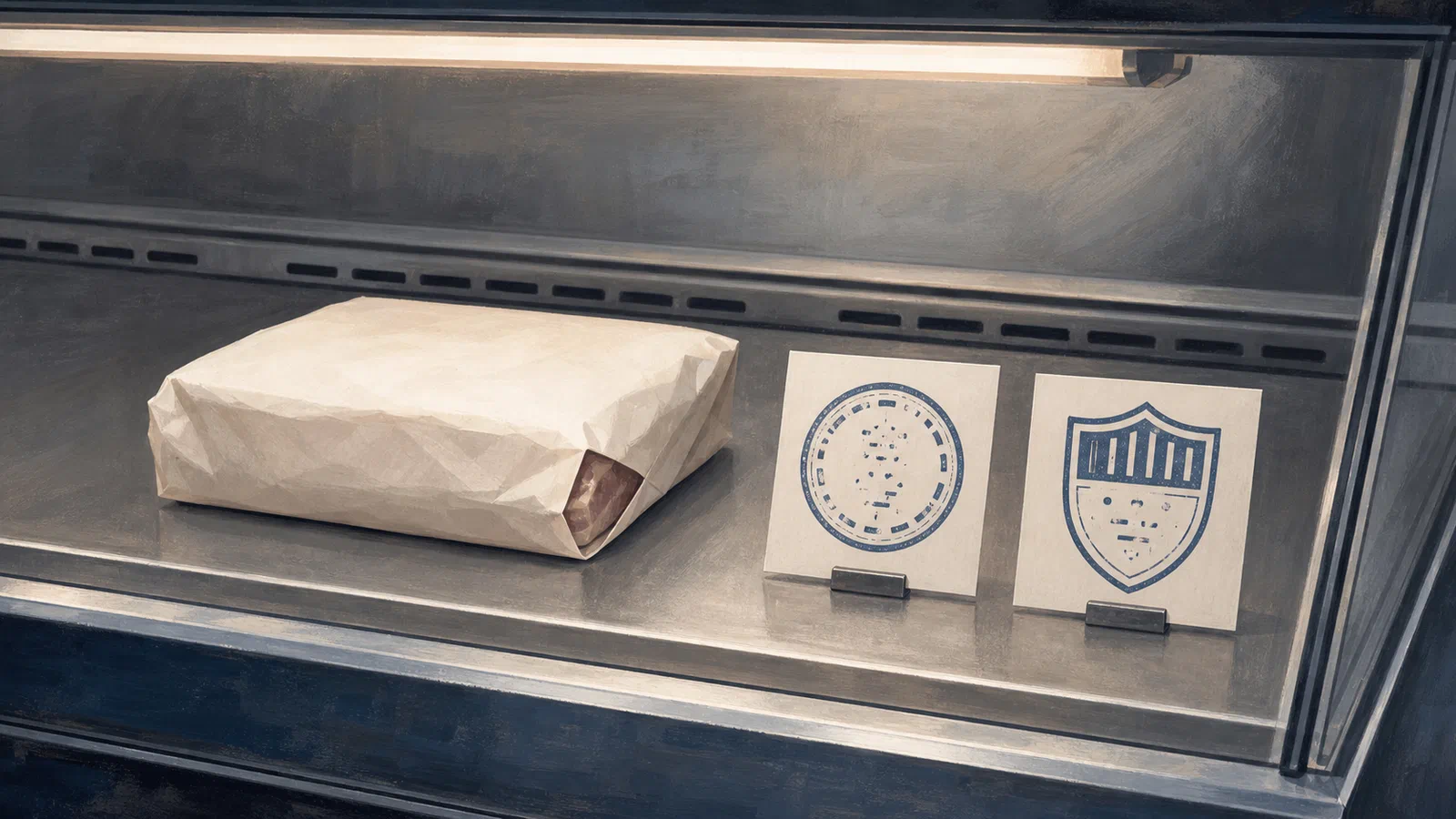
Inspection and grading look official together, but they answer different questions.