The Tank at the Fence Line
A cracked aerospace chemical tank in Garden Grove turned thousands of homes into the edge of a plant, exposing how industrial convenience and public risk meet at the property line.
The first object in the story is plain enough: a tank behind a fence.
Inside it sat methyl methacrylate, a colorless liquid with an acrid, fruity odor and a low flash point. The NIOSH Pocket Guide lists methyl methacrylate as a Class IB flammable liquid, with a flash point of 50 F and explosive limits in air. It is the sort of industrial material that becomes ordinary when it stays where the plant expects it to stay, inside a vessel, under pressure, under cooling, under permit, under watch.
In Garden Grove, that ordinary condition broke.
Orange County’s incident page says the Sheriff’s Department issued a mandatory evacuation order at 1841 hours on Thursday, May 21, 2026, for a hazardous-material vapor release tied to the Garden Grove chemical spill. The Associated Press reported that the tank at GKN Aerospace Transparency Systems held roughly 6,000 to 7,000 gallons of methyl methacrylate, overheated, vented vapors, and later cracked while crews tried to keep pressure and temperature under control. By Memorial Day, AP reported that about 50,000 residents had been evacuated.
The number is large. The mechanism is smaller and more troubling. A plant used a chemical for specialized manufacturing. A vessel failed. Air monitoring, sheltering, traffic control, fire command, environmental protection, public health guidance, school gyms, road closures, household medicine, pets, hotel receipts, and public fear all gathered around that vessel.
That is the public shape of a private tank.
The Plant Inside the City
GKN Aerospace’s own materials describe its transparencies business as a leading military transparency supplier and a major commercial aircraft transparency supplier, with aerospace-grade acrylic material central to its market position. The company says its work includes aircraft windows, canopies, transparent armor, coatings, and specialized acrylic systems.
There is a reason methyl methacrylate would be there. The chemical is a building block for acrylic plastics and resins. It belongs to a supply chain that produces clear strength: windows, canopies, shields, cockpit parts, and the hard transparent surfaces that make aircraft possible. Those products sound clean because transparency sounds clean. The manufacturing record is messier. Strength, clarity, weight, coatings, and precision all have material histories.
The Garden Grove story should resist the easy cartoon of evil industry hidden inside a helpless neighborhood. Aircraft parts do real work. Specialized materials require specialized plants. California contains ports, defense suppliers, warehouses, refineries, studios, hospitals, labs, and neighborhoods because modern life stacks incompatible needs onto the same land.
The harder question is how honestly that stacking is governed.
A residential street can sit beside a plant for years while risk remains abstract. People drive past loading bays and fences. A parent learns which route avoids traffic. A business keeps a hazardous-material plan. A city files zoning and emergency records. Regulators inspect, settle, monitor, or miss. The uneasy arrangement becomes ordinary because ordinary days are persuasive.
Then a tank heats up, and the map changes.
Emergency as Boundary
Official response became a system of moving boundaries. Orange County issued evacuation orders. California activated statewide response capacity. The governor’s office said on May 24 that California had mobilized more than 785 state and local emergency personnel for the Orange County hazmat response, including specialized hazmat teams, local law enforcement, firefighters, California Highway Patrol officers, public health staff, environmental scientists, toxicologists, engineers, and sheltering personnel.
Twenty real-time air monitoring devices had been deployed to track volatile organic compounds and particulate matter, the same announcement said, while state health and environmental agencies coordinated on air monitoring, public health, and nearby water bodies. It also said there was no known chemical leak on the ground or in the air at that time.
That last point deserves care. A serious response can be large even when confirmed damage remains limited. Evacuation is an act of uncertainty management. It asks people to leave before proof arrives in the form everyone fears. If officials wait for certainty, the emergency has already chosen its own path.
Residents hear contradiction because public language has to carry technical uncertainty inside plain commands. Leave now. Air readings are normal. The tank may fail. A crack may lower pressure. Stay out. We are monitoring. There is no known leak. Keep waiting.
Those sentences belong to the same emergency. They are hard to live under because each one is partial.
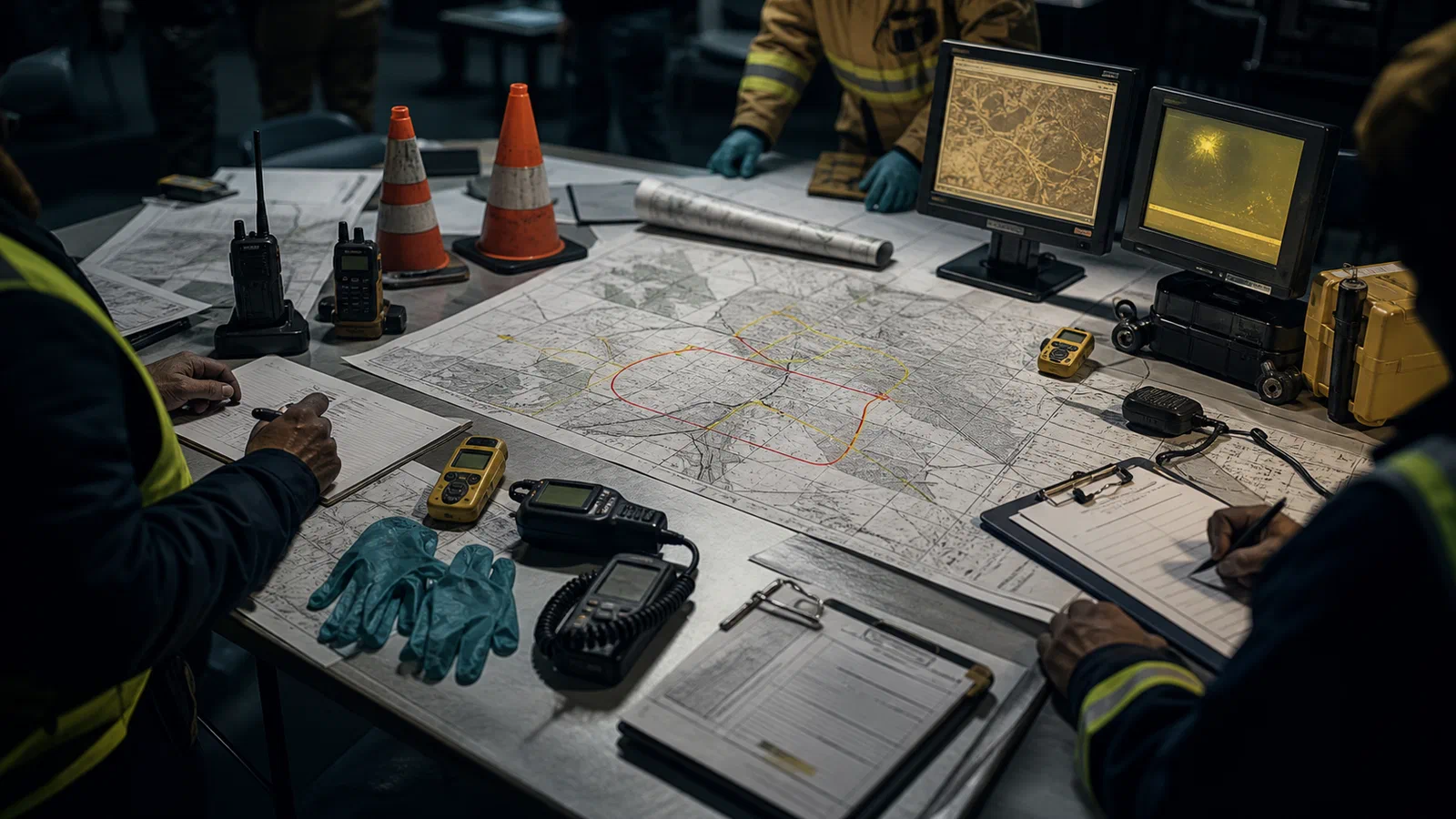
An emergency response turns uncertainty into orders, routes, shelters, and monitors.
The Chemical With a Short Distance
Methyl methacrylate teaches the reader why the evacuation was plausible without turning the event into spectacle.
NIOSH describes it as a colorless liquid with an acrid, fruity odor. It can enter through inhalation, ingestion, skin contact, and eye contact. The listed exposure limits are 100 ppm as an eight-hour time-weighted average under both NIOSH and OSHA entries. Its immediately dangerous to life or health value is listed at 1,000 ppm. The flash point, explosive limits, and vapor behavior make heat and confinement central to the hazard.
PubChem notes that methyl methacrylate vapor can travel and flash back toward an ignition source. The specific facts at Garden Grove remain subject to investigation, but the general lesson is already visible. Some chemicals have a short civic distance. They travel through air, drainage, emergency routes, school calendars, and family logistics faster than liability can be assigned.
This is where the inherited media frame can flatten the story. One frame makes the company the villain and the neighborhood the victim. Another makes officials the competent managers of a contained technical event. A third turns the chemical into disaster imagery before the record supports that conclusion. Each frame supplies a moral shortcut.
The record supports a narrower and stronger claim. A high-consequence material was stored inside a dense urban setting. When control weakened, the cost of caution left the property. That cost landed on residents, small businesses, schools, health systems, roads, and emergency agencies before any courtroom or regulator could settle responsibility.
That is enough.
The Risk Assessment Lens
A risk assessment starts by separating pieces that public language tends to collapse. In a four-part OIP risk framework , the basic parts are hazard, pathway, consequence, and uncertainty. Garden Grove fits that frame cleanly. The hazard was methyl methacrylate in a large overheated tank. The pathway was the chain that could connect heat, pressure, vapor, ignition, drainage, wind, response timing, and nearby people.
The consequences included exposure, fire, evacuation, business closure, public expense, and household disruption. The uncertainty sat in the tank itself: temperature, pressure, crack behavior, vapor movement, weather, and the exact condition of the vessel.
There was already a formal risk-assessment record for the facility, although it answered a narrower question. South Coast AQMD says an AB 2588 Health Risk Assessment evaluates how toxic emissions are released from a facility, how they disperse through the community, and how they may affect human health. Its 2025 annual report
lists GKN AEROSPACE TRANSPARENCY SYS INC in Garden Grove as facility ID 140961, with an approved HRA, estimated cancer risk of 6 chances in one million, non-cancer acute hazard index of 0, non-cancer chronic hazard index of 0.5, and an HRA approval year of 1996.
The record has a narrow job. A routine air-toxics HRA is a picture of permitted emissions and modeled exposure. The Garden Grove emergency was an accident-pathway problem. South Coast AQMD’s own prioritization process says it considers toxicity, volume, and proximity to receptors such as hospitals, schools, daycare centers, worksites, and residences. Those are the right categories for a fence-line event. The public also needs the accident-side record: What did the facility’s worst credible tank-failure scenario look like? Which receptors were mapped? Which road closures, shelters, and warning times were assumed? Which control failed first in the pathway?
EPA’s Risk Management Program materials point to the same distinction. EPA describes RMP*Comp as a tool for off-site consequence analyses, including worst-case and alternative scenarios, under the federal Risk Management Program.
Public access to Risk Management Plan data, EPA says, runs through reading rooms, state or local emergency planning contacts, FOIA for non-off-site-consequence data, or a yes-or-no inquiry to the RMP Reporting Center about whether a specific facility has submitted an RMP. I did not find an open-web proof that this Garden Grove facility had an RMP filing for this process, and a blank web search proves little under those access rules. It does show the public information gap.
That gap is the risk story. In risk analysis and risk management , analysis tells people what could happen and how sure the record allows them to be; management decides what will be done. Garden Grove residents mostly saw the management side: evacuation lines, monitors, roadblocks, shelters, and official updates. The analysis side stayed harder to see. The same tension appears in floodplain fights, where government may communicate risk while local choices decide who lives inside it, as in the floodplain essay . A single risk number can make a dangerous arrangement look more understood than it is when the pathway stays hidden.
The Price of Ordinary Operations
Industrial society usually prices production and emergency response separately.
A plant buys chemicals, equipment, labor, insurance, permits, and compliance support. A city budgets for police, fire, planning, roads, and communication. Residents pay rent or mortgages near job centers, schools, family networks, and transit routes. Regulators write rules around expected conditions, reporting thresholds, penalties, and inspection cycles.
The separation works until a failing vessel connects the ledgers.
The governor’s response list reads like a public invoice written in real time: firefighters, law enforcement, hazmat teams, scientists, traffic officers, air monitors, shelters, public health guidance, relocated patients, highway closures, and advance planning staff. Residents add their own invoice: missed wages, hotel rooms, pet care, medication access, spoiled food, closed shops, fear for property, and the strain of waiting for official permission to go home.
Some of those costs may be recoverable later. Some will disappear into ordinary life. A family may spend money it cannot neatly document. A worker may lose hours and avoid a lawsuit. A small business may reopen and absorb the week as bad luck. A public agency may spend through overtime and mutual aid. The final account will be both legal and invisible.
That split is familiar in environmental and industrial risk. The plant owns the tank. The public owns the emergency.
What Records Can Show
The public record around GKN will need careful treatment before any final judgment.
AP reported that some Garden Grove residents filed a federal class-action lawsuit and that GKN apologized to residents and businesses forced to evacuate while saying it was working around the clock to reduce leak risk. AP also reported that GKN agreed in 2025 to pay more than $900,000 to settle air-quality violations involving recordkeeping, permitting issues, and nitrogen oxide emissions, citing a South Coast Air Quality Management District report.
That history cannot be treated as proof of the tank failure’s cause. It can be treated as a reason to ask better questions.
What chemicals were stored onsite, and in what volumes? What permits, inspection records, emergency plans, and maintenance records governed this tank? What did local agencies know before May 21? What did the company report? What did regulators require? What did nearby residents have a meaningful chance to know? Did emergency planners have credible worst-case maps before the incident, or did they have to build public understanding during the event itself?
The risk-assessment version is sharper: What was the hazard, what pathway carried it offsite, what consequence was tolerable, and what uncertainty was left for residents to bear?
Those are record questions, not mood questions.
The distinction matters for fairness as well as accountability. A hazardous-material emergency can happen even when a company complies with many rules. A regulator can have a file and miss a weak point. A city can inherit old industrial land patterns it would never design cleanly today. Residents can live near a plant because housing choice is constrained, because work is nearby, because life is already arranged there.
Good judgment has to hold all of that without losing the central fact: risk placed at the fence line does not stay private when the fence line fails.
The Neighborhood as Detection System
Many public risks become visible only when ordinary people are asked to change their lives.
The air monitor may detect vapor. The drone may detect heat. The agency may detect pressure. The household detects risk when the phone screams, the road closes, the shelter opens, the medication stays inside the evacuated house, and the child asks when home comes back.
Human detection is crude, but it is powerful. It reveals how much public life depends on trust in quiet technical competence. Most residents do not inspect tank valves. They do not audit permit histories. They do not model vapor plumes. They trust that someone has done the boring work before the sirens arrive.
The Garden Grove emergency strained that trust because the boring work became visible all at once. Air monitoring had to be explained. Chemical exposure had to be translated. Evacuation boundaries had to be justified. The company had to speak through an emergency it helped create. Public agencies had to protect people while depending on technical facts many residents could only receive secondhand.
Public confidence in industrial risk rests less on dramatic disaster response than on the quiet credibility of everything that happens before response begins. That is the civic problem beneath the incident.

The neighborhood learns about the plant when the plant’s risk crosses the street.
After the Tank Cools
If the Garden Grove tank cools, vents, stabilizes, or empties without a major explosion or ground release, relief will be real. It should also be incomplete.
A close call is evidence. It shows the physical arrangement of risk. It shows the emergency capacity needed to hold that risk in place. It shows which households sit inside the consequence zone. It shows how quickly a private production process can ask the public to supply patience, movement, shelter, money, and trust.
The right lesson is neither panic nor complacency. It is a demand for clearer maps, better records, stronger maintenance proof, more honest public notice, and emergency plans that treat nearby residents as people with claims on the truth before the plume exists.
The tank at the fence line may end as a contained incident. The fence line itself remains. Around it are homes, schools, roads, agencies, and the public bargain that lets dangerous materials serve useful purposes only when someone can prove the danger has been governed.