The Text Message in the Archive Box
Judge Bates's Presidential Records Act order turns private-channel government into a fight over who owns the memory of official power.
The Message
A text message can look too small for constitutional weight.
It arrives on a phone, glows for a moment, changes a meeting, settles an instruction, confirms a promise, moves a schedule, or narrows a choice. Then the screen darkens. The message seems private because the device is private. It seems ordinary because everyone works this way now.
On May 20, 2026, Senior U.S. District Judge John D. Bates treated that small object as part of the public record. His preliminary injunction directs the Executive Office of the President, the White House Office, the Office of the Vice President, and White House Chief of Staff Susie Wiles to comply with the Presidential Records Act. The order takes effect at 9:00 a.m. on May 26.
The practical instruction is plain. Covered employees may use Signal, WhatsApp, text, instant messaging, or other nonofficial electronic accounts for presidential or vice presidential records only when an official account is copied at creation or a complete copy reaches an official account within 20 days.
By May 28, the defendants must file a notice describing the compliance steps they have taken. The order also requires them to send the order to covered employees and to maintain records policies that match the Act.
The news event is narrow. The civic story follows the route a government fact travels before public access begins.
Watergate, Then WhatsApp
The Presidential Records Act is a post-Watergate law. The National Archives explains its basic bargain: official records of the president and staff belong to the United States, and the Archivist takes custody when a president leaves office.
The law did not erase executive privilege, private life, national-security limits, or delayed access. It created a public ownership rule for official presidential records and a process for transfer, retention, restriction, and eventual public access. The presidency keeps room to govern. The record gains a path out of the presidency.
The path carries civic weight because an administration is more than speeches, orders, and press conferences. Government also happens in drafts, schedules, briefing notes, meeting summaries, staff instructions, policy options, deleted edits, calendar changes, and messages that look minor until a later crisis asks who knew what, when, and why.
Judge Bates’s 54-page opinion begins with that institutional point. The Act, he wrote, preserves materials tied to the president’s official responsibilities and makes the history of an indispensable office more democratic. He found that the plaintiffs had shown a substantial risk that the government had fallen short of full compliance in three areas: electronic records created on personal devices, records created by the president or vice president themselves, and records discarded by the president.
The phone message sits inside those categories. A public decision can now be born on a private device. The act of preservation has to move with the medium.
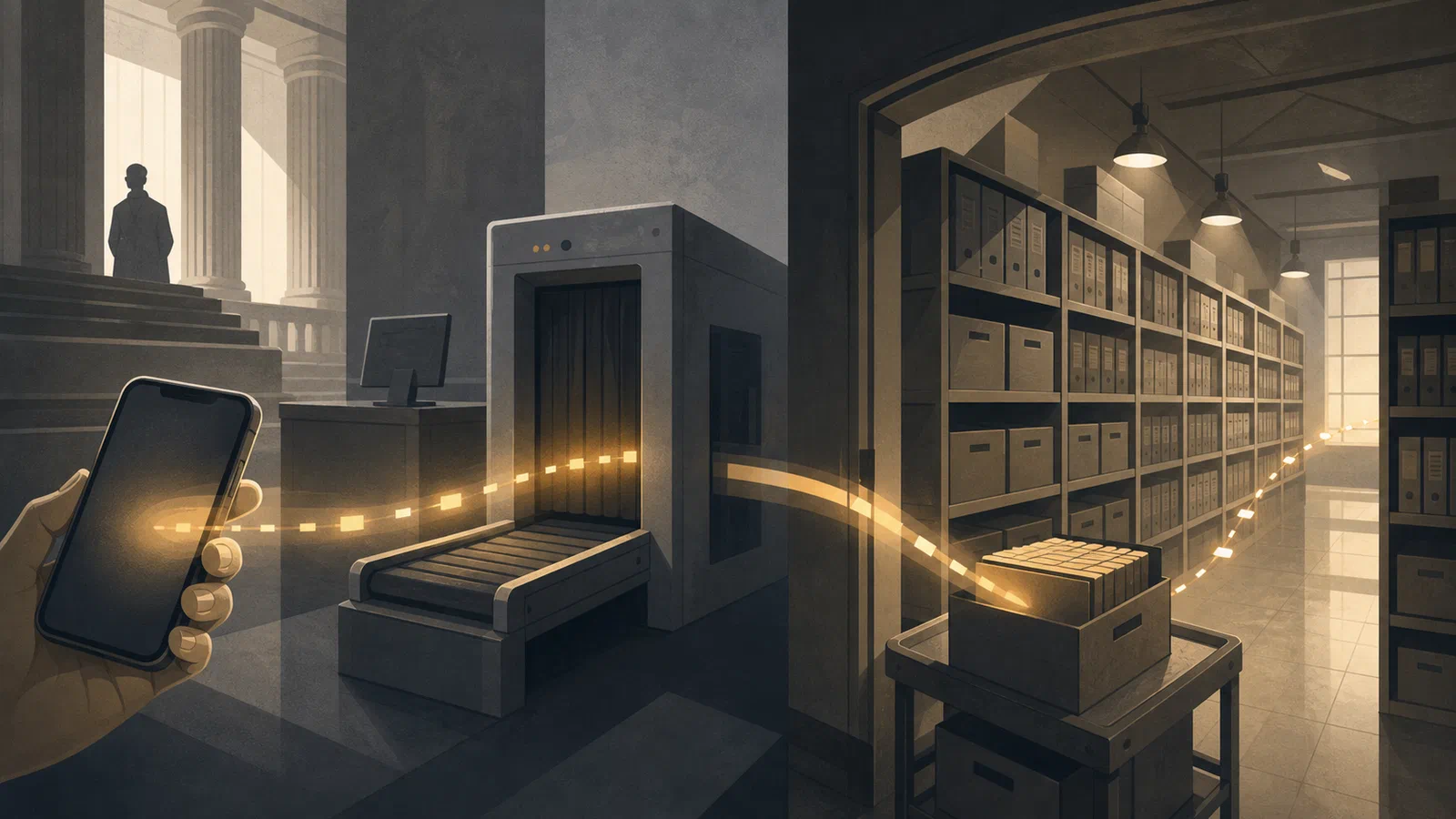
A private channel can become a public record only if the route is built before the message disappears.
The Office Legalized Its Own Exit
The conflict began with an April 1 Office of Legal Counsel opinion. In that OLC memorandum , the Justice Department concluded that the Presidential Records Act exceeds Congress’s powers and intrudes on executive autonomy. The memo described the Act as an unconstitutional regulation of a constitutional office.
That is the executive branch’s strongest frame. A president needs confidentiality, speed, candor, and independent constitutional authority. The presidency cannot operate as a congressional file room. A law that tries to manage the president’s own papers may, in the government’s account, move beyond recordkeeping and into control.
That concern deserves an exact hearing. Presidents need space for confidential advice. Foreign policy, national security, appointments, pardons, and internal deliberation can require privacy during the work itself. The public record can be delayed, privileged, restricted, or screened. Nobody serious should pretend that a working presidency can be run with every note open to immediate public view.
Judge Bates drew a narrower line. He treated the case as a preservation dispute, separate from a live-disclosure demand. A record can be preserved today and remain unavailable for years. The difference is real. Preservation keeps the possibility of later accountability alive. Immediate disclosure moves information into present politics.
The OLC memo collapses that distinction too aggressively. If official presidential records are personal presidential property at the moment they are created, the public archive depends on voluntary transfer. If a president can treat the Act as invalid across the board, the public loses the record at the point of origin. The later request arrives after the evidence has already gone dark.
The Archive as Infrastructure
An archive sounds quiet. It actively holds the state’s memory in public custody.
The archive is civic infrastructure. It lets Congress investigate waste and error after the fact. It lets courts understand administrative history. It lets later presidents learn what their predecessors tried. It lets journalists, historians, watchdog groups, and citizens compare public statements against internal choices once the legal waiting periods have run.
The Act builds delay into that system. Presidential records usually enter public access through the Freedom of Information Act after a waiting period, with added restrictions for national security, appointments, confidential advice, trade secrets, and personal privacy. The public does not get everything at once. The country gets custody first.
Custody is the hinge. A record held in public custody can be withheld under lawful rules. A record that never reaches public custody has escaped the rules entirely.
Text messages and encrypted apps carry more force than their informality suggests. A paper memo naturally wants a file. An email on an official account naturally falls into a server. A Signal message on a personal phone lives in a thinner place. It can shape official conduct while looking administratively homeless.
The Bates order tries to give that homeless record an address. Copy the official account when the message is created, or forward the complete copy within 20 days. The instruction is bureaucratic in the best sense. It turns a constitutional argument into a workflow.
The Tradeoff in the Drawer
Recordkeeping has costs. Staff time goes into capture, sorting, training, and retention. Lawyers have to define categories. Records offices have to preserve material that may never interest the public. Officials may write with less candor if every official message has a future audience.
Those costs are real. They are also the cost of governing through offices instead of personal ownership.
The public has its own cost curve. When records vanish, later oversight becomes guesswork. A future Congress can subpoena a person, but memory is weaker than a contemporaneous file. A future historian can reconstruct public events, but the internal sequence may be gone. A future citizen can read the speech, but the decision path behind the speech may have disappeared on a phone.
That is the institutional bargain the court preserved for now. The presidency retains privilege, delay, and confidentiality tools. The public retains ownership of official records and a preservation pathway. The judge’s order does not answer every separation-of-powers question; a preliminary injunction rarely does. It holds the archive open while the case proceeds.
That restraint is important. A court can overreach when it manages executive operations too closely. An executive can overreach when it declares a statute invalid and acts on that conclusion before a court agrees. The middle ground here is administrative: preserve the record while the legal fight continues.
The Public File
The most serious part of this dispute reaches past nostalgia for paper. It concerns official memory under modern communication.
Government now moves through tools built for speed, deletion, informality, and personal convenience. Those tools are useful precisely because they feel less formal than the file. A phone makes work easy. It also makes public ownership harder to see.
The Constitution gives the presidency real independence. The same system gives Congress power to create public property rules for official records, according to Judge Bates’s present view. The fight will likely continue. The May 20 order is not the final word on presidential papers, private channels, or the reach of Congress over executive memory.
For now, the country has a smaller instruction with wider meaning. If official power travels through a private message, the message needs a public route. If the presidency makes a record, the record belongs in a system that can outlast the person who sent it.
The phone may be private. The office is not.

The public may wait years for the file, but the file has to survive the day it is made.