The Warning Label in the Weeds
A Supreme Court fight over Roundup asks who gets to decide when a risk becomes visible on the bottle.
A plastic jug of weedkiller has a job before anyone opens it.
It sits on a garage shelf, in a landscaping truck, in a farm shed, or beside a public park maintenance cart. Its label tells the user what the product is, how much to mix, where to spray, which gloves to wear, and what hazards matter enough to print in small type. The label is part instruction manual, part legal shield, part public-health signal.
On Monday, April 27, 2026, that small paper surface reached the Supreme Court.
The case, Monsanto Company v. Durnell , asks whether the Federal Insecticide, Fungicide, and Rodenticide Act preempts a label-based failure-to-warn claim when the Environmental Protection Agency has not required the warning. Put plainly: if EPA approves a pesticide label without a cancer warning, can a state-law jury hold the company liable for failing to include one?
The answer will matter far beyond one brand. It will shape how risk travels through American law: by federal agency review, by state tort suits, by juries, by scientists, by farmers, by consumers, and by companies whose products sit in ordinary places until someone gets sick.
The Man Behind the Case
John L. Durnell sued Monsanto in Missouri state court after years of using Roundup. According to Reuters reporting carried by WHBL , Durnell said he developed non-Hodgkin lymphoma after long exposure to glyphosate, Roundup’s active ingredient. A Missouri jury awarded him $1.25 million in 2023, and a state appeals court later upheld the verdict.
Bayer, which bought Monsanto in 2018, is trying to use the Supreme Court case to contain a much larger litigation problem. Reuters reported that more than 100,000 plaintiffs have filed Roundup-related suits in state and federal courts, and Bayer announced a proposed $7.25 billion settlement in February 2026 for many current and future claims.
Durnell’s personal claim has become a national test because the lawsuit is built around a label. He argues that the product should have warned users about cancer risk. Monsanto answers that EPA repeatedly approved glyphosate labels without that warning, and federal law should block state-law claims seeking a different result.
The object gives the case its mechanism. Durnell’s claim puts a concrete mechanism before the justices: EPA allowed Roundup’s label to stay silent about cancer risk, and a Missouri jury said Monsanto should have warned users anyway.
The Law on the Label
Pesticide law gives EPA heavy responsibility. Glyphosate has been registered as a pesticide in the United States since 1974, and EPA says it reviews registered pesticides on a 15-year cycle under FIFRA. On its glyphosate page , the agency states that glyphosate is widely used against broadleaf weeds and grasses, and that its prior human-health review found no risks of concern when used according to the current label. EPA also says its longstanding cancer classification is that glyphosate is not likely to be carcinogenic to humans.
That sentence is central to Monsanto’s argument.
FIFRA gives EPA authority over pesticide registration and labeling. It also blocks states from imposing labeling or packaging requirements that differ from federal requirements. Monsanto says that structure protects farmers, manufacturers, and regulators from a patchwork of warnings. A pesticide sold across the country, the company argues, needs one federally supervised label, not fifty practical versions created through court verdicts.
Bayer’s statement before argument framed the case as a demand for regulatory clarity. The company said Congress created a nationwide framework for pesticide labels, and that companies should be able to rely on science-based federal approvals when bringing products to market.
There is a real concern there. Agriculture depends on repeatable instructions. A label that changes by jury verdict can create confusion for farmers, distributors, retailers, and insurers. A warning written to satisfy one state’s litigation climate may overstate risk in another place, or crowd out instructions that protect users against more immediate hazards.
But the same label can also become too narrow. Federal approval can lag new evidence. Agency review can be slow, political, understaffed, or too close to the industries it supervises. A national label may look clean because it is consistent, while hiding unresolved scientific conflict under the authority of one agency.
The Science Keeps Moving
The fight over glyphosate has always lived in that gap.
EPA’s position is one pole. The International Agency for Research on Cancer is another. In 2015, IARC classified glyphosate as probably carcinogenic to humans , citing limited evidence in humans, sufficient evidence in experimental animals, and strong evidence for genotoxicity.
EPA has rejected IARC’s conclusion. The agency says it used a larger dataset, including registrant-submitted studies and open-literature studies, and that its review supports a different cancer classification. That disagreement gives the label dispute its pulse.
The label can carry only so much uncertainty before it stops being useful. A label that warns about every contested risk can train users to ignore warnings. A label that waits for complete consensus can leave users unaware while the science matures.
The legal system has no easy way to hold that tension. Courts prefer questions that can be answered. Labels prefer short instructions. Science often arrives as a changing record, with confidence levels, exposure routes, contested methods, and evidence that looks different depending on what counts as relevant.
Glyphosate’s regulatory history shows that strain. EPA withdrew its 2020 interim registration review decision in September 2022 after the Ninth Circuit vacated the human-health portion and after the agency faced deadlines tied to ecological review and Endangered Species Act consultation. EPA says it is updating its evaluation of glyphosate’s carcinogenic potential and working toward a final registration review decision.
So the Court is not looking at a settled civic object. It is looking at a live administrative record printed on plastic.
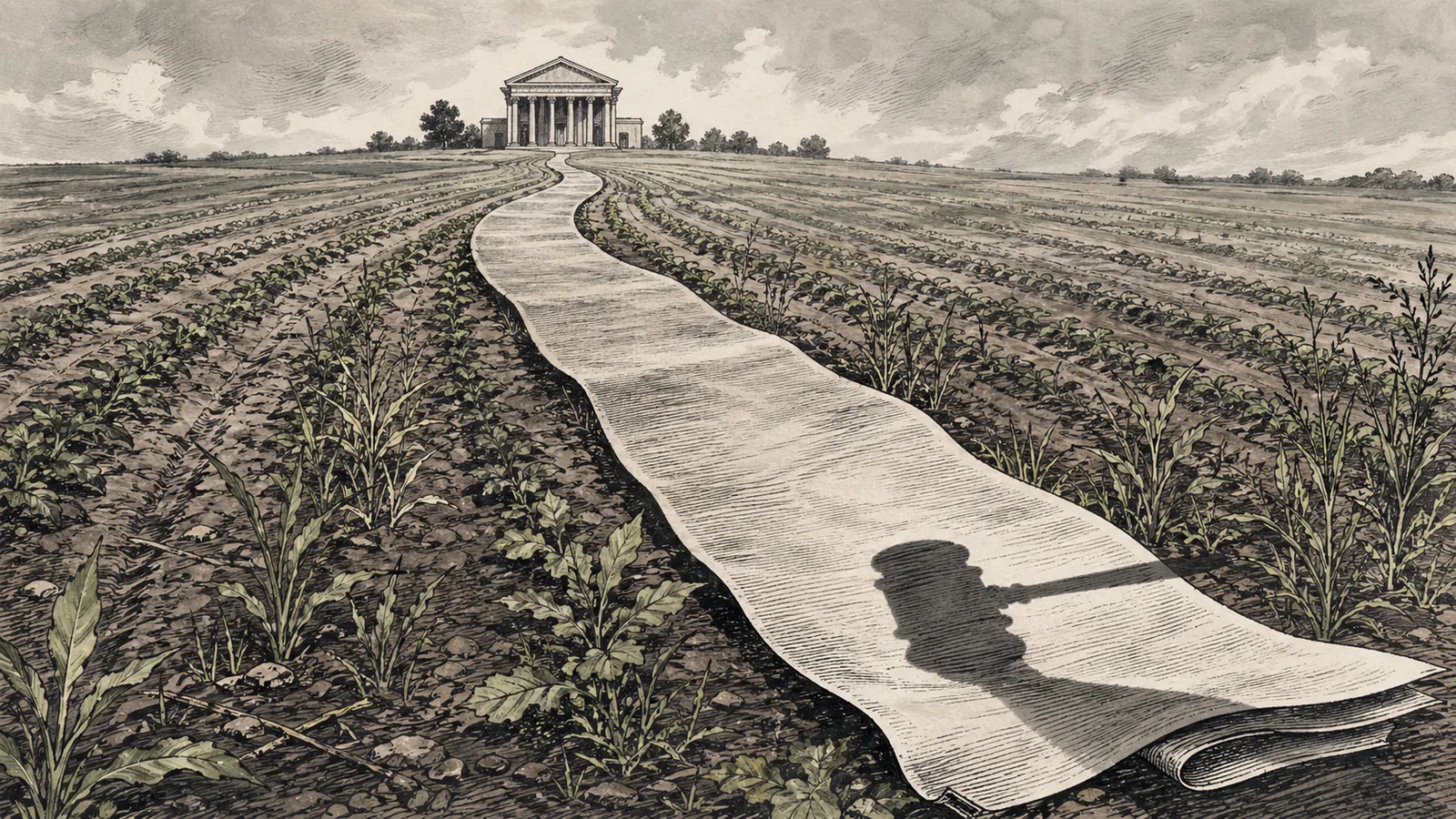
The case turns farm certainty and public warning into one narrow question of federal law.
The State-Law Backstop
Durnell’s side argues that state failure-to-warn law does not add a foreign rule onto FIFRA. It enforces the same basic command: a product should not be misbranded, and a label should warn adequately about danger.
The Legal Information Institute’s case preview puts the dispute in federalism terms. Monsanto says FIFRA blocks the Missouri claim because EPA approved the label and any substantial change needs agency permission. Durnell says Missouri law and FIFRA are equivalent in the way they require adequate warning, so his claim does not impose an extra labeling rule.
That distinction sounds technical. It decides whether the courthouse door stays open for thousands of plaintiffs.
If Monsanto wins broadly, federal approval may become a shield against many state failure-to-warn claims involving pesticides. That could bring consistency to national labeling and reduce litigation pressure on companies. It could also move more public-health accountability into EPA’s hands at a time when many people across the political spectrum distrust federal agencies.
If Durnell wins, state suits remain available as a pressure valve. Juries could keep reviewing whether a label was adequate in real-world use. That can expose weak warnings and force companies to internalize harms. It can also produce uneven results, high settlement pressure, and warnings driven by courtroom risk as much as science.
The hard part is that both concerns are valid. National labeling can protect users by making instructions uniform. State tort law can protect users by making labels answerable to lived injury.
American law has long used both systems because each one catches failures the other misses.
The Farm, the Garage, and the Court
Roundup is a familiar industrial chemical with agricultural, commercial, and household history. It has lived in ordinary places for decades. That familiarity gives the case its force.
For growers, glyphosate has been a cheap and reliable tool in weed control. For Bayer and many farm groups, the threat reaches past damages in old cases. The threat is a legal climate that makes a widely used herbicide harder to supply, insure, sell, or trust.
For plaintiffs, the same familiarity cuts the other way. A product used by ordinary people should carry ordinary warnings when evidence of harm grows serious enough. A user should not need to read court filings, scientific monographs, or agency dockets to understand what risk a bottle may carry.
The label is where those worlds meet.
It is also where civic trust gets tested. EPA asks the public to trust its scientific judgment. Companies ask farmers and consumers to trust federally approved labels. Plaintiffs ask juries to trust lived injury and contested science enough to demand warning. The Court must decide which trust relationship federal law protects most.
That decision will arrive in legal language: preemption, misbranding, state-law duties, agency approval, impossibility. The public will feel it in simpler terms. Who gets to put a warning on the bottle?
The Blank Space
A warning label is never only text. It is a decision about what the public deserves to know before acting.
Too many warnings can blur judgment. Too few can hide danger. A federal label can bring order. A state verdict can bring accountability. A product can be legal, useful, profitable, and leave hard questions in the space where a warning might have been.
The Supreme Court cannot settle every argument about glyphosate. It may leave many of them unresolved. Its decision will set how much room state law has to speak when EPA has already allowed the label to stay silent.

The smallest print becomes the place where science, law, and memory have to share space.
The next time someone reaches for a jug on a shelf, the label may look like an instruction. After Durnell, it will also look like a boundary line.