The Warning Reached the Bridge
Titanic's central lesson is not that danger went unseen. It is that a large organization can receive a clear warning, divide responsibility for it, and continue toward disaster.
The iceberg was hidden in the dark. The danger was not.
Before Titanic struck ice on the night of April 14, 1912, the ship had received warnings about ice in or near its route. Yet it continued at high speed through a moonless night and a calm sea, conditions that made ice harder to see. At 11:40 p.m., the lookout saw what the organization had failed to act upon.
The collision sank the ship. The decisions made before and after it turned the sinking into a mass-casualty disaster.
A Warning Is Not a Safeguard
Risk systems often confuse receiving information with responding to it. A report is filed. A message is relayed. A concern is noted. Everyone involved can later say that the warning existed.
But information does not protect anyone by itself. A warning becomes a safeguard only when somebody with authority changes the plan.
The British Wreck Commissioner’s Inquiry found that Titanic received ice reports, did not alter course, and maintained excessive speed under the conditions. A credible warning could have led to slower speed, a different course, or stronger lookout coverage. None of those responses required knowledge of the future. They required professional judgment under uncertainty. The question was not whether a collision was certain. It was whether the cost of caution was reasonable when the possible consequence was catastrophic.
The ship’s officers faced pressure from custom as much as from any one person. Speed in ice-prone waters was not treated with the alarm it would receive after the disaster. The ship complied with the lifeboat rules then in force. Familiar practice and legal compliance created a comforting answer: this was how serious people operated serious ships.
That answer failed the people aboard.
The Minimum Became the Standard
Titanic carried 20 lifeboats with space for 1,178 people, far fewer than the number aboard. The rule governing lifeboat capacity had not kept pace with the size of passenger ships. The vessel could satisfy the regulation while remaining unable to evacuate everyone.
This is where legal compliance becomes morally dangerous. A minimum rule is useful when it captures the real hazard. When technology, scale, or operating conditions outrun the rule, the minimum can become a shield against judgment.
The ethical duty was not difficult to state: a passenger ship should have a survivable place for every passenger and crew member. That principle did not depend on a fresh regulation. It followed from the purpose of the safety system.
The same problem appears whenever professionals treat a rule as the outer edge of responsibility. Building codes, cybersecurity checklists, environmental permits, financial controls, and workplace procedures all provide baselines. None can substitute for the judgment of people who can see that the baseline no longer fits the risk.
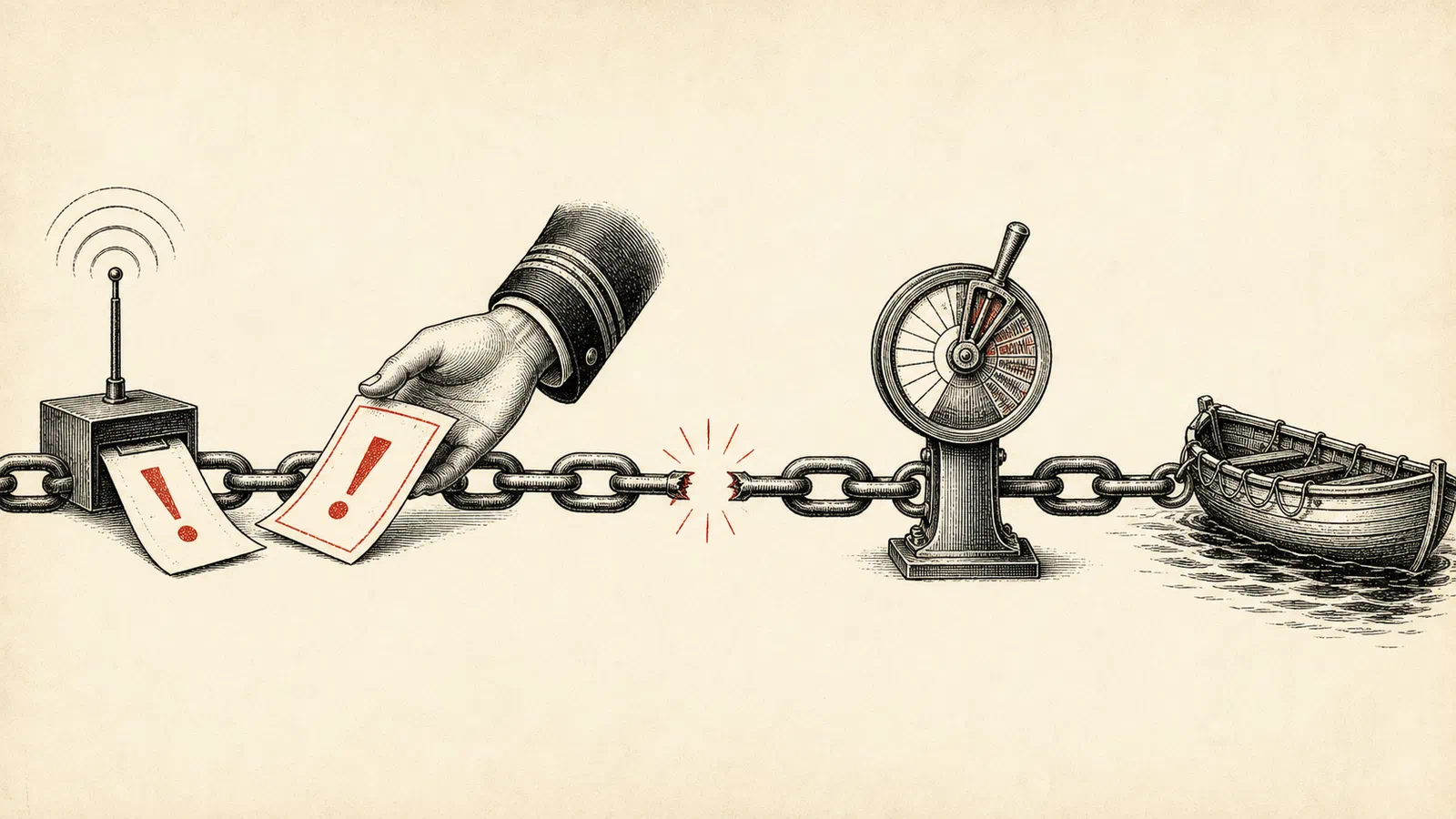
The break usually occurs between knowing and acting.
Responsibility Spread Thin
Large organizations can make grave failures look ownerless.
One person receives the warning. Another interprets it. Another controls the schedule. Another owns the equipment. Another writes the rule. Another assumes that somebody closer to the problem will intervene. Each person holds a piece of responsibility, while no one feels the full weight of the outcome.
This structure can punish the person who interrupts it. A lower-level professional may risk status, promotion, or employment by raising a concern that delays an expensive operation. Mid-level managers may soften the message before it reaches someone with authority. Senior leaders may receive a concern stripped of its urgency. The organization does not have to order anyone to ignore danger. It only has to make delay costly and ownership vague.
The practical duty for a professional without final authority is demanding but limited: do the work honestly, state the risk plainly, preserve a traceable record, and carry the concern as far as the role permits. Documentation is not cowardice. It keeps a real warning from being reduced later to a rumor or a misunderstanding.
Yet documentation cannot become another ritual of self-protection. A warning buried in a file has not protected the public. Leaders must build paths that carry credible concerns to people who can slow, stop, or redesign the work.
The Cost of Continuing
The temptation in a high-performing organization is to treat continuation as neutral. The ship keeps moving. The launch stays on schedule. The plant remains online. The release ships Friday. Stopping requires explanation, while proceeding feels like the absence of a decision.
Proceeding is a decision.
When credible evidence points toward catastrophic harm, the burden should shift. The organization should have to justify continued exposure, not force the cautious professional to prove disaster in advance. This is not a demand for paralysis. It is a rule of proportion: the larger the possible loss and the weaker the ability to recover, the stronger the case for cheap, reversible caution.
Slowing a ship is reversible. Drowning is not.
The enduring image of Titanic is the iceberg, a white shape emerging too late from black water. The more useful image is the message reaching the bridge earlier in the night. It had crossed the distance. It had named the hazard. What it could not do was force an organization to change course.
That part remains our responsibility.