The World the UN Was Built For
How Postwar Human Rights, Migration Norms, and Global Institutions Were Designed for Europe ~ and Applied to a Very Different World
In the years after World War II, the victors attempted something new. After two global wars in a single generation, they agreed to a set of rules meant to prevent a third. The result was a postwar framework ~ the United Nations , the Universal Declaration of Human Rights , refugee conventions , and NATO ~ that continues to define global order.
These ideas were not abstract. They were shaped by specific societies, experiences, and assumptions. One Western mistake was assuming they could be applied indefinitely, without friction, and to populations that do not share the historical memory or moral foundations that made them work.
This essay makes a narrow claim: the postwar global order was built for Western Europe and its Atlantic allies, and its later extension to the Third World was neither neutral nor free of consequence.
The Postwar World That Shaped the United Nations
The UN’s founding in 1945 was as much trauma response as diplomacy. Europe had just endured industrial slaughter, mass displacement, and state collapse. Cities lay in ruins. Populations were hungry. The architects of the system understood how fragile order could be.
The Universal Declaration of Human Rights reflected this reality. Its authors treated political authority, legal restraint, rights, duties, and individual moral equality as universal aspirations that had to be carried by real institutions.
These assumptions were earned. They emerged from societies that had already passed through centuries of internal violence, religious war, and political consolidation. The authors had not forgotten brutality. They were trying to contain it.
The system worked ~ within the societies it was designed for.
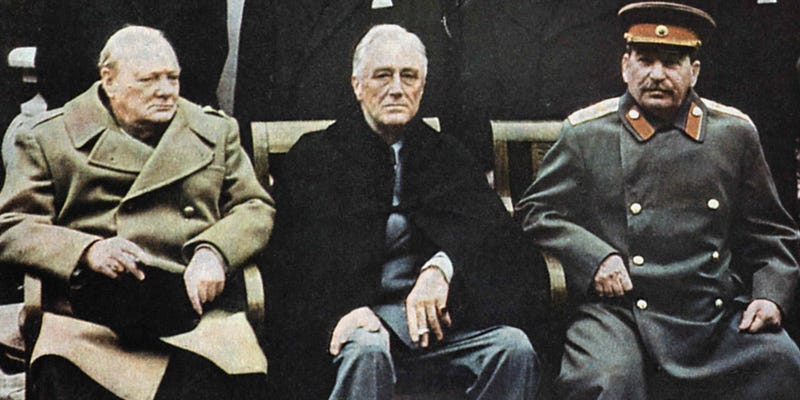
Who Built the UN ~ and Who Didn’t
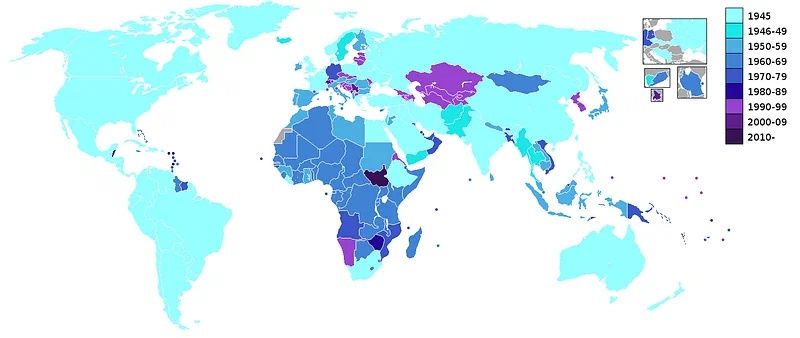
The early UN was dominated by Western Europe, North America, Latin America, and a small group of Commonwealth and Allied states. Africa, the Middle East, and South Asia were barely represented.
In 1945, most of Africa remained under imperial administration. Much of Asia had not yet completed postwar state formation. The Third World did not exist as a political bloc.
This is not a critique. It is a description.
The rules were negotiated by states that shared recent memories of total war, had consolidated internal authority, treated borders as settled, and viewed rights as inseparable from law.
The system was coherent from birth.
Only later ~ through decolonization and Cold War expansion ~ were these frameworks extended wholesale to societies with different political traditions, stronger kin or religious authority, and different institutional forms of power and survival.
Japan’s Choice ~ How a Non-Western State Made Western Institutions Work
Japan complicates the story in a useful way.
Unlike much of the postwar world, Japan adopted Western institutions as tools of survival rather than moral obligation. Following the Meiji Restoration and the devastation of World War II, Japan made a deliberate choice ~ preserve national continuity by internalizing Western legal, economic, and political forms faster and more thoroughly than its peers. This wasn’t submission ~ it was strategy.
Japan adopted constitutional governance, independent courts, bureaucratic professionalism, property rights, contract enforcement, and civil administration not because they were universal ideals, but because they worked. These institutions were not forced onto an alien society. They were embedded within one that already valued hierarchy, obligation, discipline, and social cohesion.
Western law didn’t replace Japanese culture ~ it locked into it.
Japan arguably protects core Western institutional values more rigorously than many Western states themselves. The rule of law constrains power. Public institutions retain legitimacy. Borders are enforced. Civic obligation is expected. Rights are privileges of duty.
This outcome flowed from deliberate choices ~ many of them controversial in the West. Institutional openness was paired with strict border control, limited immigration, and resistance to large-scale demographic change. Social trust and legal coherence were preserved.
Japan shows that Western institutions can travel ~ but only when they are absorbed by societies willing and able to uphold them in good faith.
Japan is not an exception to the argument.
It’s evidence for it.
What the “Third World” Actually Means ~ State Formation and Power
The term Third World remains analytically useful because it describes a shared historical and structural condition, not a moral category.
It refers to states that did not emerge from the European state-building process, did not consolidate internal authority before independence, and often carried pre-modern social structures into modern legal forms. In many of these societies, political authority remained personal, loyalty remained vertical, and the threat of violence remained proximate.
Power takes different forms in different places. Political order has always grown out of interests, shared history, and necessity rather than abstract design. The postwar system nevertheless assumed a shared destination ~ that once granted formal sovereignty and legal equality, societies would converge.
That assumption, rather than universality itself, would prove costly.
So, why did universal human rights behave so differently once extended beyond their original institutional context?
Human Rights Without Preconditions ~ When Universality Breaks
As human rights norms spread, what began as safeguards within stable societies became mandates applied regardless of institutional capacity or social obligation. The issue was never the rights themselves, but the removal of the conditions that made those rights enforceable and legitimate.
Universal rights assume good faith and shared obligation. When law answers first to clan or creed, that assumption fails. Rights no longer protect freedom so much as they advantage those willing to act without restraint.
Societies that grant rights without corresponding expectations of civic
responsibility fall into a timeless trap ~
entitlement without obligation,
resentment without reciprocity.
That produces unfairness within systems that depend on mutual restraint and cooperation. The West stopped treating civic rights as duty-bound privileges and divorced them from social responsibility. Respect, however, is a two-way street, and the value of Western citizenship has fallen sharply.
Nowhere would that cost become more visible than in the application of universal rights across borders.
Migration and Moral Asymmetry ~ When Humanitarian Norms Outrun State Capacity
Refugee protections were originally designed to manage temporary displacement among culturally adjacent populations, not permanent demographic transformation. Over time, those protections hardened into moral absolutes, even as the conditions that justified them disappeared.
The result is moral asymmetry.
Western states increasingly treat humanitarian rules as unconditional, while some arrivals come from systems where trust is low and politics can be zero-sum. In such environments, the rational strategy is often to secure one’s group first, because the state cannot always be relied upon to enforce rules impartially or consistently.
Host societies absorb administrative and political risk when rights expand faster than reciprocal social obligation can be taught or enforced. By extending rights across borders without maintaining credible expectations of civic responsibility, Western societies have often treated migration as a moral exercise rather than an institutional one ~ weakening the objective value of citizenship itself.
In doing so, the West has forgotten that freedom is not guaranteed, and that citizenship is a scarce and hard-won inheritance ~ not an entitlement.
Most of the World Never Forgot That Power Matters
Most of the world remembers that life is harsh ~ that power, borders, and identity matter. In those societies, political behavior remains oriented toward collective survival and group continuity rather than universal trust and the virtue of diversity.
Western societies increasingly behave as if prosperity and stability are permanent rather than contingent. That mismatch cannot hold.
Order depends on shared assumptions about authority, obligation, and belonging. And when those assumptions don’t hold true?
Institutions collapse.
Values Are Practiced Before They Are Protected
History is consistent: empires rise and fall with the spirit of their people.
Governments endure only while they reflect the values and expectations of their citizens. When they do not, legitimate rule is dead.
The postwar order assumed a common moral floor.
That assumption was faulty from the start.
Japan’s postwar path reminds us that global order is built through disciplined adoption by societies that preserve internal cohesion.
Global orders do not fail in a vacuum ~ they fall when great societies forget their bloody past.
Author’s Note
This essay is an attempt to describe how global institutions actually formed ~ not how we wish they had.
It’s not a policy prescription, nor an argument for retreat or exclusion. It’s a structural diagnosis of a system built under specific historical conditions and later extended far beyond them.
If you disagree, I welcome it ~ but only on the merits of the argument itself.
Read closely. Question the assumptions. Engage in good faith.