What Happened at Camp Mystic?
A Primer on the July 4, 2025 Texas Flood Tragedy
“They were just screaming and praying. The water was moving too fast to do anything.”
Rescuer, CNN interview
On the night of July 4th, while fireworks lit up the Texas Hill Country, a dangerous storm stalled over the Guadalupe River Basin.
By sunrise, it turned deadly.
Camp Mystic, a century-old girls’ camp nestled along the riverbank near Hunt, Texas, was among the hardest hit.
Before dawn, rising water surged into parts of the camp.
Eyewitnesses say it happened fast ~ tents and cabins surrounded in minutes, counselors shouting through darkness, girls scrambling barefoot toward higher ground.
This was a tragedy ~ and a failure of risk communication, hazard awareness, and safety planning. And it’s raising tough questions:
How did a youth camp end up in a mapped floodway?
Why wasn’t the threat better understood?
Who is responsible ~ the camp, the parents, the government, or all the above?
Role and Disclosure Note
I work as a life safety consequences specialist with the U.S. Army Corps of Engineers. Our team models life loss from levee and dam breaches across the country ~ mapping out how floods kill, where, and why.
While this event wasn’t caused by a structural failure, the conditions were eerily familiar: low warning time, rapid inundation, and vulnerable populations with limited escape options.
In my upcoming piece, I’ll walk through the flood in detail: what happened, why it happened, and how we can learn from it.
Because this flood was no fluke. It was a warning ~ and next time, the water may rise somewhere else.
Disclaimer: The views expressed in this article are my own and do not reflect the official policy or position of the U.S. Army Corps of Engineers, the Department of Defense, or the United States Government.
Combined Full Timeline
July 1 to 5 Texas Flood & Camp Mystic Tragedy
Sources: CNN, USA TODAY, KSAT, NWS, Floodbase, TDEM, USGS, and local reporting
The Guadalupe River rose more than 25 feet in under 90 minutes.
That’s not a typo.
How the Camp Mystic Flood Became a Catastrophe
The flood that overtook Camp Mystic in the early hours of July 4 wasn’t just a natural disaster.
It was a system failure on multiple levels ~ hydrological, bureaucratic, and human.
On the surface, the storm was extraordinary.
Tropical moisture from Storm Barry collided with a high-pressure system and stalled over the Texas Hill Country, dropping as much as 16 inches of rain in 48 hours.
The terrain was primed for disaster: steep slopes, limestone bedrock, and poor soil absorption gave the water nowhere to go but down.
Camp Mystic was built inside a mapped flood hazard zone.
In fact, several buildings sat directly inside a regulatory floodway.
(A regulatory floodway is a no-build zone next to a river where water needs room to flow during a flood ~ putting anything there, like cabins or roads, can make floods worse and more dangerous for everyone nearby.)
Geography only tells part of the story.
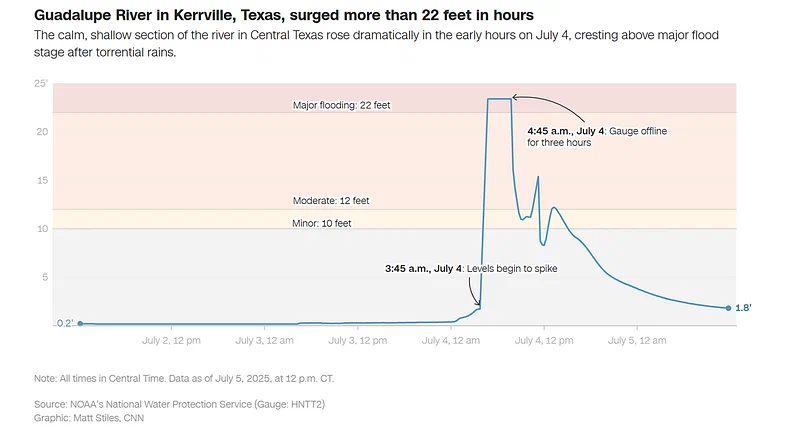
By the time the first official Flash Flood Warning was issued at 1:14 a.m., the rain had already intensified.
A full Flash Flood Emergency wasn’t declared until 4:03 a.m. ~ by then, the flood was already moving through the river corridor.
The warning existed. The failure was turning that warning into fast, cabin-by-cabin evacuation in darkness, heavy rain, and rising water.
Camp Mystic lost power before dawn.
River gauges failed just as the surge accelerated.
First responders were being swept away.
By morning, deputies and first responders were urging evacuations and pulling people from dangerous water.
But it was too late.
The Bubble Inn, a cabin caught at the confluence of the Guadalupe River and Cypress Creek, was obliterated.
Twenty-seven campers and counselors died, along with longtime owner Dick Eastland.
Survivors were pulled from rooftops, trees, and wreckage by helicopter.
History Repeating Itself
This wasn’t the first time the Guadalupe River flooded.
It was the second mass casualty event related to flooding in the area.
In 1987, ten teenagers died after their van was swept away in another Guadalupe River flood.
That tragedy prompted calls for better planning and safer infrastructure.
Those lessons did not settle the planning problem.
Camp Mystic remained open.
Its cabins remained in the floodway.
The risk faded into routine.
Most summer camps don’t plan for a 20-foot wall of water arriving in the dark with power out and no real-time alerts.
Maybe they should.
Deep Dive Teaser
In the follow-up, I break down the flood in full ~ with maps, warning gaps, and a risk-informed analysis of what went wrong.
I published additional primers like this throughout the week to provide background information you might be interested in.
Thanks for reading!