What Is Risk? A Four-Part Framework
A practical way to use hazard, pathway, consequence, and uncertainty
Risk is a framework for decision making.
In everyday choices and technical work, four key terms help us define and articulate “risk.”
The Four-Part Risk Framework
Hazard names the source of potential harm, pathway describes how it reaches exposed people or assets, consequence captures the impact if it lands, and uncertainty marks the limits of knowledge about timing, severity, and human behavior.
Hazard: what is coming to get you?
Pathway: how does it reach the target?
Consequence: what’s the damage if it hits?
Uncertainty: what do you NOT know about?
Here’s a mnemonic that helps me remember:
Harry Potter Can Use → Magic!
H → Harry → Hazard
P → Potter → Pathway
C → Can → Consequence
U → Use → Uncertainty
Magic ~ this simple framework provides a straightforward way to think about risk.
The Framework at a Glance
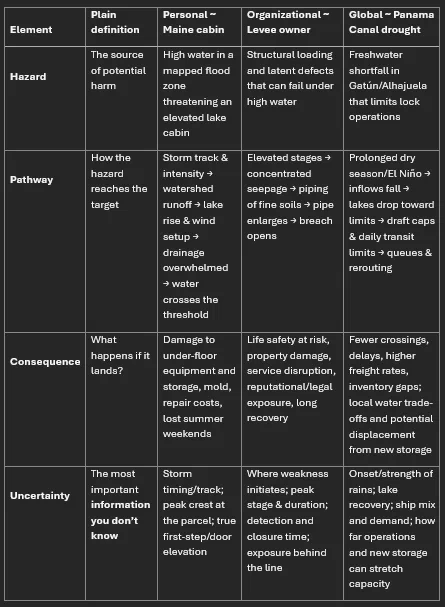
The rest of this essay presents the four-part framework applied to three levels of risk ~ personal, organizational, and global.
Hazard
“The source of potential harm.”
If you own a home in a flood zone, then you probably already know of at least one individual level hazard: fast water.
Heavy rainfall, swollen rivers, and coastal surge can push water above finished floors.
Let’s say you own a cabin on a lake in Maine. The property is in the “100-Year Floodplain.”
100 years sounds pretty unlikely. Right?
As a rule of thumb, a 1% annual chance of flooding stacks to roughly 26% over 30 years. So something like a 1 in 4 chance your digs flood before you’ve paid off the mortgage.
Read More on Localized Flooding
What Happened at Camp Mystic? A Primer on the July 4, 2025 Texas Flood Tragedy
Flash Flood Alley: Why Flash Floods Kill Texas Hill Country and the Limits of Early Warning
Risks can also be identified at an organizational level.
Now let’s say your family owns and maintains a levee on a river.
Your family may identify sustained loads on the levee wall as a hazard.
Overtopping in extreme floods, internal erosion, and age-related deterioration are all potential failure modes.
Historic cases like Teton Dam in 1976 and multiple New Orleans levee and floodwall failures in 2005 show how latent defects can become system-level threats under the right, or perhaps wrong, conditions.
Read More on Levee Management
Zoom out to 30,000 feet and we can identify international or even global risks.
Consider recent cases of megacities like Capetown, South Africa taking their municipal water supplies to the brink of disaster. If not for a miraculous rain event ending the “400-year drought” (the drought lasted roughly four years), the city would have reached “Day 0” ~ completely running out of water with no realistic plan to acquire more.
In this context, you might identify climate change in general as the hazard, with myriad consequences and hundreds of pathways. Climate change is a risk with an impressive amount of uncertainty.
Perhaps you would rather be more specific and decide to focus on water scarcity as the hazard. Water scarcity is a growing concern for many regions .
Back in 2022, Panama experienced their “worst drought ever.”
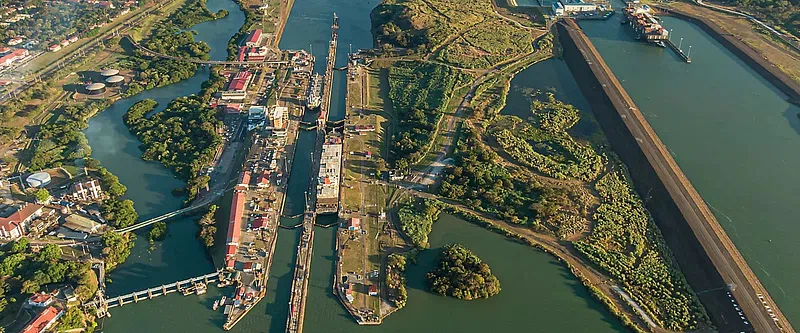
The Panama Canal’s locks run on freshwater from the upland Gatún and Alhajuela lakes. Prolonged dry seasons and El Niño patterns can push those reservoirs too low to lift ships through the extensive lock system.
In a normal year, the PCA operates within narrow margins ~ every drop of rain gets used. The same water that moves boats up and down the system’s locks also serves roughly two million people, Indigenous communities, farms, and hydropower facilities ~ prolonged droughts can squeeze a shared supply and force decision makers into tough positions.
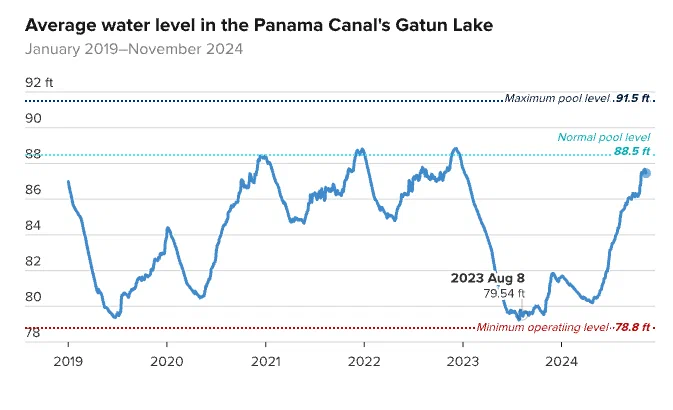
Despite the drought hype, tonnage moving through the canal did not decline dramatically in 2023 (down just 1.5% from record high tonnage in 2022).
If you’d like to know more, this New Security Beat article is a helpful companion.
Instead, the Panama Canal Authority (PCA) appears to have maximized available water and avoided disastrous shipping impacts.
The stress was real ~ longer waits, detours, and higher freight ~ but smart operations prevented a broader shipping breakdown.
For the global economy, you might say that the hazard is a prolonged Panamanian drought that could cause shipping delays (or in extreme cases a complete shutdown of the canal).
In either case (megacities and droughts affecting major shipping lanes) the hazard can be described simply: “not having enough water.”
Pathway
“The specific chain of events that must occur for the hazard to lead to a consequence.”
Let’s think about our lakehouse in Maine.
The cabin sits in a mapped flood zone, but it is up on 8-foot stilts. It’s not the nicest thing ever, but it’s pretty awesome. You’ve put some money into it, but if a freak storm comes through ~ dumping a bunch of rain upstream ~ you’ll probably flood.
The pathway lives where meteorology meets local hydraulics:
Storm Tracks Over Watershed → Short, Intense Rainfall Builds Runoff → Lake Level Rises With Wind Setup at Shoreline → Drainage/Outfalls Overwhelmed or Backed Up → Water Crosses the Threshold at Stairs/Doors →
Interior Flooding.
This sequence of events takes you from the storm, to the lake, and all the way back into your soggy living room.
For our friend who owns the levee, his pathway unfolds as a progression inside the structure.
Elevated stages apply sustained load → Seepage concentrates along weak zones → Fine soils begin to move (piping) → The pipe enlarges under flow →
A section fails and a breach opens.
Transitions and penetrations ~ gates, floodwall joints, utility crossings ~ are frequent initiation points.
Once a breach forms, water rips through the structure until it reaches equilibrium or the opening is plugged.
The Panama Canal Authority’s pathway is linear:
Prolonged Dry Season/El Niño → Inflows to Gatún & Alhajuela Decline (ie: less rain) → Reservoirs Drop Toward Operating Limits → Draft Limits & Daily Transit Caps Imposed → Vessel Queues and Rerouting →
Delays and Higher Shipping Costs.
Each notch down in lake level shows up as fewer crossings and higher cost per shipping container ~ eventually raising the price of everything that arrives by boat.
Now let’s shift from “how the trouble finds you” to “what happens when it arrives?”
Consequence
“The specific harm, loss, or missed benefit that could occur if the hazard materializes.”
On an individual level, a flood will wreck the stuff under the cabin first ~ storage, power panel, water heater, pumps, stairs, deck, dock, and the soil around the pilings. Tools, kayaks, and gear get soaked; outlets corrode; compressors and heaters take damage.
Floodwater can scour foundations and loosen stairs. After the water recedes, humidity builds and mold grows quickly.
Then there are the financial costs: deductibles, mold treatments, dock and shoreline repairs, well testing, septic pumping, lost rental nights, higher insurance premiums next year.
The season is short, so every delay means fewer weekends at the lake.
Mud on the steps, a warped plank on the dock, a quiet click where the breaker used to hum. You write checks, make calls, and watch the calendar move ~ July into August, August into the school year.
Repair costs and lost days get baked into the wood grain like a new ring around the old.
Levee owners face completely different consequences.
Consequences of a levee failure begin with life safety and extend to property loss, service disruption, reputational harm, and legal exposure. Post-event tasks typically include investigations, corrective design, budget reprioritization, and sustained public engagement to rebuild trust.
Picture the scene:
Sirens fade and the room fills with fluorescent light. On the table, a paper map with red circles marks where the water found its way. Dump trucks rumble through the night; excavators lay a clay scar across the breach.
Neighbors ask two questions that hang in the thick, humid air ~
1. How did this happen?
2. When can we go home?
Soil samples go to the lab; emails pile up; the high-water line dries on porch posts ~ a brutal testimony to the flood. Locals say they won’t trust the levees next time around. And unfortunately,
Trust moves a lot slower than water.
Trust returns one meeting at a time, bit by bit, with each shovel full of dirt, until the levee (and the community) is whole again.
Truth is, some questions may never disappear ~
and some memories won’t ever fade.
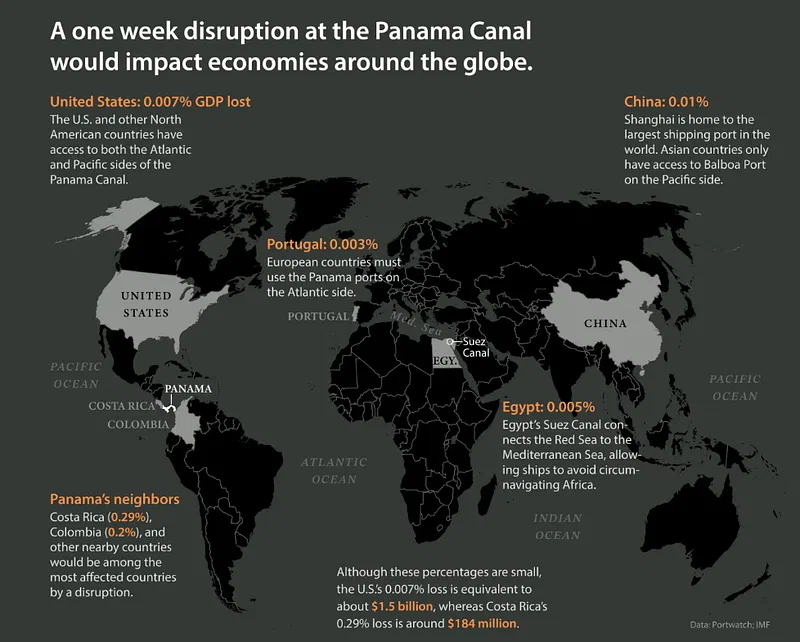
At a global scale, an extended drought hits the Panama Canal the same way a flood hits a cabin ~ it goes for what’s exposed first.
Traffic through the canal slows down.
Draft limits and daily caps cut the number of ships that can cross. Queues build at the anchorages ~ dozens of ships waiting for passage. Smaller vessels might get bumped from the list for bigger ships.
Some carriers choose to sail the long way around South America.
Freight rates tick up, shipping schedules slip up, and existing inventories get used up.
Warehouse teams sit idle while the boxes they need to stack are stuck floating out on the water. Shoppers may find odd gaps in the aisles of their local grocery stores ~ products replaced with signs that say “Out of Stock.”
Describing the complete set of consequences for a canal shut down is beyond the scope of this essay.
Woodwell Climate and the UN trade and development group have each done interesting analyses on disruptions to major shipping lanes.
If we had perfect information about the present ~ and the future ~
we would make the “right” decision every time.
In reality, perfect information is incredibly rare and next to impossible to achieve in practice.
The exact probability of each step in the pathway, the magnitude of the consequences ~
the nature of the hazard itself may be in doubt.
“There is no risk without uncertainty.”
Uncertainty
“The most important information you don’t know.”
Uncertainty is more than just noise at the edge of the problem ~
You can’t have risk without uncertainty.
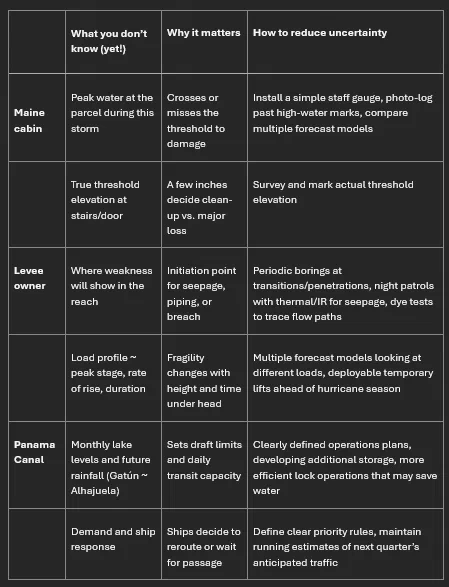
In each of our examples, the key unknowns are different, but they play the same role:
They dictate timing, scale, and fallout.
The pivotal unknowns for our summer home in Maine are:
- When a particularly nasty storm hits
- Which direction it comes from
- How high the water climbs at the property
- The true first floor elevation threshold
For the levee owner, the uncertainties are:
- Where are the weak points in the levee walls?
- How much water is loaded up against the levee when it breaches?
- What (and who) is behind the levee? ~ This will be known to some degree.
- Detection and closure time ~ how quickly can crews spot, staff, and close a breach?
For the Panama Canal Authority:
- When seasonal rains arrive ~ how much ends up in Gatún/Alhajuela?
- How strong and how long the next El Niño/La Niña cycle runs.
- Net inflows vs. outflows ~ watershed runoff, evaporation, and operational use.
- Will new storage (Indio River dam) move forward? What timeline? Will there be social constraints?
- How quickly will backlogs unwind once water levels and canal operations return to normal?
Uncertainties exist in everything.
The universe itself is governed by immutable rules of probability and chance.
One more study ~ one more round of analysis and discussion ~ can help reduce uncertainty. You can “buy down” risk by spending additional time, money, and resources learning more about current conditions.
^ If possible, this is certainly a good idea. ^
You can even develop predictive models to estimate what might happen given a set of conditions. Unfortunately, no predictive model ever perfectly forecasts outcomes of real, complex systems ~ especially open systems like the weather.
A responsible modeler will provide a range of possibilities to reflect the uncertainty that remains ~ baked into the model’s assumptions and data inputs.
Every organization (public, corporate, individual households) makes decisions ~ usually in an environment dominated by uncertainty.
In the real world, leaders can’t always punt on critical decisions and wait for new information or better data.
The purpose of risk analysis is to support decision-making when uncertainty is unavoidable using good, science-based evidence to frame choices and inform leaders, not to claim certainty.
So what should we do about all this uncertainty?
The practical move is to use a range of possible values for the things you aren’t sure about.
Look for new information that can help narrow those ranges.
“When in doubt, test it out.”
Sensitivity analysis is a kind of “what-if” technique that studies how changing inputs or assumptions in a model affect its outputs.
Document choices and assumptions so if you predict the wrong future ~ at least everyone will be able to understand what you were thinking.
Life is a Risky Business
We do what we can to identify the risks.
- Name the hazard so something obvious doesn’t catch you off guard.
- Trace the pathway so you can block or narrow routes.
- Estimate the consequence so people and property stay in view.
- Describe the uncertainty so choices stay disciplined even when the picture is blurry.
The same structure works at every scale ~ a single cabin, a levee system, an international shipping lane.
Risk Analysis is about helping people make better decisions in a world of uncertainty, trade-offs, and complex systems.
I’ll leave you with this mnemonic to help you remember our 4-part framework:
Harry Potter Can Use → Magic!
H → Harry → Hazard
P → Potter → Pathway
C → Can → Consequence
U → Use → Uncertainty
Magic ~ this simple framework provides a straightforward way to think about risk.
Try “Harry Potter Can Use Magic” on a risk you are facing this week.
Name the hazard, trace the pathway, estimate consequences, and identify uncertainties ~
Then make one deliberate move to reduce the uncertainty.
Series Note
This is the first in a long series of essays that will cover Risk Management and Risk Analysis from top to bottom. Come along with me as I learn about the exciting, emerging science of risk.