Whose Yes
A promise can serve love, or serve the self.
A yes can leave my mouth before my soul has caught up.
Someone asks, and my pride hears it first. It feels good to be needed, trusted, useful. The word yes starts to glow before I have looked at the real promise.
That is where a good instinct can bend. Service can become appetite with better manners.
The Bureau of Labor Statistics tracks how Americans spend daily time working, doing household tasks, caring for children, and using leisure hours. Its 2025 release says full-time workers averaged 8.1 hours on days they worked. The CDC says adults are recommended to get at least 7 hours of sleep each day.
Those facts don’t settle the spiritual question, but they guard against fantasy. A day has walls, and a promise has to live inside them.
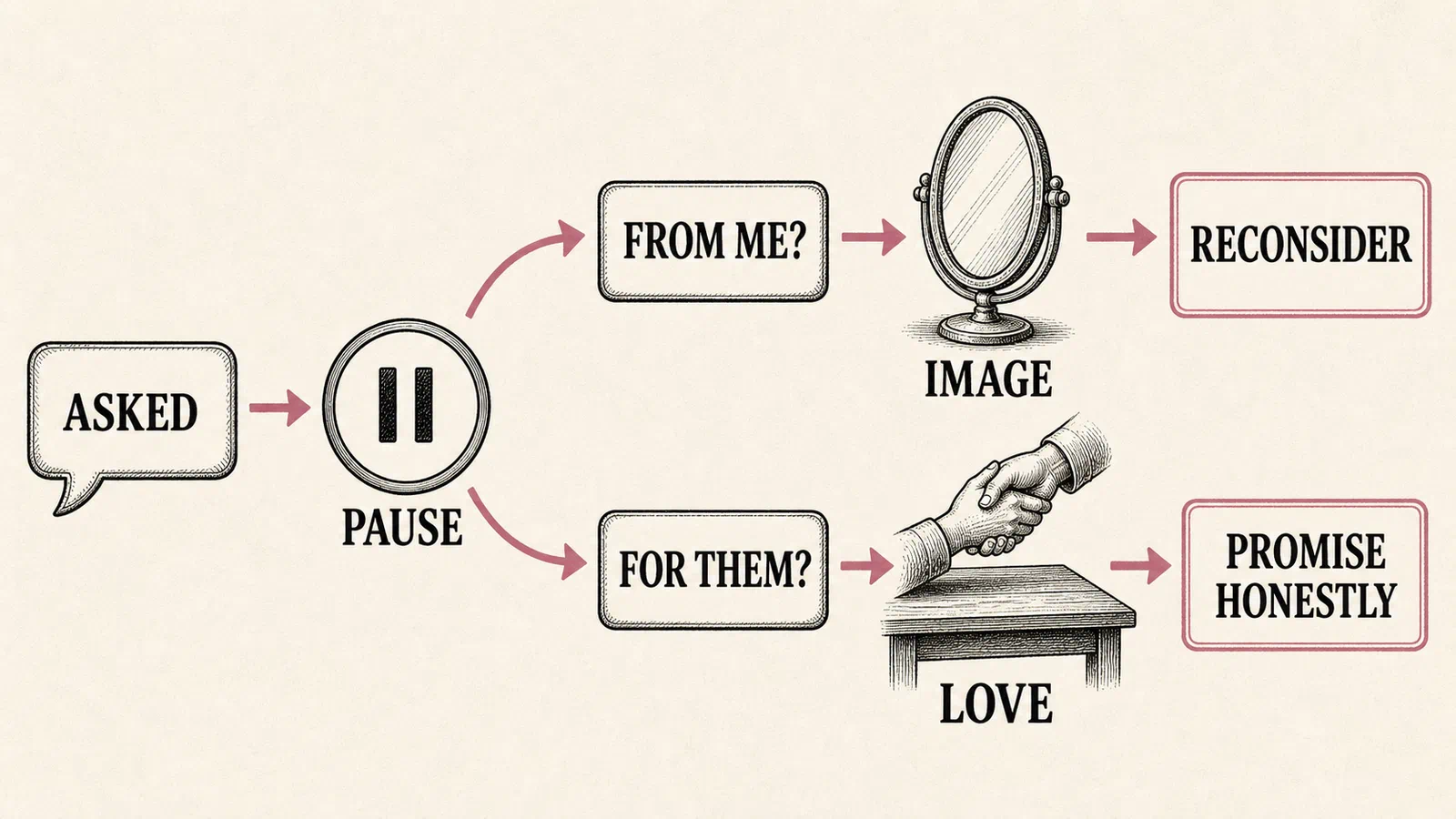
The honest yes starts by asking whom it serves.
Before I Answer
A yes can serve love, or serve the self.
A promise isn’t holy because it sounds selfless. It becomes honest when it can survive the question under it.
Is this yes from me, or for them?
When I am the center, I get the benefit: I look useful, I dodge the discomfort of disappointing someone, and I keep the private glow that comes when another person thinks I am generous.
For them means ordered toward their good. It may cost me something. It may interrupt my plan. But it is aimed at love, not applause.
Christianity has made this harder for me in the right way. It doesn’t let love remain a warm mood. Love is an act of the will, ordered toward the good of another person. That can mean yes. It can also mean wait, no, not now, or I need to keep the promise I already made.
Some yeses come quickly because duty is obvious. A sick child. A friend in danger. A person who needs help right now. No one needs a ceremony to do the plain good.
Most of my yeses aren’t like that. I usually have a moment to look at the day, pray, and ask whether I am helping a person while secretly managing my image.
That pause is humbling because it takes the shine off the answer. Good. Some shine needs to come off.
I want to help, but I need to see whether I can promise that honestly.
That sentence isn’t dramatic, and it isn’t performing. It tells the truth before the yes becomes a little stage.
If the yes is for them, say it cleanly and keep it.
If the yes is for me, I need to stop calling it love.