Returning to the Gold Standard Will Break the Economy
What Glitters Isn't Always Gold
What if your dollars were suddenly tied to a metal that cannot expand with the needs of a modern economy?
That is the problem behind the gold standard.
The idea sounds reassuring. Gold feels real, scarce, and hard to manipulate. But money is not just a symbol of value. It is also plumbing for wages, debt, credit, trade, banking, and emergency response.
Reverting to gold-backed money would not simply discipline Washington. It would force the economy through a monetary straitjacket, with a severe one-time adjustment risk and a long-term bias toward deflation.
Every few years, the idea returns in speeches, online arguments, and cable-news segments. It appeals to nostalgia for sound money and fear of inflation.
But a policy can feel stable and still be dangerous.
Why The U.S. Left The Gold Standard

For much of American history, the dollar was tied to gold. Paper money could be redeemed for a fixed amount of metal, and the government could not expand the money supply freely.
That limit sounded prudent until the economy needed flexibility.
During the Great Depression, the gold standard restricted the government’s ability to increase liquidity when banks were failing, prices were falling, and unemployment was soaring. In 1933, President Franklin Roosevelt stopped domestic dollar-gold convertibility.
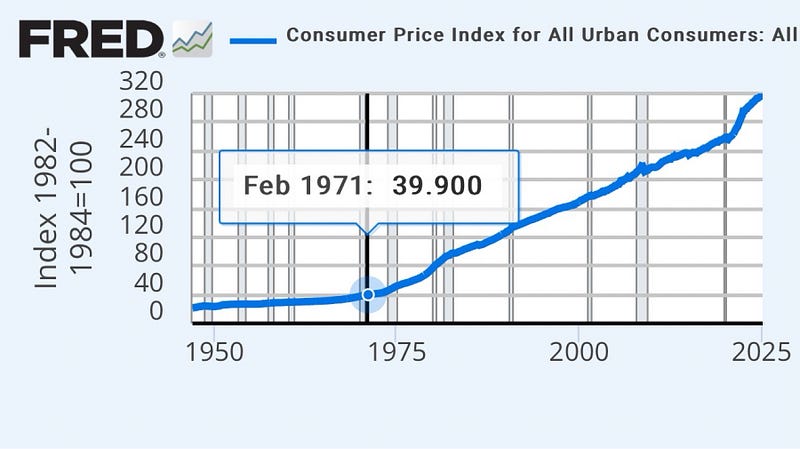
After World War II, the Bretton Woods system kept a narrower version alive. Foreign governments could redeem dollars for gold at $35 per ounce. By the 1960s, U.S. spending and foreign dollar claims strained that system. In 1971, President Richard Nixon ended convertibility.
The world moved to fiat money because a modern credit economy needs a monetary system that can expand and contract when circumstances change.
That flexibility can be abused. But removing it entirely creates a different and older danger.
The Arithmetic Does Not Work
The biggest practical problem is simple: the United States does not hold enough gold to back the money supply at ordinary gold prices.
The U.S. government owns roughly 261 million troy ounces of gold. A broad money measure such as M2 is measured in the tens of trillions of dollars.
Using early-2025 magnitudes, full backing would require gold to be valued at tens of thousands of dollars per ounce. A rough arithmetic target near $80,000 per ounce is not a forecast. It is a warning about scale.
That kind of revaluation would not be a neat accounting exercise. It would redistribute wealth, scramble expectations, and invite a crisis of confidence over who gets redeemed, when, and at what price.
Even partial backing has a trust problem. The United States tried a version of that in the 1960s. Once foreign governments doubted that U.S. gold reserves could cover claims, redemption pressure drained the system.
A fractional gold standard works only while everyone believes the fraction will hold. Once that belief breaks, the mechanism turns into a run.
What It Would Mean For Households
For most people, a gold standard would not mean simple stability.

It would mean less flexibility when things go wrong.
Inflation is painful. But deflation can be brutal, especially for households with fixed debts. If wages and prices fall while mortgage, student-loan, car-loan, and credit-card obligations remain fixed, the real burden of debt rises.
That is why deflationary cycles can deepen recessions. People delay purchases. Businesses cut wages or workers. Borrowers struggle. Defaults rise. Banks tighten credit. The cycle feeds itself.
A gold standard also limits crisis response. Under a fiat system, the Federal Reserve and Treasury can provide liquidity, backstop markets, and support emergency lending. Those powers carry tradeoffs, including moral hazard and inflation risk. But they exist because financial systems can freeze.
Under a strict gold standard, the government’s ability to respond would be tied to metal reserves instead of economic need.
That is not discipline. It is institutional paralysis at the worst possible moment.
The Political Appeal Is Emotional


Few mainstream economists support returning to gold because the historical record is not flattering.
The Reagan administration studied the question in the early 1980s and rejected a return. Federal Reserve officials have also warned that a gold standard would remove the central bank’s ability to adjust interest rates and money supply in a downturn.
The appeal is not mainly technical. It is emotional.
Gold seems clean compared with budget deficits, bank balance sheets, and central-bank discretion. It feels like a return to a time when money “meant something.”
But simplicity is not the same thing as institutional competence.
A gold standard would reward hoarding, constrain emergency policy, and shift power toward whoever controls metal reserves. It would also sacrifice the ability to manage a large, leveraged, globally connected economy.
Gold Is Valuable. That Does Not Make It Stable Money.
Gold can preserve value over long periods. It can hedge fear, inflation expectations, currency weakness, and geopolitical uncertainty.
But gold prices also swing with speculation, central-bank demand, mining supply, jewelry demand, investor psychology, and global risk sentiment.
That makes gold useful as an asset and unreliable as the sole anchor for daily prices, wages, rents, and debt contracts.
A household budget cannot be run on a metal price that moves because investors are scared. A national payment system cannot be reduced to a vault count.
The key institutional question is not whether gold is valuable. It is whether gold can govern a modern economy better than accountable monetary institutions can.
The evidence says no.
The Gold Standard Would Break More Than It Fixes
Could the United States technically return to some form of gold-backed money?

Yes.
Should it?
No.
The idea sounds safe because gold feels solid. But the mechanism would make the economy more fragile, not less. It would make debt harder to carry, crises harder to fight, and monetary policy less responsive to real conditions.
Fiat money requires discipline. Central banks can make mistakes. Governments can borrow recklessly. Inflation can punish households.
But the answer to bad monetary governance is better governance, not a system that turns economic management over to the supply of a metal.
What matters is not whether money is backed by gold. What matters is whether money can support work, contracts, saving, investment, and crisis response without losing public trust.
The gold standard sounds like a safe bet. In a modern economy, it is a gamble on rigidity.