Why did the Mexican Navy Ship Cuauhtémoc Crash Into the Brooklyn Bridge?
What we know about the crash and what it reveals about risk, diplomacy, and responsibility.
Not all collisions leave wreckage in the water ~ some leave questions in their wake.
The Cuauhtémoc Crash: What Happened on the East River
On a quiet Saturday evening, a majestic, triple-masted tall ship from Mexico sailed through New York City’s East River, its string lights glowing, its sails full, its crew in dress whites.
Then the rigging snapped.
At about 8:24 p.m. on May 17, 2025, the ARM Cuauhtémoc, a 297-foot Mexican Navy training vessel, struck the Brooklyn Bridge.
All three masts broke. Two sailors died.
Nineteen others were injured, some critically. Witnesses reported seeing crew members dangling from the shattered rigging, suspended in harnesses, waiting to be pulled down.
The ship lost power and drifted in reverse into the bridge. The Cuauhtémoc’s masts shattered; the bridge suffered only minor damage.
A Mexican Navy Training Ship With Global Symbolism
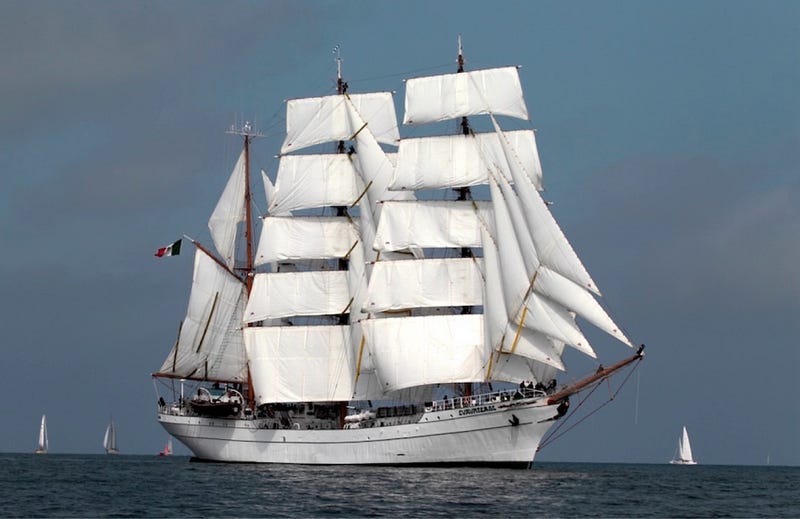
This is not a warship.
The Cuauhtémoc is Mexico’s flagship training vessel, the final stop in a cadet’s education at the Heroica Escuela Naval Militar.
Every year, it embarks on a global tour. The 2025 voyage spanned 22 ports over 254 days and was designed to test seamanship, showcase culture, and project goodwill.
Named after the last Aztec emperor, the ship carries history and national identity on every voyage.
Cuauhtémoc remains celebrated in Mexico as a national hero and a symbol of resistance against conquest.
The vessel that bears his name was built in 1982 and modeled after Germany’s Gorch Fock I , a tall ship designed to impress.
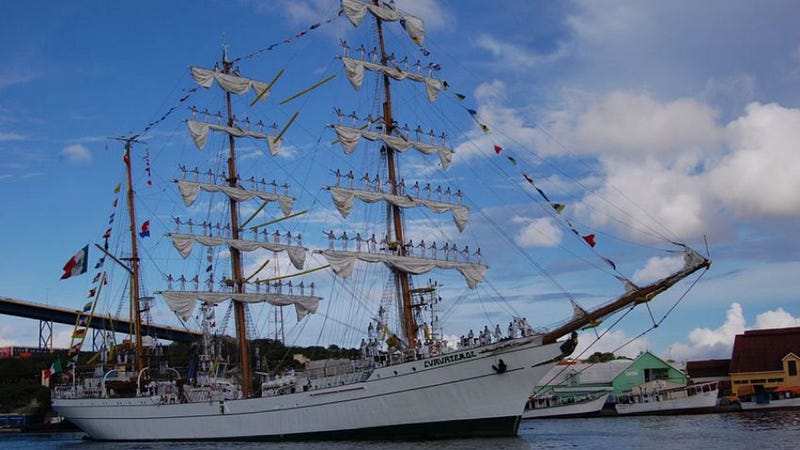
With its towering masts, 2,377 square meters of sail, and home port in Veracruz, the Cuauhtémoc makes a spectacle of every arrival.
Cadets stand on the yards as it enters port, transforming the ship itself into a stage for naval pageantry.
Brooklyn Bridge Collision: Human Error or Mechanical Failure?
Within hours, the story was being shaped.
Mexico’s President Claudia Sheinbaum called it an “unfortunate accident.”
A New York City councilmember called it “exceptionally reckless.”
Early accounts described a loss of control after departure. The National Transportation Safety Board opened an investigation and treated the available cause information as preliminary.
There were 277 people aboard a vessel that towers 160 feet above the water, dangerously close to the Brooklyn Bridge’s clearance at high tide.
So far, no public finding had assigned direct responsibility.
That leaves hard questions for the Navy, the pilots, and the planners who approved the ship’s route through one of the East Coast’s most trafficked waterways.
Risk Management vs. Ceremony: When Goodwill Missions Go Wrong
This wasn’t just a mechanical failure.
It was a miscalculation in the mission itself. A ship built for open waters was steered into a dense, unpredictable river for symbolism, culture, and international diplomacy.
That tension, operational risk vs. public relations, is familiar to anyone who’s worked in or around government.
You want visibility.
You want to represent your country with pride.
The Cuauhtémoc was a floating ambassador.
But goodwill doesn’t bend steel.
Who’s Responsible for the Cuauhtémoc Accident?

The investigation was ongoing, and the public record did not yet support a final cause finding.
This isn’t just about what failed in the engine room.
It’s about what failed during planning.
Questions remain about route approvals, clearance checks, and whether diplomacy outweighed safety in planning the visit.
The U.S. Coast Guard and Mexican Navy were reviewing the incident, but it’s unclear how these decisions were allowed to stack up so precariously.
What the Crash of the Cuauhtémoc Tells Us About Public Sector Risk
This was not only bad luck. It exposed a systems failure in operations, planning, and coordination.
Public sector missions, especially ceremonial ones, are often treated as immune from critical questioning.
But when things go wrong, they go wrong in public.
The damage is not limited to ships or schedules. It extends to credibility, safety culture, and diplomatic trust. And as history shows, from peacetime naval reviews to national parades gone awry, ceremonial risk is real and often underestimated.
After the Brooklyn Bridge Crash: What Comes Next?
At the time of the original essay, the Cuauhtémoc remained docked in New York under review.
The Brooklyn Bridge has reopened.
Two sailors, young people at the start of their naval careers, died in the crash.
At the original publication date, official public updates had not yet named them. Their absence would be felt across the Cuauhtémoc.
Whether this becomes a footnote or a turning point remains to be seen. But the lesson stands:
Symbolism doesn’t soften impact. Ceremony, without accountability, is just choreography.
What good is a goodwill tour that forgets to steer?